
A bio-inspired robot developed by a robotics company in Shanghai drew heated discussion overseas on social media recently, largely because its appearance is too lifelike.
In the video footage, this blond, blue-eyed robot face naturally makes eye contact with people and engages in real-time conversation. Because its appearance is so lifelike but its movements still lack smoothness, netizens have been debating extensively whether it could trigger the so-called “uncanny valley effect.”
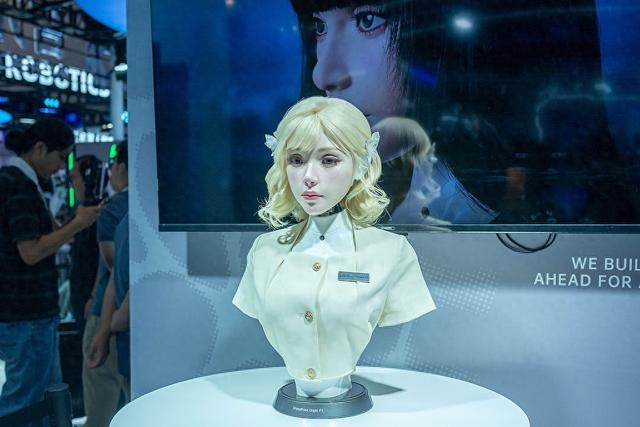
The so-called “uncanny valley effect” usually refers to the discomfort or even fear that people can feel when a robot or virtual character becomes increasingly similar to human appearance, due to subtle unnaturalness.
The robot, code-named Origin F1, is developed by Shouxing Technology. Public information indicates that it is a desktop bionic robot designed for real-world human-machine interaction scenarios. Its head, eye, and facial motion modules have 26 degrees of freedom in total. It supports multi-modal perception through vision and voice, and enables facial recognition, voice recognition, and synthesis.
After the video was posted on overseas social media, some people said that the Origin F1’s eye gaze and skin texture are quite realistic, and the “uncanny valley effect” has been reduced to the minimum. “If it had a robot body with smooth actions and easy walking, and the price was affordable for ordinary people, I would genuinely consider it,” one netizen commented.
Another view holds that although the Origin F1 looks close to a real person, the movement of its head is still unnatural—more like a toy—so it can feel somewhat creepy and trigger the “uncanny valley effect.”
Earlier, when Shouxing Technology’s founder Hu Yuhang discussed the issue of the “uncanny valley” effect in a media interview, he said that the key to crossing the uncanny valley lies in motion control: “You need to move like a human, so you can sufficiently cross the uncanny valley. There is no real person in the physical world who stays completely motionless, or who moves at a constant speed. So even if you achieve perfection in appearance, if the motion control behind it isn’t humanlike enough, the uncanny valley effect will be amplified.”
Hu Yuhang believes Shouxing Technology’s products are already on the right side of the uncanny valley curve. He expects that within the next two years, they may further cross the uncanny valley effect, bringing the products into ordinary people’s daily lives.
Some netizens have indeed expressed support for Shouxing Technology’s R&D team. They believe that eye contact and blink control are already progress in human-machine interaction technology, with room for significant improvements in the coming years.
Public information shows that Shouxing Technology was founded in 2024. Recently, it announced externally that it has completed a Series A2 financing round of several hundred million yuan. The round was jointly led by CICC Jinshi and Geely Capital. Shouxing Technology said the funds will mainly be used to expand its bionic product matrix, build standardized mass-production lines, and iterate on bionic embodied AI algorithms.
There have been precedents where robots caused negative effects due to being “too humanlike.” XPeng Motors’ humanoid robot IRON also got caught in controversy over whether it was disguised by a real person.
On November 5, 2025, XPeng Motors unveiled its next-generation IRON at a tech day event. Due to the way IRON moved—“walking like a cat”—and its overly natural appearance in the video, which looked very close to a real human, social platforms both at home and abroad quickly saw doubts about whether “there is a real person hidden inside the robot.” XPeng Motors then had no choice but to release a continuous-shot video to address the concerns.
Reporter Yu Yan, The Paper (ThePaper.cn)