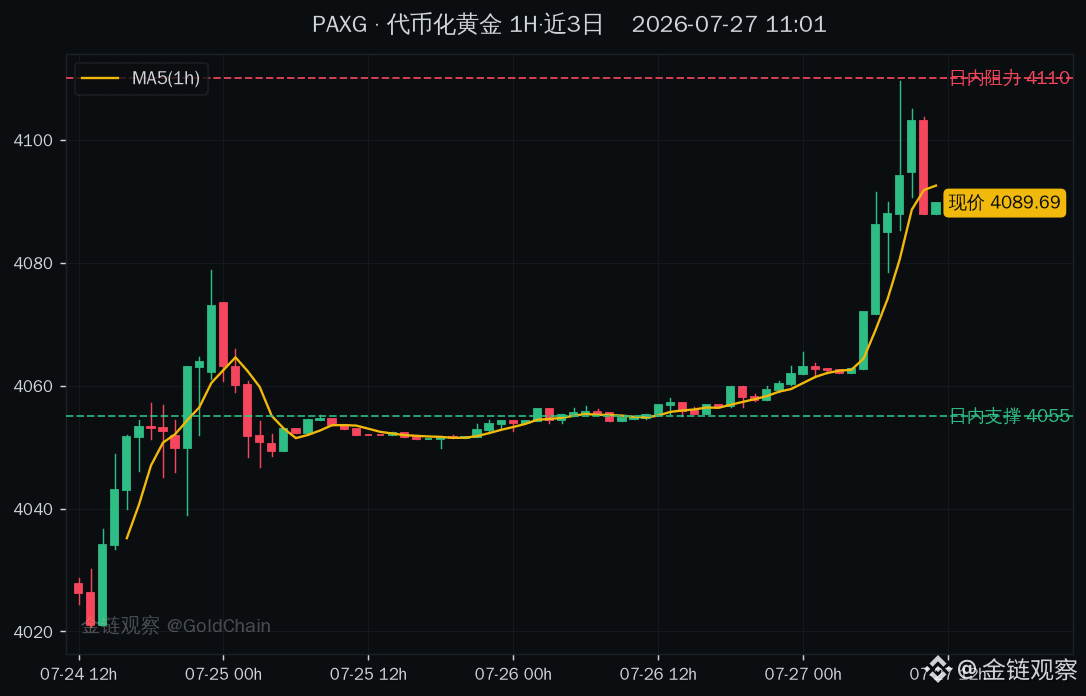
Around 11 a.m. on the morning of July 27 Beijing time, Gold closed at 4093.53, about 0.23% lower than the reference level given by the model. The move is small, and the direction is downward.
What’s worth noting is the explanation behind it. The attribution pins this decline to two lines: first, the market is hearing that Ukraine has launched an attack on Iranian military vessels in the waters of the Caspian Sea, giving the Middle East conflict and the Russia-Ukraine front a "converging" feel—these kinds of headlines initially push up the risk premium embedded in oil prices, rather than the safe-haven premium in gold; second, the technology sector has pulled money back to itself—when risk appetite lifts, the safe-haven side naturally loosens.
The counterintuitive part is right here: when news of an escalation in conflict breaks, gold doesn’t rise—it falls. Because what the market truly fears has never been the fighting itself, but rather an interruption to energy supply, and that bill would be booked first on crude oil. The confidence level of this attribution can only be considered moderate; treat it as one interpretation, not a conclusion.
Next, watch two things: whether oil prices keep surging higher or start to give back, and how many days this round of inflows into tech stocks can hold up. If either side turns, this 0.23% divergence could be wiped out quickly. $PAXG tracks spot gold, so the macro-level tug-of-war it reflects is more tangible than any single piece of news.
So the question is: has the safe-haven logic truly stepped out, or has the money just temporarily changed locations?
#黄金
What’s worth noting is the explanation behind it. The attribution pins this decline to two lines: first, the market is hearing that Ukraine has launched an attack on Iranian military vessels in the waters of the Caspian Sea, giving the Middle East conflict and the Russia-Ukraine front a "converging" feel—these kinds of headlines initially push up the risk premium embedded in oil prices, rather than the safe-haven premium in gold; second, the technology sector has pulled money back to itself—when risk appetite lifts, the safe-haven side naturally loosens.
The counterintuitive part is right here: when news of an escalation in conflict breaks, gold doesn’t rise—it falls. Because what the market truly fears has never been the fighting itself, but rather an interruption to energy supply, and that bill would be booked first on crude oil. The confidence level of this attribution can only be considered moderate; treat it as one interpretation, not a conclusion.
Next, watch two things: whether oil prices keep surging higher or start to give back, and how many days this round of inflows into tech stocks can hold up. If either side turns, this 0.23% divergence could be wiped out quickly. $PAXG tracks spot gold, so the macro-level tug-of-war it reflects is more tangible than any single piece of news.
So the question is: has the safe-haven logic truly stepped out, or has the money just temporarily changed locations?
#黄金