
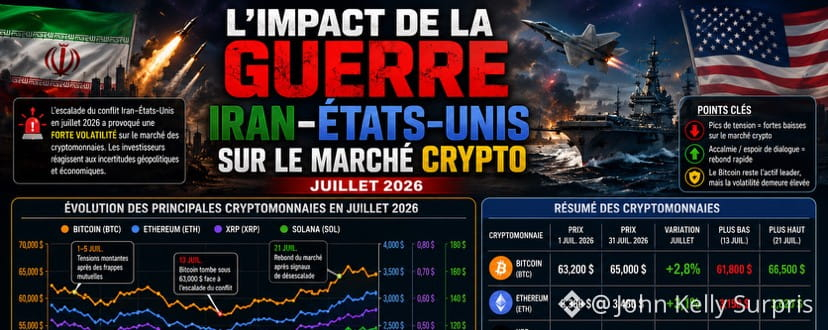

Since the beginning of 2026, the conflict between Israel, the United States, and Iran has established itself as one of the main drivers of volatility for global financial markets, including cryptocurrencies. Between fragile ceasefires and sudden resurgences of hostilities, Bitcoin and altcoins have been moving in step with geopolitical announcements.
An escalation in multiple acts
The Iran conflict of 2026 began on February 28 and sharply intensified, causing dramatic volatility in global markets. Since then, the situation has gone through several cycles of ceasefires and renewed fighting. After the “12-day war,” which ended in a truce, the ceasefire eventually broke down: the April 2026 ceasefire lasted for two months, before a new ceasefire agreed on June 8 became the third attempt to pause hostilities in just over a year.
On July 8, President Donald Trump said at the NATO summit in Ankara that the ceasefire with Iran was “over,” and since then the United States and Iran have returned to active hostilities. U.S. Central Command confirmed that it struck more than 60 small vessels of the IRGC in the Strait of Hormuz, while Iran retaliated with attacks on Kuwait and Bahrain. Even today, the situation remains unstable: on July 23, Iran announced the suspension of its offensive operations while Israel warned it would respond with force to any new Iranian attack. This was followed the same day by Tehran launching additional missile strikes against Jordan and other regional targets.
Bitcoin, a risk asset… but increasingly resilient
Each surge in tensions immediately weighed on prices. After Trump’s July 8 statement, Bitcoin fell back below $62,000 and $450 million in positions were liquidated, including $350 million just in altcoins. A year earlier, on June 13, 2025, when Israel struck Iranian nuclear sites, Bitcoin dropped by nearly 4% in a single day, falling from $107,000 to $103,000. During the June 8, 2026 strikes— the largest since April—Bitcoin again fell by more than 2%.
But a new phenomenon is emerging: on July 8, as WTI oil jumped 5% to 7% to its highest level since June 22, Bitcoin declined by only about 2.5%, to $62,000. This gap is largely explained by the very nature of the Strait of Hormuz, through which about 20% of the world’s oil supply—and significant LNG volumes—transit: it was that specific asset that the ceasefire protected, concentrating the risk premium in crude oil rather than in a digital asset that no oil tanker carries.
Some analysts see this as a structural signal. Inflows into Bitcoin ETFs show that institutional investors are buying the dips rather than exiting the market, representing a major shift compared with prior geopolitical cycles in which this kind of structural demand did not exist.
The transmission channel: oil and monetary policy
The shock wave does not pass only through the leading heads of geopolitics: it also flows through energy markets and expectations for monetary policy. Brent prices rose from roughly $70 to more than $110 per barrel in March, before stabilizing between $95 and $100, while the market has now largely ruled out the possibility of rapid Fed rate cuts—an expectation that weighed on capital flows toward risk assets such as cryptocurrencies. Inflation data from the U.S. Bureau of Labor Statistics also highlighted an inflation spike directly linked to the war, cooling hopes for new rapid rate cuts.
Iran, a direct actor in the crypto market
Notably, Iran is not only an exogenous source of risk: the country has become an active user of cryptocurrencies. The war waged by the United States and Israel against Iran has brought the Iranian crypto market—valued at $7.8 billion—back into focus. Citizens and authorities are increasingly turning to it to store and transfer money during periods of turmoil. The analysis firms Chainalysis and Elliptic have also found sharp increases in outflows from Iranian exchange platforms just after the airstrikes.
Another unexpected development: Iran has started accepting Bitcoin as a payment method for the new transit tolls it introduced in the Strait of Hormuz in March 2026. This is an estimated revenue source of about $7.7 billion on an annualized basis, which could create a new source of demand for Bitcoin.
Some altcoins are more directly exposed than Bitcoin. Ethereum has fallen two to three times as much as Bitcoin with every new outbreak of tension in the conflict, while Tron has historically been the main payment rail used by Iran for its stablecoin activities. Nobitex—the country’s largest exchange platform—has routed at least $2 billion through Tron since 2023. In early June, the U.S. Treasury sanctioned Nobitex and three of its counterparts, and a hack that siphoned $90 million from the platform in June 2025 caused Tron to drop 6.5% in a single day.
Where do things stand today?
As of July 26, 2026, the situation remains hanging by a thread. Traders are discussing easing tensions with Iran and a drop in oil prices that could trigger a broader rally in Bitcoin and risk assets this week—even though, according to some observers, this scenario anticipates a ceasefire that has not yet been officially agreed.
Key takeaways
• Volatility but no collapse: each escalation triggers one-off drops of 2% to 5% in Bitcoin, followed by quick rebounds as soon as de-escalation signals appear.
• Oil, the main transmission channel: the real contagion route runs through energy prices and inflation/rate expectations, more than through a direct link between war and crypto.
• Differentiated exposure: Ethereum and Tron, which are more closely tied to Iranian uses and market liquidity, often react more strongly than Bitcoin.
• A strategic use by Iran: between sanctions evasion, paying tolls in Bitcoin, and capital flight to personal wallets, crypto is playing an increasingly growing role in Iran’s wartime economy.
• New institutional resilience: inflows into Bitcoin ETFs suggest that some investors now treat these geopolitical shocks as buying opportunities rather than exit signals.
This article is for informational purposes and does not constitute investment advice. Cryptocurrency markets are highly volatile, especially in a context of unstable geopolitics.