

Digital Overload and an Exhausted Brain Cortex: Why Excessive Battle Royale Gaming Negatively Affects Real-World Road Safety
Abstract
Although short-term exposure to motion video games has been found in some studies to enhance certain visual spatial measures, long, continuous gaming sessions—especially in fast-paced battle royale games such as BGMI (Battlegrounds Mobile India)—lead to acute cognitive neural fatigue. This article explores the neurobiological foundations underlying the driving difficulties encountered after gaming, focusing on the depletion of the prefrontal cortex, narrowed attention, and executive dysfunction. By examining cognitive studies and prior traffic psychology research, we analyze why excessive screen time directly worsens real-world road safety decision-making and situational awareness.
## 1. Introduction: The Cognitive-Neural Contrast Between Gaming and Driving
Driving an automated vehicle through heavy traffic is a complex, multimodal task that requires continuous risk assessment, spatial distribution of attention, and smooth executive control. By contrast, modern tactical shooter games are designed to penetrate the brain’s reward loop, imposing a focused and localized state of intense engagement.
When a gaming session extends continuously for hours, the brain shifts from a state of acute activation to one of cognitive fatigue. Far from being harmless entertainment, excessive games drain the limited metabolic resources needed for real-world tasks that require calm, calculated thinking.
## 2. The Science of Mental Fatigue: Depletion of the prefrontal cortex
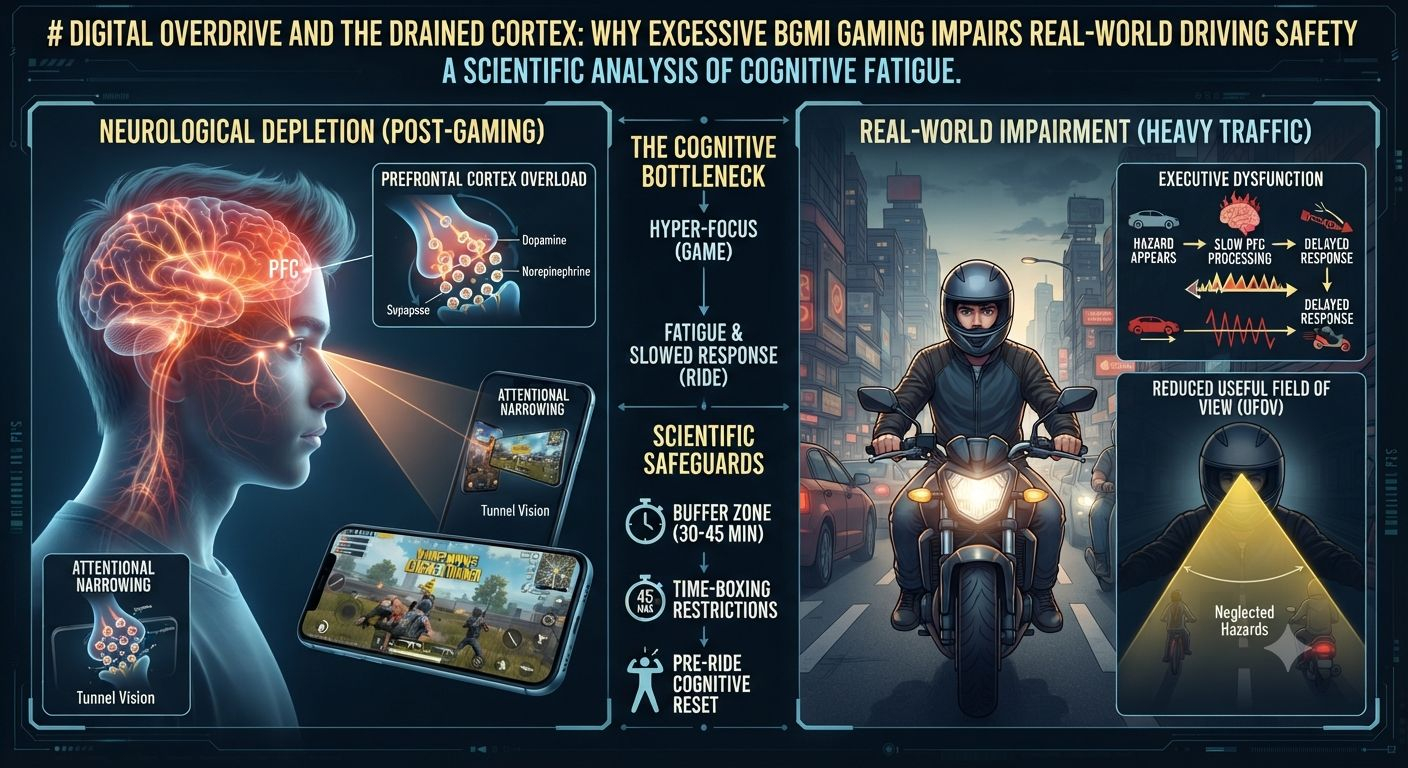
The main reason you struggle with decision-making in heavy traffic after a long gaming session lies in the prefrontal cortex.
* Increased executive function load: The prefrontal cortex is responsible for executive functions such as working memory, impulse control, risk assessment, and complex decision-making.
* Neural fatigue: During continuous BGMI gameplay, the prefrontal cortex is bombarded with rapid stimuli that require hundreds of binary choices carried out in fractions of a second, such as shoot or hide, move or stay put. This ongoing stimulation depletes the brain’s supplies of glucose and neurotransmitters like dopamine and norepinephrine.
* Real-world outcome: When you put down your phone and get on your bike, your prefrontal cortex is functionally depleted. In heavy traffic, where calm and accurate decision-making is crucial, the fatigued prefrontal cortex struggles to evaluate options effectively, leading to hesitation, confusion, and poor judgment.
## 3. Tunnel Vision: Failure of Peripheral Spatial Awareness
You may have noticed that it’s difficult to obtain an overall view of all aspects of the road. Cognitive research on attention narrowing strongly supports this.
* Screen-boundaries effect: In mobile action games, all critical threats are concentrated on a small rectangular screen directly in front of the user’s central vision.
* Dorsal pathway fatigue: The brain’s dorsal visual pathway handles spatial awareness and tracking peripheral motion. Prolonged fixation on a digital screen trains the visual system to ignore broad peripheral cues in favor of high-contrast central threats such as enemies that appear on the minimap or targeted aim.
* Impaired traffic scanning: Real-world driving relies heavily on the useful field of view—the visual area where you can capture and process information without moving your head or eyes. Studies on cognitive fatigue show that effortful neural pathways significantly shrink the useful field of view. Instead of freely scanning mirrors, blind spots, and side alleys, your visual system after gaming suffers from functional tunnel vision, making awareness of road aspects dangerously slow.
## 4. Thinking Failures and Delayed Response Times
In traffic, thinking involves predicting the behavior of other vehicle drivers and responding immediately to changing variables. Previous studies on prolonged screen exposure and psychomotor performance highlight specific failure points:
* Continuous attention breakdown vs. multitasking: While action-game players often show fast reaction times in the short term, sustained attention sharply degrades once a certain threshold is crossed. Continuous play leads to mental saturation, reducing the brain’s reserve cognitive capacity.
* Delayed danger response: When an unexpected danger occurs in heavy traffic—such as sudden vehicle braking or a pedestrian stepping forward—the exhausted brain suffers from a longer cognitive bottleneck. The time it takes for sensory data to travel from the eyes, be processed in the visual cortex, pass through the fatigued prefrontal cortex, and execute motor commands on your bike’s brakes and fuel throttle becomes much longer.
## 5. Conclusion and Restricted Recommendations
Your symptoms—difficulty making decisions, a sense of mental chaos, and reduced overall vision while driving—are not coincidental; they are the direct biological fingerprint of acute cognitive fatigue caused by excessive gaming. When your brain’s executive control center is overwhelmed by virtual combat, you become a clear hazard on public roads.
### Scientific Guarantees for Safe Driving:
1. Post-game buffer zone: Never transition directly from a gaming session to driving a vehicle or riding a bike. Apply a strict buffer zone of 30 to 45 minutes of complete screen-free time to allow glucose levels in the prefrontal cortex and neural discharge rates to return to normal.
2. Time-setting constraints: Restrict BGMI sessions into strictly defined time blocks—for example, a maximum of 45 to 60 minutes per day—separated by physical activity and rest periods.
3. Cognitive reset before driving: If you have to drive after gaming, practice a physical grounding exercise such as deep breathing or walking to force your visual system to expand its focus back toward the wide-angle periphery before dealing with the road.
in heavy traffic.