





Web3 spent its first decade transparent by default. Every balance, trade, and vote was visible on-chain. This transparency has become a hard constraint rather than a feature. As protocols handle more valuable assets, users demand privacy. At the same time, regulators require verifiability.
This dual requirement has triggered an intense race between three core technical approaches. These approaches are hardware-based Trusted Execution Environments (TEEs), Fully Homomorphic Encryption (FHE), and Zero-Knowledge (ZK) proofs.
The catalyst that made this narrative live occurred on December 30, 2025. On this date, Zama launched its FHE mainnet. In January 2026, Zama ran a real confidential sealed-bid auction on Ethereum. This production proof point attracted over 11,000 participants and secured $118.5 million in committed capital. It moved private computing from theoretical promises to real execution.
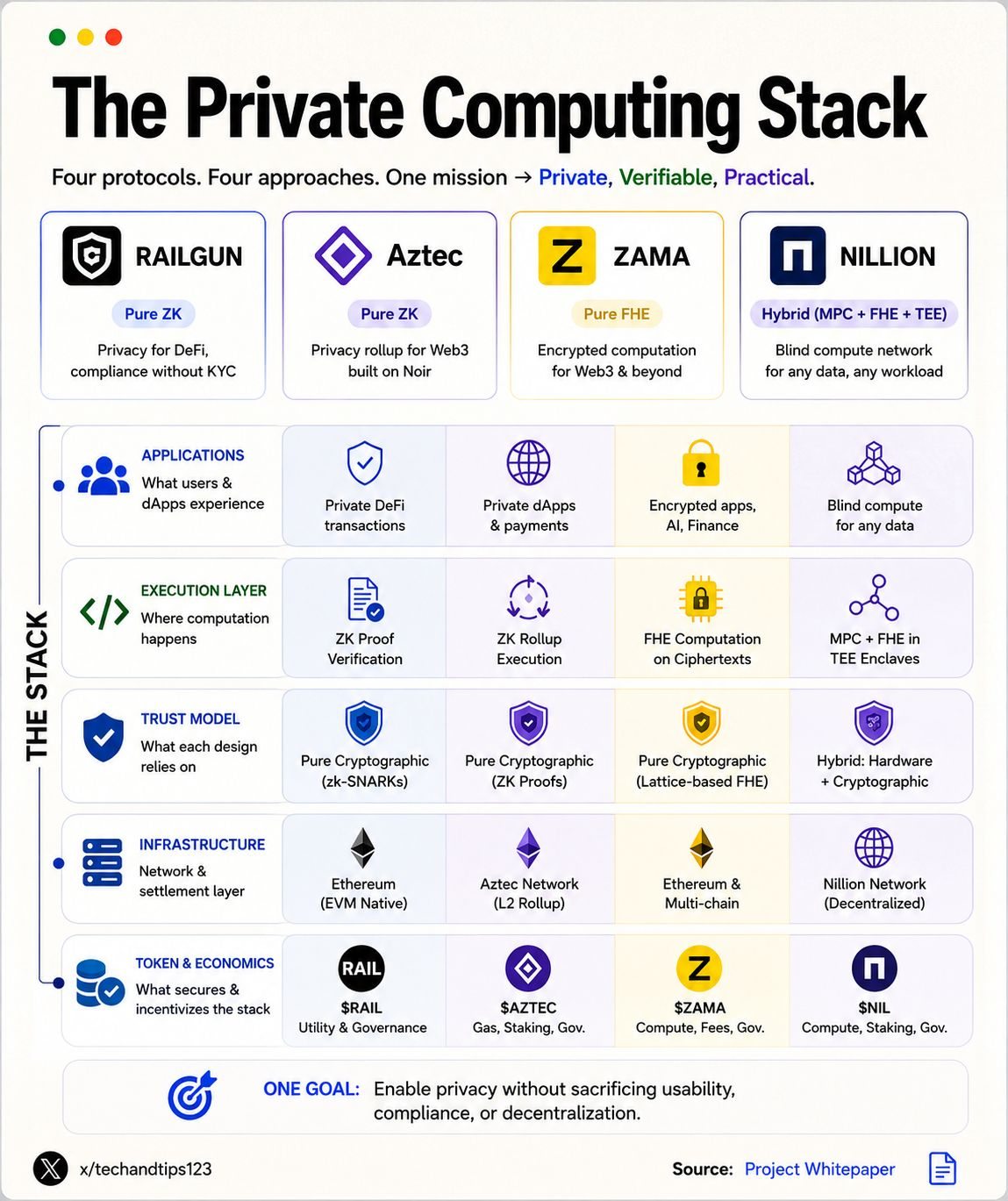
We will analyze four protocols representing different stages of maturity. These are Railgun, Aztec, Zama, and Nillion. Together, they form a clear barbell spectrum in the private computing space. In this deep dive we tried to evaluate these protocols across nine core pillars to find the actual winners. We analyzed trust assumptions, real usage, and token value capture. Let's Dive in ...
❍ The Cryptographic Spectrum:
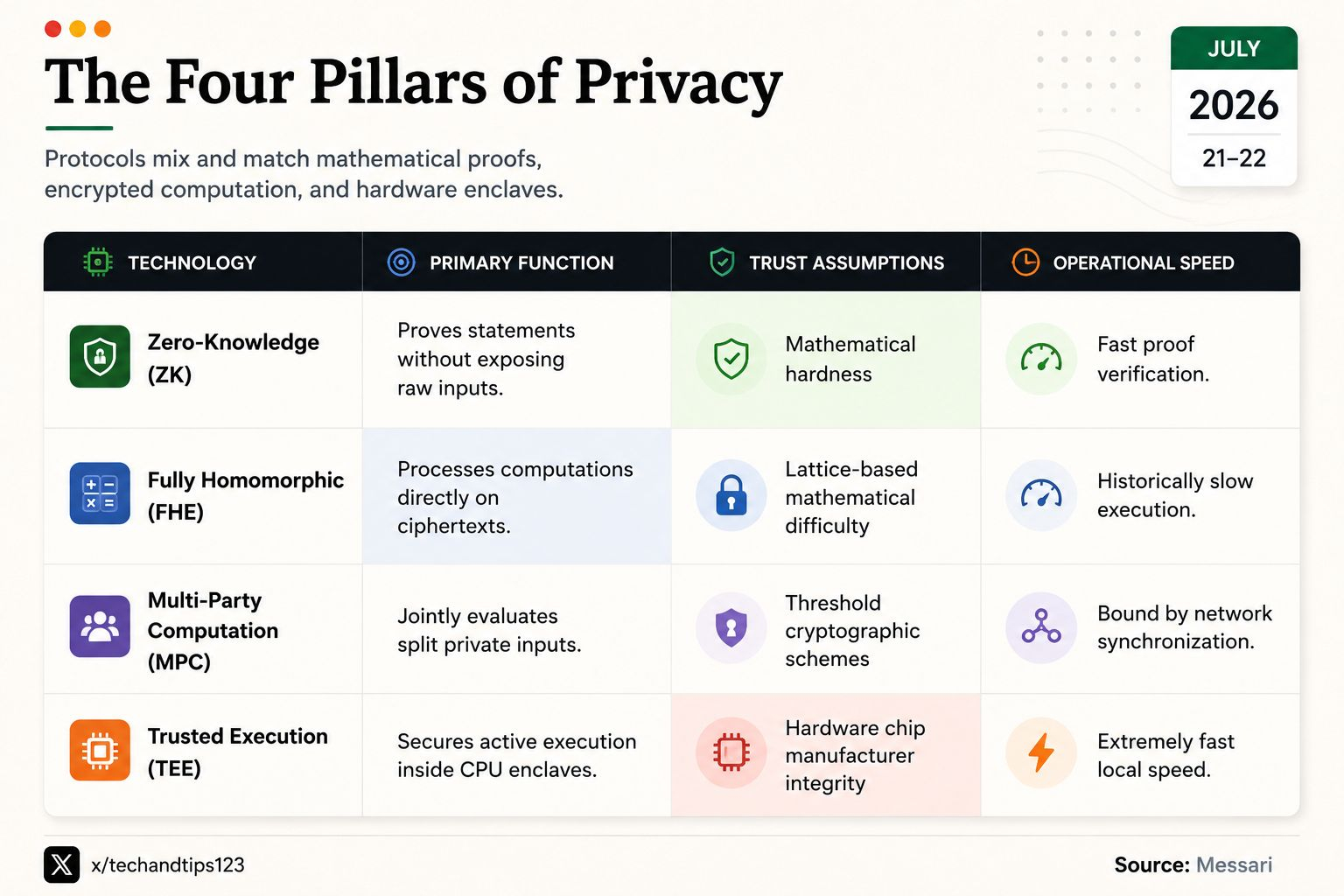
A Zero-Knowledge Proof allows a prover to convince a verifier that a statement is true. This process reveals no information beyond the statement's truth. It must satisfy completeness, soundness, and zero-knowledge properties. Completeness means an honest prover can convince an honest verifier. Soundness means a dishonest prover cannot cheat. Zero-knowledge ensures no extra data is leaked. These proofs can be interactive or non-interactive.
Okey, a zero knowledge proof can prove to a bouncer that you are over 21 by showing them a government-issued stamp on your hand that only glows under UV light, letting them verify your age instantly without them seeing your birthdate, home address, or ID card.
Fully Homomorphic Encryption enables computations directly on encrypted data. This means companies can process data without decrypting it first. Users experience standard functionality while keeping total privacy.
Fully Homomorphic Encryption is like sending your tax forms to an accountant inside a locked puzzle box where they can use special built-in mechanical arms to fill out all the math and staple the pages together through tiny slots, returning the completed tax return to you without ever reading your income details.
Multi-Party Computation allows multiple independent nodes to evaluate a joint function of private inputs. No individual node can see the private inputs of other nodes.
Now, Multi-Party Computation is like a group of friends figuring out who has the biggest crush on someone in the friend group by writing down their secret crush on slips of paper, tearing them into confetti, mixing them up in a giant bowl, and running a ballot tally where everyone sees the final winning name, but no one ever finds out who voted for who.
Trusted Execution Environments isolate sensitive data at the hardware level inside a secure CPU area. External operating systems cannot read this memory. However, this model relies on the chip manufacturer's physical security. If the hardware chip is compromised, the enclave security fails.
Okey, a Trusted Execution Environment is like keeping your diary locked inside a steel box welded directly to the inside of a shared rental car's dashboard; the rental company gives you the car to drive anywhere, but they cannot open that specific welded box, unless someone takes a blowtorch and permanently ruins the car's dashboard to pry it open.
I. Trust Model — Cryptographic vs. Hardware
The trust model defines the security of a private computing protocol. It separates protocols relying on pure mathematical security from those relying on physical hardware chips. Pure cryptographic guarantees protect user data regardless of node location. Hardware-trust models introduce physical vulnerabilities and manufacturer dependencies.
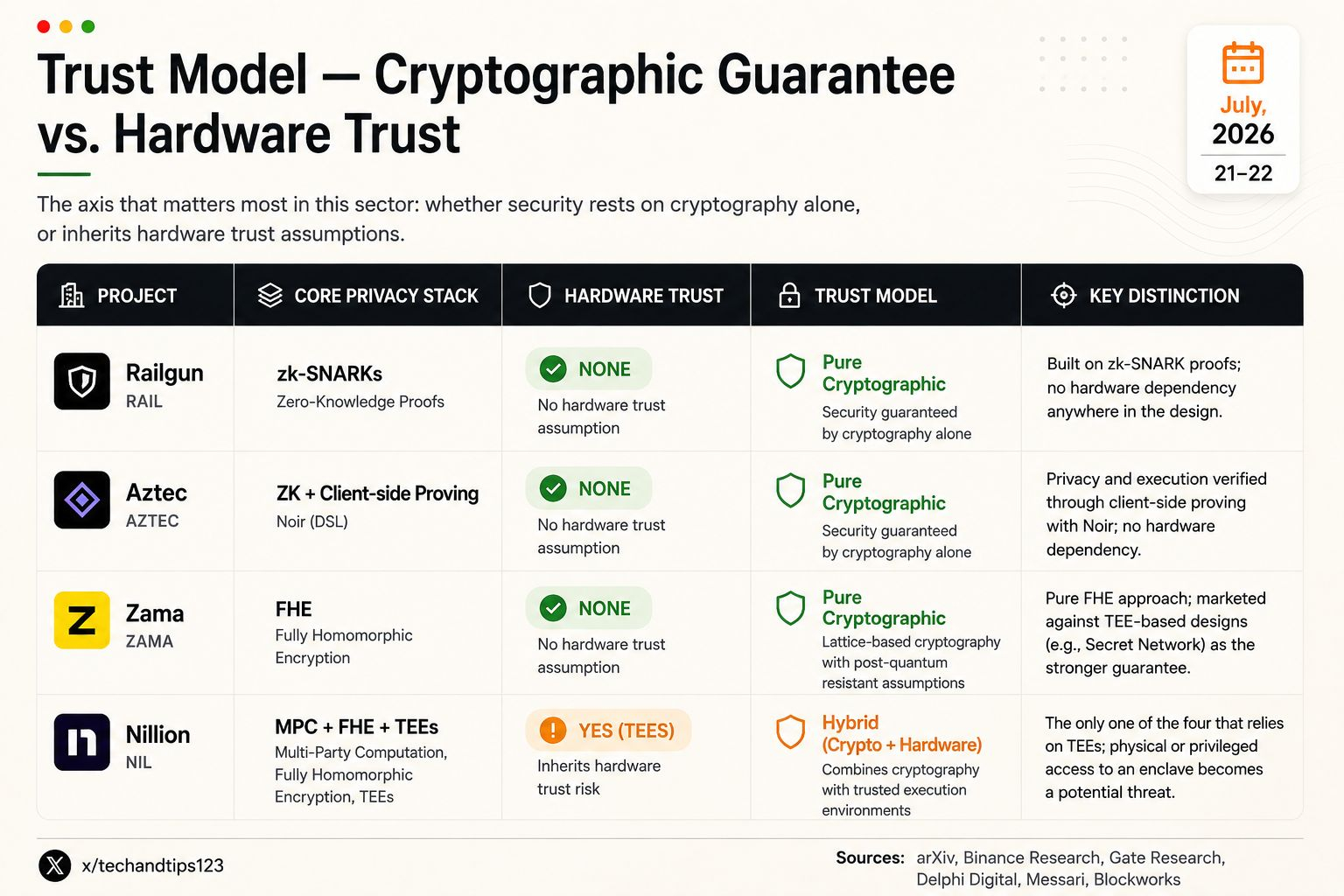
Railgun operates with pure ZK cryptography. It utilizes zk-SNARK proofs to verify private transactions within smart contracts. It has zero hardware trust assumptions in its entire design. Similarly, Aztec implements a pure ZK architecture. It uses local client-side proving on the user's device via its Noir language. No private data is ever sent to the network, and no hardware enclaves are required.
Zama offers a pure FHE design. It rests on lattice-based cryptographic hardness assumptions. This design is fundamentally post-quantum resistant. Its security is built on the Learning with Errors mathematical framework. This is expressed using the formula b=s. A+e . Recovering the secret key is mathematically equivalent to solving the shortest vector problem in high-dimensional lattices.

Nillion is the major exception in this group. It blends Multi-Party Computation, Fully Homomorphic Encryption, and Trusted Execution Environments into a single hybrid stack. This means Nillion is the only protocol that inherits hardware-trust risks. It utilizes AWS Nitro Enclaves to manage its secure execution. This dependency introduces a critical physical attack surface.
An adversary with physical or privileged access to these enclaves represents a major security threat. A single government subpoena to AWS could compromise the physical infrastructure.
II. Performance Overhead — The Real Cost of Privacy
Privacy is useless if the system is too slow to use. Cryptographic operations require significant computational power, introducing a privacy tax in the form of latency and high fees. Minimizing this overhead is the primary engineering challenge for Web3 developers.
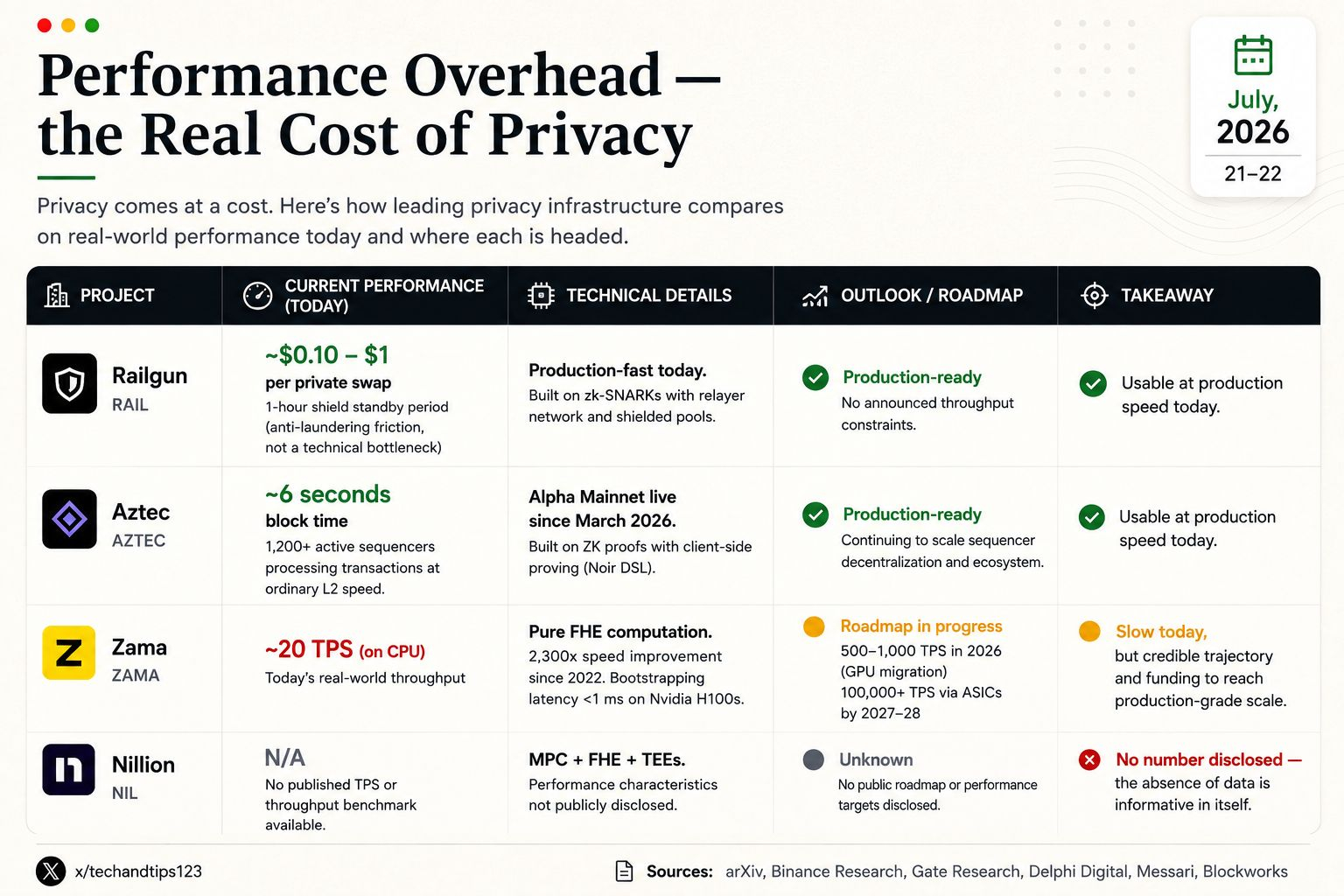
Railgun is fully optimized for production-grade speed today. A typical private swap inside its shielded pool costs between $0.10 and $1.00 in transaction fees. The system enforces a 1-hour standby period when users shield their assets. This delay is not a technical bottleneck but a deliberate anti-money laundering compliance friction. Users can bypass this standby by unshielding their tokens back to the depositor's wallet immediately if needed.
Aztec also delivers high-performance metrics. Its Alpha Mainnet has been live since March 2026. The network features 6-second block times, processed by over 1,200 active sequencers. By batching transactions into succinct proofs, Aztec delivers private execution at standard Layer-2 speeds.
Zama is the clear performance laggard today. It processes only about 20 TPS when running on standard CPUs. However, Zama has documented a 2,300x speed improvement since 2022. It has reduced its bootstrapping latency to under 1 millisecond on Nvidia H100 GPUs.
Its technical roadmap targets 500 to 1,000 TPS via GPU migration in late 2026, and 100,000+ TPS by 2027 or 2028 through dedicated ASIC chips. To optimize performance, Zama executes FHE operations symbolically on the host blockchain. This offloads calculations asynchronously to an external coprocessor.
Nillion has published no official throughput or speed benchmarks in any source. In a sector defined by performance challenges, this complete lack of data is highly informative. It makes verifying Nillion's capacity for enterprise workloads impossible.
III: Real Usage Volume — Who's Actually Using This?
Great technology means nothing without real users and capital. Evaluating cumulative transaction volumes and locked capital reveals the true adoption of each network. Speculative narratives cannot hide thin on-chain activity under close inspection.
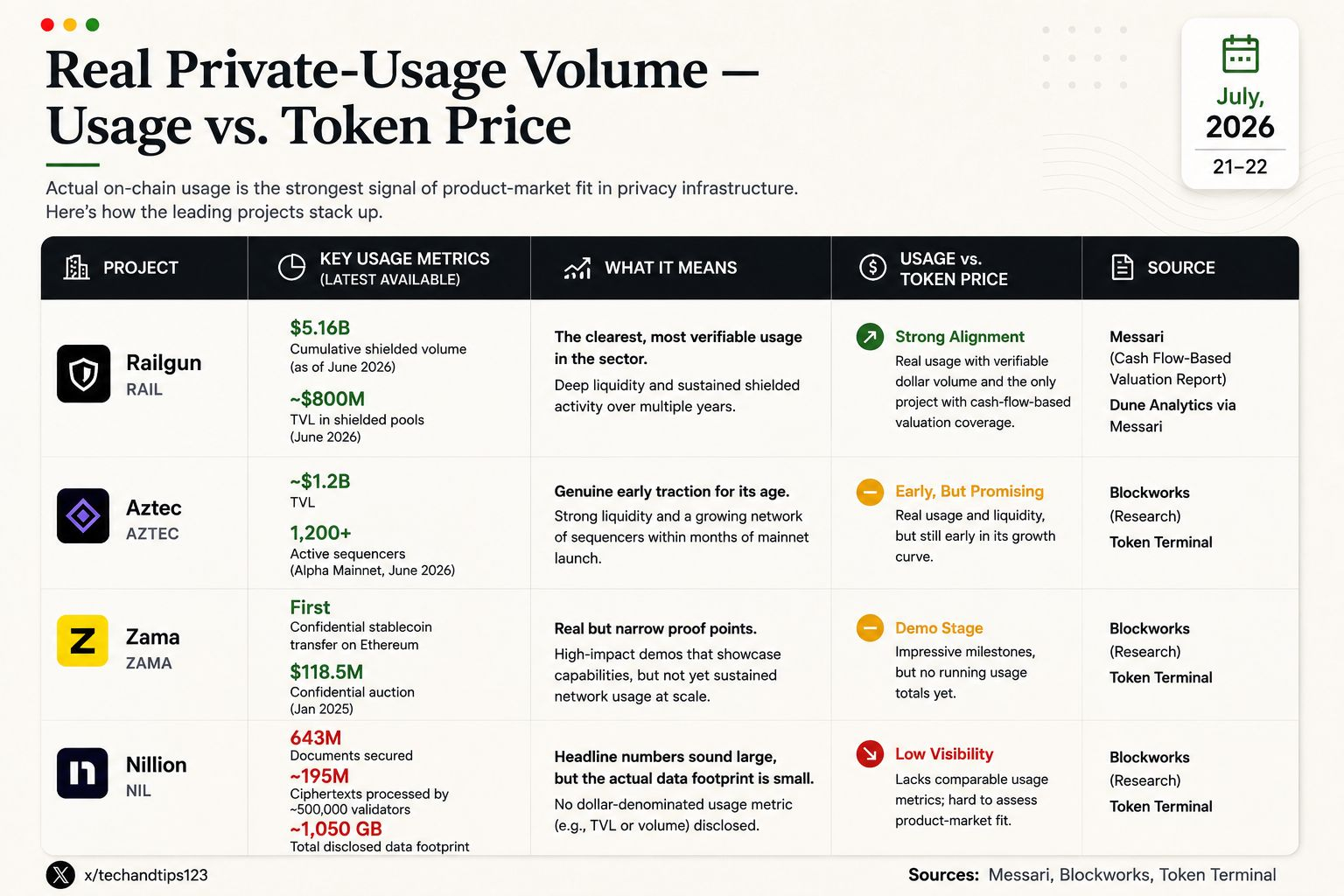
Railgun has the most mature, verifiable transaction volume in this sector. As of June 2026, the protocol has processed $5.16 billion in cumulative shielded volume. It boasts approximately $800 million in Total Value Locked (TVL) sitting in its shielded pools. It is also the only network to receive independent financial valuation coverage. Financial research firm Messari published a comprehensive cash-flow report analyzing its economics.
This external validation confirms Railgun's status as a mature utility protocol. Aztec has captured significant early momentum for its age. It attracted roughly $1.2 billion in TVL within months of launching its Alpha Mainnet. This capital is supported by over 1,200 active sequencers. This rapid growth indicates high interest in its privacy-native Layer-2 network.
Zama's traction consists of narrow proof-of-concept demonstrations rather than sustained volume. Its milestones include running the first confidential stablecoin transfer on Ethereum. It also executed a confidential auction in January 2026. While these events successfully demonstrated FHE capabilities, they have not generated a continuous running transaction volume.
Nillion presents a major mismatch between its marketing and its physical usage. The protocol advertises massive metrics, claiming over 643 million secured documents and 195 million ciphertexts processed by 500,000 validators. However, the actual data footprint behind these figures is only 1,050 GB (approximately 1 TB). This represents an extremely small data pool. It is smaller than a standard teenager's personal gaming PC. Furthermore, Nillion has disclosed no dollar-denominated volume or TVL metrics.
IV. Demand Drivers — Where the Evidence Is Real
We must distinguish between speculative token pumps and organic utility demand. Sustained user adoption is driven by networks solving real-world friction. The market responds differently to protocols with verified utility versus those with speculative narratives.
Railgun saw its transaction volume surge during a broader industry push for Ethereum privacy. Its trading volume spiked 10x, reaching $7.5 million in a recent stretch. This rally was triggered by public support from Ethereum co-founder Vitalik Buterin. He endorsed Railgun's integrated compliance features. This organic demand signal demonstrates the high market appetite for compliant, EVM-native privacy.
Aztec enjoys deep grassroots and community backing. It raised 50% of its token sale capital directly from its community and testnet participants. This public sale attracted 16,741 individual buyers who committed 19,476 ETH. This high community participation ensures a decentralized base of stakeholders. It reduces the risk of early token dumps and strengthens network security.
Zama proved its demand viability during its January 2026 confidential auction. This event attracted over 11,000 active bidders committing $118.5 million in capital. This high turnout shows real demand for secure on-chain auctions that protect against front-running and MEV bots.
Nillion shows a critical gap between its narrative and its visible traction. While its documentation aims for enterprise AI, healthcare, and finance workloads, its partnerships lean toward retail influencer marketing. Its primary agreements include promotions with college-athlete networks like Postgame and retail products like NFT Locker. This retail marketing focus reveals a lack of enterprise or institutional buyers.
V: Value Capture — Real Mechanisms vs. Narrative
A protocol can feature state-of-the-art cryptography but still be a terrible investment if its token lacks value capture. Sustainable models must link network utility directly to token value. This economic connection determines the long-term survival of the asset.
Railgun implements a robust fee-capture model. It collects transaction fees on shielded swaps and transfers. These fees flow directly to the DAO treasury, with rewards distributed to active stakers and participants. This cash-flow engine was independently modeled by Messari. The firm's report analyzed Railgun's fee capture against Ethereum's capital growth.
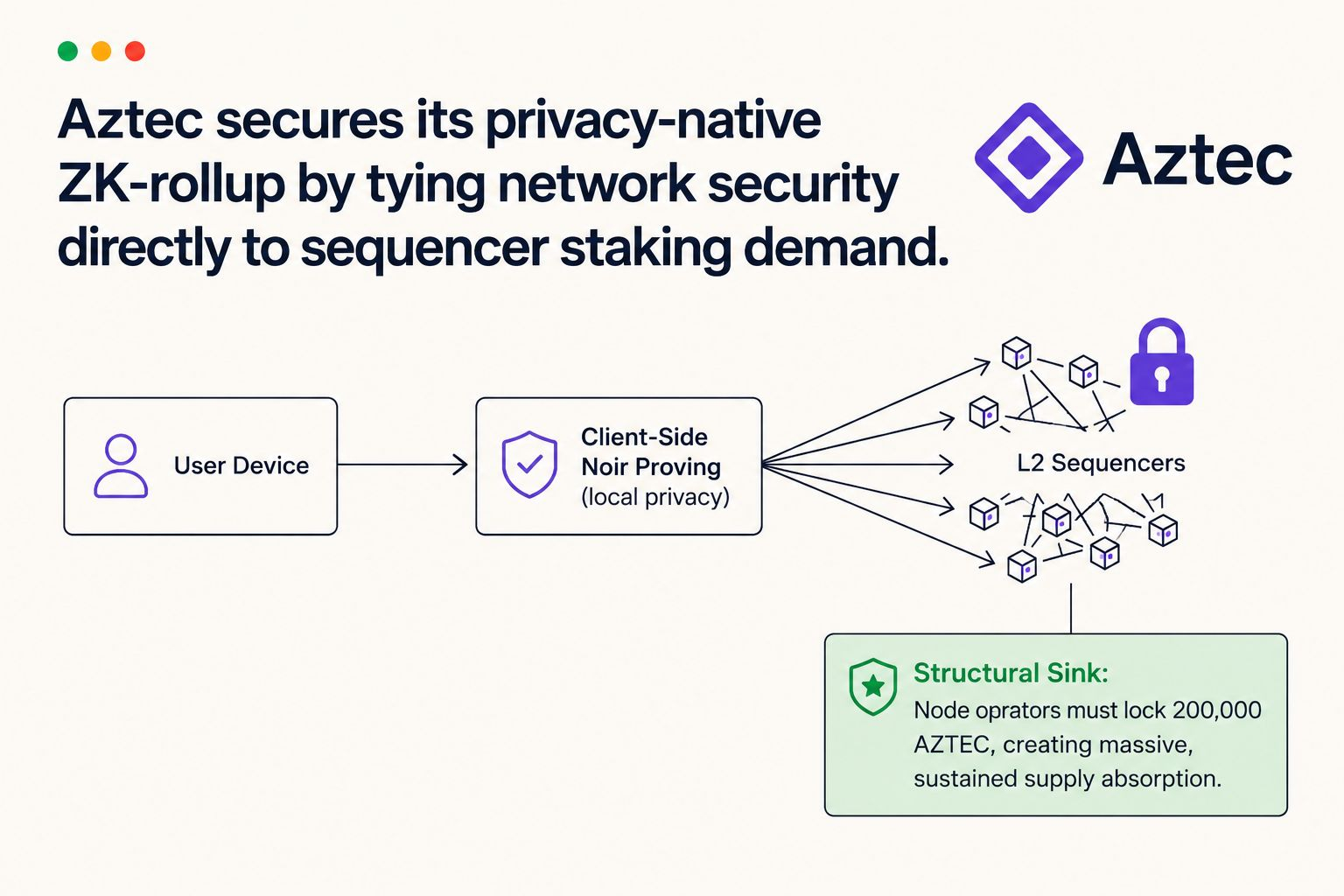
Aztec captures value through sequencer staking. Node operators must lock up a minimum of 200,000 AZTEC to sequence transactions. This staking requirement ties network security directly to token demand. While its value capture is less deflationary than its peers, it aligns validator incentives with network expansion.
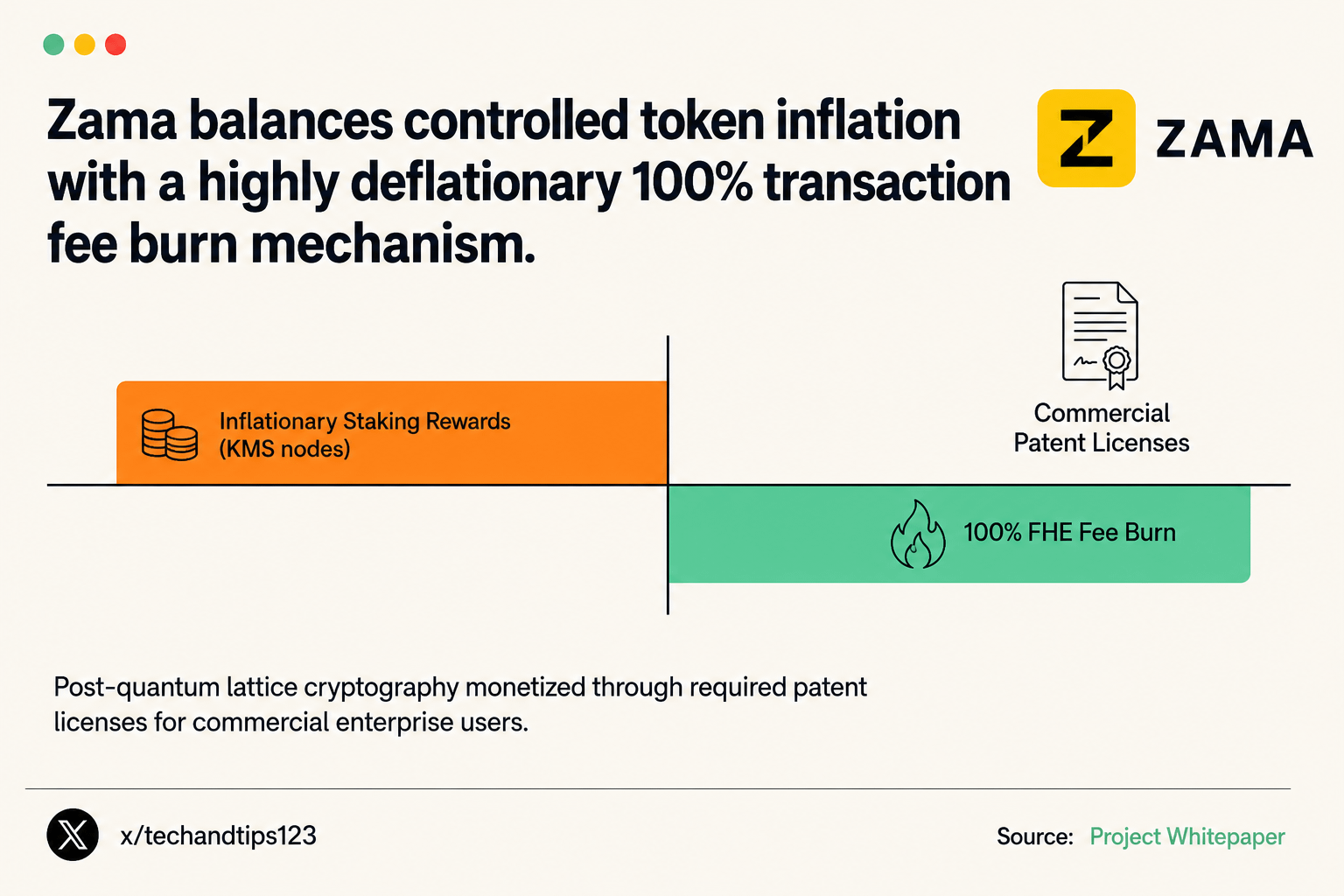
Its ultimate success depends on the Layer-2 sequencer economy maturing. Zama utilizes a highly deflationary burn-and-mint model. The network burns 100% of transaction fees collected from FHE verification and decryption. Staking rewards are funded through controlled token inflation, while the fee-burning mechanism offsets this dilution. Because current network throughput is low, the absolute size of the burn is still small. However, Zama also monetizes its technology by requiring commercial users to purchase a patent license.
Nillion uses a weak fee-for-compute utility model. It charges flat fees for raw data storage and processing but has no built-in burn or buyback mechanisms. Without these structural sinks, the token suffers from high selling pressure as validators liquidate their earnings. This flaw has driven a 96% price drawdown from its March 2025 high, leaving the protocol with a modest $18 million to $20 million market cap.
VI: Token Utility — How Each Token Actually Works
Token utility must be designed to mitigate the velocity problem. High-velocity tokens face constant sell pressure because users buy them only to spend them immediately. Introducing structural holding incentives is critical for maintaining token value.
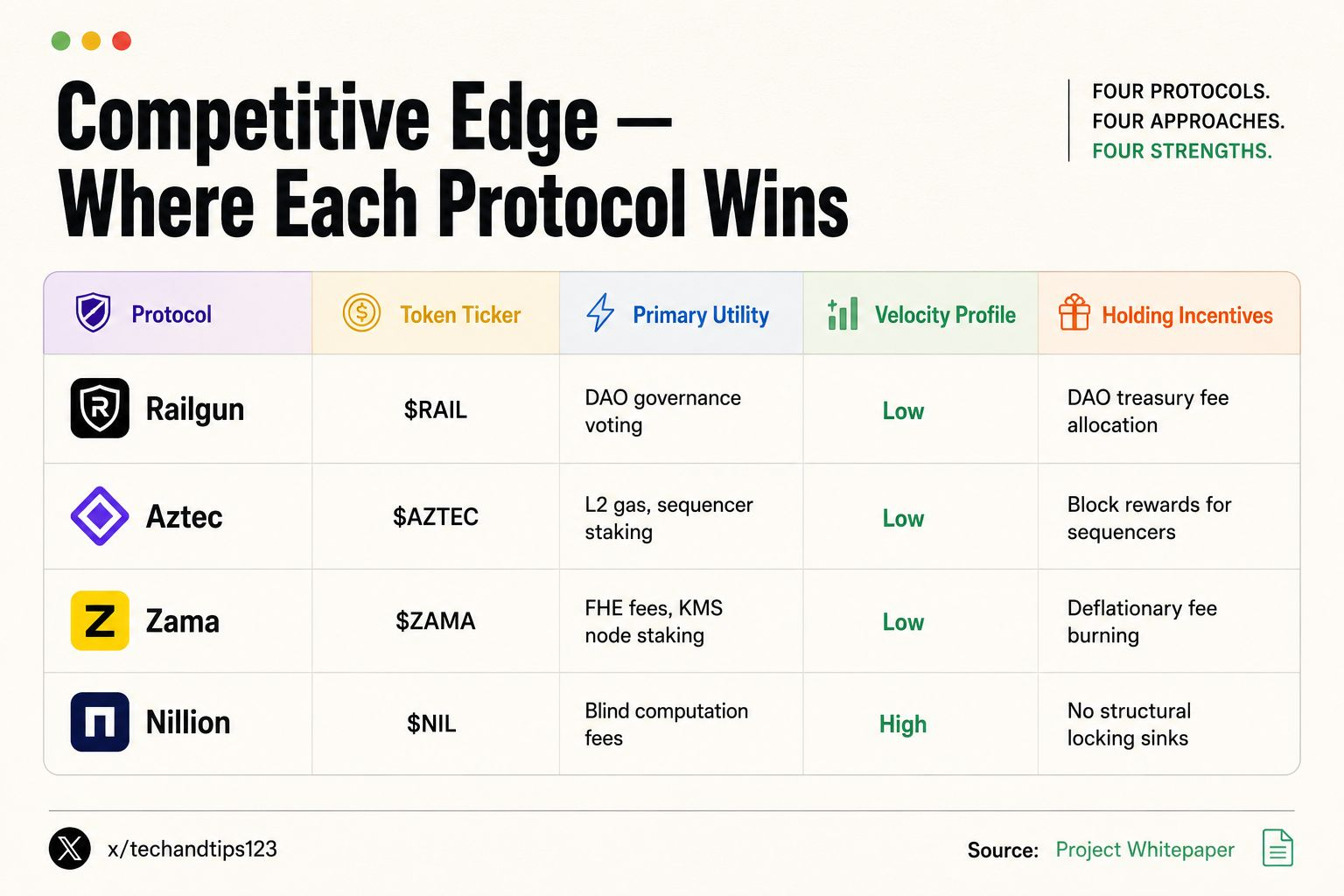
The Railgun token, $RAIL, is used strictly for decentralized governance. It allows holders to vote on parameters inside the Railgun DAO. Because transaction fees inside the shielded pool are paid in native host-chain assets, the token has no utility outside of voting. This design avoids token velocity issues, but it limits the token's direct connection to transaction volume.
The Aztec token, $AZTEC , serves multiple roles inside its Layer-2 network. It is used to pay transaction gas fees, secure nodes, and vote on governance. By requiring validators to stake 200,000 AZTEC, the system locks up significant supply. This model reduces token velocity and aligns node operators with the network's health.
The Zama token, $ZAMA , is used for fee payments, delegated proof-of-stake (DPoS) staking, and governance. Staking secures the decentralized coprocessors and Key Management System (KMS) nodes. These KMS nodes manage the decryption keys using Multi-Party Computation. Burning 100% of FHE transaction fees provides a strong holding incentive for validators and stakers.
The Nillion token, $NIL , is used strictly as a payment medium for computing and storage across its network. This creates a classic velocity trap. Users buy the token to pay for services, and node operators immediately sell their earned tokens to cover hardware costs. Without staking sinks or burn mechanisms, the token faces constant downward pressure.
VII: Recent Catalysts — Who's Executing?
Execution separates winners from pretenders. Evaluating recent catalysts provides a clear scorecard of which development teams are hitting their targets. The early months of 2026 introduced major catalyst events across the sector.
Zama has demonstrated rapid execution, achieving three major milestones in a short window. It launched its FHE mainnet in December 2025. This was followed by its $118.5 million confidential auction in January 2026. On February 2, 2026, Zama executed its Token Generation Event (TGE). It raised between $118 million and $121 million via a sealed-bid Dutch auction.
The auction itself used FHE-encrypted bids to prevent front-running, demonstrating its technology. However, Zama's uncapped supply requires its burn mechanism to run indefinitely to offset ongoing inflation. Aztec also executed its TGE in early 2026. Its token went live on February 11-12, 2026, following an on-chain community sale. This public sale raised 19,476 ETH from 16,741 participants.
Following this launch, Aztec activated its decentralized sequencer model, requiring operators to stake at least 200,000 AZTEC. Railgun did not experience a single catalyst event but benefited from a sustained rally. This rally was driven by the growing demand for EVM-integrated privacy solutions. However, its highly concentrated supply remains a risk, with 78.31% of tokens held by the top 10 addresses.
Nillion faced negative structural events. On July 24, 2026, a major token unlock released an additional 1.9% of the total supply. Absorbing this new supply is difficult for a token that is already down 96% from its March 2025 all-time high.
For Zama, the key catalyst is its late 2026 GPU migration to scale transaction throughput. For Aztec, watch for the transition from Alpha Mainnet to a fully permissionless validator set. For Railgun, watch for integrations into additional Layer-2 EVM networks to lower base fee costs. For Nillion, watch for any future release of concrete, verifiable performance metrics.
VIII. Regulatory & Compliance Posture — Who Survives?
The sanctioning of Tornado Cash proved that uncompliant privacy is terminal. Regulatory enforcement has made compliance tools a necessity for survival. Modern privacy protocols must build compliance mechanisms directly into their core architecture.

Railgun has built compliance directly into its smart contracts. It features a decentralized system called Private Proofs of Innocence (Private POI). This tool monitors tokens entering the contract to verify they do not originate from blacklisted addresses, without requiring KYC. It automatically generates a ZK proof of spendability, ensuring the funds are clean. The integrated Railway wallet categories tokens into Spendable, Pending, Incomplete, and Restricted states.
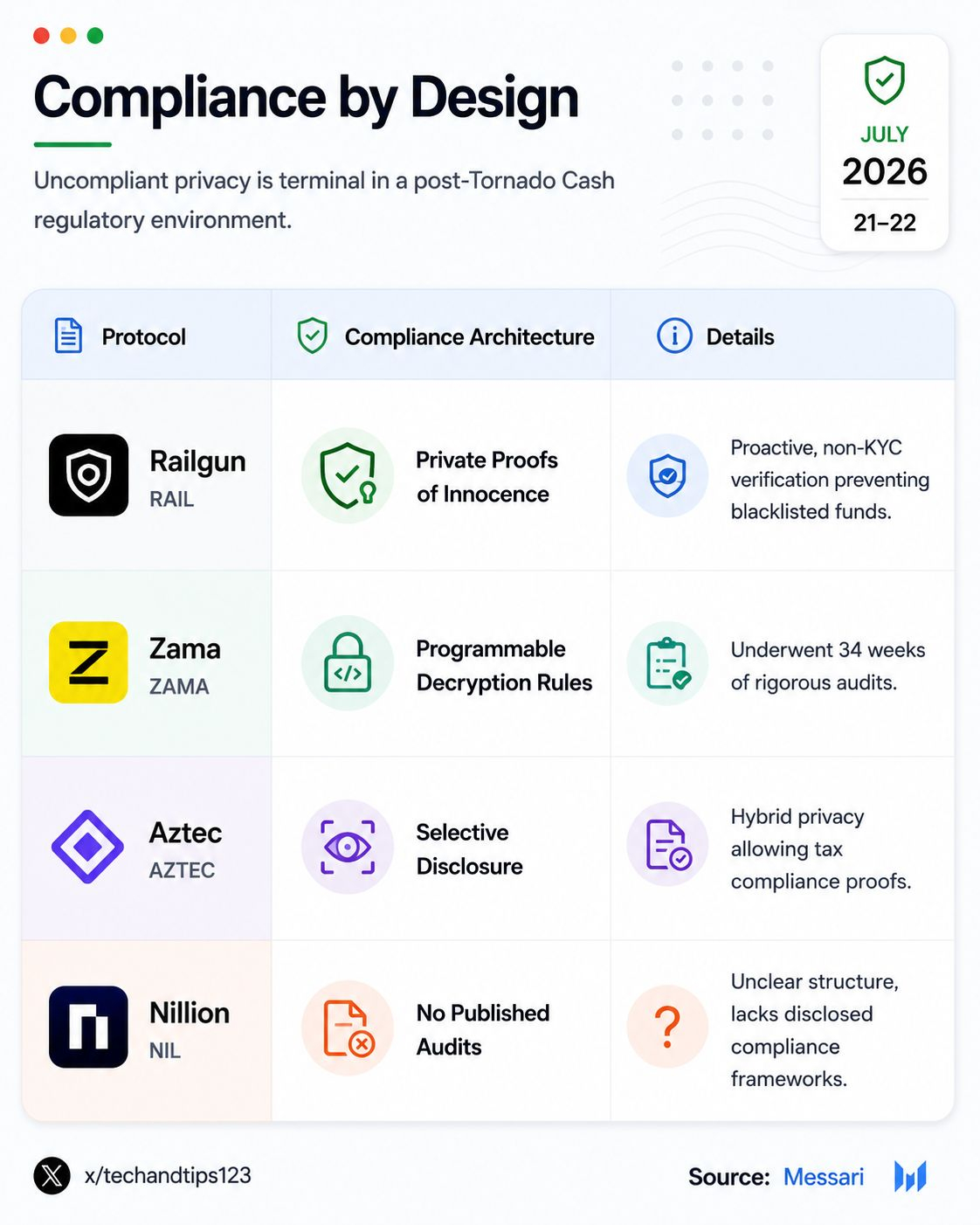
Restricted tokens are identified as coming from illicit activities and can only be unshielded back to their origin. Users can also generate shareable viewing keys to selectively share transaction histories with auditors. Aztec takes a compliance-friendly approach at the protocol level. It uses selective disclosure features, allowing users to prove specific properties, such as tax compliance, without revealing their full transaction history. However, this privacy-first philosophy stands in tension with the fact that Aztec's own token presale required KYC verification.
Zama integrates programmable compliance for decryption rules directly into its FHEVM. This allows institutions to verify solvency or audit portfolios without decrypting the underlying data. Zama backed this compliance model with a rigorous security process, undergoing over 34 weeks of audits, one of the largest audits in decentralized history.
Nillion has disclosed no compliance tools or independent security audits in available sources. This lack of transparency, combined with its hardware-trust dependencies, creates a weaker compliance posture compared to its peers.
IX: Business Model — What Each Protocol Actually Sells
Sustainable business models require a clear commercial product, target audience, and competitive edge. Protocols must convert complex cryptography into real services that capture transaction fees.
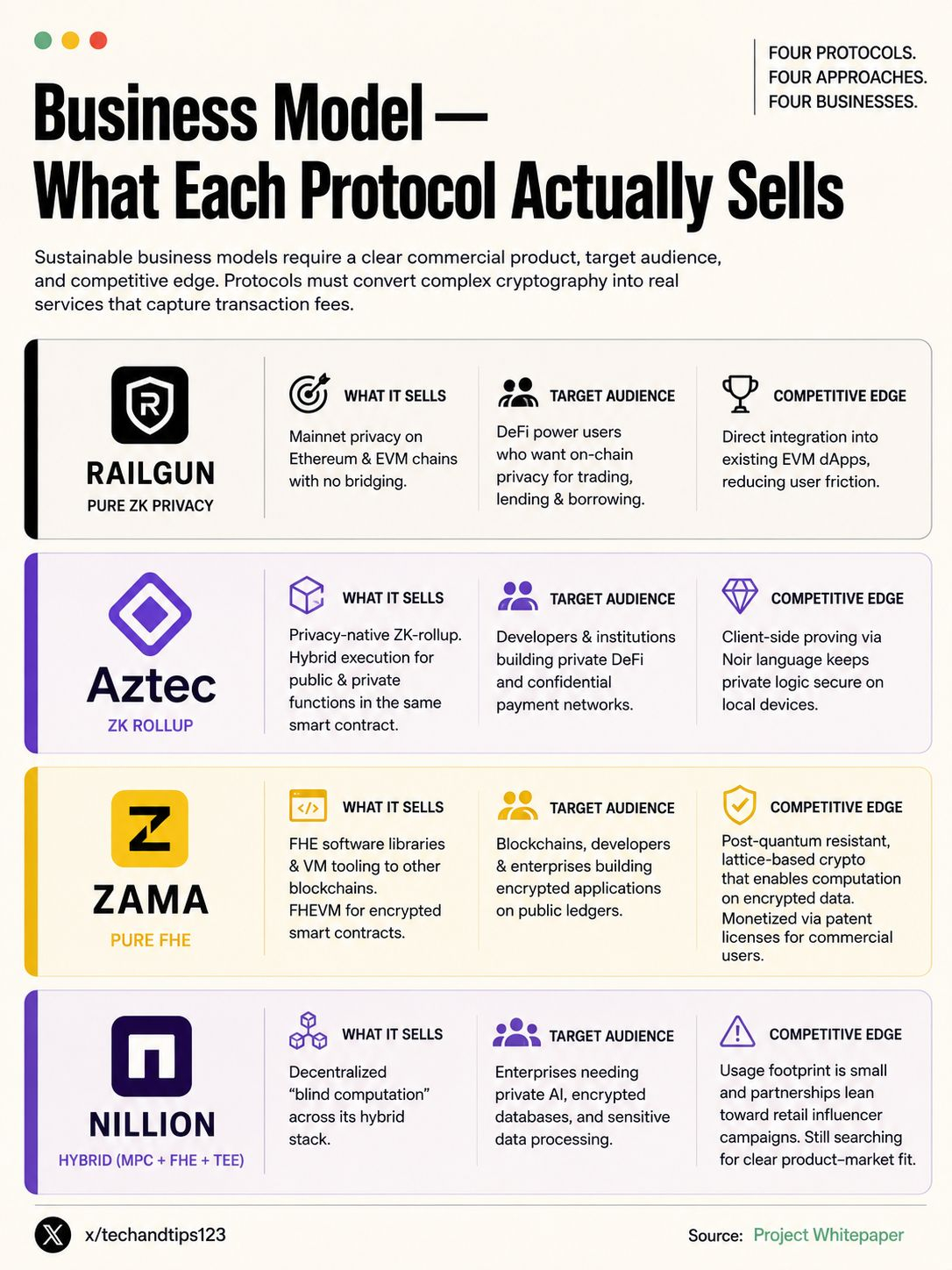
Railgun sells mainnet privacy directly on Ethereum and other EVM-compatible chains with no bridging required. Its target audience is DeFi power users who want on-chain privacy for trading, lending, and borrowing. Its competitive edge is direct integration into existing EVM dApps, reducing user friction.
Aztec sells a privacy-native ZK-rollup. This hybrid execution model allows the same contract to run both public and private functions. It targets developers and institutions building private DeFi and confidential payment networks. Its competitive edge is client-side proving via its specialized Noir language, which keeps private smart contract logic secure on local devices.
Zama sells FHE software libraries and VM tooling directly to other blockchains. Its FHEVM allows developers to build encrypted smart contracts on public ledgers. Its competitive edge is post-quantum resistant, lattice-based cryptography that enables computation on encrypted data. It monetizes this open-source stack by requiring commercial users to purchase a patent license.
Nillion sells decentralized "blind computation" across its hybrid stack. It aims to secure private AI, encrypted databases, and sensitive healthcare or financial data processing. However, its actual usage metrics reveal a small footprint, and its partnerships lean toward retail influencer campaigns. It is still searching for a clear commercial product-market fit.
❍ FIN.
The private computing stack has evolved from academic theory into a highly competitive market. The sector is structured as a clear barbell rather than a uniform category. At one end sits Railgun, representing a mature, revenue-generating protocol with over $800 million in TVL. It features a battle-tested compliance model and verified cash flows, though it remains limited by high token concentration. In the middle are Aztec and Zama, representing high-conviction bets with innovative, pure cryptographic architectures.
Both executed successful token launches in early 2026, bringing advanced cryptographic techniques out of the lab and into production. At the underperforming end of this barbell sits Nillion. It serves as a clear warning sign of how vanity metrics can fail to capture value.
Despite using popular buzzwords like FHE, ZK, and MPC, its actual usage metrics and market performance fall short of its marketing claims. For developers and allocators, the primary takeaway is that cryptographic buzzwords are no substitute for architectural integrity and verified transaction volume. By focusing on pure cryptographic trust models and robust value capture, protocols can build sustainable ecosystems that survive regulatory scrutiny. As the sector continues to mature, this focus on real-world utility will drive the next phase of private computing adoption.