

▍ In a bear market cycle, should you buy on the left side or wait for the right side?
Many friends, for extra safety, will choose to buy on the right side—this increases certainty, but the trade-off is that you lose some of the potential profit space.
But is “waiting for the right side” really that easy?
Let’s look at a real-world example: cost-basis models based on different coin ages are one of the most effective signals of past bear-market trend reversals—historically, they have almost never failed.
When “short-term cost” (red line) breaks above “long-term cost” (green line), that’s what we commonly call the “right-side signal” of a trend reversal.
Before that, you usually experience a process like this: the price breaks below the red line (labeled 1), then rebounds to the green line and meets resistance (labeled 2), along with a series of repeated tests.
From the chart, the structure from February to July looks very similar to June to December of 22’. We use the coefficient obtained by dividing the green line position by the red line; it’s 1.11 now, whereas back in 22’ it was 1.08.
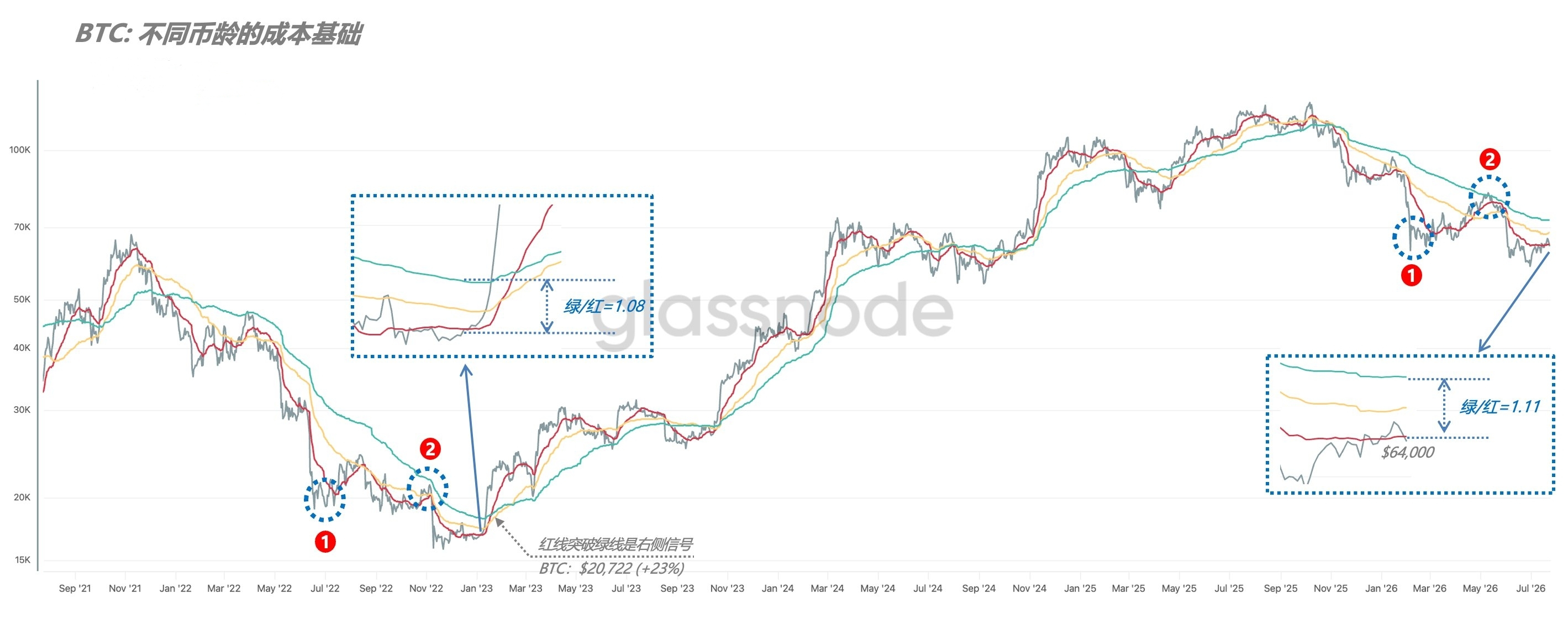
In other words, the relative distance between the current cost bases is pretty similar to the bear-market bottom in 22’ (the cost of chips for short- and long-term holders is fairly close). Put simply, as long as BTC puts in a few big bullish candles from here, you can pull the red line above the green line directly and trigger the right-side signal.
If we take the moment when the BTC price crosses above the red line as the starting point, then when the right-side signal appeared in 22’, BTC had already risen by 20%. Since the relative position of the cost basis is the same, then recalculating to now (BTC at $64,000), reaching $76,000 might be when the signal triggers.
But here’s the problem!
If it reaches 76k via $BTC (i.e., through that move), would you dare to buy? Would you still be willing to buy?
For those who have been sitting in cash waiting for 50k/40k, at this point should you keep waiting, or follow the signal and chase the high to buy?
If it were me, I’d definitely feel very anxious and torn:
If you don’t buy, there’s the risk of missing the entire bull run;
If you buy and then it drops back to 50k, your mindset would collapse...
Writing this article is not meant to emphasize whether the left side is better or the right side is better. Instead, it’s to help everyone understand—through real-world examples—that bottom-fishing isn’t as simple as pressing the Enter key on your keyboard.
It’s a systematic engineering project. From macro to micro, analysis, backtesting, forecasting, planning, execution, and risk control—every step requires thorough preparation.
Other people’s thinking is always someone else’s. Even if you copy and paste it perfectly, you still may not get the same result.
If you say you went all-in at $16,000 in the previous round, then I can only say: if you’re not just talking big, then chances are you had exceptional luck—or you’re a chosen one.
▶ Trading principles ◀
Character determines your trading ceiling, because the market is a machine that amplifies human nature:
Greed, luck-seeking, and evading responsibility may hide for years in real life, but in trading they quickly turn into losses. Excellent traders don’t predict more accurately—they respect probabilities more, accept reality more, and are better at executing rules.
The fundamental reason the market exists is that the future cannot be predicted with precision: if everyone knew the answer, there would be no trading.
Therefore, the essence of trading is not to predict whether prices will rise or fall, but to build an advantage under uncertainty: lose less when you’re late, make more when you’re on time. Stand on the side of probability by using discipline and risk control.
Continuous learning, admitting mistakes, strict self-discipline, focusing on your circle of competence, controlling position sizing, and following the trend.
Trading is like做人:
What the market ultimately rewards are those who see reality clearly, respect规律, and take long-term stable action.