
Korea wants to become a computing power hub.
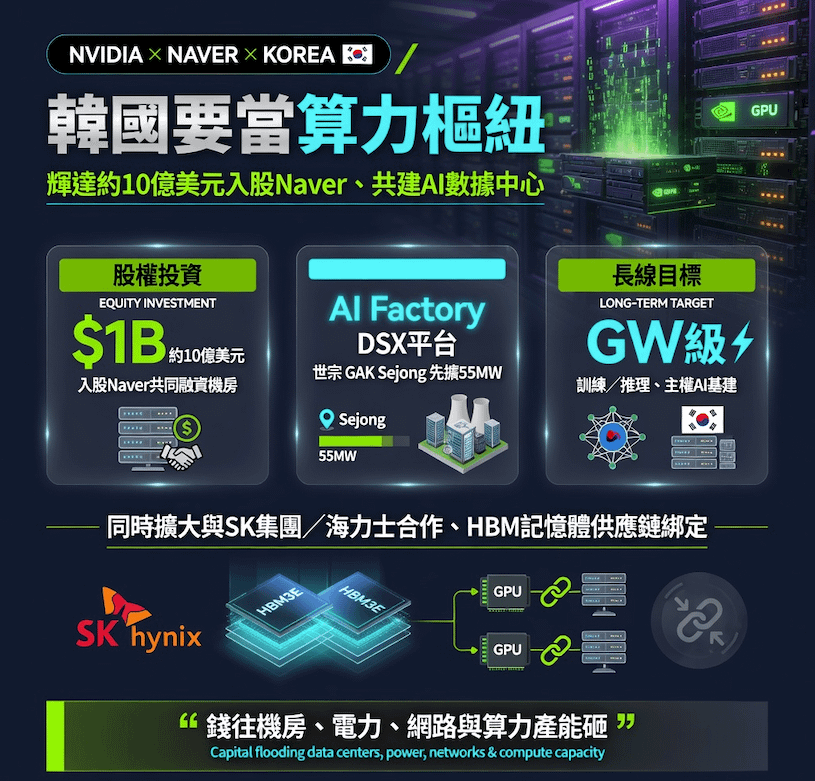
Nvidia plans to invest about $1 billion in the Korean internet giant Naver, using a stake subscription approach to jointly build AI data centers; at the same time, it will expand its cooperation with the SK Group (including SK Hynix). The GPU vendor is getting even more tightly linked with the companies building data centers and with memory suppliers.
This can be viewed in two layers.
One layer is the technical roadmap: Naver plans to build an AI Factory in Korea using Nvidia's DSX platform, starting with expansions to the massive data center from Sejong’s GAK Sejong. The public plan is roughly to begin with 55MW, then ramp up to 100MW and 200MW, and in the long term even target gigawatt (GW) scale—doing training, post-training, and inference. The focus is on sovereign AI infrastructure for enterprises, industries, and the government.
The other layer is capital action: roughly $1 billion in equity, giving Nvidia another identity—besides shipping products, it also becomes a shareholder that operates data centers. If the chips sell well, the data center business benefits too; going forward, inference will become more cost-efficient, and per-query resource usage will drop. If hardware growth slows down, downstream equity still leaves a path for returns.
Korea has been called out, and it has its own rationale. Samsung and SK Hynix carry very high weight in the global HBM/high-bandwidth memory market, and HBM has long been one of the bottlenecks that holds back the AI chip supply chain and delivery schedule. Naver controls local search and cloud services; SK is stuck on memory; add Korea’s electricity, land, and industrial policy—and those pieces come together. Seoul wants to move one step further from being a “parts-exporting power,” to seize the position of Asia’s compute power center.
Looking bigger, in the past two years, sovereign AI data center deals across Asia and the Middle East have been lining up with similar storylines: Japan, Saudi Arabia, and the UAE all have comparable scripts. While model leaderboards are still being argued over, real money is already being poured into data centers, power, networking, GPUs, and HBM. Whether open source helps or constrains the situation, whether chips run into bottlenecks—of course that matters. But what’s playing out publicly at the same time is this: who is the first to build compute capacity into nationally scalable, operational infrastructure.
How does Taiwan see it? Advanced process technology and advanced packaging are still TSMC’s stronghold. Korean manufacturers are constrained by memory, and now Korea is also turning its AI factories/cloud into a national-level narrative. Asia’s supply chain is increasingly looking like three lines running in parallel: logic, storage, and compute deployment—each competing for position. Whoever gets data centers, power, networking, and policy working first will earn an extra ticket for the second half of the game.
The arms race will continue to compare models;
What’s really burning money—and truly bottlenecking—has already shifted to power, land, networking, and full-factory-scale compute capacity.