

Regarding enterprise stablecoins, in the past few years the market has been discussing a “that will happen” story.
This story has many versions, but the core storyline is largely the same: traditional financial institutions are moving in, and compliant stablecoins will become the underlying infrastructure for cross-border payments. Corporate treasury management will undergo a paradigm shift as a result. And what will carry all of this is a new generation of stablecoins jointly developed and supported by banks, payment institutions, and technology platforms.
Few people question this narrative.
In fact, precisely because it’s so reasonable, the market has given it such high attention and expectations. After all, institutions and enterprises do need a kind of digital dollar that can take advantage of blockchain efficiency while also being acceptable to the finance, compliance, and risk teams. However, most of the discussion so far has remained focused on the future: which institutions are preparing to enter, what products are about to be launched, and which payment and settlement scenarios are likely to migrate onto the chain.
Until recently, the market has seen two lines of leads worth observing together:
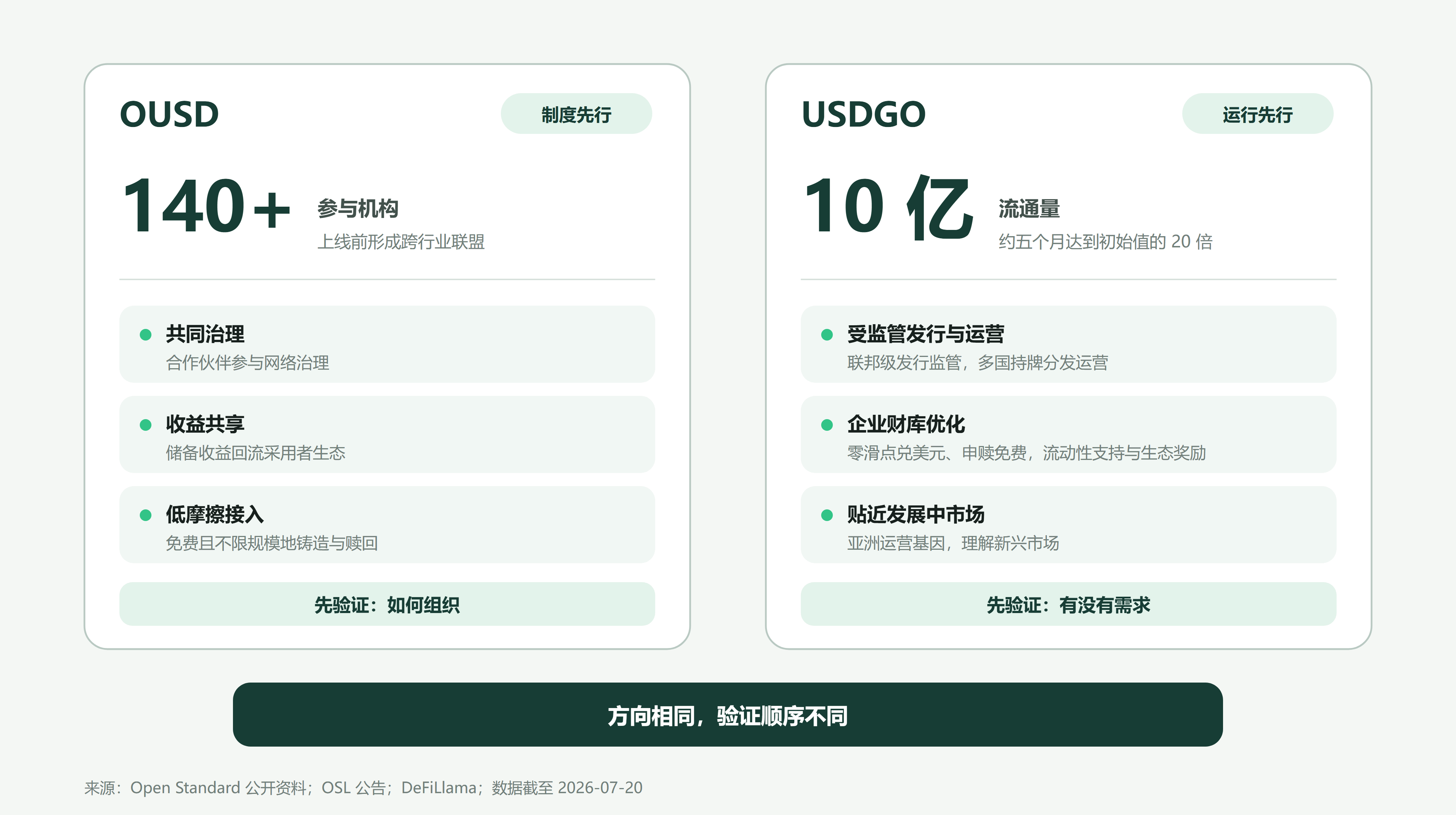
On June 30, Open Standard officially announced Open USD (OUSD). It brings together more than 140 financial, payment, technology, and crypto companies including Visa, Mastercard, Stripe, BlackRock, BNY, Google, and Coinbase, and plans to launch in late 2026.
On July 20, according to DefiLlama’s statistics, another enterprise stablecoin, USDGO, surpassed $1 billion in circulation. It entered the top six of the world’s compliant stablecoin circulation and became the largest USD compliant stablecoin operated by an Asia-based stablecoin operator.
In a sense, OUSD intends to elevate the demand for enterprise stablecoins into a global industry consensus, and USDGO’s $1 billion provides a realistic early-reference sample for that consensus.
It seems enterprise stablecoins have entered a new phase of “distribution is king.”
1. With USDT and USDC already here, why do we still need “OUSDs”?
With USDT and USDC having already built a massive liquidity network, why does the market still need another USD stablecoin?
This is an old topic—also the first hurdle that all enterprise stablecoin discussions must overcome. In the past, many debates reduced the opportunity for enterprise stablecoins to two structural pain points in traditional payment systems:
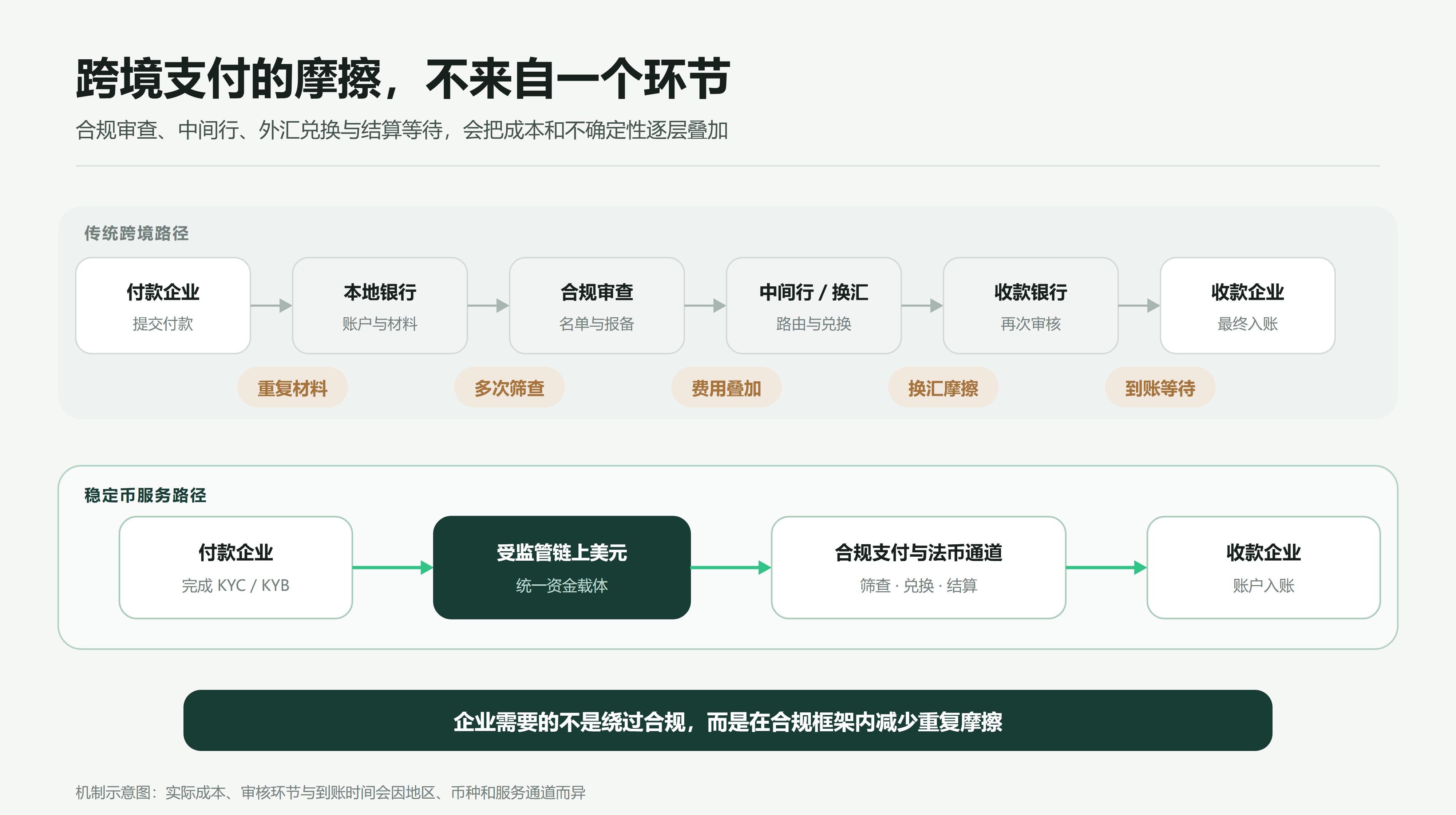
First are compliance costs. Compliance reviews for cross-border fund flows are not one-off; they are embedded into every transaction—anti-money-laundering checks, sanctions-list screening, cross-border reporting, and rule alignment across different jurisdictions. With each additional step comes more uncertainty;
Second is settlement efficiency. A cross-border B2B payment of tens or hundreds of thousands of dollars often goes through multiple steps, such as message routing, intermediary banks, FX conversion, and final crediting. This stacks up fees, FX point spreads, and capital-occupancy costs, and the settlement cycle often takes several business days.
But in reality, the opportunity for enterprise stablecoins has never come only from the fact that existing stablecoins are “not compliant enough,” or that traditional payment systems are “not fast enough.” The deeper reason is that the way businesses use capital is fundamentally different from how crypto users use stablecoins.
To understand, in the crypto market, stablecoins are first and foremost a type of liquidity asset.
In this setup, exchanges provide the trading entry points, wallets and blockchains handle transfers, and DeFi protocols provide lending, market making, and yield scenarios. This also means that as long as a stablecoin has sufficiently deep trading pairs and on-chain liquidity, users will naturally choose it.
However, a multinational enterprise would not migrate supplier payments, merchant settlement, and treasury management onto the blockchain merely because a certain stablecoin transfers faster. It also needs to handle issuer risk, subscriptions and redemptions, fiat conversion, technical integration, accounting treatment, liquidity management, and regulatory requirements across different markets.
To put it plainly, what enterprises truly care about is an entire set of issues—such as: Who is the legal issuer? Who manages the reserve assets? Can large subscriptions and redemptions be completed smoothly? How does conversion work between fiat and stablecoin? Can financial costs be optimized? How do you integrate with existing financial systems? How do you complete customer identification, anti-money-laundering, sanctions screening, and accounting treatment?
Beyond that, from the perspective of economic benefits, the traditional stablecoin model formed for the crypto trading market may not be replicable into the enterprise payments domain in a copy-and-paste way.
In the past model, issuers like Tether/Circle only needed to be responsible for stablecoin issuance and reserve management, and they captured most of the revenue generated by the reserve assets. Meanwhile, exchanges, wallets, and various on-chain protocols took on the “dirty work” of providing trading entry points, product integration, liquidity building, and user acquisition.
In the crypto market, this model can work well because stablecoin itself is an indispensable liquidity tool for exchanges and on-chain protocols. Even if the channels cannot directly share reserve revenue, they can still earn returns through trading, custody, lending, and other services.
But in the enterprise market, the cost of distributing a stablecoin is clearly much higher. Payment companies, banks, and financial-technology platforms not only have to complete technical integration and compliance reviews, but also need to persuade enterprises to switch settlement tools, adjust fund-flow processes, and continuously provide fiat on/off-ramps, liquidity management, accounting reconciliations, and customer service.
But if the economic benefits generated by stablecoin scale growth are still mainly monopolized by the issuers, then the institutions that are actually responsible for finding customers, building payment channels, and driving enterprise adoption may not have enough incentive for long-term investment.
OUSD and USDGO are also trying to change this relationship:
According to the design published by Open Standard, in addition to small management fees needed for daily operations, the returns generated by reserve assets will be distributed to partner entities such as banks, payment platforms, e-commerce companies, and technology service providers. In other words, OUSD is a stablecoin network jointly built and jointly governed by adopters that shares economic returns.
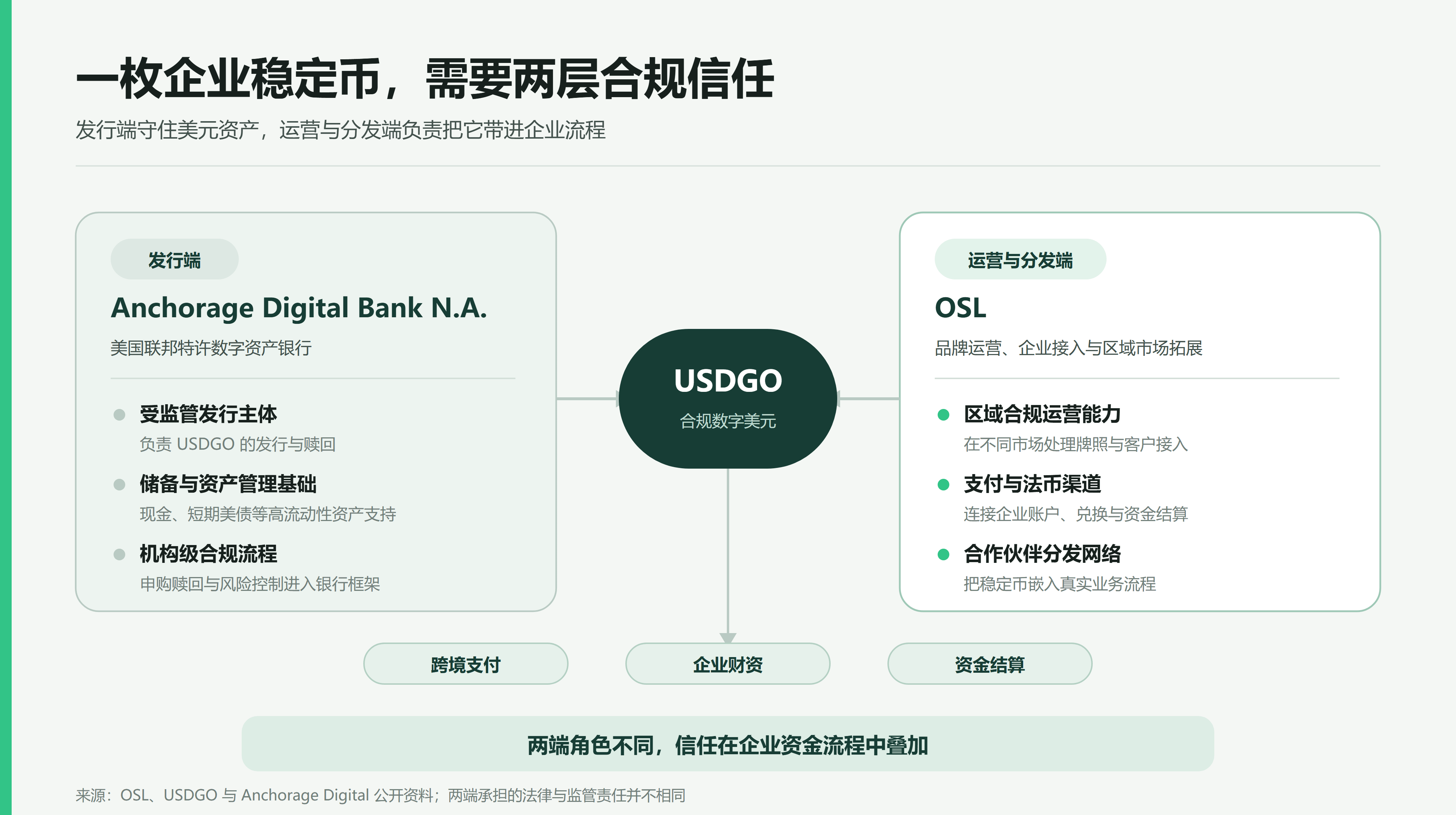
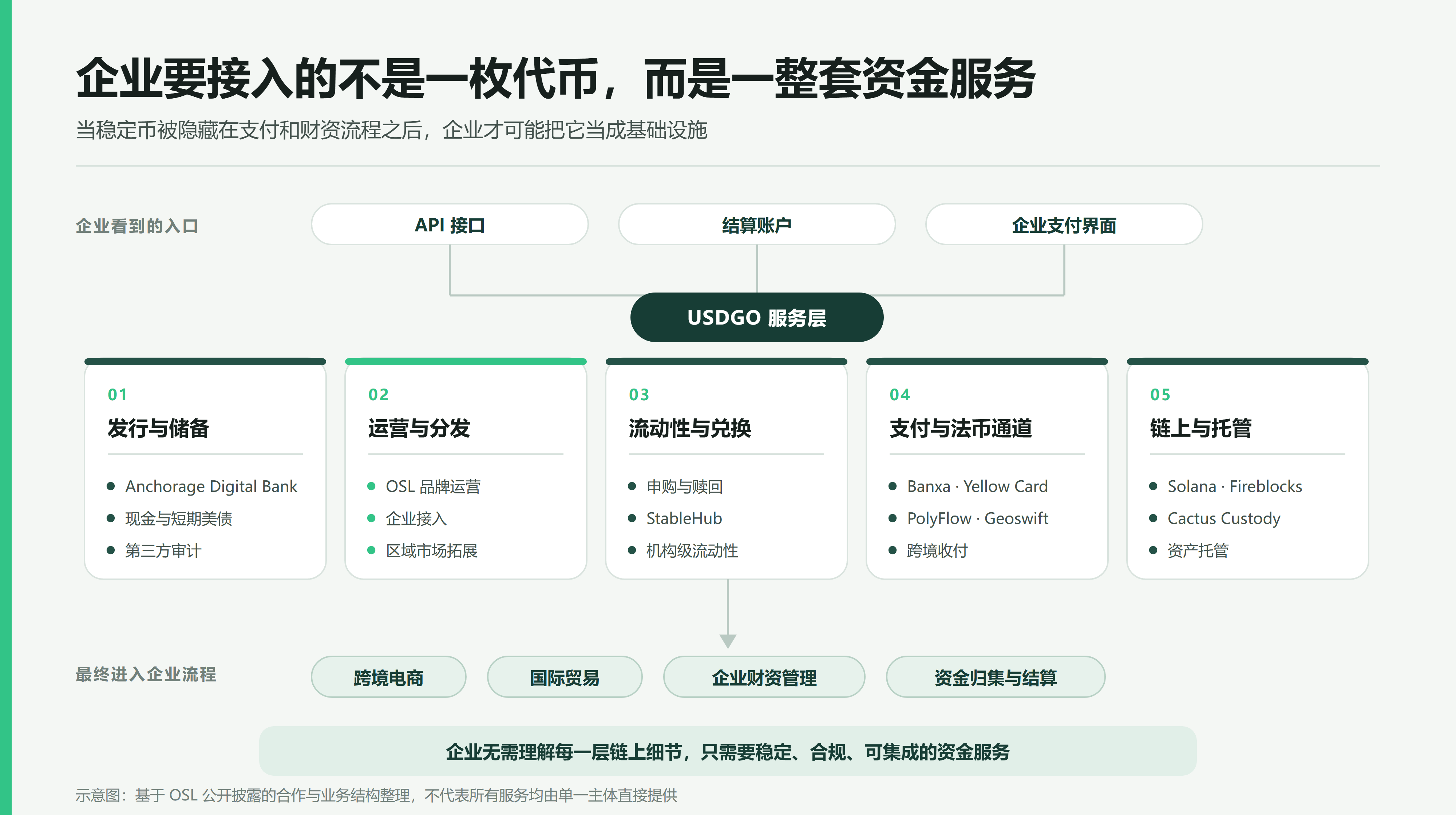
USDGO, meanwhile, chooses a different path that is more oriented toward real-world execution. It starts from a regulated issuance model, regional distribution, and specific enterprise scenarios. Anchorage Digital Bank provides the issuance and reserve foundation, while OSL is responsible for brand operations, market distribution, and enterprise onboarding. It then gradually connects payment, custody, fiat on/off-ramps, and liquidity service providers. The aim is to reduce the barriers for enterprises to access and use stablecoins through professional division of labor among issuers, regional operators, and service partners. Customers in the USDGO ecosystem can also receive ecosystem participation rewards.
The two paths differ slightly, but they point to the same industry judgment: what enterprises need has never been only a token that can transfer on-chain. They need a capital network that can connect different markets, accounts, fiat systems, and commercial platforms.
For banks, it may be used for digital-asset settlement and enterprise treasury management. For payment companies, it may be used for merchant settlement and cross-border payments. For internet platforms, it may become a foundational tool for merchants, creators, and gig-worker payouts. For crypto businesses, it can continue to serve on-chain transaction and liquidity roles.
From this perspective, enterprise stablecoins are indeed entering a “distribution is king” phase. And OUSD’s launch also shows that traditional large payment institutions are trying to demonstrate that global finance, payments, technology, and crypto enterprises are willing to sit down at the same table around a new way of organizing stablecoins.
However, whether it can truly be transformed into a genuinely efficient, continuously operating payment and distribution network remains unknown—after all, the scale of a distribution network and the actual business scale it generates are still two different things.
2. USDGO’s early validation—what signals are worth paying attention to?
If you want to judge how far OUSD can go in the future, USDGO—already operating for nearly half a year—offers a valuable leading sample worth observing.
It officially launched on February 10, 2026. The initial issuance on Solana was $50 million. After that, the circulating supply exceeded $68 million within a month, broke $100 million in April, surpassed $500 million in June, and further reached $1 billion in July.
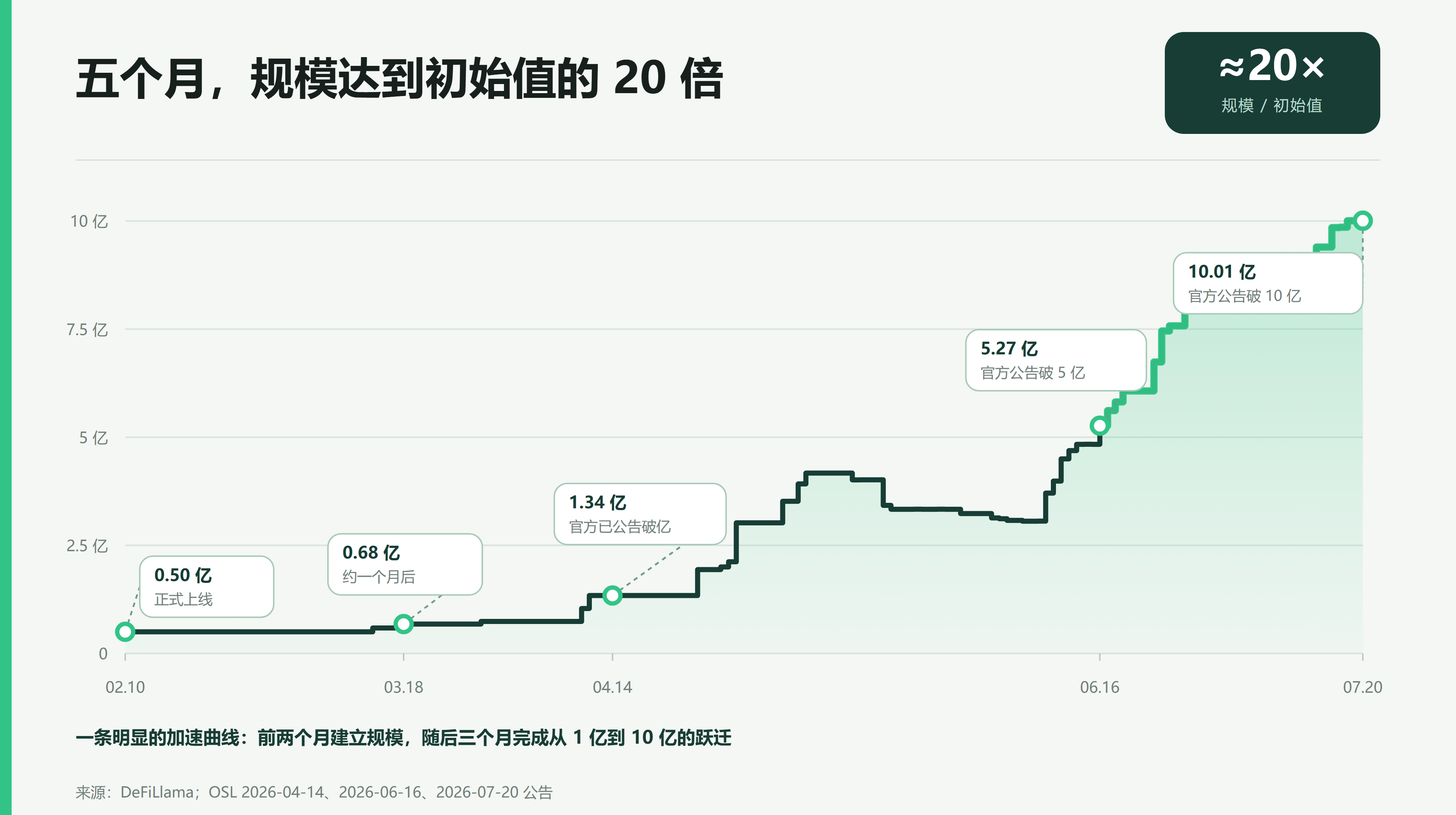
In less than half a year, growing from $50 million to $1 billion suggests at least that even though USDT and USDC already account for the majority share of the stablecoin market, the enterprise-level demand for compliant digital dollars is still a massive blue ocean that remains to be developed—and that it can be converted into a non-trivial amount of real capital, while also making people willing to hold and use it.
And the $1 billion that is genuinely worth paying attention to is, of course, not just the growth rate.
For enterprises, USDGO’s appeal depends not only on which blockchain it operates on, nor merely because on-chain transfers are faster. As described above, the prerequisite for enterprises to use stablecoins is that issuance, reserves, subscriptions/redemptions, regional distribution, fiat on/off-ramps, and compliance services can be stitched into a complete chain of processes.
For example, the issuer Anchorage Digital Bank N.A. is the first federally regulated crypto bank in the U.S. Among the major names that issued stablecoin alongside Anchorage, the most typical include the global cross-border payments giant Western Union, and the global stablecoin leader Tether (yes—in the U.S., a compliant dollar stablecoin is Tether issued through Anchorage).
In other words, the issuer behind USDGO is not any of the typical offshore foundations, nor is it some Web3 project or crypto community organization. Instead, it is a licensed institution regulated by the U.S. Office of the Comptroller of the Currency (OCC) and holding a federal banking license.
As for OSL Group—the OSL group that serves as USDGO’s operator and distributor—users who have long been paying attention to Hong Kong’s crypto market are likely not unfamiliar with it. As Hong Kong’s first licensed listed virtual-asset platform, it has long been one of the representative banners for the development of Hong Kong’s virtual-asset market. In recent years, it has also begun aggressively laying out the payment and trading track focused primarily on stablecoins, and it has obtained dozens of compliance licenses and registration approvals worldwide.
This means that at least along the visible compliance chain, USDGO provides a “double-insurance” architecture that is closer to the traditional financial mindset: the compliance attributes of U.S.-dollar assets are endorsed by federal-level banks, while the rollout and distribution in Asian markets are handled by licensed public institutions.
Of course, compliance alone is not enough to make enterprises truly use stablecoins. Traditional businesses use bank accounts, so they do not need to separately find custodians, foreign-exchange platforms, clearing networks, and transaction verification tools. Therefore, if stablecoins require companies to assemble an entire stack of on-chain infrastructure themselves, it will be difficult for them to become a truly mainstream commercial tool.
Therefore, from the very beginning, USDGO was not built solely around token issuance. It also attempted to combine payments, trading, custody, fiat on/off-ramping, and liquidity management. While providing comprehensive infrastructure, it delivers ecosystem support aimed at helping enterprise customers reduce costs and increase efficiency. According to information disclosed by OSL, USDGO has partnered with payment and trading service providers including Banxa, Yellow Card, GoldStack, PolyFlow, Geoswift, and Vantage, covering scenarios such as cross-border e-commerce, international trade, on-chain fund transfers, enterprise treasury management, and digital-asset trading. In terms of on-chain infrastructure and institutional custody, it also integrates Solana, Fireblocks, Cactus Custody, and Amber Group.
The key to this path is not to teach every enterprise to learn wallet management and operate on-chain; rather, stablecoins should be hidden behind payment and treasury-management workflows. What enterprises see can be an API, a settlement account, or an enterprise payment interface, while the underlying funds complete cross-border movement, conversion, and clearing via stablecoins.
This is also similar to the direction repeatedly emphasized by OUSD’s participating institutions: stablecoins ultimately should not become a product that end users need to specifically understand. Instead, they should function like internet protocols—becoming foundational infrastructure hidden behind real business.
On another level, it is also not a coincidence that USDGO chooses to enter from Asian enterprise cross-border business and emerging markets.
Compared with the relatively unified financial markets in Europe and the US, cross-border capital flows in Asia, Africa, and Latin America face more friction—such as local currency exchange-rate volatility, insufficient bank coverage, inconsistent clearing times across regions, complicated FX conversion steps, and additional costs and delays introduced by intermediary banks.
The reason OSL lists Southeast Asia, Africa, and Latin America as key application markets—and stresses that USDGO is being used for cross-border fund transfer, trade financing, enterprise cash management, e-commerce, and interactive entertainment—is precisely because demand for U.S.-dollar assets in these regions is already very clear. However, the costs for enterprises to obtain USD liquidity, complete cross-border payments, and manage funds in transit are often higher than in mature financial markets.
From this perspective, the value stablecoins provide here is not only faster transfer speed. It also includes unifying funds from different regions into an on-chain U.S.-dollar asset that can flow 24/7—such as the zero-spread USD exchange, free subscriptions/redemptions, and 7x24 support offered by USDGO. Plus, additional participation incentives from ecosystem partners also aim to help participating enterprises further reduce financial frictions and opportunity costs, achieving real cost reduction and efficiency gains.
3. From $1 billion to $10 billion—what do enterprise stablecoins really compete on?
If you look at it simply, OUSD is more like a global stablecoin alliance jointly built by major institutions, while USDGO is more like an enterprise digital USD service that has already been operating in regional markets.
What both have validated so far is not the same.
OUSD has tried to bring large financial institutions, payment companies, and technology platforms back to the same table to discuss stablecoin governance and economic models, but it has not yet proven whether a distribution network can truly form—unified, efficient, and continuously operating—among more than 140 participants. USDGO, meanwhile, has already shown that a newly issued enterprise stablecoin can accumulate $1 billion in circulating supply in a relatively short period and actively expand into different markets and scenarios. Still, it needs to further prove that these funds can flow into payment, settlement, and enterprise finance cycles for the long term in a stable manner.
Overall, going from $1 billion to $10 billion is not simply nine times more issuance. What truly needs to be accomplished is a series of transformations: from capital entering the system, to capital continuously flowing, to enterprises developing layers of usage dependence.
Therefore, in the next phase, competition for enterprise stablecoins depends not only on market capitalization and circulating value, but also on the following dimensions.
First, beyond the circulating size, more important is the quality of the capital.
After all, for example, how many companies does the $1 billion come from? Is the capital concentrated in a small number of institutions or platforms? Are enterprises holding it as long-term operating funds, or as short-term allocation and ecosystem-incentive funds? Only when capital sources gradually diversify and form stable enterprise balances will the circulation scale truly have sustainability.
Second is real usage efficiency.
Once the capital is minted, it still needs to truly flow. A stablecoin with $1 billion in circulation but most funds sitting idle long-term is commercially different from a stablecoin with the same $1 billion in circulation that is continuously used for vendor payments, merchant settlement, cross-border receipts, and enterprise fund collection. The business value is completely different.
Next comes liquidity and redemption capability.
Enterprise stablecoins often need to handle not hundreds-of-dollars small transactions, but flows of hundreds of thousands to millions of dollars. Whether large subscriptions and redemptions are smooth, and whether the price spreads between different stablecoins and fiat are stable, determines whether enterprises are willing to use them as a routine tool.
If a company needs multiple exchange and redemption plans in advance for a single payment, then stablecoins have not truly reduced the complexity of capital management—they have only shifted complexity from the banking system to the on-chain environment. Therefore, for enterprise stablecoins to become a routine tool, they must establish sufficiently deep liquidity, stable fiat on/off-ramps, and a subscription/redemption system capable of handling large inflows and outflows of capital.
Finally, there’s the sustainability of the business model and the ability to expand globally.
Whether it’s OUSD’s reserve revenue sharing or the incentives and service ecosystem built by USDGO around partners, it all needs to deal with changes across interest-rate cycles and handle differences across regions’ licensing, data, KYC, AML, sanctions screening, and fiat rails.
This means competition among enterprise stablecoins won’t simply be a replication of the market-share battle between USDT and USDC. It’s more like a competition of integrated capabilities: issuance and reserves are only the starting point. The final system must combine the payment network, banking channels, customer relationships, liquidity, technical integration, and regional compliance.
Written at the end
Every industry transformation has, in fact, gone through similar stages.
The market is still heatedly debating “who will do what,” but real changes have quietly moved beyond the initial tipping point:
The emergence of OUSD is absolutely an important milestone in enterprise stablecoins moving toward maturity. It means that the “enterprise stablecoin” track has genuinely entered the mainstream view of global financial institutions.
At the same time, USDGO also used its $1 billion in circulation over half a year to prove that enterprise stablecoins can be issued, held, and have the base liquidity to support large payments.
But $1 billion is still only a new starting point.
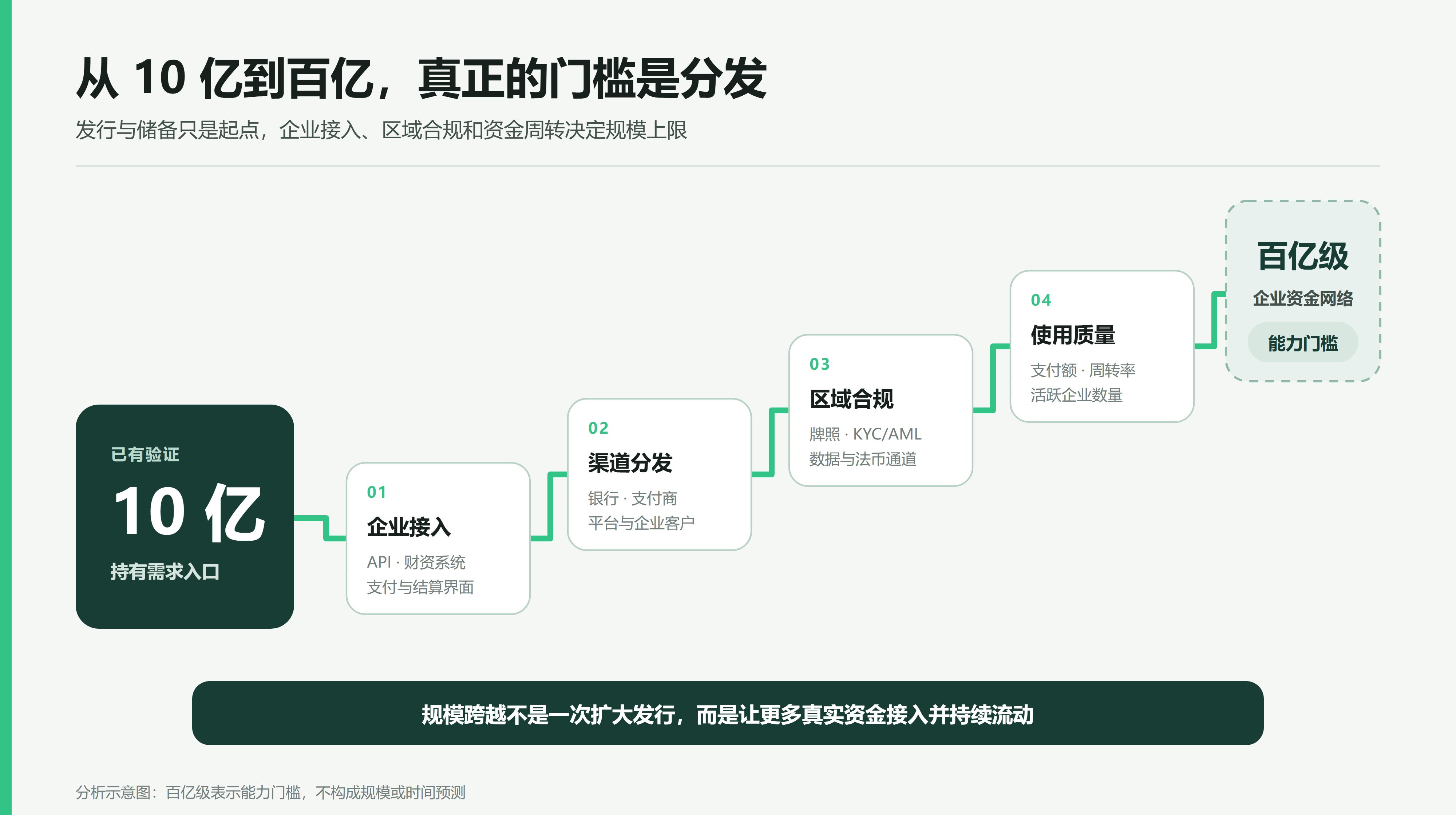
To go from $1 billion to $10 billion, what truly needs to be crossed is the complete chain from “being issued” to “being held,” and then from “being held” to “being continuously used,” so that OUSD or USDGO keeps entering trade, payments, and enterprise treasury cycles.
Perhaps in the future, once digital dollars become as natural as a bank interface, enterprises won’t even need to know which specific stablecoin sits underneath. Only then will stablecoins truly transform from a crypto asset into foundational infrastructure for global commerce.