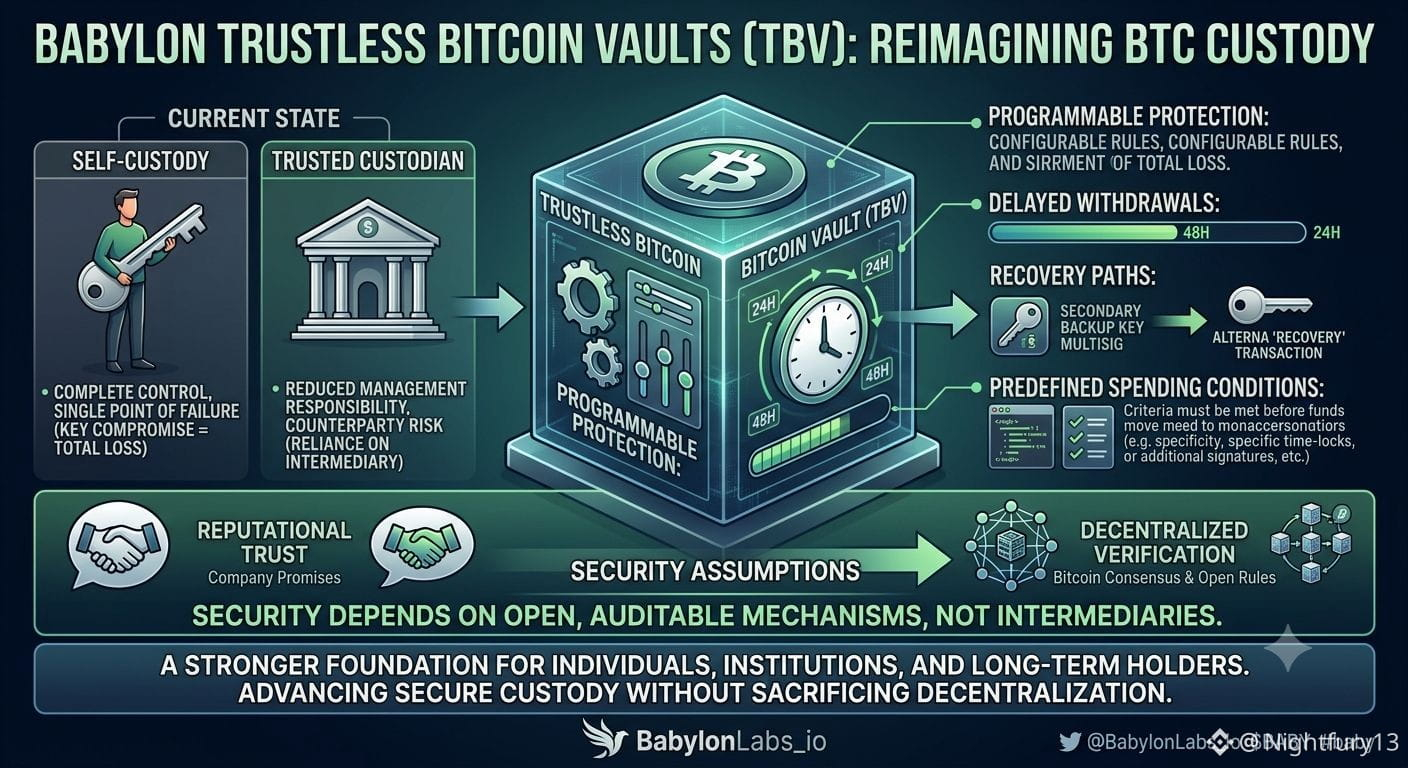
#baby $BABY I've been digging deeper into Babylon Trustless Bitcoin Vaults (TBV), and what caught my attention isn't just the technology, it's the philosophy behind it. For years, Bitcoin holders have had to choose between two imperfect options. Either keep complete control through self-custody and accept that a single mistake or compromised key could permanently lose funds, or hand assets to a trusted custodian and introduce counterparty risk. TBV is an attempt to narrow that gap by making security depend more on transparent, verifiable rules than on trusted intermediaries.
The idea of a vault isn't simply to "lock" Bitcoin. A Trustless Bitcoin Vault is designed to give BTC holders programmable protection over how funds can move. Instead of every transaction being immediately final with no safeguards, vault policies can introduce protective mechanisms such as delayed withdrawals, recovery paths, and predefined spending conditions. These features are intended to give users time to react if keys are compromised while still preserving Bitcoin's trust-minimised security model.
What makes this especially interesting is that the security assumptions remain centred on Bitcoin rather than on a company making promises. The more critical the assets become, the more important it is that security comes from open, auditable mechanisms instead of reputation. If TBV continues to mature, it could provide a stronger foundation for individuals, institutions, and long-term BTC holders seeking better protection without sacrificing decentralisation.
I'm looking forward to seeing how Babylon continues to develop this approach and how Trustless Bitcoin Vaults can expand the possibilities for secure Bitcoin custody. @BabylonLabs_io #baby $BABY
The idea of a vault isn't simply to "lock" Bitcoin. A Trustless Bitcoin Vault is designed to give BTC holders programmable protection over how funds can move. Instead of every transaction being immediately final with no safeguards, vault policies can introduce protective mechanisms such as delayed withdrawals, recovery paths, and predefined spending conditions. These features are intended to give users time to react if keys are compromised while still preserving Bitcoin's trust-minimised security model.
What makes this especially interesting is that the security assumptions remain centred on Bitcoin rather than on a company making promises. The more critical the assets become, the more important it is that security comes from open, auditable mechanisms instead of reputation. If TBV continues to mature, it could provide a stronger foundation for individuals, institutions, and long-term BTC holders seeking better protection without sacrificing decentralisation.
I'm looking forward to seeing how Babylon continues to develop this approach and how Trustless Bitcoin Vaults can expand the possibilities for secure Bitcoin custody. @BabylonLabs_io #baby $BABY