
As the Federal Reserve shrinks its balance sheet and regulators such as the SEC strengthen compliance reviews of the cryptocurrency market, the cryptocurrency market has entered a long bear market. Due to the poor liquidity of NFT, domestic restrictions on secondary sales of data have led to the gradual decline of the NFT market along with the entire cryptocurrency market.
Recently, Tencent’s data storage platform Huanhe announced that based on business adjustment arrangements, the Huanhe APP will be offline at 24:00 on June 30, 2023. Users who hold collections need to make refunds before June 30, 2023. Major manufacturers have withdrawn from the NFT market not only because of poor market conditions, but also because of the various industry chaos and compliance risks contained in the domestic data storage market. This article will analyze the legal compliance issues related to Shuzang NFT from a technical perspective.
1. The casting of NFT
In order to understand the compliance issues related to the domestic data storage market, you first need to understand the NFT casting process.
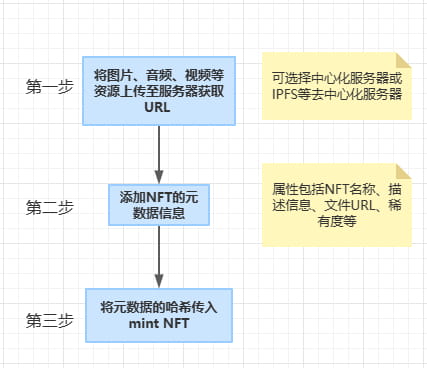
The first step is to upload the file resource of the NFT to be minted to the server to obtain the URL. Here you can upload pictures, audio, video and other resources, so you can see "audio NFT", "3D model" and other data collections on the Shuzang platform. When uploading, you can choose to upload file resources to a centralized server or a decentralized server such as IFPS and AR. The difference between the two is that the decentralized server has the characteristics that the blockchain itself cannot be tampered with and the data is permanently stored, which greatly ensures the safe and reliable storage of data.
The second step is to add the metadata information of the NFT. The metadata information here includes NFT attributes such as name, description information, rarity, and the URL of file resource storage.
The third step is to pass the hash of the metadata into the minted NFT.
During the entire NFT casting process, addresses need to pay gas when interacting on the chain. This part of the gas is not paid to the Shuzang platform but to the nodes or miners. The amount of gas for each transaction in the public chain is not constant and will vary according to the chain. Dynamically adjust according to the congestion situation. When there is extreme congestion on the chain, gas will soar.
2. Research on legal issues related to NFT infringement
1. Legal characterization of NFT
According to the above-mentioned NFT casting process, it can be seen that the entire casting and subsequent transaction flow process of NFT data are carried out in the blockchain and information network environment, and its virtual property is different from the virtual property of real property. The whole process requires nodes or miners to package and upload them to the chain. If it is a physical art work in a museum collection, the physical work needs to be digitally collected first to produce a picture form of the art work. Therefore, the manufacturing of digital collections requires investment in manpower, material resources, etc. Actual cost, which has economic value. The NFT number is expressed on the blockchain as 721 or 1155 tokens. Its number is constant when it is minted, and it has a unique ID corresponding to it on the chain, which is characterized by scarcity. NFT holders can exclusively possess, control and use it through the on-chain address.
In summary, NFT data collection as network virtual property is reflected as a kind of property rights when protected by civil law.
Article 10, Paragraph 1, Item 6 of the Copyright Law stipulates: "The right of distribution is the right to provide originals or copies of works to the public by way of sale or donation." The current mainstream view is that the carrier of distribution rights should be understood as tangible As for the material carrier, it is obvious that the NFT data collection is based on blockchain technology and does not belong to the distribution rights stipulated in the copyright law. The casting process of NFT data is to interact with the contract through the address on the chain. Its works are always placed on the Internet and should be protected by the right of information network dissemination.
2. Should the NFT data storage platform have a higher duty of care?
At present, the domestic digital storage platform supports users to upload pictures to cast and list NFT by themselves. During the casting, listing and subsequent transaction process, so-called fixed gas will be charged. As can be seen from the above, the gas for each interaction on the chain is not fixed and will be dynamically adjusted according to the congestion on the chain. For Ethereum’s sidechains, gas is very low. However, most Shuzang platforms that use the Ethereum side chain at the bottom will charge users a fee that is much higher than normal gas, and will charge a certain percentage of commissions in Shuzang's subsequent transactions.
According to Article 11, paragraph 1, of the "Supreme People's Court's Provisions on Several Issues Concerning the Application of Law in the Trial of Civil Disputes Infringing the Right to Information Network Dissemination": "Network service providers directly obtain from works, performances, audio and video products provided by network users If there are financial interests, the people's court shall determine that it has a higher duty of care for the network user's behavior that infringes on the right to disseminate information on the information network.
Obviously, the operation model of most domestic data storage platforms will directly obtain economic benefits from NFT data storage, so they should bear a higher duty of care. This higher duty of care includes the platform’s prior review of NFT data collection rights on the shelves, and proactive deletion of infringing works.
In practice, the Shuzang platform should establish an effective intellectual property review mechanism to prevent infringement of NFT Shuzang, and can also introduce advanced image recognition technology to help the platform identify infringing NFTs. The NFT infringement detection tool Yakoa, which received a US$4.8 million seed round investment from Uniswap last year, is positioned to help NFT trading platforms locate suspected infringing NFTs and collect evidence.
3. Is breaking into a black hole address the best way to stop infringement?
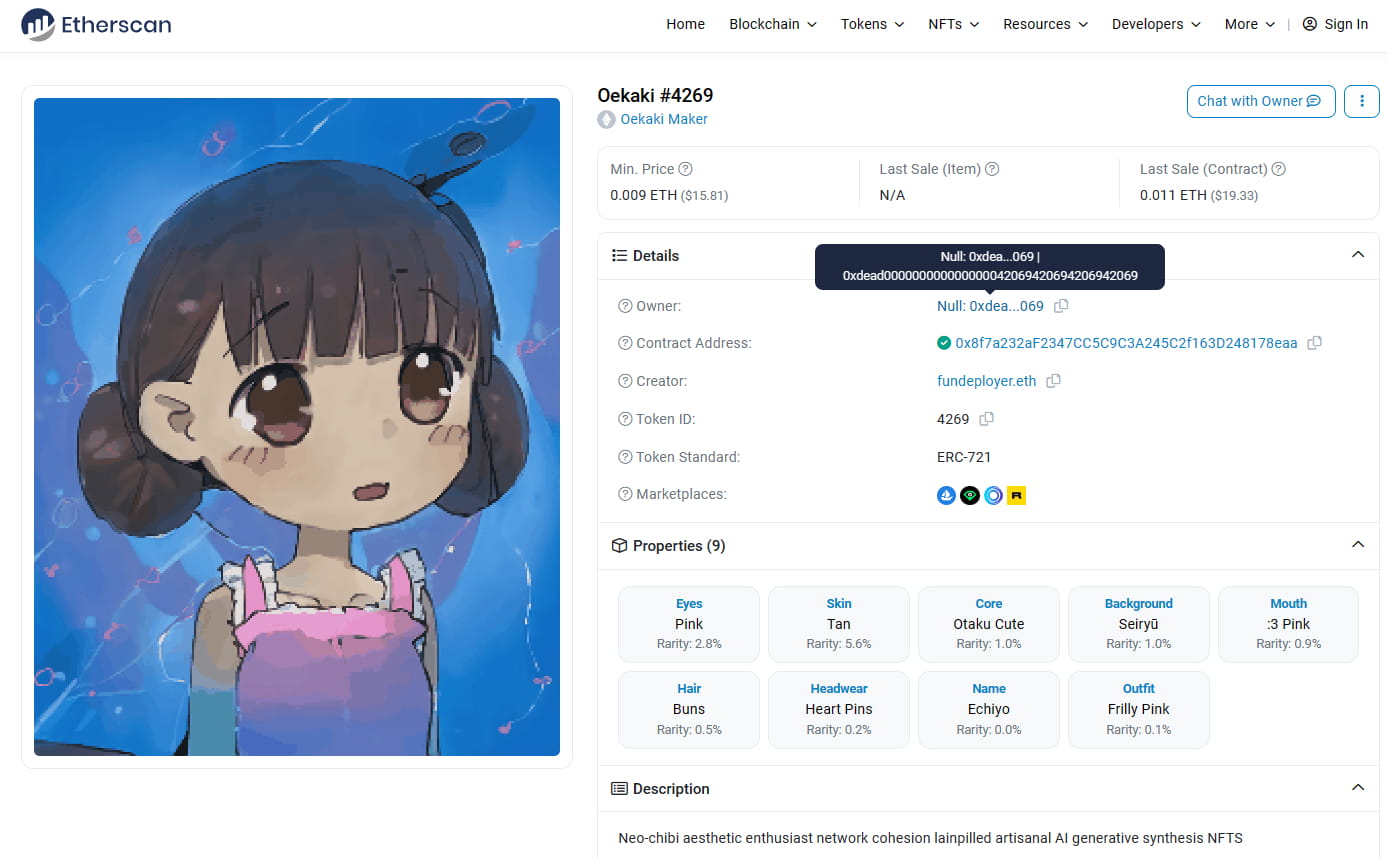
A black hole address refers to an address whose private key is theoretically lost and cannot transfer tokens. In the blockchain, it is mainly suitable for storing destroyed tokens. As a special token, NFT can indeed achieve the purpose of destroying infringing NFT by transferring it to a black hole address. However, according to Article 10 of the Copyright Law, the right to information network dissemination is provided to the public through wired or wireless means, so that the public can obtain the right to the work at the time and place of their choice. Although the NFT entered into the black hole address is permanently destroyed, it cannot be transferred out. However, the infringing NFT can still be queried through the blockchain browser, and the URL of the NFT image can be obtained to view the NFT digital collection. The picture below shows the NFT that the author found randomly from the black hole address.
In addition, many domestic data storage platforms do not upload NFT images to decentralized servers, and even all user operations are not uploaded to the chain. The author participated in an NFT infringement case. The Shuzang platform involved only stored pictures on a centralized server and issued 10,000 copies of 1155 NFT in the public chain. Subsequent user operations were not uploaded to the chain and were completely centralized. The server and backend services sell "pictures" to users as NFT data.
Therefore, the author believes that there should be a distinction between the ways to stop infringement of infringing NFT. For the infringing NFT data on the chain, the black hole address should be entered and the corresponding token URL of the NFT should be deleted; for the NFT data that is not on the chain, It only stores pictures in a centralized server, and only needs to delete the pictures in the server.
3. Future and Prospects
Blockchain technology has the characteristics of rapid iteration, and new technical terms and business logic appear every day. With the vigorous development of the digital economy, there will be more and more digital goods similar to NFT data storage. This also puts forward new requirements for filling relevant legal gaps and clarifying the application of laws. Legislation and regulatory authorities should balance the interests of all parties. Create a good business environment for the vigorous and orderly development of emerging business formats.