


Key takeaways
Regulation and massive growth: In 2025, Binance became the world's first exchange platform to receive full authorization under the internationally recognized Abu Dhabi Global Market (ADGM) regulatory framework, while surpassing the 300 million registered users worldwide. This milestone marks a new era where growth and regulatory rigor advance hand in hand.
Liquidity dominance: Binance has reinforced its position as a major global cryptocurrency liquidity player, with $34 trillion traded on the platform in 2025, including over $7.1 trillion in spot volume. The average daily trading volume across all products increased by 18% over the year.
Beyond the Order Book: The crypto ecosystem has expanded far beyond traditional trading. Binance Alpha 2.0 has thus surpassed $1 trillion in trading volume with 17 million users. Meanwhile, Binance's efforts in security, compliance, risk management, and governance have delivered tangible results in protecting users at scale.
Binance's annual 'State of the Blockchain 2025' report is now available. It outlines key themes and growth indicators related to regulation, liquidity, Web3 discovery, institutional adoption, user protection, and everyday cryptocurrency usage. To access the full results, product updates, and data, you can read the complete report (available in English) here.
Two major milestones marked the end of 2025: Binance became the first crypto exchange platform to receive full authorization under the strict regulatory framework of the Financial Services Regulatory Authority (FSRA) of the ADGM — enabling regulated trading on a global scale — and our community surpassed 300 million registered users. These joint achievements reflect the evolving demands of the industry: crypto platforms are now evaluated as true financial infrastructures. Beyond their size, liquidity, or community strength, they are judged on governance, resilience, user protection, and the ability to operate under constraints.
Trust as Infrastructure: Regulation, Resilience, and Measurable Outcomes
The ADGM framework encompasses governance, risk management, asset custody, transaction approval, and consumer protection. It thus aligns the structure of the crypto market with the standards expected of traditional financial institutions.
The report also highlights that trust is measured by results. Since 2023, Binance has reduced its direct exposure to major categories of illicit funds by 96%. In 2025, the implemented controls prevented $6.69 billion in potential losses from fraud or scams, thereby protecting 5.4 million users. During the same period, Binance processed over 71,000 legal requests, assisted in the seizure of approximately $131 million linked to illicit activities in collaboration with law enforcement, and delivered over 160 training sessions to these agencies.
Trust also relies on eliminating unnecessary friction for legitimate users. For example, the report cites the overhaul of the Enhanced Due Diligence (EDD) process: simplification of submission steps and improved acceptance rates within a short implementation cycle — all while strengthening compliance without complicating the user experience.
Where Liquidity Resides: Depth, Participation, and New Discovery Flows
Liquidity directly impacts the user experience through spreads, slippage, and execution reliability. In 2025, Binance processed $34 trillion in total trading volume across all products, including over $7.1 trillion in spot markets. Since its founding in 2017, the platform has cumulatively processed $145 trillion in trading volume.
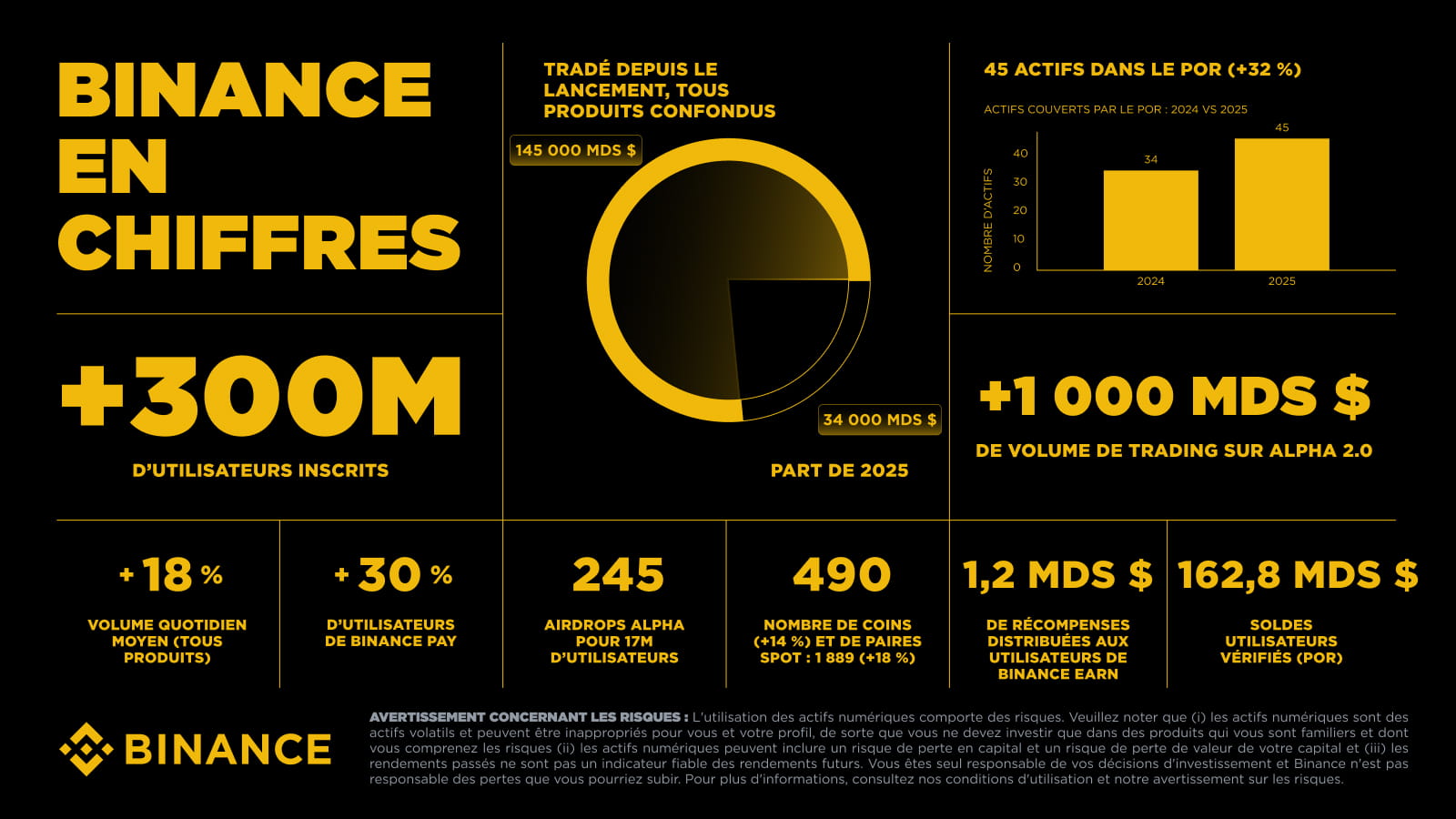
Meanwhile, participation is diversifying. Binance has expanded its spot offering to 490 cryptocurrencies and 1,889 trading pairs. New tools based on simulation and automation have also encouraged more structured user engagement.
The report highlights a significant shift in how users discover and engage with new projects. Binance Alpha 2.0 has emerged as a major integrated discovery platform within the Binance ecosystem, surpassing $1 trillion in volume and attracting 17 million users in 2025. A total of $782 million in rewards were distributed through 254 airdrops. Such scale required heightened integrity standards: risk controls blocked 270,000 malicious participants attempting to hijack campaigns, ensuring rewards went to genuine users and not bots.
Institutions in Motion: From Pilot Programs to Operational Flows
The other central theme of the report is institutional adoption, transitioning from experimentation to integration. Institutions now seek a crypto infrastructure aligned with their existing requirements in governance, collateral, reporting, and settlement. This trend has manifested on Binance through a 21% increase in institutional trading volume compared to the previous year, and a 210% surge in fiat OTC trading volume.
In 2025, tokenization moved closer to practical operational use, particularly through the use of tokenized funds as off-exchange (off-platform) collateral via Binance's institutional collateral framework. The report also describes how modular offerings, such as white-label solutions through 'Crypto-as-a-Service,' enable regulated companies to offer digital assets without rebuilding a full exchange infrastructure. The account structures offered (fund accounts, Binance Wealth, and Binance Prestige) reflect traditional finance’s capital organization, with formats tailored to managed strategies, entity integration, and dedicated service models.
Crypto in Everyday Life: Local Gateways, Payments, and Returns
Beyond trading and discovery, adoption depends on users’ ability to fund their accounts in local currency, transfer value easily, and choose yield products aligned with their risk tolerance. In 2025, fiat volume increased by 38%. The number of Binance Pay users grew by 30% year-on-year, and payment acceptance expanded to over 20 million merchants. Across the Binance Earn suite, $1.2 billion in rewards were distributed in 2025.
Conclusion
Digital finance is moving toward greater standardization, increased liquidity where execution is reliable, and a stronger user focus enabled by facilitated discovery and participation. The 2025 figures illustrate the scale achieved by Binance, but the essence lies in the demands this scale imposes: robust regulatory foundations such as the ADGM license, resilience and security programs preventing real losses, rigorous data protection, AI governance, and product design that reduces friction for legitimate users while increasing the cost of abuse for malicious actors.
*This blog post offers a selective summary of the report’s findings. The full document includes in-depth analyses, detailed context, and updates on products and infrastructure. Read the complete 'State of the Blockchain 2025' report here.*
Also Read
The Liquidity Engine That Powered Binance to 300 Million Users
Binance Becomes the First Crypto Platform to Receive a Global License Under the ADGM Framework
Raising the Bar for Responsible AI in Crypto: Binance Achieves ISO/IEC 42001 Certification
Risk Warning: The use of digital assets involves risks. Please note that (i) digital assets are volatile and may not be suitable for you and your profile, so you should only invest in products you are familiar with and understand the risks of; (ii) digital assets may involve capital loss risk and risk of losing the value of your capital; and (iii) past performance is not a reliable indicator of future results. You are solely responsible for your investment decisions, and Binance is not liable for any losses you may incur. For more information, please review our Terms of Use and our Risk Warning.