

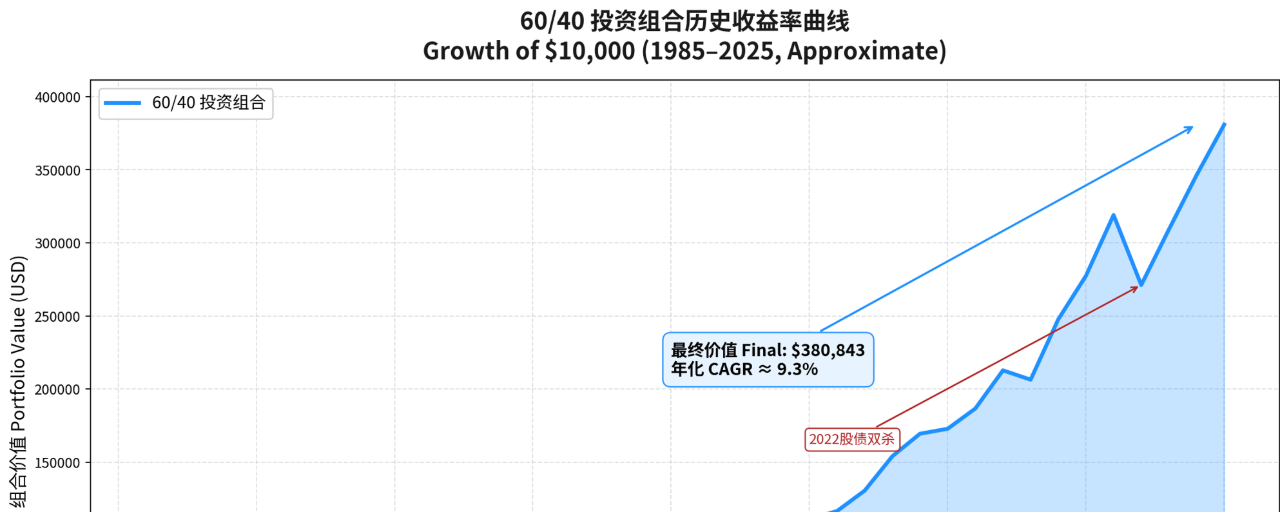

In a portfolio, the 60/40 allocation is a classic of classics—60% stocks drive growth and 40% bonds provide stability. It’s simple yet proven over time. It doesn’t chase extreme returns; instead, it uses the power of balance to safeguard long-term wealth through market ups and downs. Now, Binance’s bStocks (tokenized US stocks) brings new life to this traditional strategy.
With real US stock exposure backed 1:1 on-chain, investors can trade 24/7, self-custody, enjoy dividend auto-reinvestment, and even use their holdings directly as collateral margin for perpetual contracts—truly enabling cross-asset, high-efficiency capital management. Today, I’ll write a tutorial to share with everyone:
I. Overview of the 60/40 Investment Portfolio
The 60/40 investment portfolio is one of the most classic and widely adopted strategies in traditional asset allocation. It allocates funds in a 60% stocks + 40% bonds ratio, evolving from modern portfolio theory, aiming to strike a balance between growth and stability.
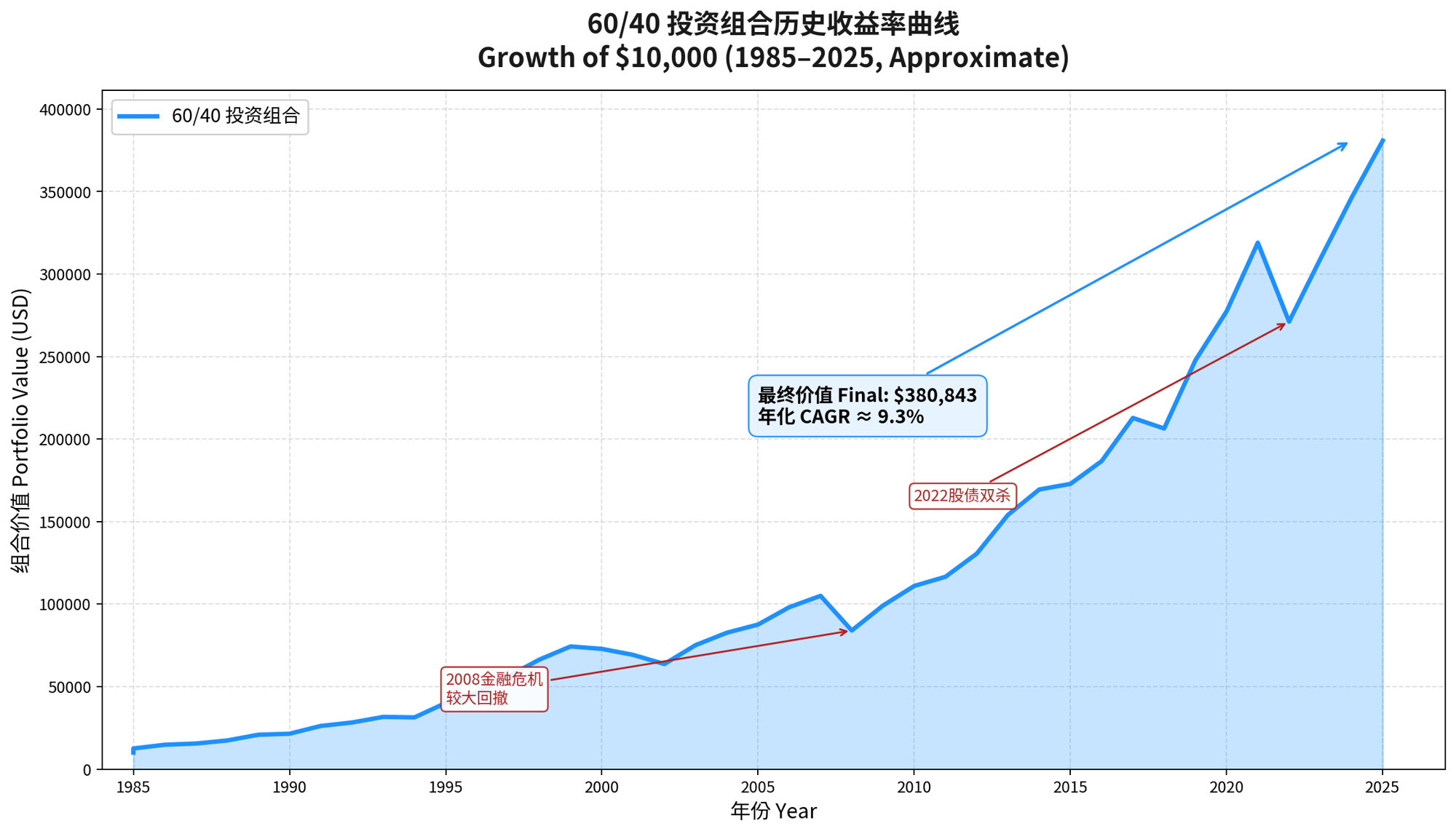
Return performance:
Initial capital: $10,000
Time span: 1985–2025 (about 41 years)
Final value: approximately $380,843
Annualized compound growth rate (CAGR): approximately 9.3%
Data notes: Based on simulations of the classic U.S. stock 60% (S&P 500 as an approximation) + 40% bonds historical performance, with emphasis on replicating drawdown characteristics in major crisis years (e.g., 2008, 2022) for educational reference.
60% Stocks (equities): takes primary responsibility for growth, capturing upside during periods of economic prosperity and delivering higher returns over the long term.
40% Bonds (fixed income): provides stable interest income and a defensive function. When the stock market falls, it acts as a buffer, lowering overall volatility.
The core idea of this strategy is: it does not aim for extreme returns. Instead, by using the negative (or low) correlation between stocks and bonds, it seeks smoother net value curves and more controllable drawdowns. It suits investors with a moderate risk appetite who are looking for long-term, steady value growth. It is often used as a benchmark allocation for retirement accounts or core holdings.
II. bStocks Portfolio Construction Method
bStocks are tokenized U.S. stocks launched by Binance (1:1 backed by real U.S. stocks, supporting 24/7 trading, self-custody, automatic dividend reinvestment, and usable as perpetual contract margin). Using it to build a 60/40 portfolio enables seamless integration of traditional U.S. stock exposure into the crypto ecosystem, achieving round-the-clock management and improved capital efficiency.
Recommended allocation example (total funds = 100%):
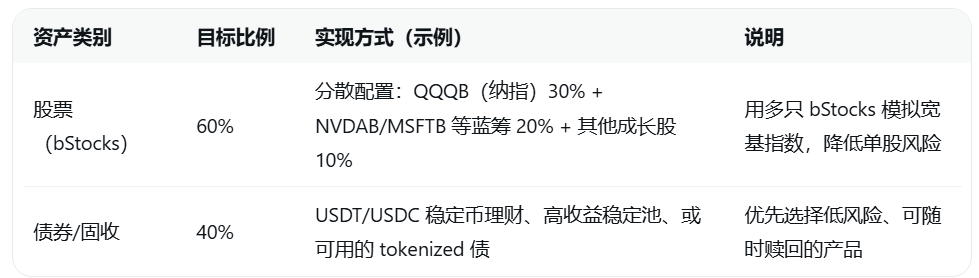
Specific Operation Steps:
Set total capital and allocate by proportion: strictly split it 60/40. For the initial setup, it’s recommended to buy in batches to avoid timing risk from investing all at once.
Build the stock portion (60%): on Binance spot, search for the corresponding bStocks trading pairs (e.g., QQQB/USDT, NVDAB/USDT), and buy with USDT. You can first buy Binance U.S. stocks and then tokenize in one click, or buy directly on spot. Supports a minimum of about 5 USDT to start and allows fractional-share trading. It’s recommended to allocate at least 3–5 underlying assets to diversify risk.
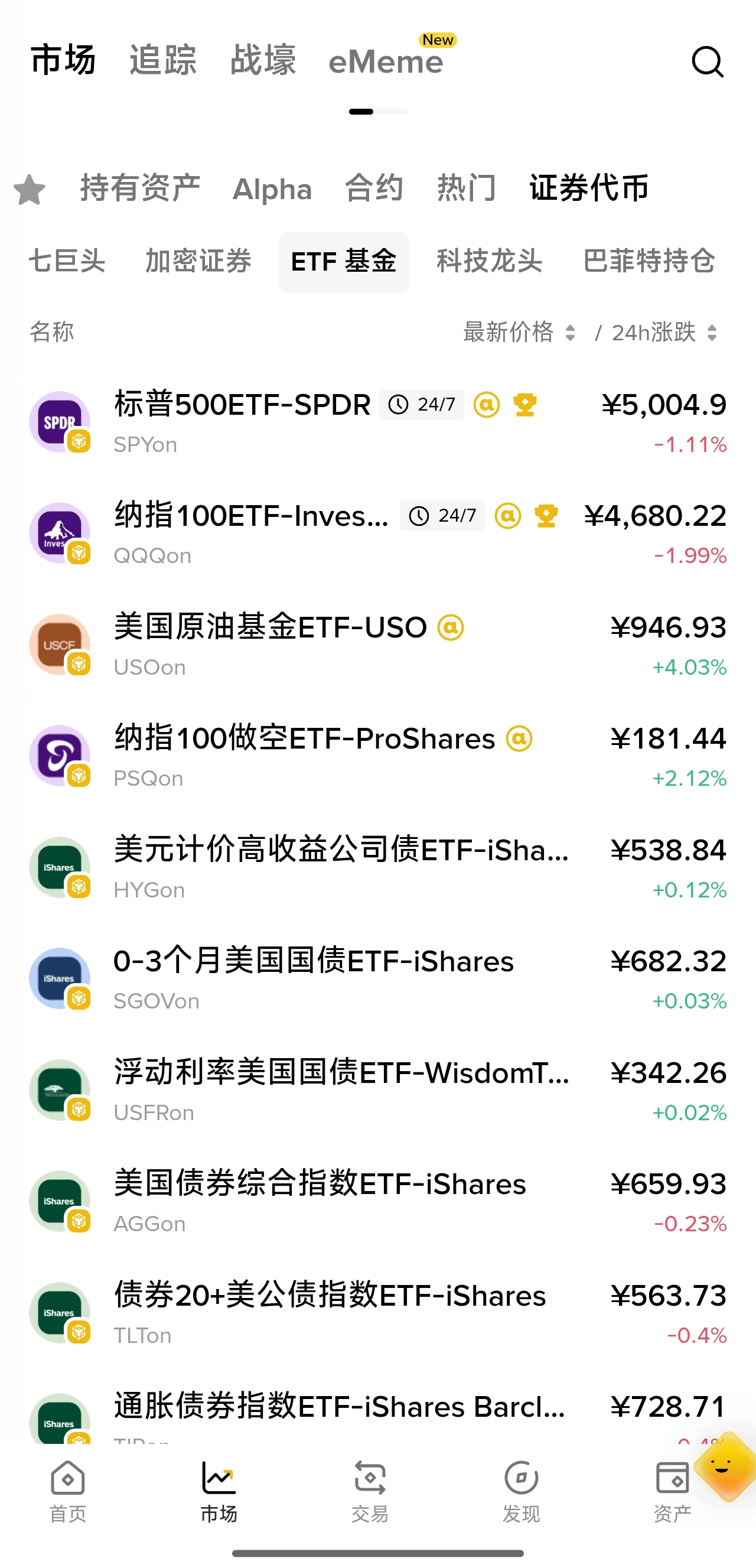
Build the fixed-income portion (40%): place funds into Binance stablecoin wealth-management, Launchpool, or other low-risk yield products. If there are tokenized U.S. Treasuries or bond-class RWA options, those can be prioritized.
Rebalancing: check once per year, or adjust whenever any category deviates from its target by more than 5%–10%. Since bStocks supports 24/7 trading, you can buy and sell anytime without waiting for U.S. market hours.
Monitoring and verification: use the Binance assets dashboard to track your ratios, and regularly review the 1:1 collateral proof page for bStocks.
Note: Currently, bStocks are mainly focused on technology growth stocks and some ETFs, so the stock portion is recommended to be actively diversified. On the fixed-income side, if there’s a lack of directly tradable long-term U.S. Treasury tokens, you can approximate with high-yield stablecoin products, and watch for changes in interest rates and risks.
III. Advantages and Return Expectations
Main advantages:
Growth and stability in balance: 60% equities provide upside potential, while 40% fixed income reduces volatility. The net value curve is typically smoother than an all-stock portfolio.
24/7 and high efficiency: bStocks supports 24/7 trading and instant settlement, so rebalancing can be done anytime. It can be self-custodied and used as margin without selling, significantly improving capital utilization.
Automatic dividend reinvestment: bStocks dividends (after tax) are automatically reflected into your holdings, making long-term compounding more seamless.
Composable across asset classes: you can easily layer DeFi yield or margin strategies, expanding the boundaries of the traditional 60/40 approach.
Simple and practical to execute: the ratios are clear, making it suitable as a core holding, with optional satellite strategies added on top.
Return expectations (based on historical data, not a commitment for the future): The classic long-term 60/40 portfolio’s annualized return is typically in the 7%–9% range (it varies across market cycles). Volatility is lower than a pure stock portfolio, and the maximum drawdown is generally controlled around 20%–30% (far better than pure equities).
On the bStocks on-chain version, the stock portion may slightly increase volatility and upside elasticity due to a tilt toward technology stocks. For the fixed-income side, if you use stablecoin wealth-management products, returns will be influenced by market interest rates. Adding DeFi or margin usage can raise overall returns, but it also increases risk. Expectations should still focus mainly on moderately steady returns with controllable drawdowns.#币安用户共创