


Author: Nikka / WolfDAO( X : @10xWolfdao )
Current Market Situation and Core Turning Points
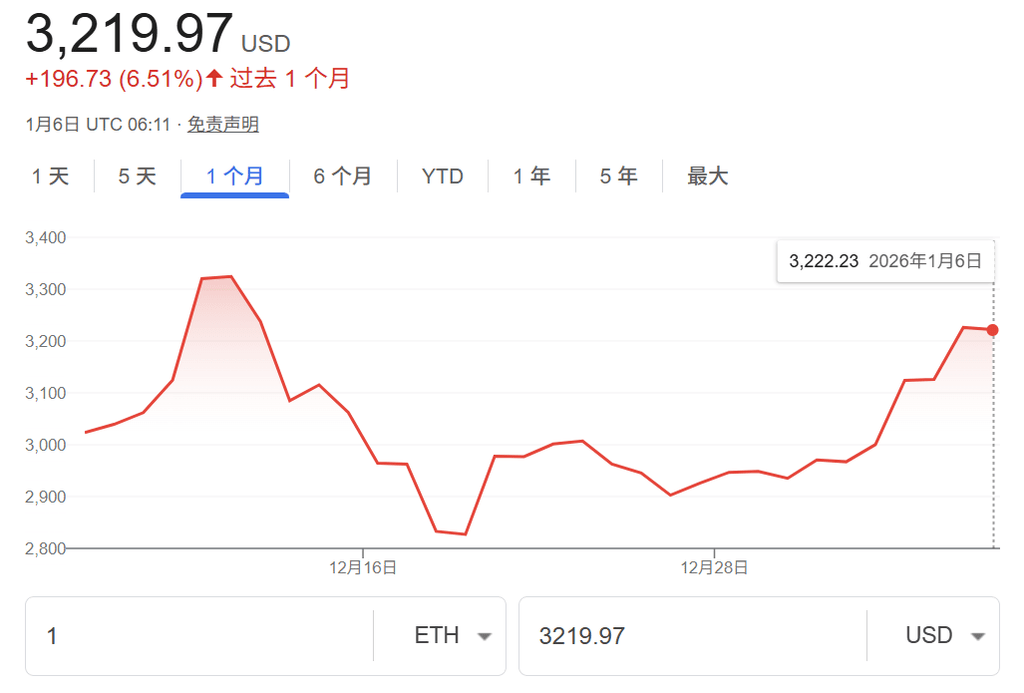
Entering 2026, the overall cryptocurrency market cap has returned to over $3 trillion, with Bitcoin's dominance briefly falling below 60%, sparking discussions in the market about the 'Competition Coin Peak Season'. Ethereum is at a critical turning point. In the short term, it has broken through $3,200, achieving a significant rebound compared to the low point at the end of 2025. Although there is still a 34% distance compared to the high point of $4,700 on September 2025, several early signals indicate that ETH may be brewing a structural market.
1. Staking Queue Reversal: Sell Pressure Significantly Decreased
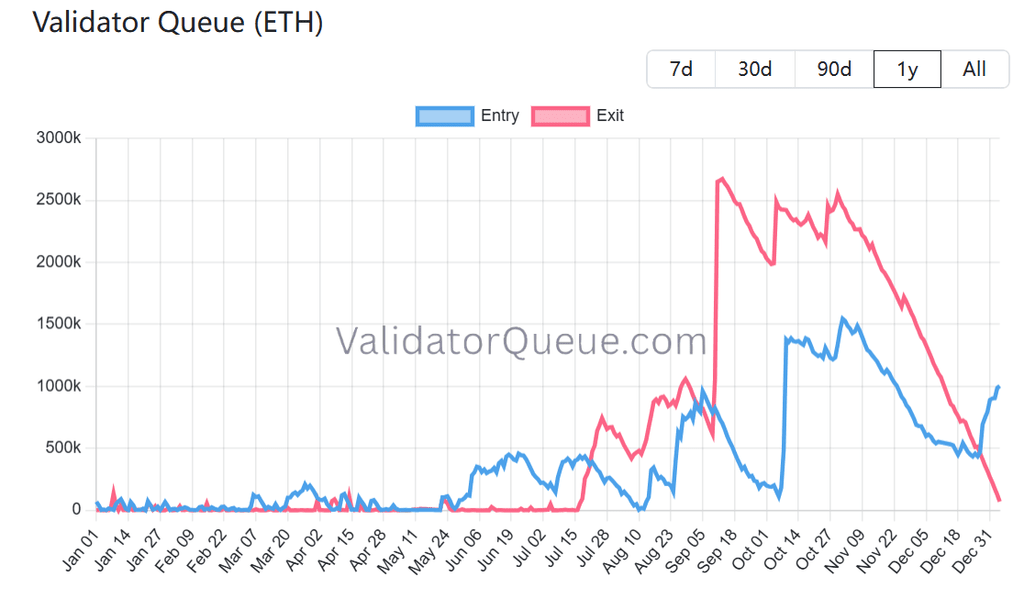
The most important catalyst for 2026 comes from the dramatic reversal in the staking queue. For the first time since July 2025, a 'shift in defense and offense' has occurred, marking a transition in investor confidence from withdrawal to locking in.
Specifically, when ETH price peaked around $4,700 in mid-September 2025, a cumulative 2.66 million ETH chose to exit staking, creating sustained selling pressure that lasted for months. After three and a half months of digestion, the current number of ETH waiting to exit is only about 80,000, meaning the source of selling pressure has largely disappeared. Meanwhile, the number of ETH waiting to enter staking has surged to 900,000–1 million, a 120% increase from 410,000 at the end of December. This figure is 15 times that of the exit queue, causing validator activation wait times to extend to 17 days.
Currently, the total staked ETH reaches 35.5 million, accounting for 28.91% of circulating supply, with annualized returns maintaining at 3-3.5%. Historical data shows that when the staking queue significantly outpaces the exit queue, it often signals an upcoming price increase. This supply lock-up will significantly reduce liquid ETH in the market, combined with whales continuously buying over $3.1 billion worth of ETH since July 2025, forming a strong foundation for upward momentum.
2. Institutional Entry: From Passive Holding to Active Participation
If staking reversal is a signal from the supply side, then the frenzy of institutional entry is the core driver from the demand side. The world's largest Ethereum treasury company, BitMine Immersion Technologies, is rewriting the rules. The company holds over 4.11 million ETH, accounting for 3.41% of total supply, but more importantly, it is shifting from 'passive holding' to 'active yield generation'.
In the past 8 days, BitMine has staked over 590,000 ETH, worth over $1.8 billion. On January 3 alone, it staked 82,560 ETH, worth approximately $259 million. The company plans to stake 5% of Ethereum's total supply through its own validator network, MAVAN, in the first quarter, with projected annual returns of $374 million. This aggressive move has not only increased the staking queue but also caused BMNR's stock price to surge by 14%.
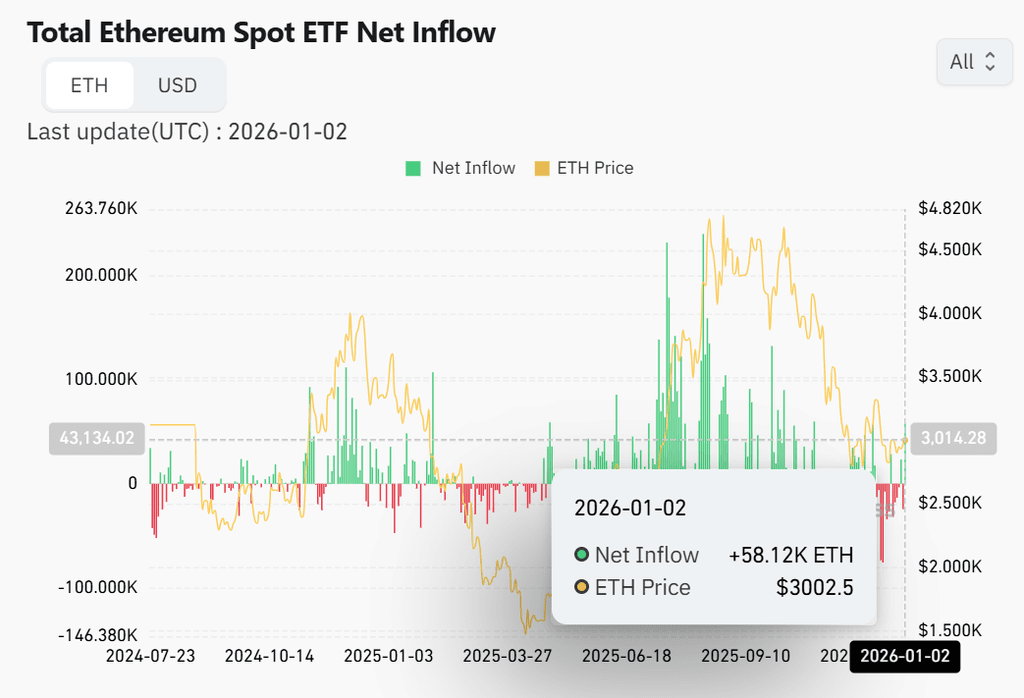
The broader institutional trend is equally remarkable. ETH spot ETFs saw cumulative inflows exceeding $9.6 billion in 2025, with total historical inflows surpassing $125 billion. In early 2026, single-day net inflows reached $1.74 billion. BlackRock's ETHA fund holds approximately 3 million ETH, valued at nearly $9 billion. Coinbase, Grayscale, and other institutions predict that 2026 will usher in the 'institutional era,' with more ETP products and on-chain vaults driving asset management scale to double.
At the same time, large on-chain holders accumulated over 10 million ETH in 2025, setting a historical high. These data collectively point to one fact: institutions no longer view ETH as purely speculative assets, but as infrastructure assets with yield potential.
3. Technological Upgrade: Evolving into a Global Settlement Layer
2025 was Ethereum's technological breakthrough year. The Pectra and Fusaka upgrades were successfully deployed, laying a solid foundation for further explosive growth in 2026. This is not just performance optimization, but a strategic transformation—positioning Ethereum as a high-throughput, low-cost global settlement layer.
The Pectra upgrade was completed in the first half of 2025. Its core breakthrough lies in EIP-7251, which increased the validator staking limit from 32 ETH to 2048 ETH, greatly facilitating large-scale institutional staking, while also increasing blob capacity, optimizing validator mechanisms, and reducing network congestion. This has cleared technical barriers for aggressive staking actions by companies like BitMine.
More importantly, the Fusaka upgrade. The upgrade, implemented in December 2025, introduced PeerDAS (Peer-to-Peer Data Availability Sampling), fundamentally changing how Layer 2 data is stored. Full nodes no longer need to download all blob data, theoretically enabling blob capacity to grow by more than 8 times, and Layer 2 fees are expected to drop by 40-90% in 2026. EIP-7892 allows dynamic adjustment of blob parameters in the future, enabling continuous scalability without hard forks—this is the institutional guarantee for long-term scalability.
The roadmap extending to 2026 is even more aggressive. The upcoming Glamsterdam upgrade will introduce Verkle Trees, enshrined proposer-builder separation (ePBS), and block-level access lists, pushing Layer 1 TPS beyond 12,000 and enhancing MEV extraction mechanisms, significantly improving network efficiency and revenue capture. These technological advancements are not theoretical—smart contract deployments and call counts have reached all-time highs, and on-chain activity has reached unprecedented levels.
4. RWA Dominance: The Monopolist of Trillion-Dollar Opportunities
Ethereum's dominance in real-world asset tokenization is becoming the strongest narrative engine for 2026. This is not self-congratulation within the crypto space, but a vote of confidence from traditional financial institutions with real money.
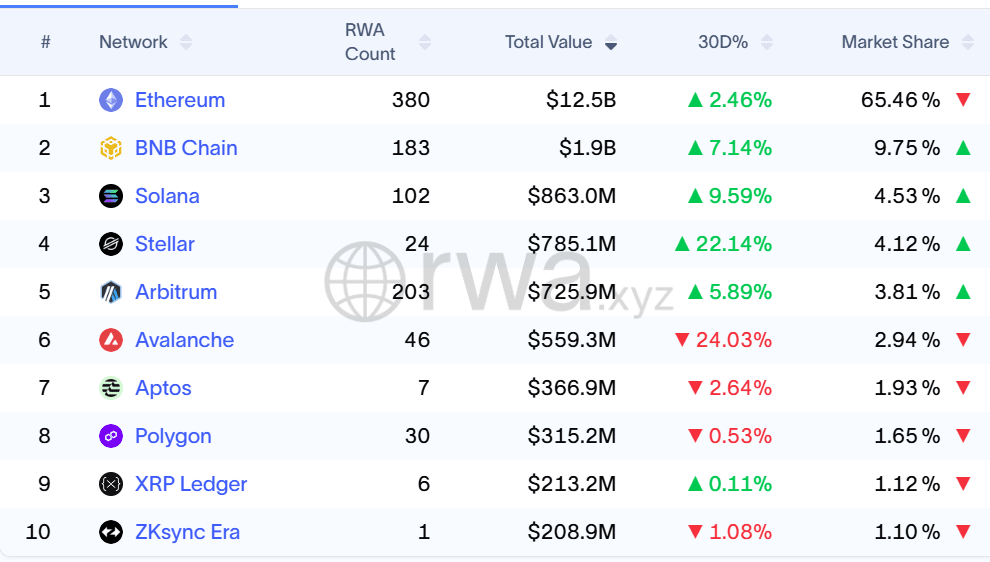
According to the latest data from RWA.xyz, on-chain tokenized assets on Ethereum have reached $12.5 billion in TVL, with a market share of 65.5%, far exceeding BNB Chain's $2 billion, and Solana and Arbitrum each below $1 billion. BlackRock, JPMorgan, and other Wall Street giants have massively tokenized government bonds, private credit, and fund products on-chain. In 2025, the RWA market grew by over 212%, with total scale surpassing $12.5 billion. Institutional surveys show that 76% of asset management firms plan to invest in tokenized assets before 2026.
Institutional forecasts predict the RWA market will expand more than 10-fold in 2026. Ethereum, as the most mature and secure settlement layer, will directly capture the vast majority of value from this trillion-dollar opportunity. The clarification of regulatory frameworks—especially the CLARITY Act and stablecoin bill expected to be implemented in the first half of the year—will further accelerate this process.
The stablecoin sector is also overwhelmingly dominated by Ethereum. Ethereum hosts over $62 billion in circulation, accounting for over 62%, and holds 68% of DeFi TVL. Institutional-level use cases such as B2B payments and cross-border settlements are accelerating their migration to the blockchain. Artemis reports that Ethereum stablecoin B2B payment volume has steadily grown between 2024 and 2025. This is not speculative capital, but genuine demand from the real economy.
Summary
Combining forces from supply, demand, and technology, Ethereum is highly likely to achieve a narrative shift from 'follower' to 'leader' in 2026. This will be a structural bull market driven by institutions, not a speculative frenzy fueled by retail sentiment.
For the E-guards who have endured hardship over the past few years, 2026 might be the year of redemption. However, patience and rationality remain essential in this brutal market.
(The above content is excerpted and republished with permission from partner PANews. Original link | Source: WolfDAO)
"From Technology to Institutions: A Complete Breakdown of Ethereum's 4 Major Turning Points in 2026" was originally published on (BlockC).