

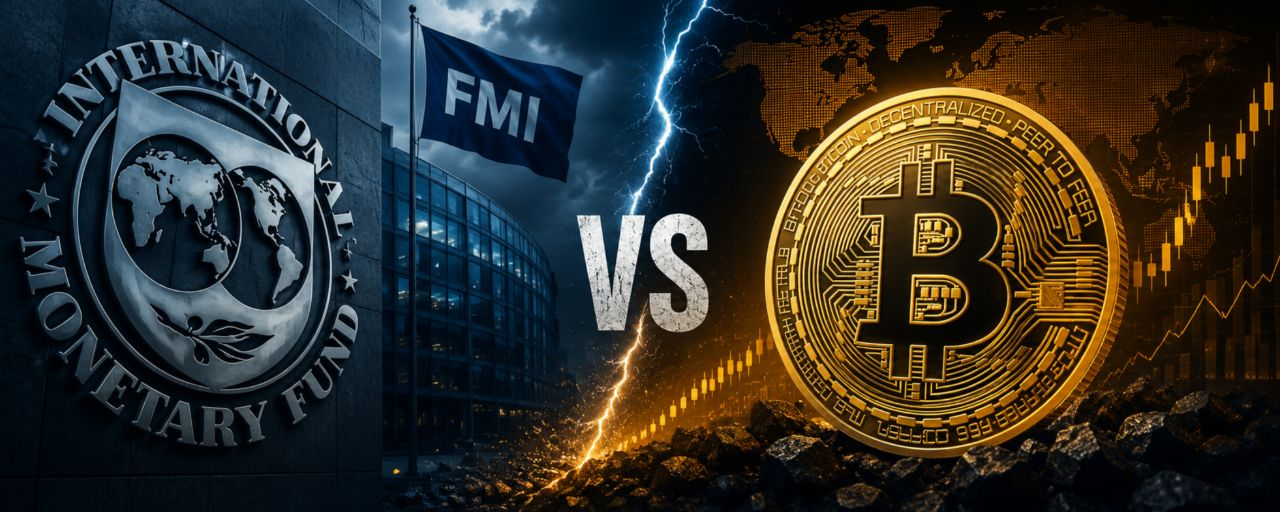

The International Monetary Fund (IMF) asked that the rules governing sovereign funds be updated—entities that manage nearly $16 trillion on behalf of different countries and, in some cases, have already begun to gain exposure to Bitcoin through regulated ETFs.
At first glance, it may seem like just another news item about regulation.
But in my view, the real message goes much further.
It’s not simply that the IMF mentions Bitcoin.
It’s about the fact that some of the institutions that manage the world’s largest capital can no longer ignore digital assets.
And that changes the conversation completely.
When I read the headline, I thought it would be another debate about restrictions or controls.
After going deeper into the report, I reached a different conclusion.
What’s really important isn’t regulation itself.
It’s that the world’s most conservative institutional money is already finding ways to gain exposure to Bitcoin through regulated financial products, while calling for clearer rules to keep moving forward.
But what are sovereign funds, and why do they matter?
Sovereign funds are investment vehicles managed by states.
They manage the wealth of entire countries, investing in stocks, bonds, infrastructure, tech companies, real estate, and other assets with a long-term horizon.
Together, they manage around $16 trillion.
To put that figure into perspective, we’re talking about a pool of capital capable of influencing entire markets.
So, each time these funds change how they invest, the rest of the financial system pays attention.
What the IMF really said:
Many headlines gave the impression that the IMF was talking directly about Bitcoin.
It wasn’t exactly like that.
The agency focused on the need to update the rules governing sovereign funds.
Their concerns revolve around issues such as transparency, governance, accountability, and the clarity of investment mandates.
As these funds participate in more complex and diversified markets, regulatory challenges also increase.
And that’s where Bitcoin comes into the picture.
Bitcoin is already part of the institutional conversation:
Some sovereign funds already have exposure to Bitcoin, mainly through regulated ETFs.
That detail matters.
We’re not seeing impulsive buying or speculative bets.
We’re seeing extremely conservative institutions using financial vehicles that comply with the existing regulatory frameworks.
That reflects a reality that, a few years ago, seemed hard to imagine.
Bitcoin stopped being an asset that only interested crypto ecosystem enthusiasts.
Today, it’s also part of the conversations among those who manage the wealth of entire countries.
Regulation no longer seems like the main obstacle:
For a long time, the debate revolved around one question.
Will institutions buy Bitcoin?
Now the question seems different.
What conditions do they need to increase that exposure?
The answer increasingly points toward legal certainty.
Large institutions usually prioritize clear rules over extraordinary opportunities.
They need to know how the assets are custodyed, how they’re reported, what legal responsibilities exist, and what level of oversight is in place.
The development of spot ETFs and other regulated products has reduced some of that uncertainty.
That’s why it’s not surprising that the IMF insists on strengthening regulatory frameworks.
What could come next:
That doesn’t mean we’ll see an immediate avalanche of buying by all sovereign funds tomorrow.
Institutional processes are slow.
Each decision usually goes through committees, audits, risk analysis, and multiple levels of approval.
But the direction of the conversation seems to have changed.
A few years ago, people were discussing whether Bitcoin had a future.
Today, the discussion is about how to integrate it into traditional financial structures safely.
That shift in narrative may be more important than any short-term price move.
What does this news leave us with?
Beyond the headline, I think this news offers an interesting lesson.
When the most conservative players in the financial system start asking for clear rules instead of rejecting a new asset class, it means the debate has evolved.
It’s not a guarantee that Bitcoin will go up.
It also doesn’t mean that all sovereign funds will invest.
But it does show that Bitcoin is no longer on the sidelines of global financial discussions.
And when an asset moves from being ignored to becoming part of the discussions among institutions that manage trillions of dollars, we’re probably looking at a new stage of market maturity.
More than asking ourselves whether institutions will come, maybe the right question is this:
What will happen when the rules they’ve been waiting for finally are on the table?