Putting that big pie as collateral on-chain—what exactly are we afraid of?
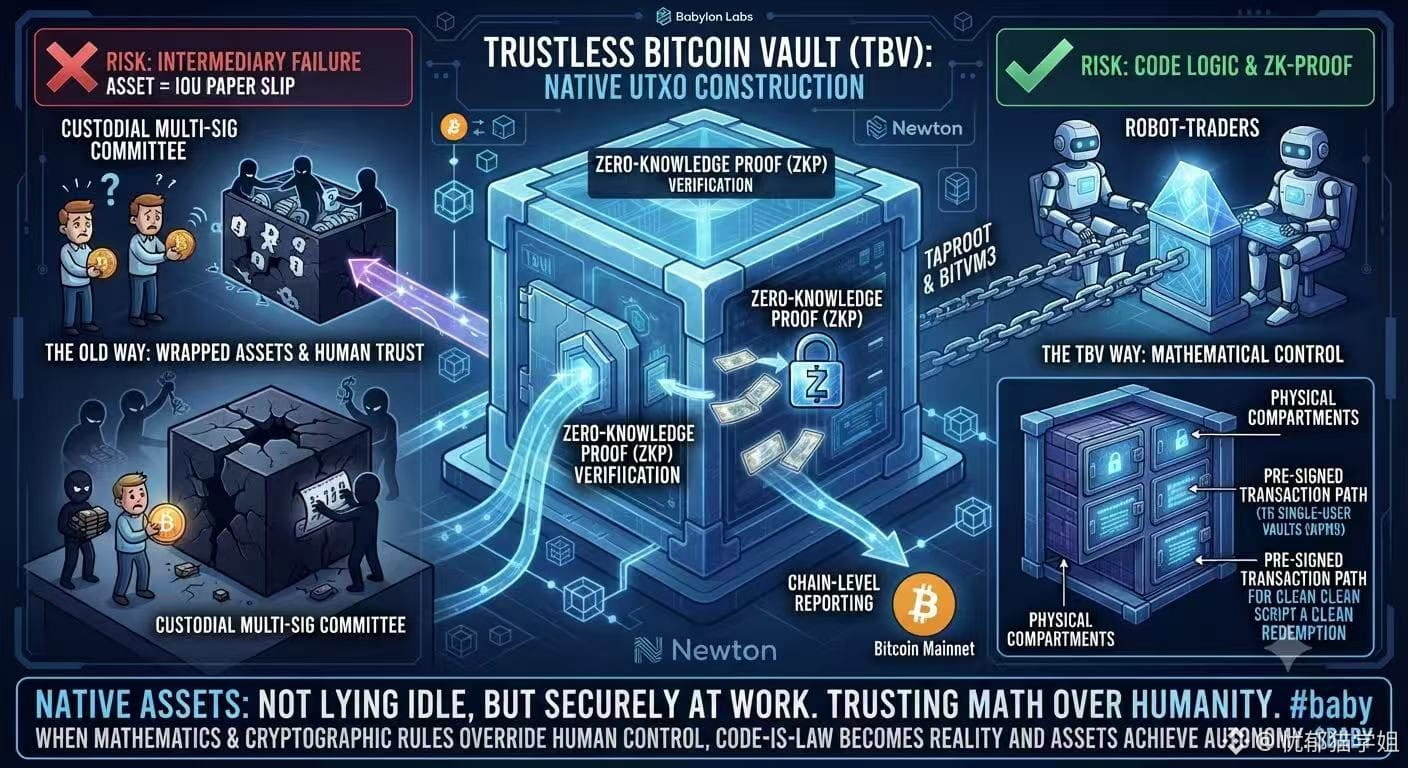
Stop talking to me about cross-chain bridges and wrapped assets. Every time I swap BTC into wBTC and use it for lending, my hands tremble when I sign. You think you hold the asset, but what you really hold is a piece of paper the custodian or a multisig committee hands you. If anything goes wrong with the middleman, your assets are gone in an instant.
Lately, I’ve carefully gone through the whitepaper of @BabylonLabs_io and the Trustless Bitcoin Vaults (TBV) mechanism. I realized everyone’s earlier path may have completely gone off course. TBV’s most hardcore technical innovation is that it doesn’t rely on the Bitcoin mainnet doing any far-off Covenant soft fork. Instead, it cleverly uses Taproot together with BitVM3 zero-knowledge proof verification to build a standalone vault directly in native UTXOs.
In plain terms, each Vault is like a single-user, single-locker physical compartment. The moment you and the protocol create the Vault, all possible liquidation and redemption routes (pre-signed transactions) are hard-coded with cryptography. The big pie never leaves the chain, never leaves the premises, and never mixes in pools. No matter how the off-chain Ethereum DeFi state changes, everything ultimately “settles” back to the Bitcoin mainnet to unlock via zero-knowledge proofs. This kind of operation that strips trust away from the “human committee” entirely and transfers it to “code logic” is, in technical design, indeed pragmatic enough.
But I still have to gripe: the mechanism kills the cross-chain bridge intermediary, yet pushes the risk entirely onto the off-chain protocol’s liquidation logic and the time-lock constraints. If an extreme market event triggers one-sided liquidity squeezing, or if the pre-signed redemption path contains a contract-logic vulnerability, the hard restrictions during the unbonding waiting period won’t make any exceptions just because the market crashes. Liquidity discount is still a cost users have to bear.
But in any case, the TBV that $BABY is bringing delivers a very profound lesson: native assets shouldn’t just sit in cold wallets rusting, and they shouldn’t compromise with centralized institutions just to chase yield. When mathematical formulas and cryptographic rules truly stand above human control, code is no longer an empty slogan—it’s truly law, and assets finally gain genuine autonomy that can cross trust barriers.
#baby $BABY
Stop talking to me about cross-chain bridges and wrapped assets. Every time I swap BTC into wBTC and use it for lending, my hands tremble when I sign. You think you hold the asset, but what you really hold is a piece of paper the custodian or a multisig committee hands you. If anything goes wrong with the middleman, your assets are gone in an instant.
Lately, I’ve carefully gone through the whitepaper of @BabylonLabs_io and the Trustless Bitcoin Vaults (TBV) mechanism. I realized everyone’s earlier path may have completely gone off course. TBV’s most hardcore technical innovation is that it doesn’t rely on the Bitcoin mainnet doing any far-off Covenant soft fork. Instead, it cleverly uses Taproot together with BitVM3 zero-knowledge proof verification to build a standalone vault directly in native UTXOs.
In plain terms, each Vault is like a single-user, single-locker physical compartment. The moment you and the protocol create the Vault, all possible liquidation and redemption routes (pre-signed transactions) are hard-coded with cryptography. The big pie never leaves the chain, never leaves the premises, and never mixes in pools. No matter how the off-chain Ethereum DeFi state changes, everything ultimately “settles” back to the Bitcoin mainnet to unlock via zero-knowledge proofs. This kind of operation that strips trust away from the “human committee” entirely and transfers it to “code logic” is, in technical design, indeed pragmatic enough.
But I still have to gripe: the mechanism kills the cross-chain bridge intermediary, yet pushes the risk entirely onto the off-chain protocol’s liquidation logic and the time-lock constraints. If an extreme market event triggers one-sided liquidity squeezing, or if the pre-signed redemption path contains a contract-logic vulnerability, the hard restrictions during the unbonding waiting period won’t make any exceptions just because the market crashes. Liquidity discount is still a cost users have to bear.
But in any case, the TBV that $BABY is bringing delivers a very profound lesson: native assets shouldn’t just sit in cold wallets rusting, and they shouldn’t compromise with centralized institutions just to chase yield. When mathematical formulas and cryptographic rules truly stand above human control, code is no longer an empty slogan—it’s truly law, and assets finally gain genuine autonomy that can cross trust barriers.
#baby $BABY