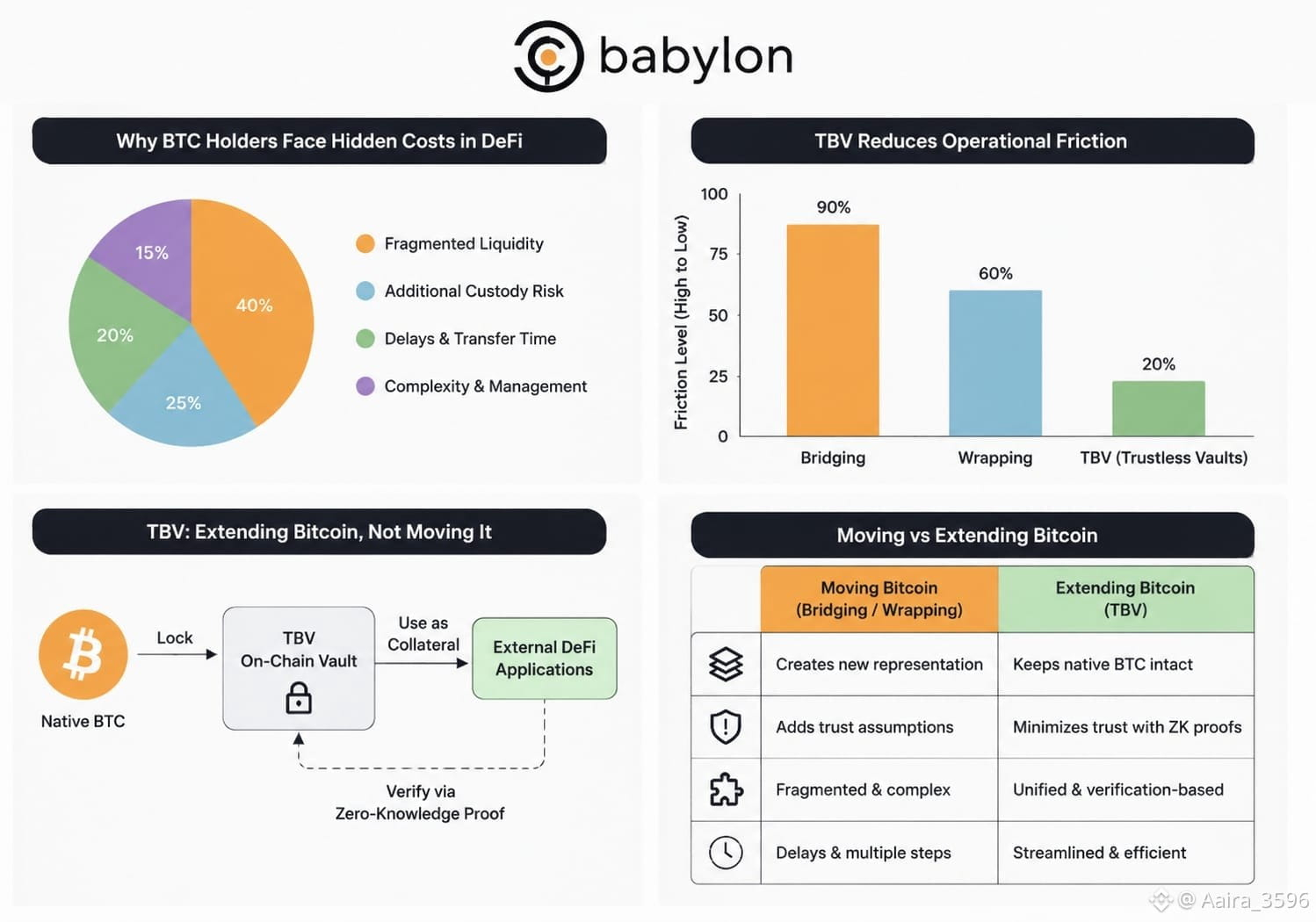
i believe the biggest hidden cost of moving Bitcoin into DeFi is not the transaction fee or the technology itself, but the complexity users inherit after leaving Bitcoin’s native environment. Every bridge, wrapped asset, and separate platform introduces new coordination points, fragmented liquidity, and additional custody assumptions.
The real challenge for BTC holders is not a lack of demand for utility. It is the difficult choice between maintaining self-custody and accessing productive opportunities. Many users end up splitting capital across different protocols, managing multiple positions, waiting for transfers, and accepting risks that do not come from Bitcoin itself.
Babylon’s Trustless Bitcoin Vaults (TBV) present a different framework. Instead of creating another representation of Bitcoin through wrapping, TBV focuses on enabling native BTC to remain under a self-custodial model while interacting with external financial systems. Users can lock BTC into on-chain vaults and use it as productive collateral, while withdrawals rely on verification of external smart contract states through zero-knowledge proofs.
The important distinction is between moving Bitcoin and extending Bitcoin. Wrapping and bridging often solve accessibility by creating additional layers around BTC. TBV aims to reduce that friction by creating a verification-based connection, where trust is minimized and the original asset remains central.
In my view, the long-term value proposition of @BabylonLabs_io is not simply increasing Bitcoin activity. It is creating a cleaner coordination layer between Bitcoin’s security principles and broader blockchain applications. However, the success of this model will depend on real adoption, security performance, and whether users find the experience meaningfully better than existing alternatives.
For me, the key question is whether trustless infrastructure can become the standard way Bitcoin participates in decentralized finance.
Could $BABY become a foundation for that transition, or will adoption remain the biggest challenge? #baby
The real challenge for BTC holders is not a lack of demand for utility. It is the difficult choice between maintaining self-custody and accessing productive opportunities. Many users end up splitting capital across different protocols, managing multiple positions, waiting for transfers, and accepting risks that do not come from Bitcoin itself.
Babylon’s Trustless Bitcoin Vaults (TBV) present a different framework. Instead of creating another representation of Bitcoin through wrapping, TBV focuses on enabling native BTC to remain under a self-custodial model while interacting with external financial systems. Users can lock BTC into on-chain vaults and use it as productive collateral, while withdrawals rely on verification of external smart contract states through zero-knowledge proofs.
The important distinction is between moving Bitcoin and extending Bitcoin. Wrapping and bridging often solve accessibility by creating additional layers around BTC. TBV aims to reduce that friction by creating a verification-based connection, where trust is minimized and the original asset remains central.
In my view, the long-term value proposition of @BabylonLabs_io is not simply increasing Bitcoin activity. It is creating a cleaner coordination layer between Bitcoin’s security principles and broader blockchain applications. However, the success of this model will depend on real adoption, security performance, and whether users find the experience meaningfully better than existing alternatives.
For me, the key question is whether trustless infrastructure can become the standard way Bitcoin participates in decentralized finance.
Could $BABY become a foundation for that transition, or will adoption remain the biggest challenge? #baby