


受益于人工智能赛道蓬勃发展,Stripe 迎来业绩大年。无论大型 AI 实验室,还是中小型开发团队,大多通过该公司完成交易支付。
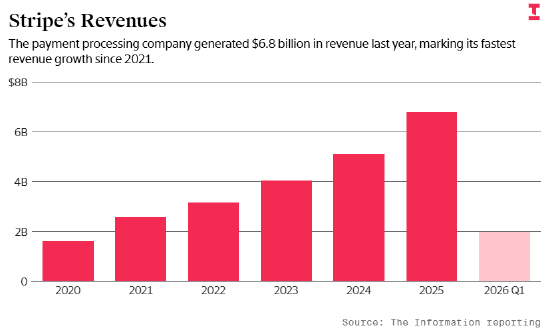
据了解公司财务数据的知情人士透露,这家支付巨头去年营收大涨三分之一,达到 68 亿美元,创下 2021 年以来最快营收增速。Stripe 现金流创造能力十分强劲,2025 年自由现金流飙升 52% 至 32 亿美元。充沛的现金储备,让公司敢于大举扩张业务边界。近期有报道称,Stripe 联合私募股权公司安宏资本(Advent International),给出 530 亿美元报价收购 PayPal。
Insiders say that in Q1 2026, Stripe revenue reached $2 billion. The company is aggressively pushing revenue diversification to reduce dependence on its payments-and-settlement core business, and has been rolling out value-added services such as bill management, invoice issuance, and automated tax solutions. Stripe said that the annualized revenue from these support businesses could exceed $1 billion in 2026.
The AI boom has brought benefits to Stripe: subscriptions and usage-based billing for leading AI companies such as OpenAI and Anthropic are processed through Stripe, and as AI vendors’ revenues surge, Stripe can take a cut in fees. Meanwhile, Stripe has already completed an acquisition to round out supporting services and further empower its AI payments business.
After a round of equity tender offer acquisitions was completed in February 2026, Stripe’s latest valuation stands at $159 billion. Earlier this year, the company spent about $1 billion to acquire Metronome, a usage-based billing service provider. AI billing rules are complex: user fees can change in real time based on usage, and tiered pricing is often required. Stripe said this acquisition will support the rollout of payment for all-category usage-based billing models, and that usage-based billing is a defining feature of the AI industry over the next decade.
Strong financial muscle gives Stripe the confidence to pursue more high-risk M&A initiatives. In recent months, many companies have started tightening their spending on AI technology. Stripe is also deeply tied to a fast-growing business model: using middleman platforms to route AI inference requests and allocate compute demand to model service providers with lower costs.
Several companies disclosed that earlier this year, OpenRouter, an AI model routing platform valued at $1.3 billion, chose Stripe to handle end-to-end services including payment settlement, invoice issuance, and tax management. Tech media outlet The Information reported last week that several large technology firms have already offered to acquire OpenRouter for billions of dollars, valuing it far higher than its valuation in the previous round of funding.
OpenRouter has a strong fit with Stripe: the platform charges AI end users, and on top of the fees users pay to the model providers, it can add a service fee of up to 5.5%.
Stripe launched an AI gateway service in March this year. Developers can call multiple major language models and analyze usage all in one place, making it easier to bill their own customers. Stripe product manager Miles M? Matthias posted on the social platform X, saying that at this stage, the AI gateway does not charge any additional fees and will also provide AI compute tokens to developers for free as an incentive. Other payment companies, such as travel expense payment provider Ramp, have also been rolling out similar AI gateway features.
At the same time, Stripe is moving into crypto payments, riding the wave of AI development. Last year, Stripe spent $1.1 billion to acquire the crypto startup Bridge, which can help businesses convert funds into stablecoins and handle stablecoin issuance and stablecoin payment clearing. Stripe also invested in Tempo, a public-chain project focused on stablecoin payments, in the same year. Recently, it teamed up with Visa, Mastercard, Coinbase, and others to become a founding member of the new stablecoin Open USD alliance.
Stripe believes that stablecoin payments for AI agents—small, frequent payment scenarios adapted to stablecoins—can be used to pay for services such as model calls and compute rental. They are more suitable for real-time small payments and can also support fully automatic machine-to-machine payments across software systems. Matthias said on the X platform that Stripe is developing an automated machine-to-machine payment function adapted to the AI gateway.
Stripe declined to comment on this report.
Acquiring PayPal: reshaping the global payments landscape
If the PayPal acquisition goes through, the overall landscape of the payments industry is likely to undergo major changes. In addition to its own digital wallet, PayPal also owns Venmo for merchants and Braintree, a backend payments service provider. This deal could help Stripe improve its profit margins over the long term and ease bargaining pressure from large customers.
In the early days, Stripe served a range of Silicon Valley startups such as Lovevery, Shopify, DoorDash, and others. Today, most of these customers have grown into industry giants, significantly strengthening their bargaining power. Many large customers have demanded lower transaction fees, while also splitting orders among multiple payment service providers such as Braintree, Adyen, and Worldpay. E-commerce giant Shopify added PayPal as a backend settlement channel two years ago.
Even if the overall deal value is $53 billion, Stripe’s actual cash outlay is likely far lower. Private equity firms are reportedly involved in the acquisition, and the transaction is likely to be structured with a mix of loan financing. Reports suggest that what Stripe truly values is certain high-quality assets owned by PayPal, such as Venmo, rather than taking over the entire company.
Insiders say Stripe has recently been focusing on adjusting transaction structures to reduce the share of credit card transactions as much as possible and encourage more orders to be processed via direct debit from bank accounts. This approach can lower credit card network clearing fees and interbank exchange fees, which have long been major cost items for Stripe’s payments business.
Stripe launched a financial connectivity product, Financial Connections, to compete with Plaid. It helps users securely link bank cards and allows businesses to authorize access to account information. At the same time, Stripe has built its own digital wallet, Stripe Link: it can be used to pay with credit cards, and it also supports direct bank connections for online checkout.
However, when it comes to consumer audiences, Stripe’s brand recognition is far weaker than that of PayPal Wallet and Venmo—both of which have vast numbers of individual users who have linked bank cards. This is also the core reason why PayPal’s consumer-focused spending business is so attractive to Stripe.
As of now, PayPal has not publicly responded to the acquisition offer. External speculation is that PayPal may seek to raise the acquisition bid, or choose to continue operating independently under its new CEO and turn around performance. PayPal will release its Q2 earnings report next Tuesday.