
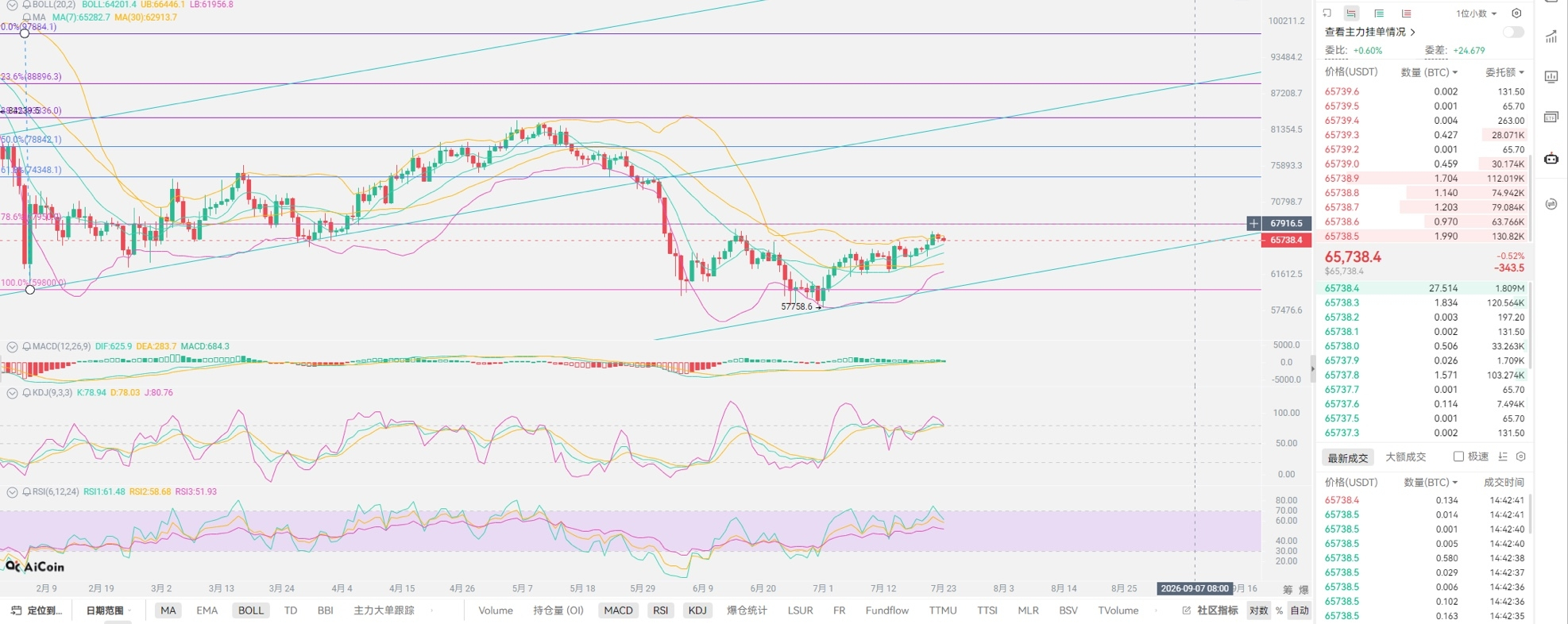

After we finished discussing the spot market trend yesterday, today I’ll talk about futures. First, determine yesterday’s spot situation. A major issue is that short-term capital is gathering slowly. Since there isn’t any large amount of capital likely to enter within the short term, then achieving a breakthrough-type行情 (a significant trend reversal/breakout) is definitely not something we can realize in the coming half month. In addition, Trump was reported yesterday to have brought up the risk that in September the U.S. may still face a government shutdown. This piece of news is very likely to push back the September rate cut. Even if a rate cut is decided in the short term, the timeline will likely shift later—at least the reversal is expected between 11 and 12 months. A year-end rate cut won’t do much to help the crypto market. As it’s also near year-end, more listed companies will only make their financial reports look even better; it’s not very realistic to expect big new investment. This year’s overall tone is largely concentrated between September and October. With no good行情 in these two months, for the crypto market, it’s essentially been a bear-market year. As for the biggest macro-level positive news, which I also mentioned yesterday—nothing more than the legislation in Russia and subsequent cooperation from South Korea. Everyone can take a careful look into that.
Many friends believe that Russia’s legislation is a huge advantage. Everyone should understand that Russia is in a dire situation and urgently needs crypto as a form of salvation. Foreign trade settlement relies almost entirely on digital currencies. The sanctions imposed by the U.S. have not ended, and the settlement methods are still mostly stablecoins, not Bitcoin. As for South Korea’s legislation, it also cannot be implemented before the U.S. bill takes effect in 2027. This avoids a lot of regulatory pressure from the U.S. side. The push from these small economic countries is not strong enough. For us, the biggest positive is waiting for the U.S. bill to be officially implemented. At least it will trigger a wave of market movement. Before that, there won’t be too much volatility—whether it rises or falls, it will not exceed a fluctuation of 20,000 points. Once the trend is confirmed, we need to rely on short-term price action. On the daily chart: today’s resistance level has shifted downward to around 67,916. Yesterday it was still near 68,000, which proves that the near-term bearish move is becoming more obvious.
Under conditions of extremely heavy resistance, it shows that the long-side participants’ capital is about to run out. There’s a high likelihood of a collapse occurring before the price even fully tests the resistance level. Of course, the support below remains solid—especially the 62,000 support from the earlier breakout point, which is quite clear. Someone will likely step in to buy the dip. For users looking to go long or short, it’s safest to execute trades as close as possible to the resistance and support levels. As for Ethereum, it is actually more resilient: the breakdown lacks sufficient force, and there is not much bearish intention. It’s only 42 points away from the strong resistance around 2,000, so the danger level is relatively high. With insufficient long-term momentum, a collapse or a breakout can happen in an instant. Compared with Bitcoin’s market behavior, the most likely scenario is a pullback to repair—especially since the 4-hour chart has not shown any clear repair trend. For the depth of the downward repair, first look below 1,900, and around 1,880. This is almost in line with Bitcoin’s move. Remember: don’t try to catch the deep drop on either of these. If you have profits, you need to retreat.