
PART.01
Breaking News Focus: Behind Chen Zhi's Repatriation, the Crypto Warning of the 15 Billion Bitcoin Confiscation Case
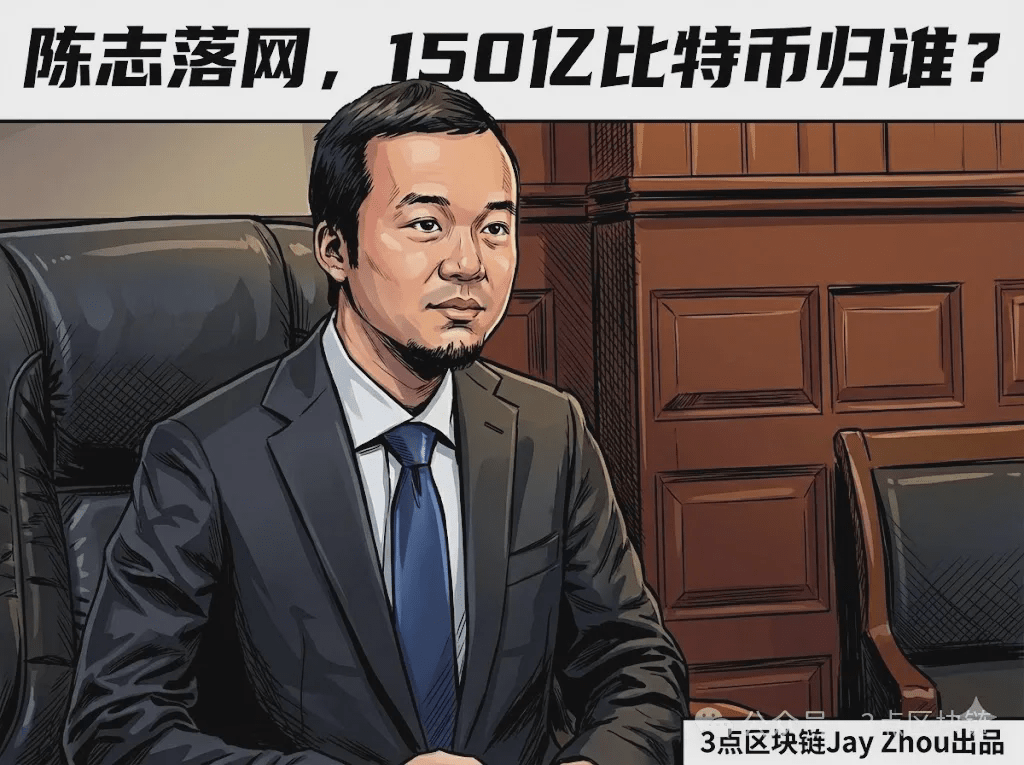
According to a report by the Cambodia China Times on January 7, 2026, Chen Zhi, a key figure in a transnational crime case whose $15 billion worth of Bitcoin was confiscated by the United States, was arrested in Cambodia and repatriated to China. This sudden news not only marks a critical stage in the investigation of cryptocurrency black money spanning multiple countries, but also sends a strong regulatory signal to the global cryptocurrency market that "cryptocurrencies are not above the law."
As the central figure in the largest cryptocurrency asset seizure case in U.S. judicial history, Chen Zhi's arrest will refocus market attention on cryptocurrency regulation and criminal risks.
The core story of the Chen Zhi case: From a telecom fraud empire to 15 billion Bitcoin in illicit funds.
Previously, I wrote an article titled "How Did the US Seize 120,000 Bitcoins Belonging to Chen Zhi, a Big Shot in the Industrial Park?", which garnered 400,000 views. Chen Zhi's business empire began in the internet cafe industry, a field deeply rooted in Lianjiang, Fujian, and his rise to power is heavily marked by the early gray market of the internet industry.
Chen Zhi was born in Xiao'ao Town, Lianjiang County, Fujian Province. He left home to make a living before graduating from middle school. After traveling to Guangdong, Jiangsu and other places, he finally settled down as a manager in an internet cafe.
At that time, in the early 2000s, the Internet in China was in its infancy. The rise of online games created a huge demand for Internet access. People from Lianjiang, with the advantage of family unity, were sweeping the Internet cafe industry across the country. At its peak, nearly half of the Internet cafes in the country were operated by people from Lianjiang, and in Shanghai, 70% to 80% of the Internet cafes were controlled by Lianjiang operators.
This industry background provided Chen Zhi with an excellent environment for starting his business.
After accumulating experience in internet cafe operation, Chen Zhi quickly jumped on the bandwagon of his hometown's "group opening of internet cafes" and opened his first internet cafe in a coastal city in China.
Unlike ordinary internet cafes that rely solely on internet access fees for profit, Chen Zhi astutely recognized the business opportunities in online games and established two core profit centers within his internet cafe:
First, they formed a professional "gold coin farmer" team to engage in power leveling services for popular online games such as (Legend). They would sell the accumulated game gold coins and equipment to European and American players and exchange them for foreign exchange to make a profit. At that time, this was a highly profitable gray industry with a monthly profit of 400,000 to 500,000 yuan.
Secondly, he used the traffic advantage of internet cafes to privately conduct data trading and operate pirated game private servers (illegal servers), among which the (Legend) private server allowed him to quickly accumulate his first pot of gold.
With his ruthless management style and precise entry into the gray industry, Chen Zhi's internet cafe business expanded rapidly. At its peak, he had established a chain of internet cafes in multiple cities, becoming a well-known internet cafe operator in the local area.
As his internet cafe business grew, Chen Zhi's business empire began to extend into the deeper gray areas of the internet.
He used the user data and connections he accumulated in internet cafes to establish dating websites and game-based social networking websites. On the surface, they were doing compliant business, but in reality, they were driving traffic to online fraud and online gambling activities. At the same time, he was involved in data transmission and the buying and selling of account information, laying the groundwork for the subsequent development of the telecommunications fraud industry.
During this period, Chen Zhi completed the dual accumulation of initial capital and criminal resources through the combination of "legal internet cafes + gray industry". His team also gradually evolved from the initial internet cafe management team into a gray industry gang with full-chain capabilities such as data acquisition, traffic promotion and fund settlement.
After 2008, domestic internet regulation gradually tightened: on the one hand, relevant departments intensified their crackdown on illegal internet cafes and pirated private servers, continuously squeezing the profit margins of the internet cafe industry; on the other hand, special campaigns against online fraud and gambling were launched one after another, putting Chen Zhi's gray business under tremendous survival pressure.
At this juncture, some Southeast Asian countries, driven by economic development needs, have adopted lenient regulatory policies for industries such as gambling and real estate, becoming a "safe haven" for domestic gray market operators.
Against this backdrop, Chen Zhi decisively abandoned his internet cafes and related businesses in China in 2009, and with his accumulated funds, team and criminal resources, he entered Cambodia, embarking on the path of building his transnational criminal empire.
In 2015, he founded Prince Group, using legitimate businesses such as real estate, finance, and energy as a shell to secretly build a top transnational criminal organization in Asia, operating illegal businesses such as "pig butchering scams" on a large scale through 10 telecom fraud parks.
The core of its criminal chain is to launder money by using the cross-border circulation and pseudo-anonymity of cryptocurrencies: fraudsters first lure victims into transferring money with false investment rhetoric, and then cut off the traceability of funds through cross-chain transfers of cryptocurrencies, thus "laundering" illegal gains.
In October 2025, the U.S. Department of Justice formally indicted Chen Zhi, accusing him of conspiracy to commit wire fraud and money laundering, and announced the confiscation of 127,271 bitcoins he held (worth $15 billion at the time, or about 107 billion yuan), setting a record for the largest seizure of crypto assets in U.S. judicial history.
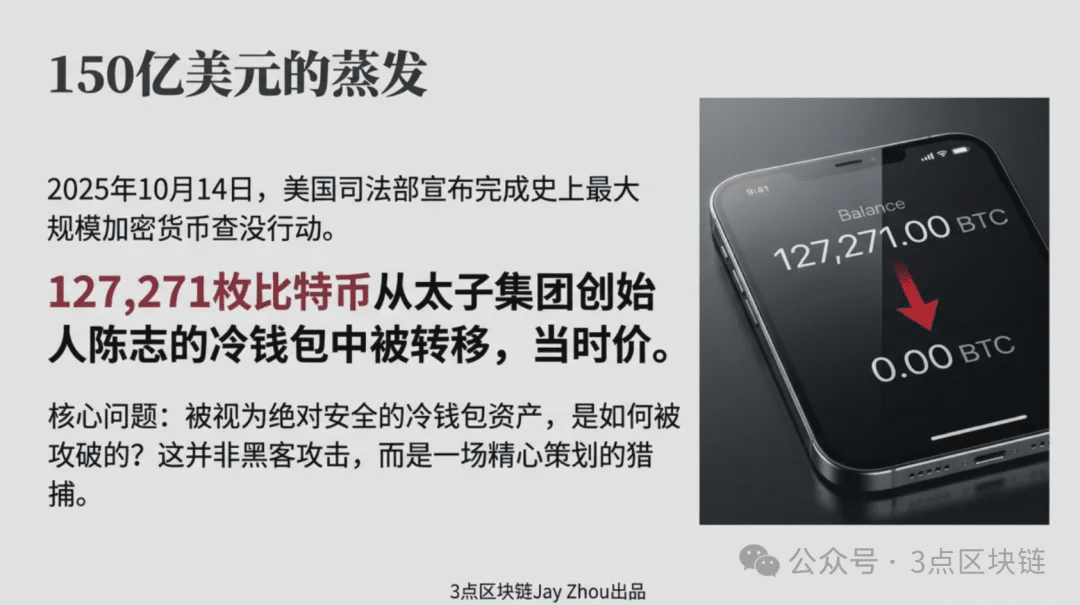 The key point is that the US authorities successfully obtained the Bitcoin private key by using a two-pronged approach of on-chain tracking technology and undercover infiltration. This operation completely shattered the market illusion of "cryptocurrency being anonymous and untraceable" and provided a reference for the technical evidence consolidation in subsequent cross-border asset recovery.
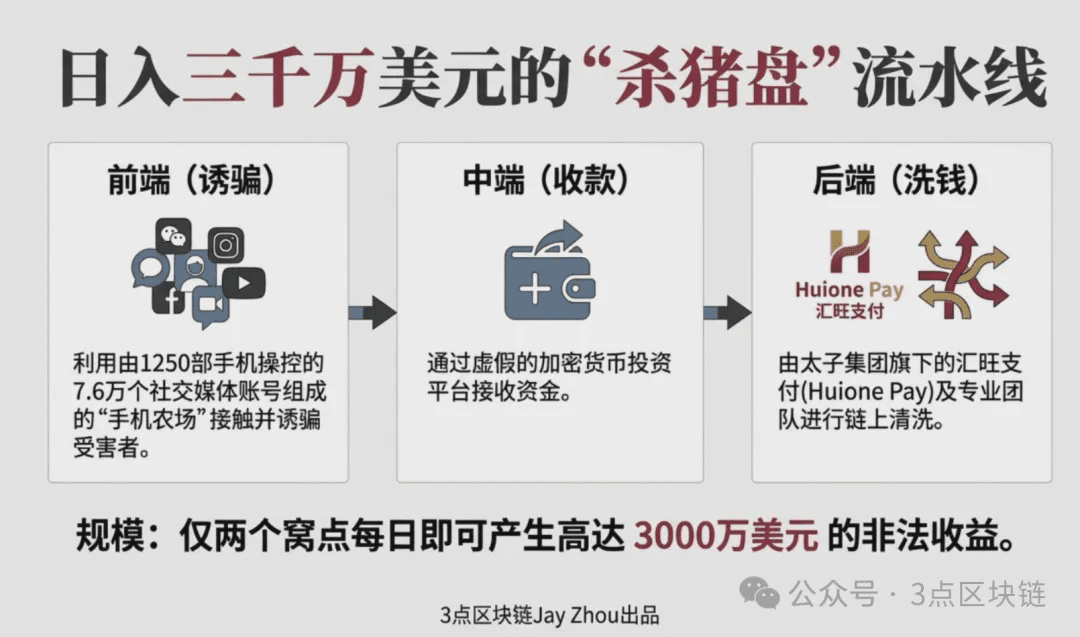
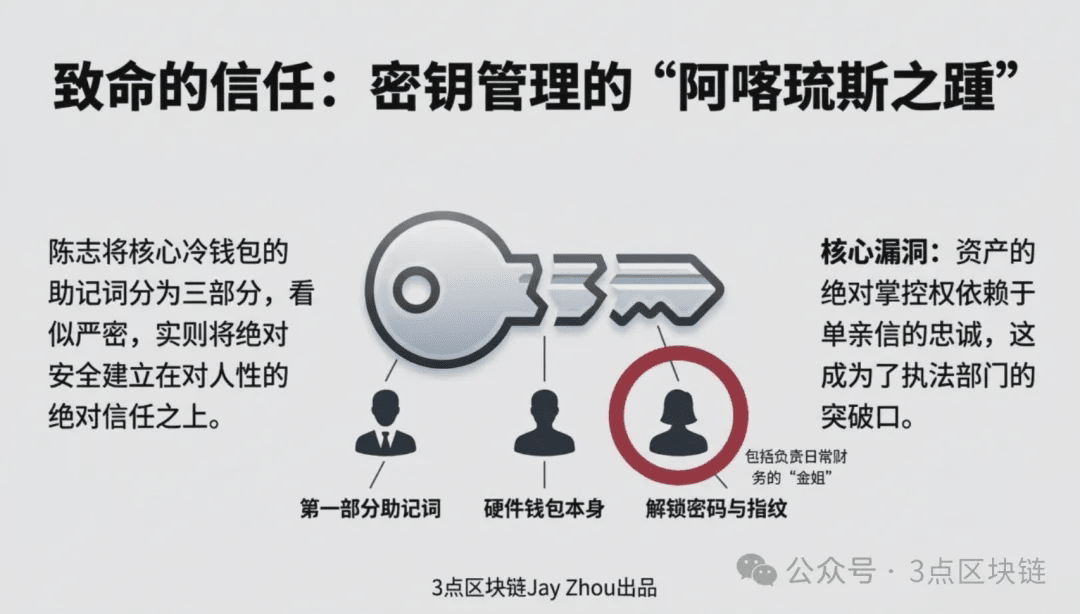
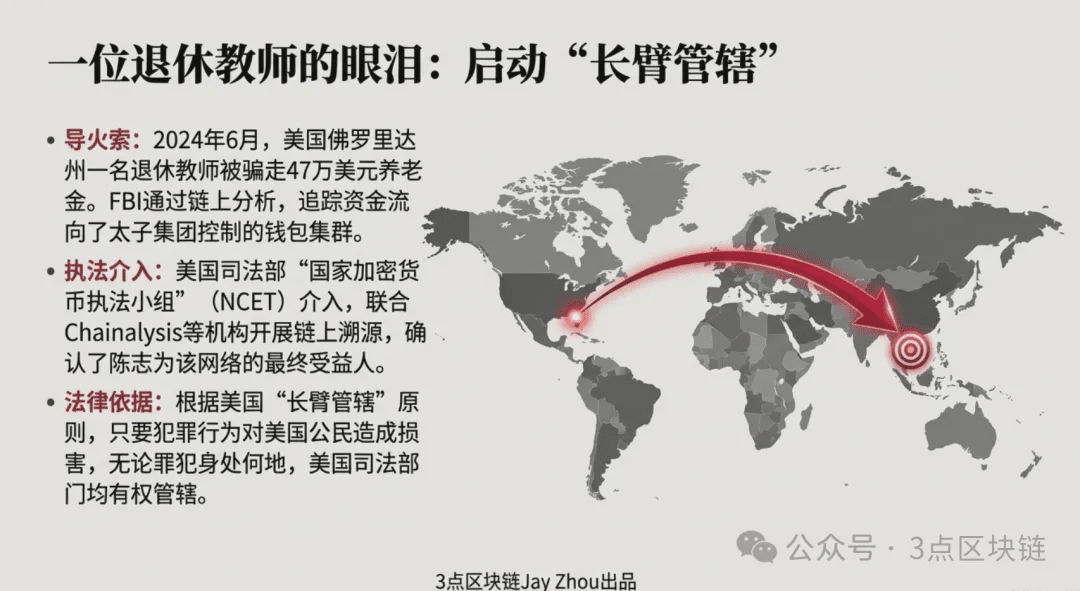
Under joint sanctions from the US, China, the UK, Singapore, Cambodia, and other countries, Chen Zhi's asset empire collapsed rapidly: Singapore froze his S$150 million assets (including real estate, yachts, and luxury cars), Hong Kong seized related properties such as office buildings in Tsim Sha Tsui and luxury homes on The Peak, and his core money laundering channel, "Huiwang Group," was also exposed as a hub for the flow of criminal funds.
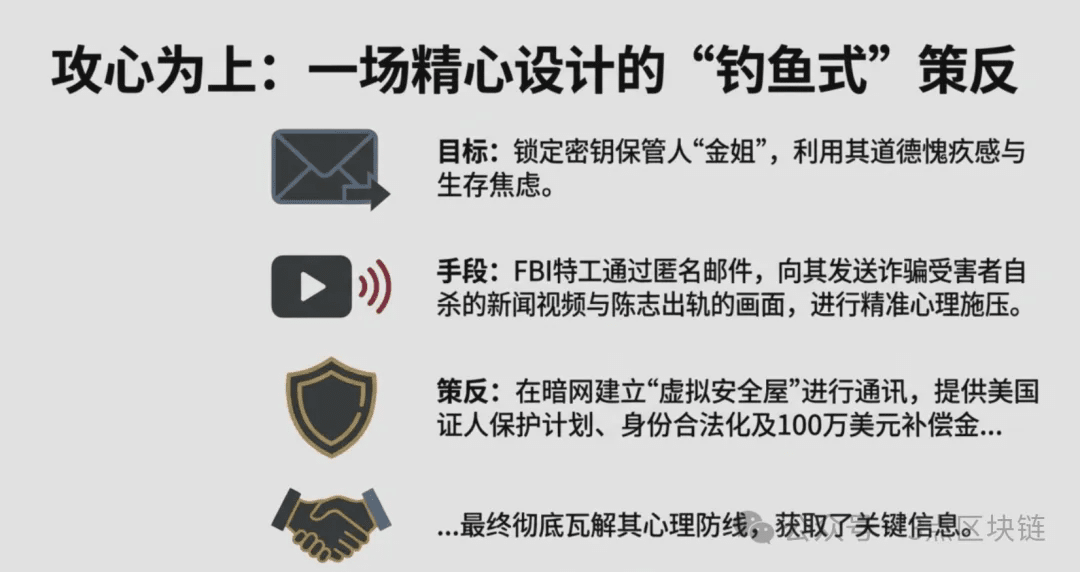
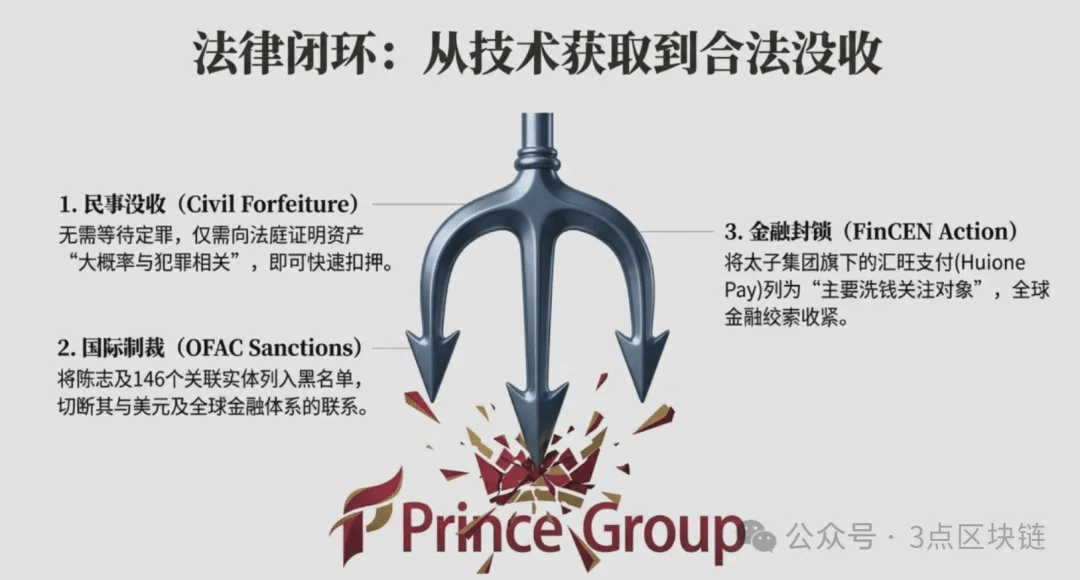
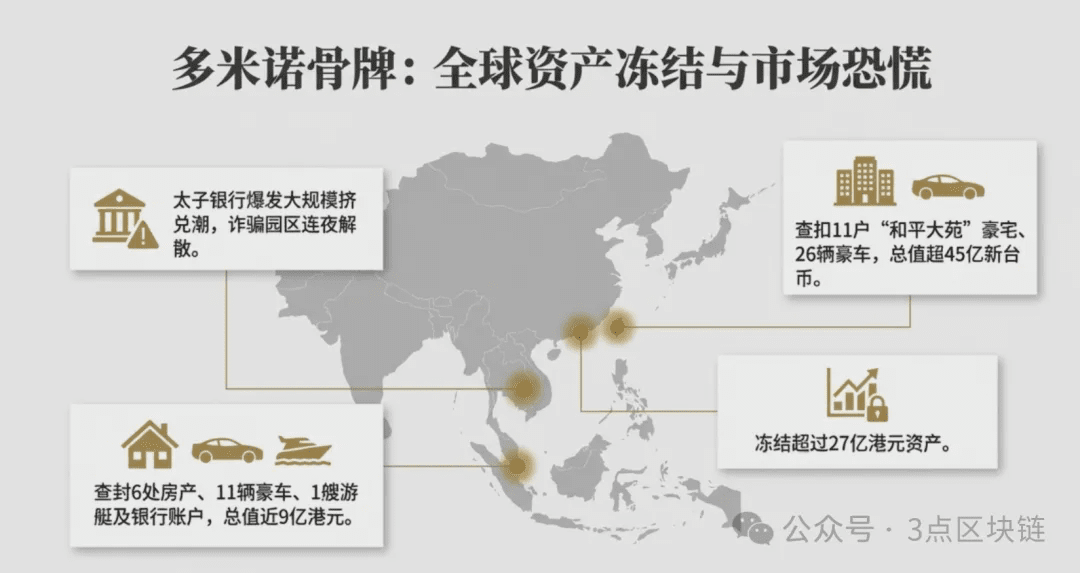
With this repatriation to China, the multinational investigation into cryptocurrency black money, which has lasted for several years, has finally reached a critical juncture.
PART.02
The core support for cross-border asset recovery: a three-pronged approach of judicial, collaborative, and technological means.
The cross-border ownership dispute over $15 billion worth of Bitcoin in the Chen Zhi case highlights the complexity of recovering stolen crypto assets.
Based on global experience in recovering stolen assets in similar cases, judicial confirmation of rights, international cooperation, and technological evidence are the three core pillars. Typical cases such as the embezzlement case of Feng in Beijing, the case of Yang Xiuzhu, one of the "100 Most Wanted Fugitives," and the Bitcoin fraud case of Qian Zhimin have provided mature and reusable practical experience for these three paths, and can also provide clear references for the subsequent cross-border asset recovery in the Chen Zhi case.
Judicial Confirmation of Ownership: The Legal Basis for the Recovery of Cryptocurrency Assets (Taking the Case of Feng's Embezzlement as an Example)
The prerequisite for cross-border asset recovery is to clarify the nature of the stolen funds in the case through domestic judicial procedures. This step directly determines the legality of the asset recovery claim and is also a key prerequisite for connecting subsequent international cooperation.
The embezzlement case of Feng in Beijing provides a precise model for the domestic judicial confirmation of ownership of crypto assets. The core commonality between this case and the Chen Zhi case lies in "converting illegal gains into crypto assets for concealment". After converting more than 140 million yuan of embezzled funds into cryptocurrency, Feng and others attempted to cut off the traceability link through an overseas "coin mixing" platform.
The procuratorate adopted a targeted "two-way penetrating review mechanism for cryptocurrencies and RMB" to accurately track the complete flow of funds from the accounts involved to cryptocurrency wallets. Ultimately, a criminal judgment clarified the illicit nature of the 92 Bitcoins involved and successfully recovered more than 89 million RMB in illicit funds.
The core logic of this domestic judicial confirmation of rights can be fully applied to the recovery of stolen assets in the Chen Zhi case: Chinese judicial authorities should first investigate Chen Zhi for "organizing and leading a telecommunications network fraud group" and "money laundering," focusing on establishing a complete chain of evidence that he used Bitcoin to launder stolen funds from domestic telecommunications fraud. Ultimately, a criminal judgment should be made to clarify the illegal nature of the 127,000 Bitcoins, laying a solid legal foundation for subsequent claims to the United States for asset return and promoting international cooperation.
International cooperation: a key approach to breaking down cross-border barriers (case studies of bilateral cooperation by Yang Xiuzhu and multilateral cooperation by Qian Zhimin)
The cross-border mobility of crypto assets dictates that transnational asset recovery must rely on international cooperation to overcome geographical barriers.
In practice, there are mature pathways for bilateral judicial assistance between China and the United States as well as multilateral cooperation among multiple countries. The bilateral cooperation model in the Yang Xiuzhu case can directly provide a reference for the China-US asset negotiation in the Chen Zhi case.
As the number one suspect on the "100 Most Wanted Fugitives" list, Yang Xiuzhu transferred a large amount of assets involved in the case while she was on the run in the United States. Through repeated consultations between China and the United States via the Joint Liaison Group on Law Enforcement Cooperation (JLG) mechanism, not only was Yang Xiuzhu repatriated to China to surrender, but the relevant assets involved in the case were also recovered based on the Treaty on Mutual Legal Assistance in Criminal Matters between China and the United States, which verified the feasibility of cooperation between China and the United States in the field of cross-border asset recovery.
The multilateral cooperation model in the Qian Zhimin case provided experience for the Chen Zhi case, which involved uniting multiple countries to strengthen the pursuit of asset recovery.
Qian Zhimin fled to the UK with 61,000 Bitcoins obtained through fraud. Through cross-border cooperation between Chinese and British law enforcement agencies, the suspect was first apprehended and sentenced overseas, and then the British side initiated civil recovery proceedings under the Proceeds of Crime Act, laying a crucial foundation for the return of the Bitcoins to the Chinese victims.
In light of the Chen Zhi case, the core logic of two collaborative models can be integrated: on the one hand, relying on the (China-US Treaty on Mutual Legal Assistance in Criminal Matters), a formal request for asset return was submitted to the US Department of Justice; on the other hand, in conjunction with multilateral institutions such as Interpol, the claim that "China is the country where the main victim is located" was strengthened to recover stolen assets, thus forming a collaborative force.
Technical Evidence: Solving the Problem of Traceability of Cryptographic Assets (Reusing Technical Experience from the Cases of Feng and Qian Zhimin)
Bitcoin's decentralized nature means that its ownership cannot be determined by traditional registration systems, but can only be verified through on-chain transaction traces. Technological means are the core support for solving this traceability problem.
This point has been fully verified in the cases of Feng and Qian Zhimin, and the technical approach used in those two cases can be directly reused in the case of Chen Zhi.
In the case of Feng, the procuratorate used blockchain big data analysis tools to trace the transfer path of the cryptocurrency involved in the case one by one, successfully establishing a real-name association between the virtual wallet address and the criminal, thus breaking the defendant's defense of "disguising the cryptocurrency." The technical tracking in the case of Qian Zhimin was even more targeted—after the British police seized Qian Zhimin's cryptocurrency wallet, they obtained the mnemonic phrase through data reconstruction and used professional on-chain analysis technology to trace the entire Bitcoin transaction record, ultimately accurately verifying that the source of the funds was the proceeds from his illegal absorption of public deposits in China.
Based on the actual circumstances of the Chen Zhi case, the technical experience gained from both cases can be directly applied: through professional on-chain analysis platforms such as Arkham Intelligence and Chainalysis, the entire chain of 127,000 Bitcoins involved in the case was traced, with a focus on verifying their connection with the flow of funds of domestic telecom fraud victims and frozen assets in Hong Kong and Taiwan, ultimately forming a complete chain of technical evidence of "victims' funds - fake investment platform - cryptocurrency wallet - Chen Zhi's actual control".
This chain of evidence not only strengthens the rigor of domestic judicial confirmation of rights, but also provides core technical support for Sino-US international cooperation, echoing the logic mentioned earlier that the US authorities solved cases through on-chain tracking.
PART.03
A stark warning for the crypto market: Compliance is inevitable under tightening regulations.
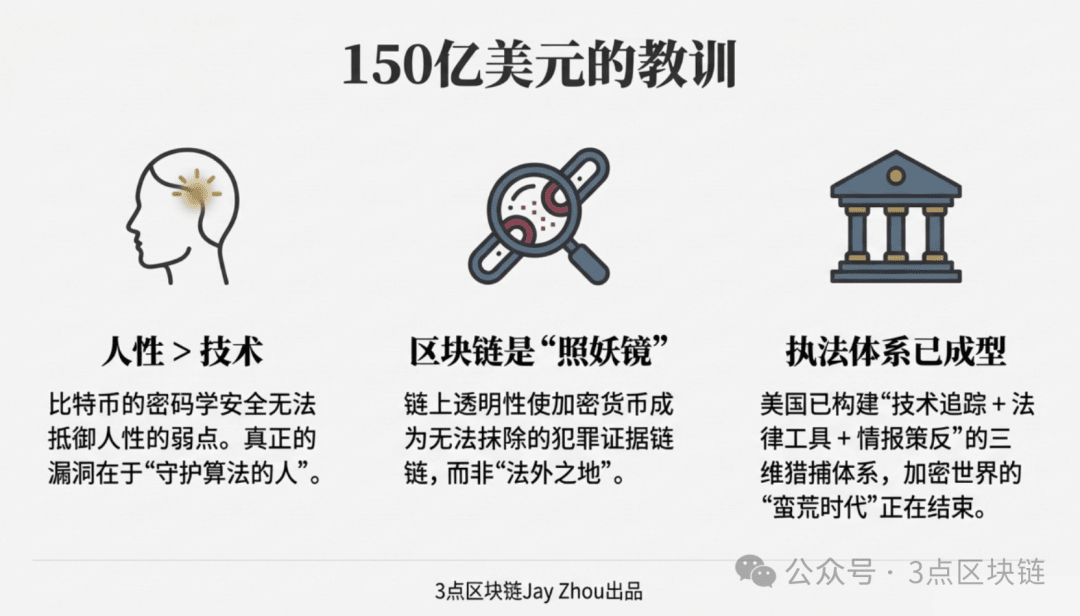
Looking back at the entire Chen Zhi case, and combining it with the common logic of the Feng Mou embezzlement case, the Yang Xiuzhu cross-border asset recovery case, and the Qian Zhimin Bitcoin fraud case, it is not difficult to find that the so-called "anonymity myth" of crypto assets has long been completely shattered by technological tracing and the combined efforts of global regulation.
Currently, the global encryption field is entering an era of strong regulation characterized by "standardized judicial confirmation of rights, normalized international cooperation, and widespread technology traceability." Compliance is not only an inevitable trend in market development, but also the bottom line for the survival of all participants.
Firstly, on-chain tracking technology has built a regulatory network that leaves no room for concealment.
From the US authorities' use of on-chain analysis to lock up 15 billion Bitcoins in the Chen Zhi case, to the blockchain big data penetration verification in the Feng case, and the wallet data recovery and full-chain tracing in the Qian Zhimin case, multiple cases have repeatedly proven that every cryptocurrency transaction leaves a permanent on-chain trace. Regulatory agencies have mature traceability capabilities, and any attempt to conceal illegal gains through crypto assets will eventually be exposed and cannot escape accountability. The perception of "anonymity and untraceability" is a thing of the past.
Secondly, cross-border regulatory collaboration has become a core force in curbing cross-border crypto crime.
The judicial assistance between China and the United States in the Yang Xiuzhu case, the cross-border relay between China and the United Kingdom in the Qian Zhimin case, and the joint sanctions and asset freezes by China, the United States, the United Kingdom and other countries in the Chen Zhi case, clearly outline the regulatory consensus that "cross-border crimes require cross-border joint governance".
As the global network for collaborative crypto regulatory cooperation continues to improve, the space for unilateral evasion of regulation will continue to narrow, and any transnational crypto crime group will face a high-pressure situation where it has "nowhere to hide".
Third, compliance is the only way for the crypto market to develop healthily.
The Chen Zhi case, involving asset disputes and judicial battles triggered by cryptocurrency money laundering, has once again reinforced the negative association between crypto assets and illegal activities, which will inevitably force countries to accelerate the improvement of their crypto regulatory frameworks and strengthen the regulatory responsibilities of platforms.
For ordinary investors, only by abandoning the wishful thinking of "speculation and profit-seeking," recognizing the regulatory trends of crypto assets, and proactively choosing compliant trading platforms and staying away from suspicious assets and gray-area businesses can they truly protect their own assets. For the industry, only by anchoring itself to the direction of compliant development and integrating into the mainstream regulatory system can it shed the label of "chaotic" and achieve long-term development.
Ultimately, the outcome of the Chen Zhi case is not just a dispute over the ownership of cross-border assets, but also a profound warning to the global crypto market—cryptocurrencies are by no means above the law, and only by respecting the rules and adhering to compliance can they achieve steady and long-term development.