
Recently, I came across an article stating that there are six stages to financial freedom, and 90% of people fall at the third stage. That stage isn't one hundred million, but 500,000.

I found it quite insightful. Indeed, I've seen many real-life examples around me, so I'm writing down my own understanding.
First, the devastating impact of the 'Middle-class Illusion' stage.
That article defines financial freedom into six stages. I've converted the currency to make it easier for everyone to understand.
They are: 10,000 (Desire Stage), 100,000 (Boredom Stage), 500,000 (Social Evaluation Stage), 1,000,000 (Investment Entry Stage), 3,000,000 (Social Class Moat Stage), and 10,000,000 (Time and Mental Freedom Stage).
Today, I'll first analyze the first three stages:
The gatekeeper of the first stage is short-term desire. He places the latest smartphone, trendiest clothes, and most popular restaurants right in front of you.
Many young people cannot resist short-term temptations—spending immediately upon receiving their salary, even resorting to living off their parents if they have no income.
They constantly complain about loneliness and boredom, love ordering takeout and dining out, spend money even when broke, and keep cats and dogs. Cat food alone costs hundreds per month, and a minor pet illness can cost hundreds or thousands. How can they possibly save money?
If you don't even have 10,000 in savings, don't dream about financial freedom—it has nothing to do with you.
The gatekeeper of the second stage is boredom. Going from 10,000 to 100,000 is a long and painful process, but even reaching 100,000 is still far from enough for buying a house, let alone achieving financial freedom.
At this moment, a voice in your mind whispers, 'Why work so hard? Just buy a Chanel bag, take a trip overseas, go skiing or scuba diving, or put down a deposit on an electric vehicle.'
Life may seem colorful, but cars depreciate immediately upon purchase, becoming worthless after 10 years. Additionally, there are ongoing insurance, parking fees, and mortgage payments if financed. Many people lose their first fortune right here.
The gatekeeper of the third stage is the middle-class illusion. The wealth threshold is 500,000—this is truly a slaughterhouse.
90% of people fail right here. Many people I know have fallen at this stage. Why?
At this point, you begin to feel like a wealthy person. You develop a middle-class illusion and start indulging: comparing with friends, family, and colleagues—Who bought a large apartment? Who switched to a luxury car? Who wears designer brands all the time? Who sends their kids to elite schools? Who travels abroad during holidays?
They start upgrading their homes, increasing spending, having their wives quit jobs, hiring several maids, sending their children to elite schools, hiring foreign tutors on weekends, and taking out large loans to buy luxury homes or school district properties.
They believe they are upgrading their lifestyle, and paying off mortgages is a responsible act for their children. In reality, this lifestyle is full of risks. In the event of unemployment, illness, or loan default, the seemingly perfect life can collapse at any moment.
Moreover, children raised this way lack resilience under pressure. They have grown up surrounded only by how to take and consume, not how to create wealth or contribute.
Generally, the middle class does not control the means of production. Children raised this way may find that the cost of their upbringing far exceeds their future earnings, making the risk of relying on their parents later very high.
II. How can ordinary people protect their wealth?
Through the above cases, it precisely identifies that the real enemy at each stage is not the market, but our own desires, vanity, boredom, comparison, and arrogance—rooted in raw human nature.
The hard-earned results may ironically become the starting point of wealth loss.
This phenomenon brings multiple lessons and insights:
On one hand, psychologically, one must restrain desires and safeguard their wealth.
The essence of wealth accumulation is anti-human nature. One must overcome instinctive desires, boredom, vanity, and greed.
To cultivate your ability to delay gratification and self-restraint, when you gain the power to control the inner demon of 'I deserve a better life,' you will have entered a truly mature stage of life.
On the other hand, real wealth growth begins with account numbers and is achieved through mental maturity.
For a family, true financial security comes from your financial literacy and the continuous improvement of your financial knowledge and capabilities.
By systematically learning financial knowledge and building a cognitive system commensurate with your wealth level, you can remain clear-minded in the face of temptation, respectful toward risks, and steadfast amid market fluctuations.
Take this year's market performance as an example: although the market has been strong and the Shanghai Index has risen above 4,000, if one cannot effectively improve their own cognition to identify truly high-quality investment opportunities and suitable investment strategies, and instead relies solely on luck and rumors to chase gains and cut losses, most people will eventually lose money.
III. What products should be considered?
For ordinary people, establishing a scientific asset allocation is a crucial part of a sound financial system. Diversifying through investments in public mutual funds, large-denomination certificates of deposit, government bonds, etc., helps reduce risk and avoid concentrating in high-risk areas.
The products introduced last month, such as the Chemicals ETF (516020), have performed well, and many have asked me about other products worth recommending.
Personally, I suggest keeping an eye on the Hong Kong Information Technology ETF (159131). It is the first and currently the only index product in the market focusing exclusively on the 'Hong Kong semiconductor' industry chain. $Hong Kong Information Technology ETF (SZ159131)$
It tracks the CSI Hong Kong Connect Information Technology Composite Index (930967), with the following major holdings:
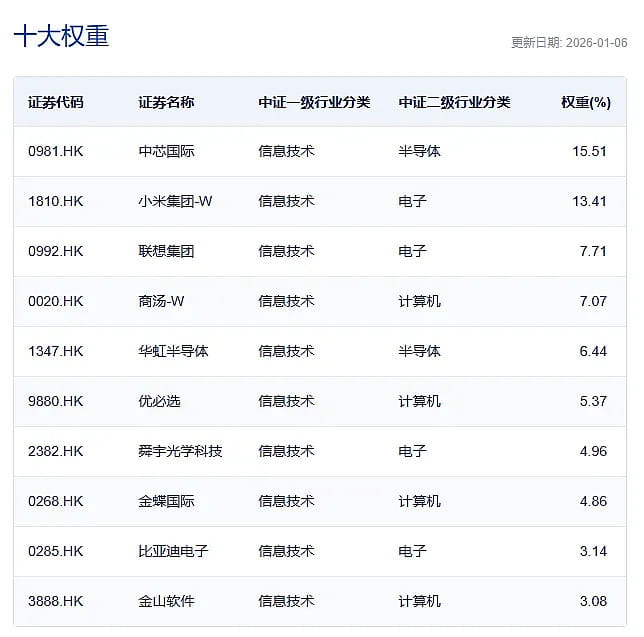
Data source: CSI Index Company, as of 2026.1.06. The constituent stocks of the index are for demonstration purposes only and do not constitute any form of investment advice, nor do they represent the holdings or trading activities of any fund managed by the company.
Key features of this product:
1. Focus on Technological Edge: Heavily weighted in Hong Kong's 'semiconductors + electronics + computer software,' excluding large-cap internet companies such as Alibaba, Tencent, and Meituan.
2. High Concentration in Top 10: The top five constituents account for 50% of the index, and the top ten make up 71%, capturing growth opportunities from leading companies.
3. Leading Returns: Since the end of 2022, the index has achieved an annualized return of 20.23%, significantly outperforming other tech indices such as the Hong Kong Connect Tech Index and the Hang Seng Tech Index.
4. Valuation Discount: The index valuation is significantly lower than major global tech indices such as the ChiNext Index and the Nasdaq 100, placing it in a global valuation discount zone.
Data source: Wind, CSI Index Company. Historical return statistics period: December 30, 2022 – November 30, 2025. The annual returns of the Hong Kong Connect Information Technology C Index over the past five full years are as follows: 2020, +45.54%; 2021, -9.54%; 2022, -34.47%; 2023, -0.25%; 2024, +21.58%. Past performance does not guarantee future results.
Such products combine future growth potential and imagination in the industry with valuation advantages. Those interested are encouraged to take a closer look.
Additionally, it should be noted that funds focused on the semiconductor sector often experience significant fluctuations in financial performance and market prices. They are relatively suitable for investors who prefer technology-driven growth, seek higher returns, and have a higher risk tolerance; or as a more aggressive component within a diversified portfolio.
Risk Warning: Funds involve risks; there is no guarantee that principal will not be lost or that profits will be made. The views expressed are solely those of the author and do not represent the position of the fund company. The content is for research and learning purposes only and does not constitute any investment advice regarding stocks, funds, or other securities. Investing involves risk; choices must be made carefully. Investors bear all risks and consequences of their investment actions.