
Cailian News Agency, July 22 (Reporter Wu Weiling): Global well-known membership-based warehouse retailer Costco (Kaishike) officially announced a partnership with JD.com today. In addition, in the recent period, Hema upgraded the traffic entry points of the Taobao app, moving from the Taobao Flash Purchase (Taobao Shanguo) section to the first screen of the Taobao app homepage. Industry analysts told Cailian News Agency’s reporter that the nearly synchronized traffic moves by the two retail giants are not coincidental; rather, real-time retail competition has moved from a race against speed to a new turning point where it is about competing for exclusivity of supply and the depth of scenario integration.
According to JD’s Blackboard News, today at the market opening, JD.com reached a cooperation with Kaishike, and JD became Kaishike’s only official e-commerce partner in China.
Relying on JD’s super supply chain, Costco’s product delivery range has expanded beyond the original service coverage for local-city shopping, covering mainland China. In some cities, the fastest delivery can reach same-day. Meanwhile, Costco e-commerce has not set any membership threshold; non-members can purchase directly. However, the non-member price is about 20% higher than the member price.
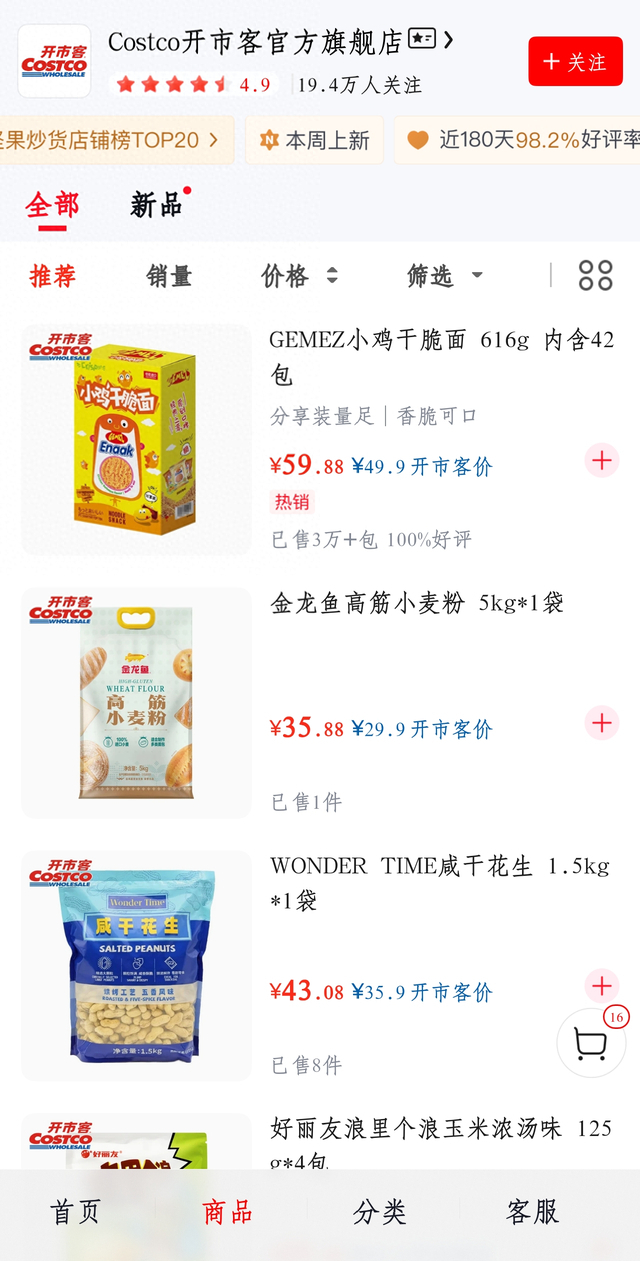
JD has stated that Costco’s official flagship store offers about 700 SKUs, covering core categories such as leisure snacks, grain-oil-condiments, and household cleaning and personal care. Since the store began a one-month trial operation, its number of visitors has exceeded 30 million. Costco’s private brand Kirkland has received widespread attention from consumers. Among them, Kirkland nuts have sold out multiple times, with sales exceeding 10,000 units.
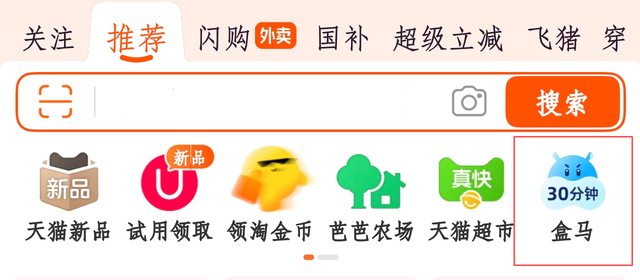
While JD is rolling out its cooperation with Costco, the Alibaba side is also integrating Hema. According to reports from multiple media outlets, in recent days, users in various places including Beijing, Shanghai, and Sichuan have found that Hema has obtained top-level traffic entry points on the first screen of the Taobao app homepage in multiple locations. Previously, Hema’s traffic entry on Taobao was placed under the Taobao Flash Purchase section, rather than on the first screen of the Taobao homepage.
Industry analysts believe that the traffic moves by Costco and Hema—nearly synchronized—are not a coincidence. “This is a clear turning point in instant retail, evolving from ‘competing on delivery speed’ to ‘competing on exclusive supply and the depth of scenario integration.’” Zhuang Shuai, founder of Bailian Consulting and a senior expert in retail e-commerce, told Caixin Media that the giants are no longer competing for rider speed; the competition focus has shifted comprehensively from fulfillment efficiency to the ability to coordinate supply-chain barriers with traffic ecosystem capabilities.
Although both JD and Alibaba are vying to build supply-chain barriers and capture traffic entry points, their path choices each have different emphases. JD cooperates with Costco in an “outward expansion” approach, introducing high-end supermarket supply, while Taobao focuses on cultivating its own ecosystem, using Hema to strengthen instant supply in the fresh-commodities category.
Each of the two paths has its own strengths and weaknesses. Zhuang Shuai, in an analysis for a Caixin Media reporter, said that JD improves supply coverage for mid-to-high-end supermarkets by bringing in Costco. At the same time, its self-operated Qixing (7 Fresh) goes head-to-head with Hema in the fresh-commodities arena, forming a two-pronged encirclement: “bringing in high-end brands from outside + planting self-operated fresh produce from within.” Alibaba, meanwhile, focuses its firepower on using Hema as a core output for the fresh-commodities category.
“JD’s advantage lies in its flexible category mix and large room for traffic synergy, but its shortcoming is that Costco’s profit and inventory control are not in its own hands. In addition, there are also in-house competition and resource allocation challenges between Fresh Hema and Costco. Alibaba’s advantage is strong end-to-end quality control across Hema and deep mastery of gross margin, but its expansion across categories and the high cost of scaling are severe.” Zhuang Shuai’s analysis says that overall, both are essentially paths from “platform aggregation” to “vertical deep cultivation.” In the short term, JD has stronger elasticity, while in the long term Alibaba’s stickiness is more stable. But both have to answer the same compulsory question: how to efficiently coordinate their own supply with external brands.”
(Caixin Media reporter Wu Weiling)