
Both companies are storage-chip heavyweights—their stocks both went through the roof, then crashed to earth. But Micron holds “true scarcity” (the piece of the puzzle AI needs most). SNDK makes “cycle money” (the price hike windfall when the whole industry is short). Who to buy depends on how long you think NAND can keep rising.
Don’t rush to look at the companies yet—first, let’s clarify what “storage chips” are all about.
A lot of people get overwhelmed the moment they hear HBM, NAND, or DRAM. Actually, just think of them as three kinds of “houses”:
HBM = a luxury mansion in the prime downtown area. Only three companies worldwide can make it. The technology is extremely difficult, and orders are already booked out through 2028—so it’s sold out before you even get a chance. This is the real, in-demand commodity—you can’t just buy it because you feel like it.
DRAM is a bit skewed but still very tight—like a “prime school-district home.” It’s mainly used in AI servers. Because HBM is so in demand, it hogs factory capacity, so DRAM production also ends up tight.
NAND is like ordinary “mass-volume apartments”—it’s storage chips used in your phone, computer, and data-center hard drives. It isn’t inherently scarce. But because the first two products are so in demand, factories allocate capacity to them; plus, the entire industry cut production earlier. As a result, it ends up creating a “temporary shortage.” And this shortage cycles over time.
Remember this analogy, and the rest will be easy to understand.
Two companies on different floors
SanDisk (US stock ticker SNDK): a “pure NAND fab” spun out of Western Digital in 2025. It sells only NAND (the “ordinary apartments” mentioned above), sitting on floors 3–4.
Micron (Micron, ticker MU): the only U.S. company that has fabs covering all three layers—HBM (luxury homes), DRAM (school-district homes), and NAND (apartments). It’s on floors 1–3.
The key difference is right here: both are rising, but the “nature” of the supply shortage is completely different.
SanDisk’s shortage is cyclical. NAND is temporarily tight because the whole industry cuts production and HBM absorbs capacity—but historically this tightness comes in a cycle every few years, and when it hits the time, it loosens.
Micron’s shortage is a mix of structural plus cyclical—its HBM is the real bottleneck scarcity that’s truly “locked,” and it sells out through 2028. The tightness in NAND is just along for the ride.
Let’s use an analogy: SanDisk is like a landlord who “caught the big real-estate boom year,” with ordinary residential properties in hand that are all collectively rising. Micron is like a developer who has “a prime central-city mansion + school-district home + properties of every kind.” The former profits from the updraft; the latter profits from the location itself.
What’s the magic behind SanDisk being so strong? A “cost lock-in” spell
SanDisk’s toughest move is its joint-venture agreement with Japan’s Kioxia, which has been extended through 2034:
Kioxia is putting in money and people to build a fab to make wafers; SanDisk injects funding into joint R&D, and both sides take wafers from Kioxia using a model of “cost plus a little bit of profit.”
Put in plain language: no matter how expensive NAND gets in the market, the cost SanDisk buys at is locked in at a low level. When the market is tight, it “buys at cost and sells at market price,” and the spread in between goes straight into its own pocket—that’s the real reason gross margin jumps from 30% to 78%.
So look at its latest quarter’s numbers (fiscal quarter ended April 2026)—you’ll probably be shocked:
Revenue is $5.95 billion, up 251% year over year
Gross margin is 78.4%, net margin is 60.8%
Free cash flow is $2.99 billion, with not a penny of debt
It’s asset-light, has zero net debt, and cash exceeds $3.7 billion—this is the highest leverage and the biggest upside swing among this round of NAND price increases.
But note: it only has one leg—NAND. Once NAND prices top out and roll over, there’s nothing else to back it up.
Why is Micron so much “steadier”? Two layers of insurance
Micron’s logic is different. It has two moats:
First: HBM is the real bottleneck. It’s the world’s third-largest HBM supplier (about 20–22% share, not aggressively expanding). Its latest HBM4 has already shipped over $1 billion. This is the most scarce commodity in AI. Orders are booked through 2028.
Second: the 16 long-term “take-or-pay” contracts (SCA). The cumulative contract value is about $100 billion, and customers pay $18 billion in cash deposits upfront. Most important of all, the terms set a price floor—guaranteed gross margin far exceeds the peak of any historical cycle.
That’s like buying “downside insurance” for home prices: if prices fall, the contract price holds you up, so you won’t lose much. But in exchange, if prices rise too much, your upside is capped. Micron chooses “stability,” not “betting on a surge.”
Micron’s latest quarter (ended May 2026) results are also explosive:
Revenue is $41.46 billion, up 346% year over year
Gross margin is 84.9%, EPS is $25.11 (the forecast was only $20.49)
Net cash is $24.4 billion, and its rating is upgraded to investment grade
And it’s naturally hedged with a full-stack setup. When NAND tops out, HBM + DRAM can still provide support; SanDisk doesn’t have that buffer.
Risk: both are expensive, and both sit at cycle-sensitive points
Once the compliments are said, you have to talk about the risks too—both of them aren’t cheap right now:
SNDK: made a new high in June (peaked around $2,373) before pulling back. Earlier RSI surged to 99 (extremely overbought, meaning the stock has risen too hard in the short term and could retrace at any time). Valuation disagreement is huge.
Micron: it’s up roughly 249% this year as well—the stock price has already priced in the most optimistic expectations.
The bigger common risk is that NAND might be close to topping out. An institution (Bernstein) expects memory prices to peak in the first half of 2027; and they’ve already observed consumer electronics (phones, computers) cutting orders because everything’s gotten too expensive.
And once NAND tops out first:
SNDK will fall even worse—because it is 100% exposed to this one point, with no hedging;
Micron tends to hold up better—HBM and the long-term contract price floors can cushion it.
So which one should you choose?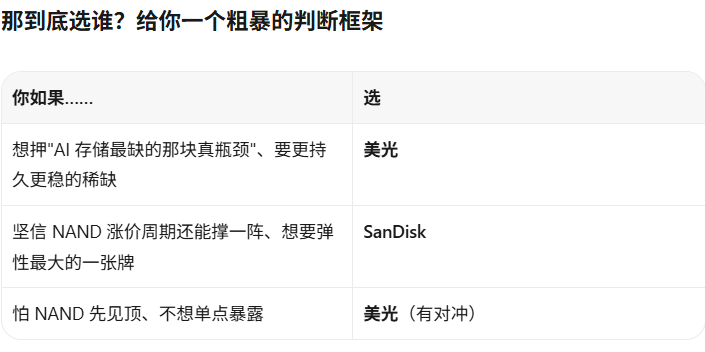
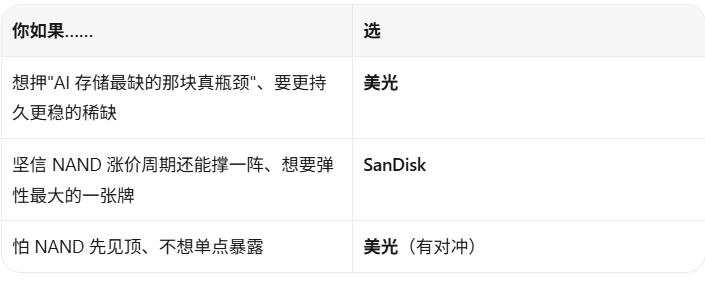
Micron is “scarcity of location,” relying on its own capabilities—there’s insurance on the downside. SNDK is “scarcity of the updraft,” relying on the cycle—strong upside, but fragile on the downside.
Both have gone crazy high and valuations aren’t low. When you enter now, it’s not “buying with your eyes closed”—you need to think it through: are you betting that NAND can still rise, or that AI’s scarcity can carry it through the cycle?
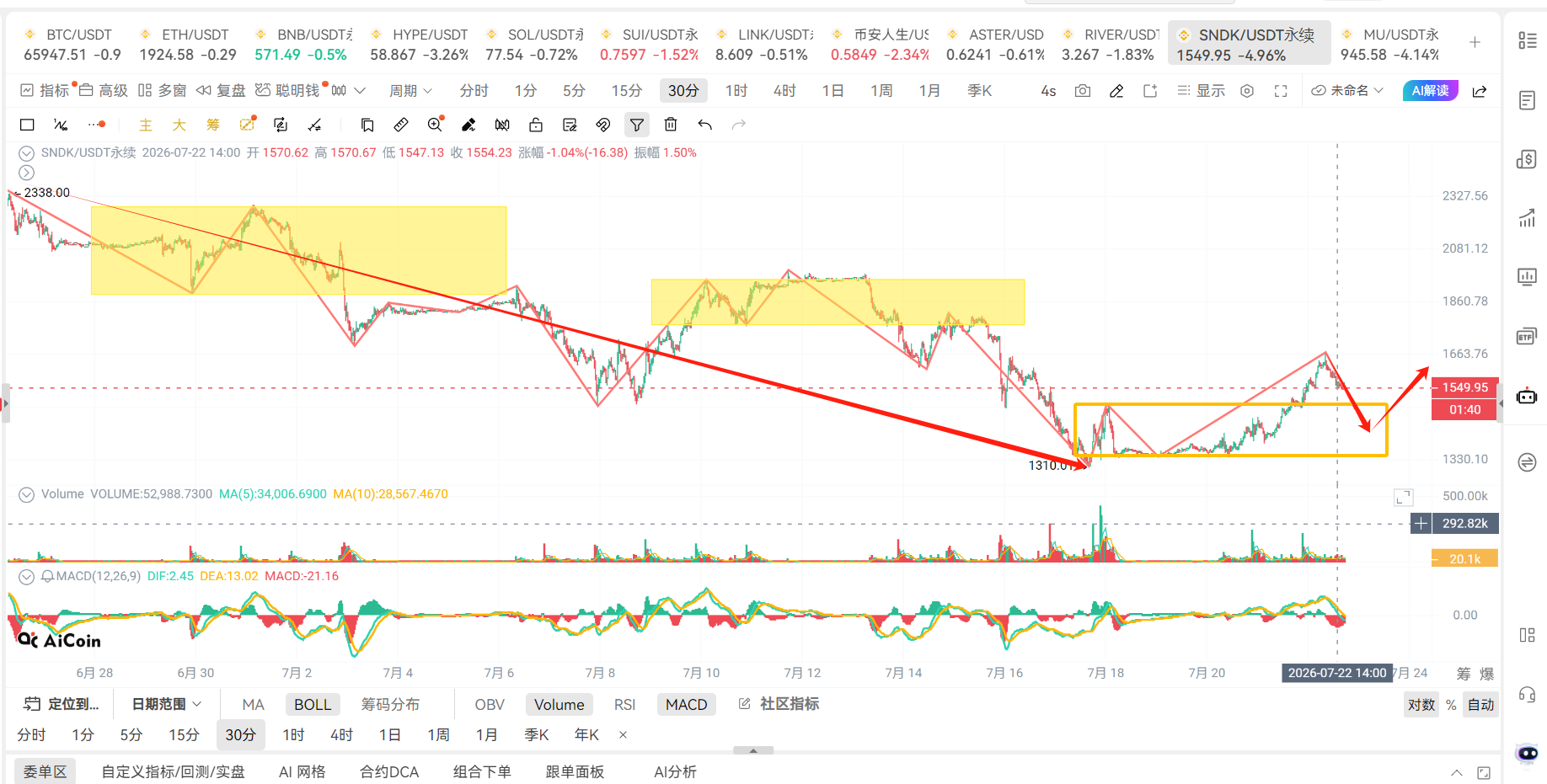
On the technical side: at least one pullback on the 4-hour chart; on the 30-minute chart the center of gravity needs to form, and you still need a pullback for a while!
..
SDNK
MU:
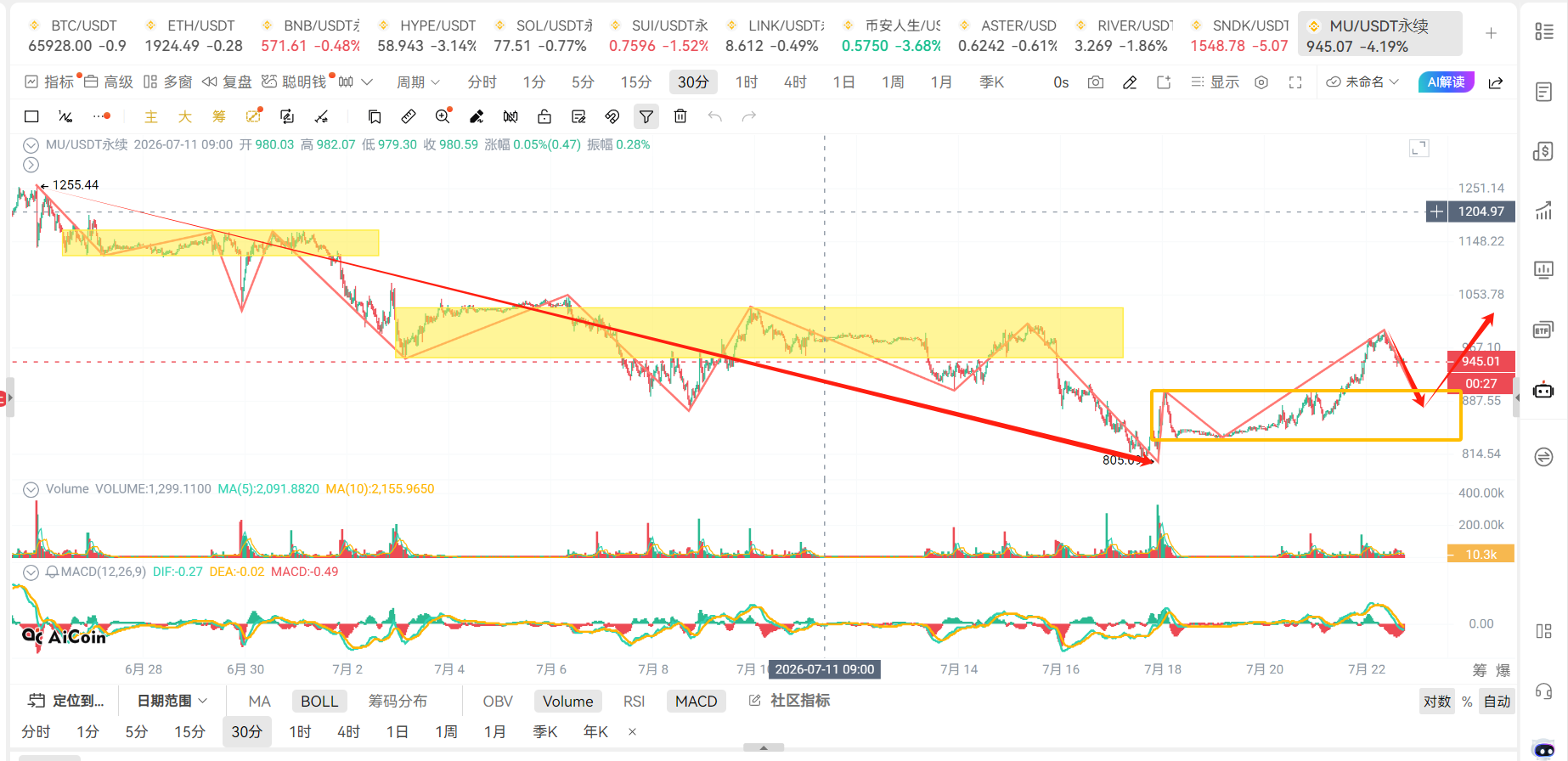
Their price trends are almost the same. In a situation where they’re almost the same, and where we’re betting rather than dealing with relative stability, I choose stability—let’s see the verdict after the market opens tonight.
MU goes long, SNAD goes short—yesterday’s surge to 1600 was the best time to short! This is a personal opinion and does not constitute investment advice!