

Over the past few days, I’ve been discussing: why does the market start to re-understand a project? Why is mechanism more important than story? Why do system capabilities determine long-term value?
Today, I’d like to share a new observation. In the past few months, discussions on X about Stablecoin (stablecoins) have been increasing. More and more payment companies, financial institutions, public chains, and exchanges are beginning to build stablecoin infrastructure. Many people think this is because the stablecoin market is getting bigger. But I’m more concerned with another question:
Why are more and more people starting to redesign how “value flows”?
⸻
1. What the market truly cares about isn’t just the asset itself
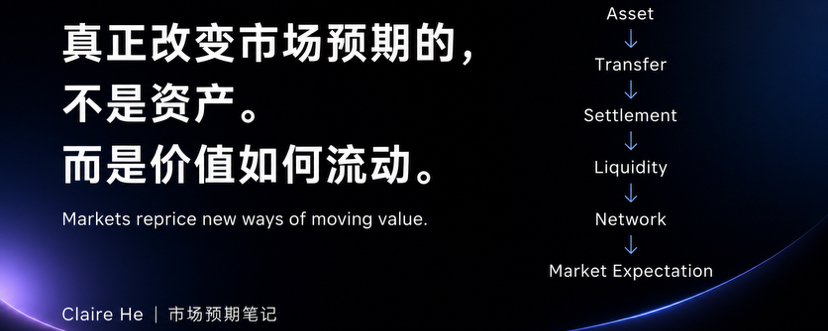
Very often, we put our attention on assets: Bitcoin, ETH, RWA, stocks, bonds. But if you look closely at the financial system, you’ll find that assets themselves change very little. What keeps changing is: how assets flow—who can participate, when they can trade, whether cross-border is convenient, whether settlement can happen in real time, and whether execution can be automated. Once the way value flows changes, the entire market structure will change with it.
⸻
2. Why stablecoins are becoming increasingly important?
Many people understand stablecoins because: their price is stable. But I think what’s truly important isn’t stability itself. It’s that they start becoming a new way to transmit value.
In the past, making payments meant: banks, business days, cross-border clearing, and multiple intermediaries. Today, more and more payments are becoming: global, 24/7, programmable, and composable.
The assets haven’t changed. What has changed is: the efficiency of value flow.
⸻
3. Why does the market reprice infrastructure?
When many infrastructure projects first appear, they often don’t get much attention. Because: infrastructure itself doesn’t directly create consumer demand. But as more and more people start using it, the market realizes: many new business models are built on top of these infrastructures. So what the market ultimately reprices is often not a payment tool itself, but: the network effects behind it.
⸻
4. What is truly worth watching is the “new value path”
In the past, value flows relied more on centralized financial systems.
In the future, more and more value may be completed directly on-chain: payments, settlement, lending, trading, collateral, and automated execution. These behaviors together form a new value path. What the market truly cares about isn’t how many transactions happen today; rather: in the future, will this path become increasingly important?
⸻
5. For Web3 projects, what truly matters is connecting value
Many projects like to discuss: what new features we have, what collaborations we’ve completed, and what products we’ve launched—these are all worth noting. But the market will keep asking: Has your product truly entered the process of value flow? Has it become an indispensable part of someone else’s needs? Can it continuously connect more users, more assets, more applications, and more capital? The long-term value usually comes from: becoming part of a network rather than existing in isolation.
⸻
6. One of my observations
In the past few years, I’ve increasingly felt that what excellent projects truly compete on is not features, not traffic, and not even marketing. It’s who can become a key node in the value-flowing network.
Because: the more important the node is, the more connections it has, and the stronger the network effects are.
the more stable the long-term expectations the market has.
⸻
My understanding is: assets create value, networks connect value, liquidity amplifies value, and market expectations come from value continuously flowing.
So, in the future, what’s truly worth paying attention to may not be: which asset will become more popular. Instead, it’s: which way of value flowing will become new infrastructure.
Not investment advice; only as an observation of market mechanisms and the industry.
#Stablecoin #Web3 #Crypto #BinanceSquare #MarketExpectation #OnchainFinance