

MrZahid
872 Posts

MrZahid
Report
Block User
Exploring crypto, Web3, and the Binance ecosystem | Sharing simple insights, updates, and ideas for the community | X: @zahidofficial22
634 Following
17.2K+ Followers
3.9K+ Liked
Posts
All
Quotes
Live
·
--
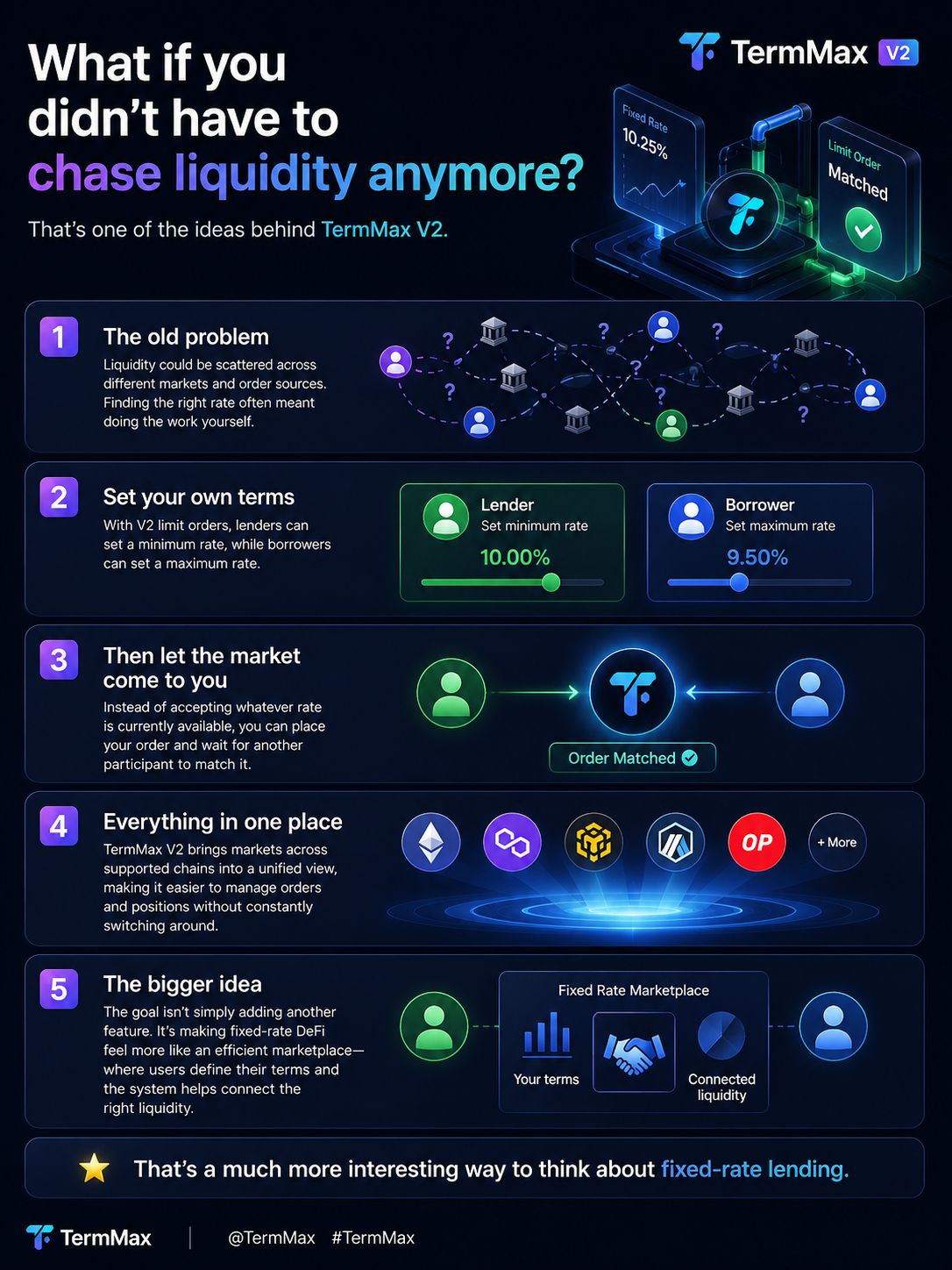
What if you didn’t have to chase liquidity anymore?
That’s one of the ideas behind TermMax V2.
The old problem, Liquidity could be scattered across different markets and order sources. Finding the right rate often meant doing the work yourself.
Set your own terms, With V2 limit orders, lenders can set a minimum rate, while borrowers can set a maximum rate.
Then let the market come to you, Instead of accepting whatever rate is currently available, you can place your order and wait for another participant to match it.
Everything in one place, TermMax V2 brings markets across supported chains into a unified view, making it easier to manage orders and positions without constantly switching around.
The bigger idea, The goal isn’t simply adding another feature. It’s making fixed-rate DeFi feel more like an efficient marketplace—where users define their terms and the system helps connect the right liquidity.
That’s a much more interesting way to think about fixed-rate lending.
@termmax #TermMax
What if you didn’t have to chase liquidity anymore?
That’s one of the ideas behind TermMax V2.
The old problem, Liquidity could be scattered across different markets and order sources. Finding the right rate often meant doing the work yourself.
Set your own terms, With V2 limit orders, lenders can set a minimum rate, while borrowers can set a maximum rate.
Then let the market come to you, Instead of accepting whatever rate is currently available, you can place your order and wait for another participant to match it.
Everything in one place, TermMax V2 brings markets across supported chains into a unified view, making it easier to manage orders and positions without constantly switching around.
The bigger idea, The goal isn’t simply adding another feature. It’s making fixed-rate DeFi feel more like an efficient marketplace—where users define their terms and the system helps connect the right liquidity.
That’s a much more interesting way to think about fixed-rate lending.
@TermMax #TermMax
That’s one of the ideas behind TermMax V2.
The old problem, Liquidity could be scattered across different markets and order sources. Finding the right rate often meant doing the work yourself.
Set your own terms, With V2 limit orders, lenders can set a minimum rate, while borrowers can set a maximum rate.
Then let the market come to you, Instead of accepting whatever rate is currently available, you can place your order and wait for another participant to match it.
Everything in one place, TermMax V2 brings markets across supported chains into a unified view, making it easier to manage orders and positions without constantly switching around.
The bigger idea, The goal isn’t simply adding another feature. It’s making fixed-rate DeFi feel more like an efficient marketplace—where users define their terms and the system helps connect the right liquidity.
That’s a much more interesting way to think about fixed-rate lending.
@TermMax #TermMax
1
314
·
--
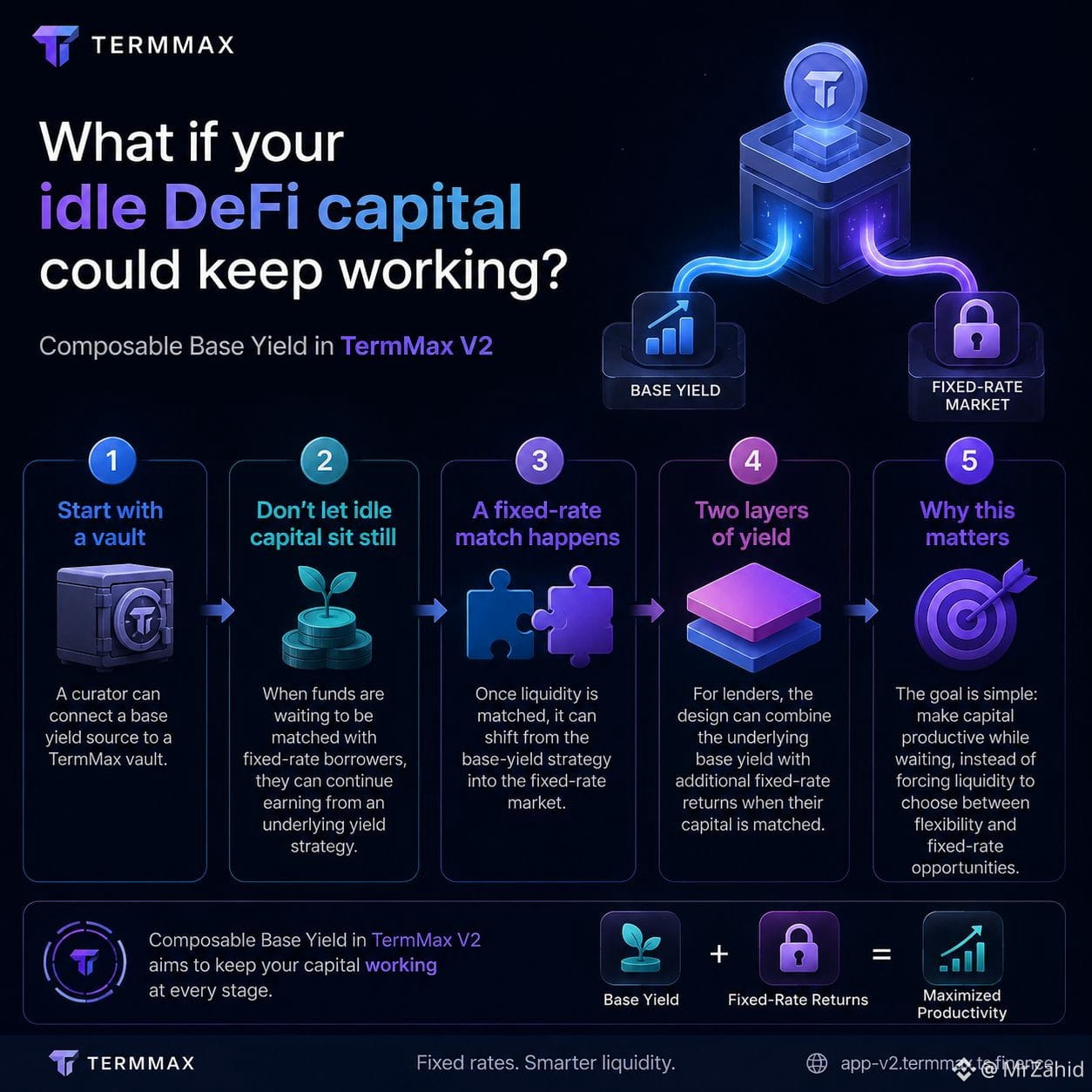
What if your idle DeFi capital could keep working?
One of the more interesting ideas in TermMax V2 is Composable Base Yield.
Start with a vault
A curator can connect a base yield source to a TermMax vault.
Don’t let idle capital sit still
When funds are waiting to be matched with fixed-rate borrowers, they can continue earning from an underlying yield strategy.
A fixed-rate match happens
Once liquidity is matched, it can shift from the base-yield strategy into the fixed-rate market.
Two layers of yield
For lenders, the design can combine the underlying base yield with additional fixed-rate returns when their capital is matched.
Why this matters
The goal is simple: make capital productive while waiting, instead of forcing liquidity to choose between flexibility and fixed-rate opportunities.
That’s a pretty interesting direction for fixed-rate DeFi.
@termmax #TermMax
What if your idle DeFi capital could keep working?
One of the more interesting ideas in TermMax V2 is Composable Base Yield.
Start with a vault
A curator can connect a base yield source to a TermMax vault.
Don’t let idle capital sit still
When funds are waiting to be matched with fixed-rate borrowers, they can continue earning from an underlying yield strategy.
A fixed-rate match happens
Once liquidity is matched, it can shift from the base-yield strategy into the fixed-rate market.
Two layers of yield
For lenders, the design can combine the underlying base yield with additional fixed-rate returns when their capital is matched.
Why this matters
The goal is simple: make capital productive while waiting, instead of forcing liquidity to choose between flexibility and fixed-rate opportunities.
That’s a pretty interesting direction for fixed-rate DeFi.
@TermMax #TermMax
One of the more interesting ideas in TermMax V2 is Composable Base Yield.
Start with a vault
A curator can connect a base yield source to a TermMax vault.
Don’t let idle capital sit still
When funds are waiting to be matched with fixed-rate borrowers, they can continue earning from an underlying yield strategy.
A fixed-rate match happens
Once liquidity is matched, it can shift from the base-yield strategy into the fixed-rate market.
Two layers of yield
For lenders, the design can combine the underlying base yield with additional fixed-rate returns when their capital is matched.
Why this matters
The goal is simple: make capital productive while waiting, instead of forcing liquidity to choose between flexibility and fixed-rate opportunities.
That’s a pretty interesting direction for fixed-rate DeFi.
@TermMax #TermMax
68
·
--
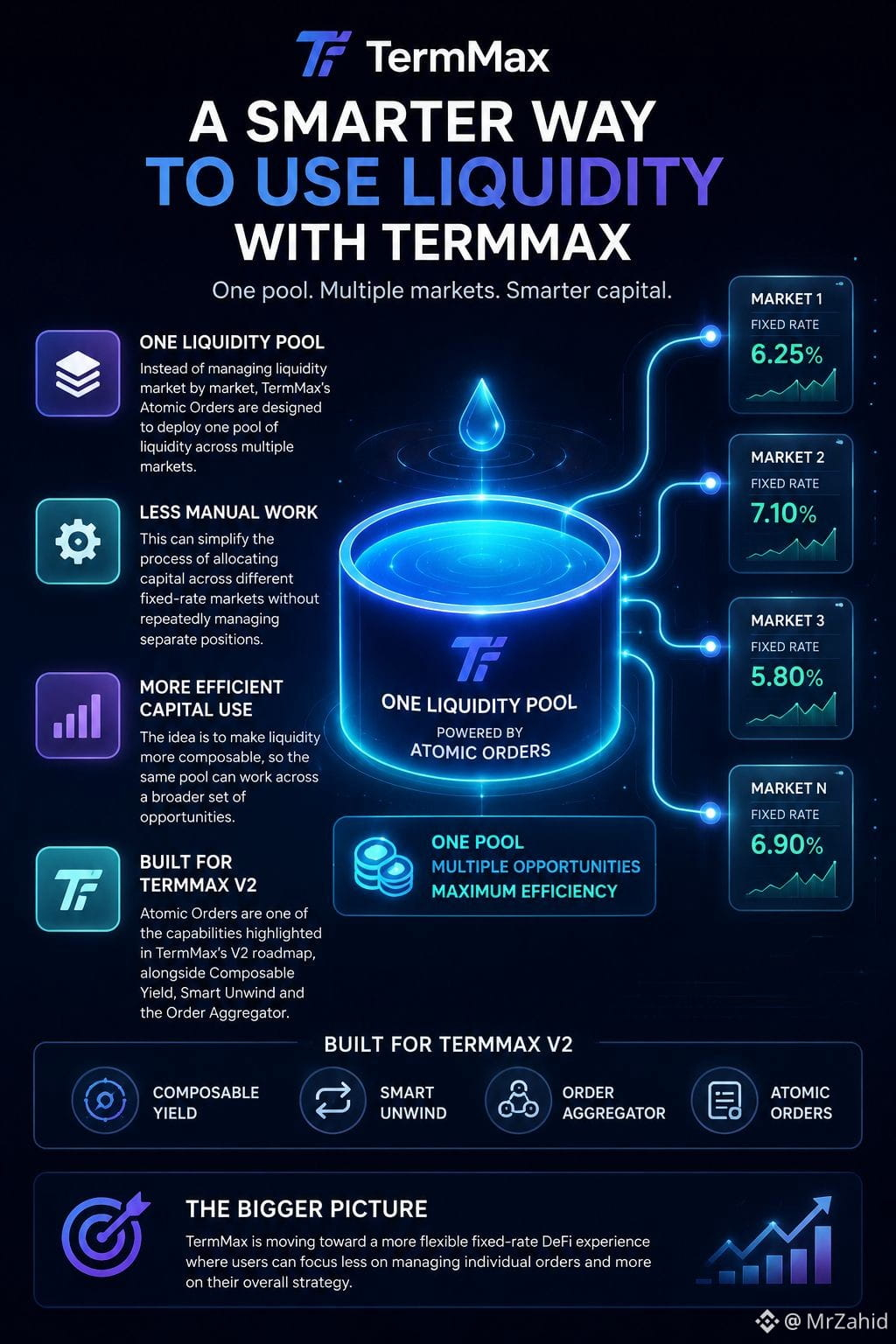
A Smarter Way to Use Liquidity with TermMax
One liquidity pool
Instead of managing liquidity market by market, TermMax’s Atomic Orders are designed to deploy one pool of liquidity across multiple markets.
Less manual work
This can simplify the process of allocating capital across different fixed-rate markets without repeatedly managing separate positions.
More efficient capital use
The idea is to make liquidity more composable, so the same pool can work across a broader set of opportunities.
Built for TermMax V2
Atomic Orders are one of the capabilities highlighted in TermMax’s V2 roadmap, alongside Composable Yield, Smart Unwind and the Order Aggregator.
The bigger picture
TermMax is moving toward a more flexible fixed-rate DeFi experience where users can focus less on managing individual orders and more on their overall strategy.
@termmax #TermMax
A Smarter Way to Use Liquidity with TermMax
One liquidity pool
Instead of managing liquidity market by market, TermMax’s Atomic Orders are designed to deploy one pool of liquidity across multiple markets.
Less manual work
This can simplify the process of allocating capital across different fixed-rate markets without repeatedly managing separate positions.
More efficient capital use
The idea is to make liquidity more composable, so the same pool can work across a broader set of opportunities.
Built for TermMax V2
Atomic Orders are one of the capabilities highlighted in TermMax’s V2 roadmap, alongside Composable Yield, Smart Unwind and the Order Aggregator.
The bigger picture
TermMax is moving toward a more flexible fixed-rate DeFi experience where users can focus less on managing individual orders and more on their overall strategy.
@TermMax #TermMax
One liquidity pool
Instead of managing liquidity market by market, TermMax’s Atomic Orders are designed to deploy one pool of liquidity across multiple markets.
Less manual work
This can simplify the process of allocating capital across different fixed-rate markets without repeatedly managing separate positions.
More efficient capital use
The idea is to make liquidity more composable, so the same pool can work across a broader set of opportunities.
Built for TermMax V2
Atomic Orders are one of the capabilities highlighted in TermMax’s V2 roadmap, alongside Composable Yield, Smart Unwind and the Order Aggregator.
The bigger picture
TermMax is moving toward a more flexible fixed-rate DeFi experience where users can focus less on managing individual orders and more on their overall strategy.
@TermMax #TermMax
161
·
--
#termmax @termmax
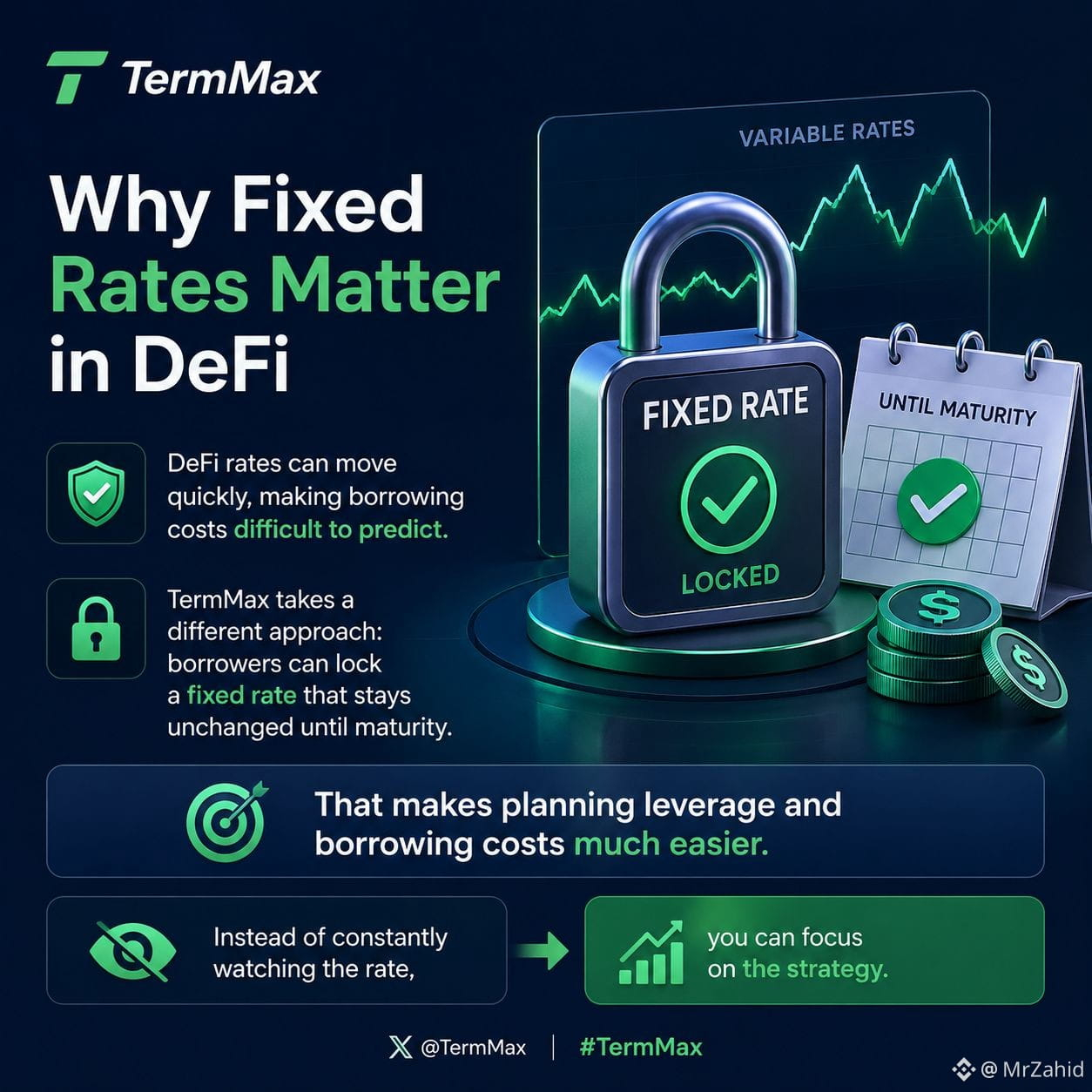
Why Fixed Rates Matter in DeFi
DeFi rates can move quickly, making borrowing costs difficult to predict. TermMax takes a different approach: borrowers can lock a fixed rate that stays unchanged until maturity. That makes planning leverage and borrowing costs much easier.
Instead of constantly watching the rate, you can focus on the strategy.
@termmax #TermMax
#termmax @TermMax
Why Fixed Rates Matter in DeFi
DeFi rates can move quickly, making borrowing costs difficult to predict. TermMax takes a different approach: borrowers can lock a fixed rate that stays unchanged until maturity. That makes planning leverage and borrowing costs much easier.
Instead of constantly watching the rate, you can focus on the strategy.
@TermMax #TermMax
Why Fixed Rates Matter in DeFi
DeFi rates can move quickly, making borrowing costs difficult to predict. TermMax takes a different approach: borrowers can lock a fixed rate that stays unchanged until maturity. That makes planning leverage and borrowing costs much easier.
Instead of constantly watching the rate, you can focus on the strategy.
@TermMax #TermMax
1
2
216
·
--
9 years. Countless innovations. Millions of users.
It's amazing to see how far Binance has come. From my first trade to exploring new products, every milestone has been part of my crypto journey.
I've unlocked 9 landmarks, but this is just the beginning. Looking forward to building, learning, and growing with the community for many more years. 🚀
Happy 9th Birthday, Binance! 🥳💛
#BinanceTurns9
9 years. Countless innovations. Millions of users.
It's amazing to see how far Binance has come. From my first trade to exploring new products, every milestone has been part of my crypto journey.
I've unlocked 9 landmarks, but this is just the beginning. Looking forward to building, learning, and growing with the community for many more years. 🚀
Happy 9th Birthday, Binance! 🥳💛
#BinanceTurns9
It's amazing to see how far Binance has come. From my first trade to exploring new products, every milestone has been part of my crypto journey.
I've unlocked 9 landmarks, but this is just the beginning. Looking forward to building, learning, and growing with the community for many more years. 🚀
Happy 9th Birthday, Binance! 🥳💛
#BinanceTurns9

111
·
--
I spent part of today digging through @grvt_io 's documentation, but instead of looking at trading features, I focused on something deeper: the trust model.
How do you trade without handing complete control of your assets to an exchange?
What stood out to me is that GRVT separates order execution from asset ownership. Matching is optimized for speed, while settlement and account integrity rely on blockchain infrastructure and zero-knowledge technology. I think that's a smarter approach than asking users to blindly trust a platform.
I also explored the API docs. Beyond basic trading endpoints, GRVT supports WebSocket market data, order management, subaccounts, and automation. That tells me the platform is designed for serious traders and developers, not just casual users.
What I keep asking myself is why this matters. My answer is simple: the next generation of exchanges won't be defined by leverage or incentives—they'll be defined by how little trust users have to place in them.
Today's research gave me a new perspective. @grvt_io seems to be building infrastructure first and hype second, and I think that's the more sustainable path.
#grvt
I spent part of today digging through @grvt_io 's documentation, but instead of looking at trading features, I focused on something deeper: the trust model.
How do you trade without handing complete control of your assets to an exchange?
What stood out to me is that GRVT separates order execution from asset ownership. Matching is optimized for speed, while settlement and account integrity rely on blockchain infrastructure and zero-knowledge technology. I think that's a smarter approach than asking users to blindly trust a platform.
I also explored the API docs. Beyond basic trading endpoints, GRVT supports WebSocket market data, order management, subaccounts, and automation. That tells me the platform is designed for serious traders and developers, not just casual users.
What I keep asking myself is why this matters. My answer is simple: the next generation of exchanges won't be defined by leverage or incentives—they'll be defined by how little trust users have to place in them.
Today's research gave me a new perspective. @grvt_io seems to be building infrastructure first and hype second, and I think that's the more sustainable path.
#grvt
How do you trade without handing complete control of your assets to an exchange?
What stood out to me is that GRVT separates order execution from asset ownership. Matching is optimized for speed, while settlement and account integrity rely on blockchain infrastructure and zero-knowledge technology. I think that's a smarter approach than asking users to blindly trust a platform.
I also explored the API docs. Beyond basic trading endpoints, GRVT supports WebSocket market data, order management, subaccounts, and automation. That tells me the platform is designed for serious traders and developers, not just casual users.
What I keep asking myself is why this matters. My answer is simple: the next generation of exchanges won't be defined by leverage or incentives—they'll be defined by how little trust users have to place in them.
Today's research gave me a new perspective. @grvt_io seems to be building infrastructure first and hype second, and I think that's the more sustainable path.
#grvt
133
·
--
Today I focused less on trading features and more on the infrastructure behind @grvt_io . One question kept coming to mind:
Why does infrastructure matter more than incentives?
Because incentives can attract users for a season, but reliable infrastructure is what keeps them there.
One thing I found valuable is GRVT's API ecosystem. Whether you're building trading bots, portfolio dashboards, or integrating institutional workflows, the platform provides REST and WebSocket APIs for market data, account management, and order execution. That tells me GRVT isn't only designing for manual traders—it's also thinking about developers and professional participants who need stable, programmable access.
I also spent time looking into the platform's risk controls. Features like isolated account structures, permissioned subaccounts, and dedicated funding accounts make it easier to separate trading strategies instead of exposing an entire portfolio to a single mistake. That's a practical improvement many traders don't fully appreciate until volatility spikes.
What I like most is the overall philosophy. GRVT doesn't try to force users to choose between centralized performance and decentralized ownership. Instead, it combines a familiar trading experience with zero-knowledge technology and self-custody, aiming to reduce that trade-off as much as possible.
I'll keep digging through the documentation because every section seems to reveal another design decision that wasn't obvious at first glance.
What do you think will define the next generation of exchanges—better liquidity, better infrastructure, or better user ownership?
@grvt_io #grvt
Today I focused less on trading features and more on the infrastructure behind @grvt_io . One question kept coming to mind:
Why does infrastructure matter more than incentives?
Because incentives can attract users for a season, but reliable infrastructure is what keeps them there.
One thing I found valuable is GRVT's API ecosystem. Whether you're building trading bots, portfolio dashboards, or integrating institutional workflows, the platform provides REST and WebSocket APIs for market data, account management, and order execution. That tells me GRVT isn't only designing for manual traders—it's also thinking about developers and professional participants who need stable, programmable access.
I also spent time looking into the platform's risk controls. Features like isolated account structures, permissioned subaccounts, and dedicated funding accounts make it easier to separate trading strategies instead of exposing an entire portfolio to a single mistake. That's a practical improvement many traders don't fully appreciate until volatility spikes.
What I like most is the overall philosophy. GRVT doesn't try to force users to choose between centralized performance and decentralized ownership. Instead, it combines a familiar trading experience with zero-knowledge technology and self-custody, aiming to reduce that trade-off as much as possible.
I'll keep digging through the documentation because every section seems to reveal another design decision that wasn't obvious at first glance.
What do you think will define the next generation of exchanges—better liquidity, better infrastructure, or better user ownership?
@grvt_io #grvt
Why does infrastructure matter more than incentives?
Because incentives can attract users for a season, but reliable infrastructure is what keeps them there.
One thing I found valuable is GRVT's API ecosystem. Whether you're building trading bots, portfolio dashboards, or integrating institutional workflows, the platform provides REST and WebSocket APIs for market data, account management, and order execution. That tells me GRVT isn't only designing for manual traders—it's also thinking about developers and professional participants who need stable, programmable access.
I also spent time looking into the platform's risk controls. Features like isolated account structures, permissioned subaccounts, and dedicated funding accounts make it easier to separate trading strategies instead of exposing an entire portfolio to a single mistake. That's a practical improvement many traders don't fully appreciate until volatility spikes.
What I like most is the overall philosophy. GRVT doesn't try to force users to choose between centralized performance and decentralized ownership. Instead, it combines a familiar trading experience with zero-knowledge technology and self-custody, aiming to reduce that trade-off as much as possible.
I'll keep digging through the documentation because every section seems to reveal another design decision that wasn't obvious at first glance.
What do you think will define the next generation of exchanges—better liquidity, better infrastructure, or better user ownership?
@grvt_io #grvt
1
355
·
--
Today I took a deeper dive into @grvt_io 's documentation, and one design decision completely reshaped my perspective on on-chain trading.
How do you build an exchange that's fast enough for active traders without asking them to give up control of their assets?
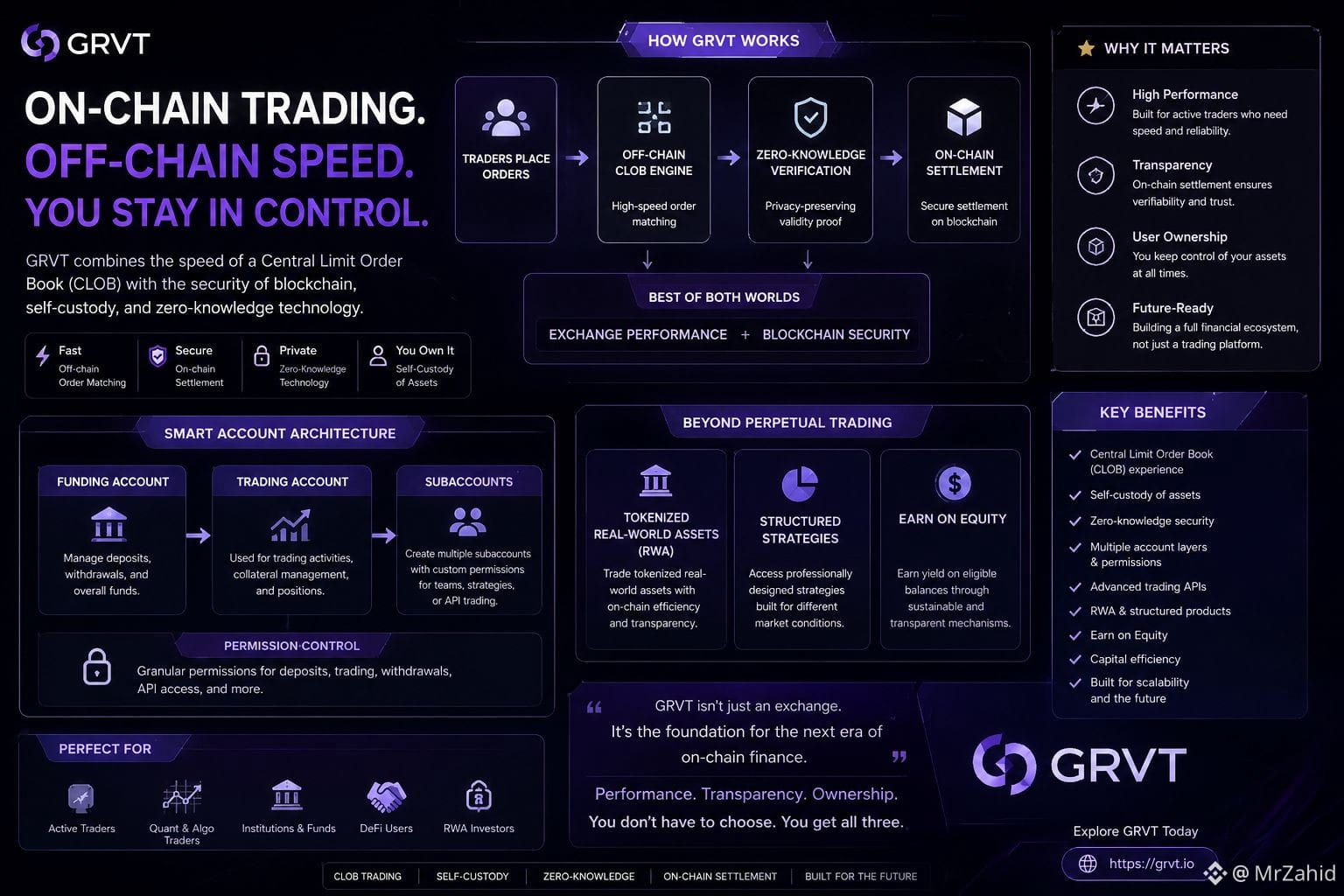
GRVT's approach is to combine a familiar central limit order book (CLOB) trading experience with self-custody and zero-knowledge technology. Orders can be matched efficiently, while key settlement and security remain anchored to blockchain infrastructure. That's a practical design choice because traders usually want both performance and transparency-not one at the expense of the other.
Another detail I found interesting is the account architecture. GRVT separates Funding Accounts from Trading Accounts and supports subaccounts with different permissions. For anyone managing multiple strategies or automated trading through APIs, that structure can make organization and risk management much cleaner.
I also noticed the platform includes features beyond perpetual trading, such as tokenized real-world asset (RWA) products, structured strategies, and an Earn on Equity mechanism for eligible balances. To me, that suggests GRVT is focused on building a broader financial ecosystem rather than relying on a single trading product.
Why does that matter? Because in the long run, I think the strongest crypto platforms will be the ones that combine usability, capital efficiency, and user ownership instead of forcing traders to choose between them.
I'm looking forward to seeing how @grvt_io continues to develop.
#grvt
Today I took a deeper dive into @grvt_io 's documentation, and one design decision completely reshaped my perspective on on-chain trading.
How do you build an exchange that's fast enough for active traders without asking them to give up control of their assets?
GRVT's approach is to combine a familiar central limit order book (CLOB) trading experience with self-custody and zero-knowledge technology. Orders can be matched efficiently, while key settlement and security remain anchored to blockchain infrastructure. That's a practical design choice because traders usually want both performance and transparency-not one at the expense of the other.
Another detail I found interesting is the account architecture. GRVT separates Funding Accounts from Trading Accounts and supports subaccounts with different permissions. For anyone managing multiple strategies or automated trading through APIs, that structure can make organization and risk management much cleaner.
I also noticed the platform includes features beyond perpetual trading, such as tokenized real-world asset (RWA) products, structured strategies, and an Earn on Equity mechanism for eligible balances. To me, that suggests GRVT is focused on building a broader financial ecosystem rather than relying on a single trading product.
Why does that matter? Because in the long run, I think the strongest crypto platforms will be the ones that combine usability, capital efficiency, and user ownership instead of forcing traders to choose between them.
I'm looking forward to seeing how @grvt_io continues to develop.
#grvt
How do you build an exchange that's fast enough for active traders without asking them to give up control of their assets?
GRVT's approach is to combine a familiar central limit order book (CLOB) trading experience with self-custody and zero-knowledge technology. Orders can be matched efficiently, while key settlement and security remain anchored to blockchain infrastructure. That's a practical design choice because traders usually want both performance and transparency-not one at the expense of the other.
Another detail I found interesting is the account architecture. GRVT separates Funding Accounts from Trading Accounts and supports subaccounts with different permissions. For anyone managing multiple strategies or automated trading through APIs, that structure can make organization and risk management much cleaner.
I also noticed the platform includes features beyond perpetual trading, such as tokenized real-world asset (RWA) products, structured strategies, and an Earn on Equity mechanism for eligible balances. To me, that suggests GRVT is focused on building a broader financial ecosystem rather than relying on a single trading product.
Why does that matter? Because in the long run, I think the strongest crypto platforms will be the ones that combine usability, capital efficiency, and user ownership instead of forcing traders to choose between them.
I'm looking forward to seeing how @grvt_io continues to develop.
#grvt
272
·
--
This morning I went deeper into @grvt_io 's documentation because I wanted to understand how trades actually work instead of just reading feature lists.
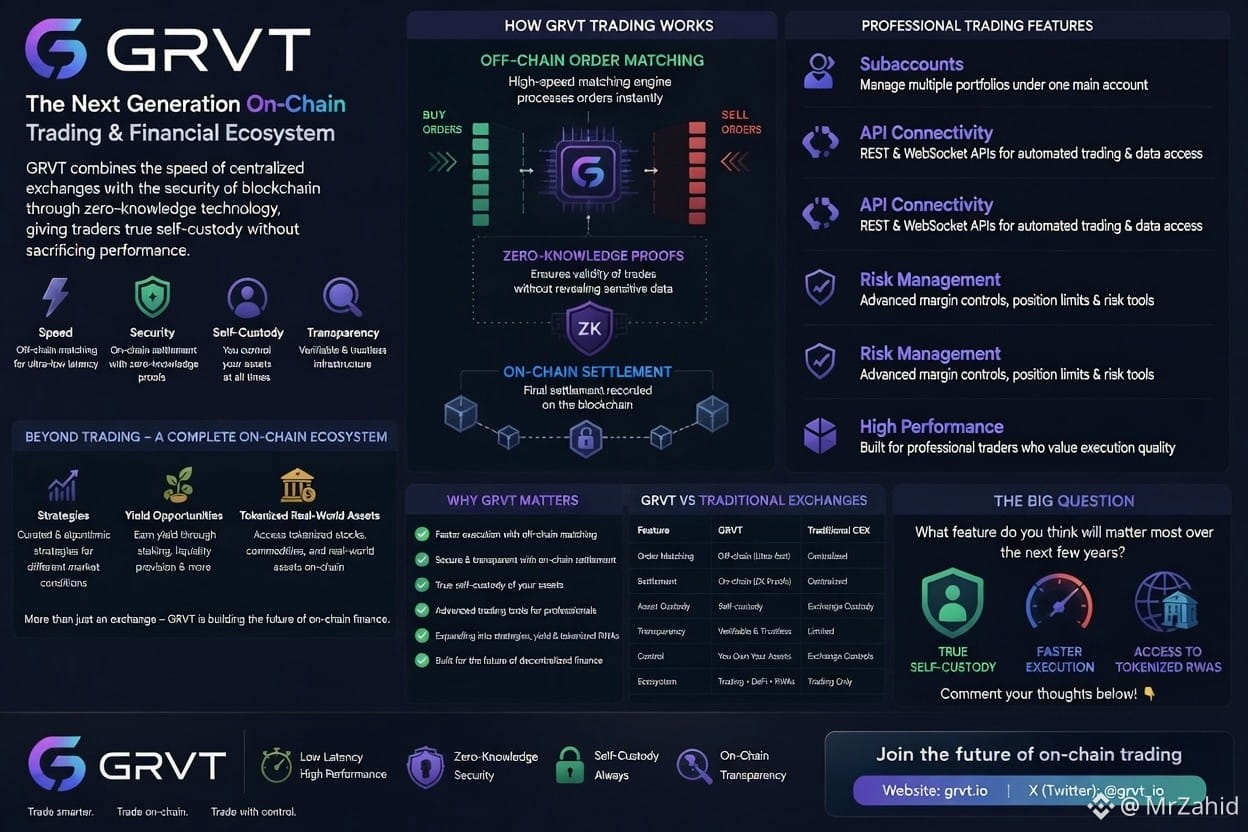
One detail I found especially interesting is that GRVT uses off-chain order matching for speed while critical settlement and asset security remain tied to blockchain infrastructure through zero-knowledge technology. That approach aims to reduce latency without giving up self-custody, which is a trade-off many traders have been looking for.
I also noticed GRVT supports multiple order types, subaccounts, API connectivity, and risk-management features that are usually expected on professional exchanges. For active traders, those tools matter just as much as low fees because execution quality often has a bigger impact on long-term performance than a small difference in trading costs.
What impressed me most is that the team isn't only building a place to trade. They're expanding into strategies, yield opportunities, and tokenized real-world assets, making the platform feel more like an on-chain financial ecosystem than a single-product exchange.
I'm still exploring the platform, but today's research gave me a much clearer picture of why GRVT is attracting attention from both experienced traders and Web3 users who want more control over their assets.
What feature do you think will matter most over the next few years: true self-custody, faster execution, or access to tokenized RWAs?
@grvt_io #grvt
This morning I went deeper into @grvt_io 's documentation because I wanted to understand how trades actually work instead of just reading feature lists.
One detail I found especially interesting is that GRVT uses off-chain order matching for speed while critical settlement and asset security remain tied to blockchain infrastructure through zero-knowledge technology. That approach aims to reduce latency without giving up self-custody, which is a trade-off many traders have been looking for.
I also noticed GRVT supports multiple order types, subaccounts, API connectivity, and risk-management features that are usually expected on professional exchanges. For active traders, those tools matter just as much as low fees because execution quality often has a bigger impact on long-term performance than a small difference in trading costs.
What impressed me most is that the team isn't only building a place to trade. They're expanding into strategies, yield opportunities, and tokenized real-world assets, making the platform feel more like an on-chain financial ecosystem than a single-product exchange.
I'm still exploring the platform, but today's research gave me a much clearer picture of why GRVT is attracting attention from both experienced traders and Web3 users who want more control over their assets.
What feature do you think will matter most over the next few years: true self-custody, faster execution, or access to tokenized RWAs?
@grvt_io #grvt
One detail I found especially interesting is that GRVT uses off-chain order matching for speed while critical settlement and asset security remain tied to blockchain infrastructure through zero-knowledge technology. That approach aims to reduce latency without giving up self-custody, which is a trade-off many traders have been looking for.
I also noticed GRVT supports multiple order types, subaccounts, API connectivity, and risk-management features that are usually expected on professional exchanges. For active traders, those tools matter just as much as low fees because execution quality often has a bigger impact on long-term performance than a small difference in trading costs.
What impressed me most is that the team isn't only building a place to trade. They're expanding into strategies, yield opportunities, and tokenized real-world assets, making the platform feel more like an on-chain financial ecosystem than a single-product exchange.
I'm still exploring the platform, but today's research gave me a much clearer picture of why GRVT is attracting attention from both experienced traders and Web3 users who want more control over their assets.
What feature do you think will matter most over the next few years: true self-custody, faster execution, or access to tokenized RWAs?
@grvt_io #grvt
2
2
180
·
--
Today I spent some time reading through @grvt_io instead of just checking the campaign page, and one thing really stood out to me.
Why does GRVT feel different from many so-called "DEXs"?
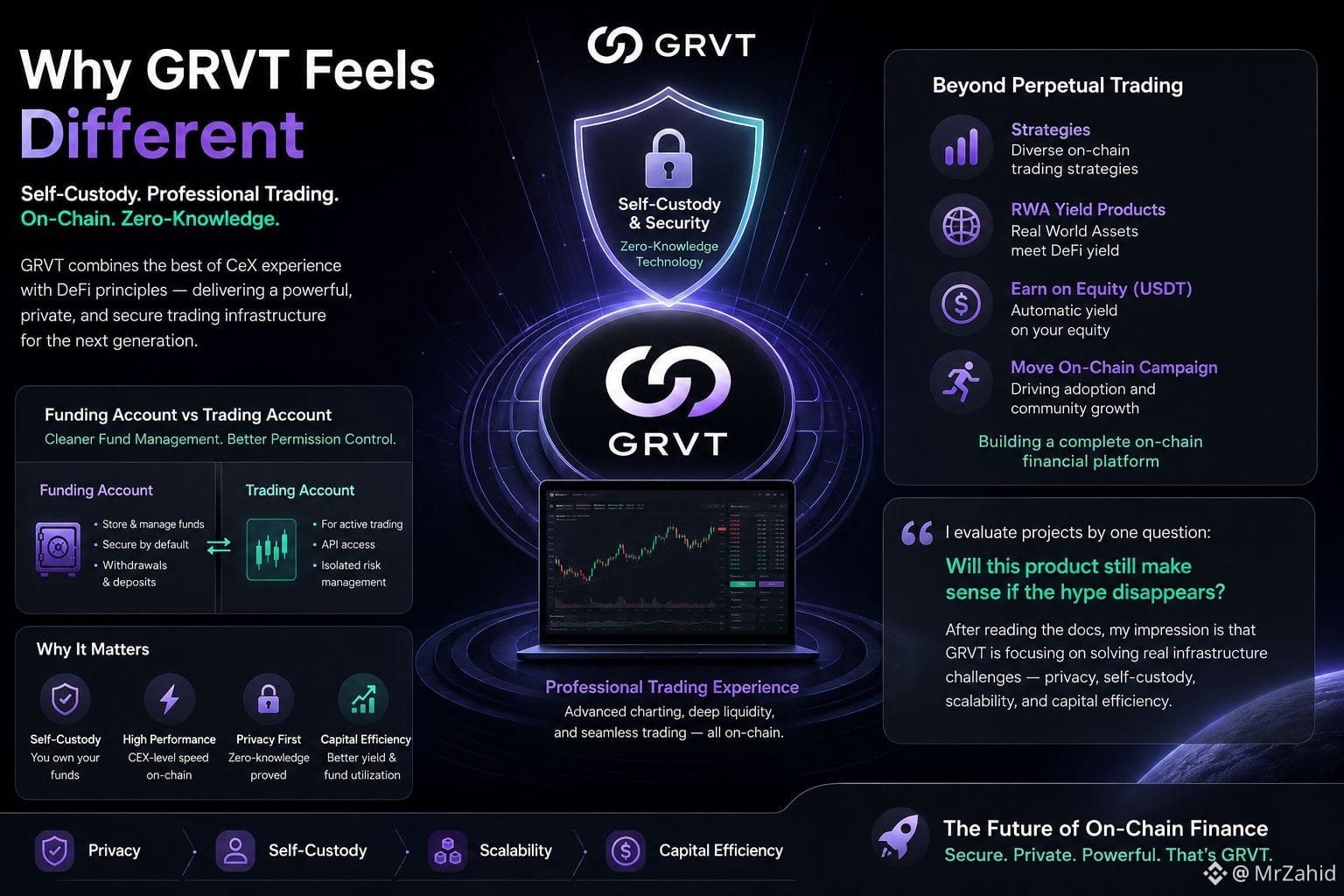
Because it isn't only chasing speed. It combines self-custody with a trading experience that feels close to a professional exchange while still settling critical actions on-chain through zero-knowledge technology. That balance matters if you care about both security and usability.
I also like how GRVT separates Funding Accounts from Trading Accounts. At first I thought it added complexity, but after reading the docs I realized it creates cleaner fund management and better permission control for active traders and API users. That's a design choice many people overlook.
Another interesting thing I noticed today is that GRVT keeps expanding beyond simple perpetual trading. Between Strategies, RWA yield products, automatic Earn on Equity for USDT, and the Move On-Chain campaign, it feels like they're building a complete on-chain financial platform instead of another exchange with a token narrative.
How do I evaluate projects? I usually ask one question: Will this product still make sense if the hype disappears?
After reading the documentation, I think GRVT is trying to solve real infrastructure problems-privacy, self-custody, scalability, and capital efficiency-not just marketing.
Interested to see how @grvt_io evolves over the next few months.
#grvt
Today I spent some time reading through @grvt_io instead of just checking the campaign page, and one thing really stood out to me.
Why does GRVT feel different from many so-called "DEXs"?
Because it isn't only chasing speed. It combines self-custody with a trading experience that feels close to a professional exchange while still settling critical actions on-chain through zero-knowledge technology. That balance matters if you care about both security and usability.
I also like how GRVT separates Funding Accounts from Trading Accounts. At first I thought it added complexity, but after reading the docs I realized it creates cleaner fund management and better permission control for active traders and API users. That's a design choice many people overlook.
Another interesting thing I noticed today is that GRVT keeps expanding beyond simple perpetual trading. Between Strategies, RWA yield products, automatic Earn on Equity for USDT, and the Move On-Chain campaign, it feels like they're building a complete on-chain financial platform instead of another exchange with a token narrative.
How do I evaluate projects? I usually ask one question: Will this product still make sense if the hype disappears?
After reading the documentation, I think GRVT is trying to solve real infrastructure problems-privacy, self-custody, scalability, and capital efficiency-not just marketing.
Interested to see how @grvt_io evolves over the next few months.
#grvt
Why does GRVT feel different from many so-called "DEXs"?
Because it isn't only chasing speed. It combines self-custody with a trading experience that feels close to a professional exchange while still settling critical actions on-chain through zero-knowledge technology. That balance matters if you care about both security and usability.
I also like how GRVT separates Funding Accounts from Trading Accounts. At first I thought it added complexity, but after reading the docs I realized it creates cleaner fund management and better permission control for active traders and API users. That's a design choice many people overlook.
Another interesting thing I noticed today is that GRVT keeps expanding beyond simple perpetual trading. Between Strategies, RWA yield products, automatic Earn on Equity for USDT, and the Move On-Chain campaign, it feels like they're building a complete on-chain financial platform instead of another exchange with a token narrative.
How do I evaluate projects? I usually ask one question: Will this product still make sense if the hype disappears?
After reading the documentation, I think GRVT is trying to solve real infrastructure problems-privacy, self-custody, scalability, and capital efficiency-not just marketing.
Interested to see how @grvt_io evolves over the next few months.
#grvt
216
·
--
#genius $GENIUS
I think the most underrated part of Genius Terminal isn’t the charting, the perps, or even the “single terminal” pitch. It’s funding. Boring? Yeah, maybe. But this is exactly why it matters. In crypto, the trade usually starts before the trade: move funds, pick the right chain, bridge, wait, sign, hope nothing breaks. That pre-trade mess is where people lose timing.
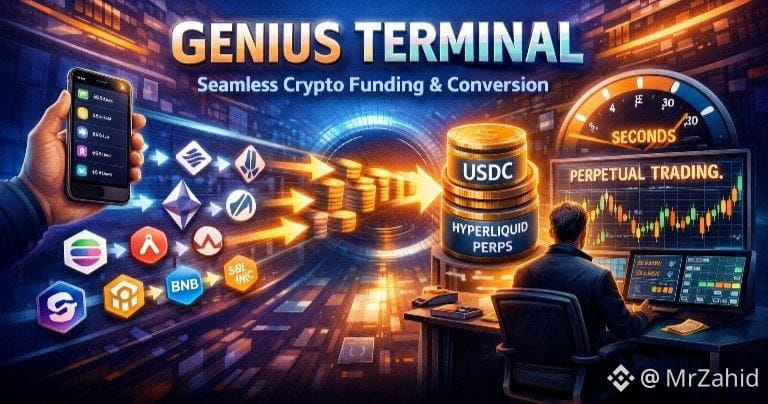
Genius tackles this at the account layer. Users can fund Genius wallets by transferring assets across Solana, Ethereum, Arbitrum, Avalanche, Optimism, Base, BNB, Sonic, HyperEVM, and Hyperliquid Perps. That’s a pretty wide surface area, and it tells me what the team really understands: liquidity isn’t loyal to one chain anymore. It rotates wherever the action is.
The sharper feature is Convert. Spot balances on Genius Pro can move into Hyperliquid USDC for perp trading, with docs claiming gas-free, signature-free bridging and confirmation times from 1 to 30 seconds. That’s not just convenience; it’s execution compression.
My hot take: whoever owns the funding layer owns the trader’s attention. Because what good is alpha if your capital is still stuck three clicks and one bridge away?
@GeniusOfficial
#genius $GENIUS
I think the most underrated part of Genius Terminal isn’t the charting, the perps, or even the “single terminal” pitch. It’s funding. Boring? Yeah, maybe. But this is exactly why it matters. In crypto, the trade usually starts before the trade: move funds, pick the right chain, bridge, wait, sign, hope nothing breaks. That pre-trade mess is where people lose timing.
Genius tackles this at the account layer. Users can fund Genius wallets by transferring assets across Solana, Ethereum, Arbitrum, Avalanche, Optimism, Base, BNB, Sonic, HyperEVM, and Hyperliquid Perps. That’s a pretty wide surface area, and it tells me what the team really understands: liquidity isn’t loyal to one chain anymore. It rotates wherever the action is.
The sharper feature is Convert. Spot balances on Genius Pro can move into Hyperliquid USDC for perp trading, with docs claiming gas-free, signature-free bridging and confirmation times from 1 to 30 seconds. That’s not just convenience; it’s execution compression.
My hot take: whoever owns the funding layer owns the trader’s attention. Because what good is alpha if your capital is still stuck three clicks and one bridge away?
@GeniusOfficial
I think the most underrated part of Genius Terminal isn’t the charting, the perps, or even the “single terminal” pitch. It’s funding. Boring? Yeah, maybe. But this is exactly why it matters. In crypto, the trade usually starts before the trade: move funds, pick the right chain, bridge, wait, sign, hope nothing breaks. That pre-trade mess is where people lose timing.
Genius tackles this at the account layer. Users can fund Genius wallets by transferring assets across Solana, Ethereum, Arbitrum, Avalanche, Optimism, Base, BNB, Sonic, HyperEVM, and Hyperliquid Perps. That’s a pretty wide surface area, and it tells me what the team really understands: liquidity isn’t loyal to one chain anymore. It rotates wherever the action is.
The sharper feature is Convert. Spot balances on Genius Pro can move into Hyperliquid USDC for perp trading, with docs claiming gas-free, signature-free bridging and confirmation times from 1 to 30 seconds. That’s not just convenience; it’s execution compression.
My hot take: whoever owns the funding layer owns the trader’s attention. Because what good is alpha if your capital is still stuck three clicks and one bridge away?
@GeniusOfficial
1
213
·
--
#openledger $OPEN
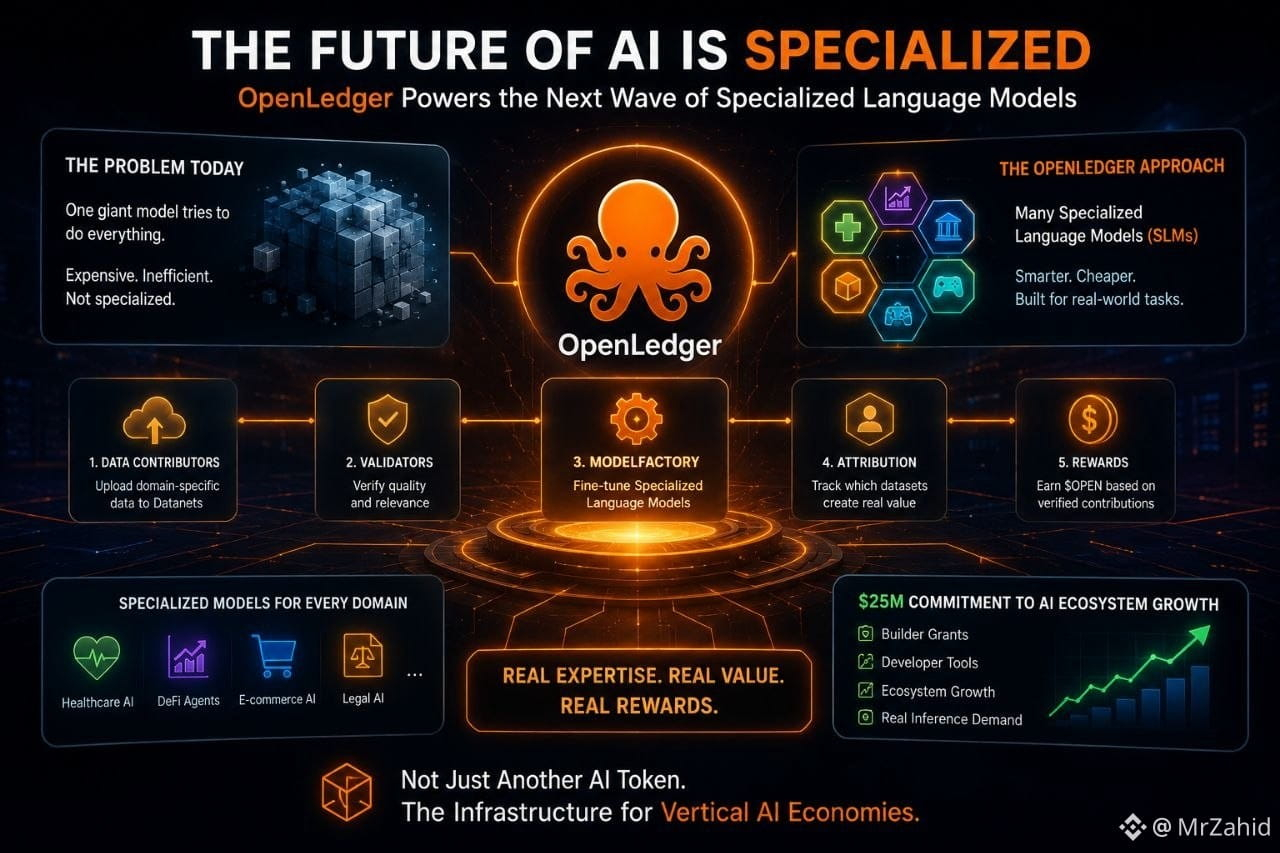
I think OpenLedger’s biggest long-term weapon might actually be its push toward Specialized Language Models (SLMs) instead of chasing one giant “god model.” That approach feels way more realistic for the future of AI.
A healthcare AI doesn’t need to write rap lyrics. A DeFi agent doesn’t need philosophy skills. OpenLedger seems to understand that specialized models trained on curated domain data can outperform bloated general-purpose systems in focused tasks while using fewer resources. That’s where Datanets and ModelFactory start making sense together.
What caught my attention is how the ecosystem tries to connect incentives directly to expertise. Contributors upload domain-specific data, validators verify quality, models get fine-tuned, and attribution tracks which datasets actually created value. In theory, that creates a smarter economic loop than today’s AI industry where companies scrape everything and contributors get nothing back 😅.
From a market perspective, I’m not trading OPEN purely on momentum. I watch whether developer activity keeps growing around OpenCircle and whether specialized models begin generating real inference demand. OpenLedger recently committed $25M toward AI-focused ecosystem growth, which tells me they’re prioritizing builders instead of empty marketing cycles.
If the SLM thesis plays out, OpenLedger could end up looking less like a speculative AI token and more like foundational infrastructure for vertical AI economies. That’s the interesting part for me.
@Openledger $OPEN
#openledger $OPEN
I think OpenLedger’s biggest long-term weapon might actually be its push toward Specialized Language Models (SLMs) instead of chasing one giant “god model.” That approach feels way more realistic for the future of AI.
A healthcare AI doesn’t need to write rap lyrics. A DeFi agent doesn’t need philosophy skills. OpenLedger seems to understand that specialized models trained on curated domain data can outperform bloated general-purpose systems in focused tasks while using fewer resources. That’s where Datanets and ModelFactory start making sense together.
What caught my attention is how the ecosystem tries to connect incentives directly to expertise. Contributors upload domain-specific data, validators verify quality, models get fine-tuned, and attribution tracks which datasets actually created value. In theory, that creates a smarter economic loop than today’s AI industry where companies scrape everything and contributors get nothing back 😅.
From a market perspective, I’m not trading OPEN purely on momentum. I watch whether developer activity keeps growing around OpenCircle and whether specialized models begin generating real inference demand. OpenLedger recently committed $25M toward AI-focused ecosystem growth, which tells me they’re prioritizing builders instead of empty marketing cycles.
If the SLM thesis plays out, OpenLedger could end up looking less like a speculative AI token and more like foundational infrastructure for vertical AI economies. That’s the interesting part for me.
@OpenLedger $OPEN
I think OpenLedger’s biggest long-term weapon might actually be its push toward Specialized Language Models (SLMs) instead of chasing one giant “god model.” That approach feels way more realistic for the future of AI.
A healthcare AI doesn’t need to write rap lyrics. A DeFi agent doesn’t need philosophy skills. OpenLedger seems to understand that specialized models trained on curated domain data can outperform bloated general-purpose systems in focused tasks while using fewer resources. That’s where Datanets and ModelFactory start making sense together.
What caught my attention is how the ecosystem tries to connect incentives directly to expertise. Contributors upload domain-specific data, validators verify quality, models get fine-tuned, and attribution tracks which datasets actually created value. In theory, that creates a smarter economic loop than today’s AI industry where companies scrape everything and contributors get nothing back 😅.
From a market perspective, I’m not trading OPEN purely on momentum. I watch whether developer activity keeps growing around OpenCircle and whether specialized models begin generating real inference demand. OpenLedger recently committed $25M toward AI-focused ecosystem growth, which tells me they’re prioritizing builders instead of empty marketing cycles.
If the SLM thesis plays out, OpenLedger could end up looking less like a speculative AI token and more like foundational infrastructure for vertical AI economies. That’s the interesting part for me.
@OpenLedger $OPEN
367
·
--
Article
OpenLedger Might Be Building the Missing Reputation Layer for AIOne thing I keep noticing in crypto AI is that everyone talks about models, but almost nobody talks about reputation.
That’s weird because in trading, reputation is basically everything.
I don’t trust a signal just because it sounds smart. I trust it when I know:
where the data came from,
who contributed it,
whether those contributors were accurate before,
and whether incentives are aligned.
That’s why OpenLedger’s architecture feels more important than people realize.
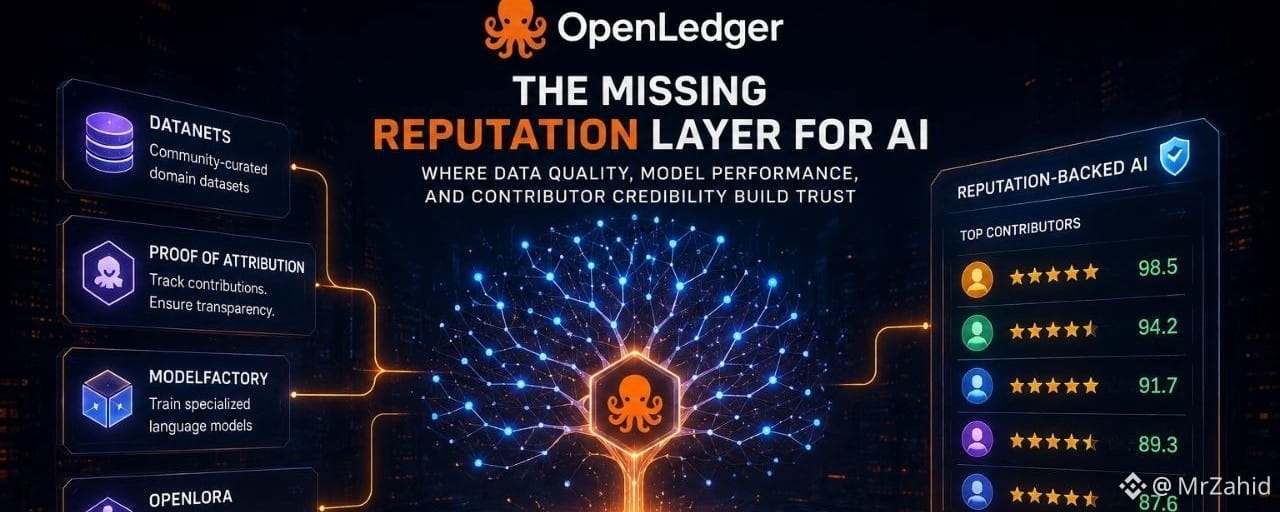
OpenLedger isn’t only trying to host AI models on-chain. The bigger play seems to be creating an economic system where data quality, model performance, and contributor credibility are all connected through transparent attribution. Their infrastructure combines Datanets, Proof of Attribution, ModelFactory, and OpenLoRA into a full AI lifecycle stack.
The interesting part? This creates the foundation for reputation-backed AI.
And honestly, I think that narrative is massively underrated right now.
Most AI systems today operate like black boxes. You ask a question, get an answer, and just hope the underlying data wasn’t garbage. But OpenLedger’s Proof of Attribution mechanism is designed to track which datasets and contributors influenced model outputs.
That changes incentives completely.
Imagine a crypto research Datanet focused only on governance risk. Contributors upload governance summaries, treasury changes, validator behavior, proposal discussions, and voting anomalies. Over time, the system can identify which contributors consistently provide high-signal information that improves downstream AI outputs.
Now suddenly contributors aren’t just “users.”
They become reputation-bearing intelligence providers.
That’s a huge shift.
Because the future AI economy probably won’t reward raw content volume. It’ll reward verified usefulness.
As a trader, this matters a lot to me. Some of the best market insights I’ve ever found came from niche researchers with tiny audiences but insanely accurate pattern recognition. Current AI systems flatten all information into the same soup. OpenLedger’s structure potentially allows weighting based on attribution quality and historical contribution value.
That’s closer to how real decision-making works.
I also think OpenLedger’s focus on Specialized Language Models (SLMs) is smarter than the market gives credit for. Research around OpenLedger repeatedly emphasizes domain-specific intelligence instead of trying to build one giant universal model.
And honestly… that aligns with how alpha actually works.
General knowledge rarely creates edge. Specialized context does.
A DeFi liquidation agent doesn’t need to understand poetry.
A governance-risk model doesn’t need movie trivia.
A trading copilot doesn’t need broad internet noise.
They need sharp, focused context trained on high-quality domain data.
OpenLedger’s Datanets are basically designed around that principle. Communities create targeted datasets, contributors improve them, models specialize on them, and attribution mechanisms distribute rewards back through the system.
What I find bullish isn’t just the technology. It’s the economic design.
If OpenLedger succeeds, the AI market may stop rewarding scale alone and start rewarding verifiable expertise.
That’s a completely different internet economy.
The platforms that dominated Web2 monetized attention.
The next generation of AI infrastructure may monetize credible intelligence.
And if that happens, OpenLedger could become much more than an AI chain. It could become the trust framework that autonomous agents use to evaluate which information - and which contributors - actually deserve influence 🤝
@Openledger $OPEN #OpenLedger
OpenLedger Might Be Building the Missing Reputation Layer for AI
One thing I keep noticing in crypto AI is that everyone talks about models, but almost nobody talks about reputation.
That’s weird because in trading, reputation is basically everything.
I don’t trust a signal just because it sounds smart. I trust it when I know:
where the data came from,
who contributed it,
whether those contributors were accurate before,
and whether incentives are aligned.
That’s why OpenLedger’s architecture feels more important than people realize.
OpenLedger isn’t only trying to host AI models on-chain. The bigger play seems to be creating an economic system where data quality, model performance, and contributor credibility are all connected through transparent attribution. Their infrastructure combines Datanets, Proof of Attribution, ModelFactory, and OpenLoRA into a full AI lifecycle stack.
The interesting part? This creates the foundation for reputation-backed AI.
And honestly, I think that narrative is massively underrated right now.
Most AI systems today operate like black boxes. You ask a question, get an answer, and just hope the underlying data wasn’t garbage. But OpenLedger’s Proof of Attribution mechanism is designed to track which datasets and contributors influenced model outputs.
That changes incentives completely.
Imagine a crypto research Datanet focused only on governance risk. Contributors upload governance summaries, treasury changes, validator behavior, proposal discussions, and voting anomalies. Over time, the system can identify which contributors consistently provide high-signal information that improves downstream AI outputs.
Now suddenly contributors aren’t just “users.”
They become reputation-bearing intelligence providers.
That’s a huge shift.
Because the future AI economy probably won’t reward raw content volume. It’ll reward verified usefulness.
As a trader, this matters a lot to me. Some of the best market insights I’ve ever found came from niche researchers with tiny audiences but insanely accurate pattern recognition. Current AI systems flatten all information into the same soup. OpenLedger’s structure potentially allows weighting based on attribution quality and historical contribution value.
That’s closer to how real decision-making works.
I also think OpenLedger’s focus on Specialized Language Models (SLMs) is smarter than the market gives credit for. Research around OpenLedger repeatedly emphasizes domain-specific intelligence instead of trying to build one giant universal model.
And honestly… that aligns with how alpha actually works.
General knowledge rarely creates edge. Specialized context does.
A DeFi liquidation agent doesn’t need to understand poetry.
A governance-risk model doesn’t need movie trivia.
A trading copilot doesn’t need broad internet noise.
They need sharp, focused context trained on high-quality domain data.
OpenLedger’s Datanets are basically designed around that principle. Communities create targeted datasets, contributors improve them, models specialize on them, and attribution mechanisms distribute rewards back through the system.
What I find bullish isn’t just the technology. It’s the economic design.
If OpenLedger succeeds, the AI market may stop rewarding scale alone and start rewarding verifiable expertise.
That’s a completely different internet economy.
The platforms that dominated Web2 monetized attention.
The next generation of AI infrastructure may monetize credible intelligence.
And if that happens, OpenLedger could become much more than an AI chain. It could become the trust framework that autonomous agents use to evaluate which information - and which contributors - actually deserve influence 🤝
@OpenLedger $OPEN #OpenLedger
That’s weird because in trading, reputation is basically everything.
I don’t trust a signal just because it sounds smart. I trust it when I know:
where the data came from,
who contributed it,
whether those contributors were accurate before,
and whether incentives are aligned.
That’s why OpenLedger’s architecture feels more important than people realize.
OpenLedger isn’t only trying to host AI models on-chain. The bigger play seems to be creating an economic system where data quality, model performance, and contributor credibility are all connected through transparent attribution. Their infrastructure combines Datanets, Proof of Attribution, ModelFactory, and OpenLoRA into a full AI lifecycle stack.
The interesting part? This creates the foundation for reputation-backed AI.
And honestly, I think that narrative is massively underrated right now.
Most AI systems today operate like black boxes. You ask a question, get an answer, and just hope the underlying data wasn’t garbage. But OpenLedger’s Proof of Attribution mechanism is designed to track which datasets and contributors influenced model outputs.
That changes incentives completely.
Imagine a crypto research Datanet focused only on governance risk. Contributors upload governance summaries, treasury changes, validator behavior, proposal discussions, and voting anomalies. Over time, the system can identify which contributors consistently provide high-signal information that improves downstream AI outputs.
Now suddenly contributors aren’t just “users.”
They become reputation-bearing intelligence providers.
That’s a huge shift.
Because the future AI economy probably won’t reward raw content volume. It’ll reward verified usefulness.
As a trader, this matters a lot to me. Some of the best market insights I’ve ever found came from niche researchers with tiny audiences but insanely accurate pattern recognition. Current AI systems flatten all information into the same soup. OpenLedger’s structure potentially allows weighting based on attribution quality and historical contribution value.
That’s closer to how real decision-making works.
I also think OpenLedger’s focus on Specialized Language Models (SLMs) is smarter than the market gives credit for. Research around OpenLedger repeatedly emphasizes domain-specific intelligence instead of trying to build one giant universal model.
And honestly… that aligns with how alpha actually works.
General knowledge rarely creates edge. Specialized context does.
A DeFi liquidation agent doesn’t need to understand poetry.
A governance-risk model doesn’t need movie trivia.
A trading copilot doesn’t need broad internet noise.
They need sharp, focused context trained on high-quality domain data.
OpenLedger’s Datanets are basically designed around that principle. Communities create targeted datasets, contributors improve them, models specialize on them, and attribution mechanisms distribute rewards back through the system.
What I find bullish isn’t just the technology. It’s the economic design.
If OpenLedger succeeds, the AI market may stop rewarding scale alone and start rewarding verifiable expertise.
That’s a completely different internet economy.
The platforms that dominated Web2 monetized attention.
The next generation of AI infrastructure may monetize credible intelligence.
And if that happens, OpenLedger could become much more than an AI chain. It could become the trust framework that autonomous agents use to evaluate which information - and which contributors - actually deserve influence 🤝
@OpenLedger $OPEN #OpenLedger
1
318
·
--
Verified
#openledger $OPEN
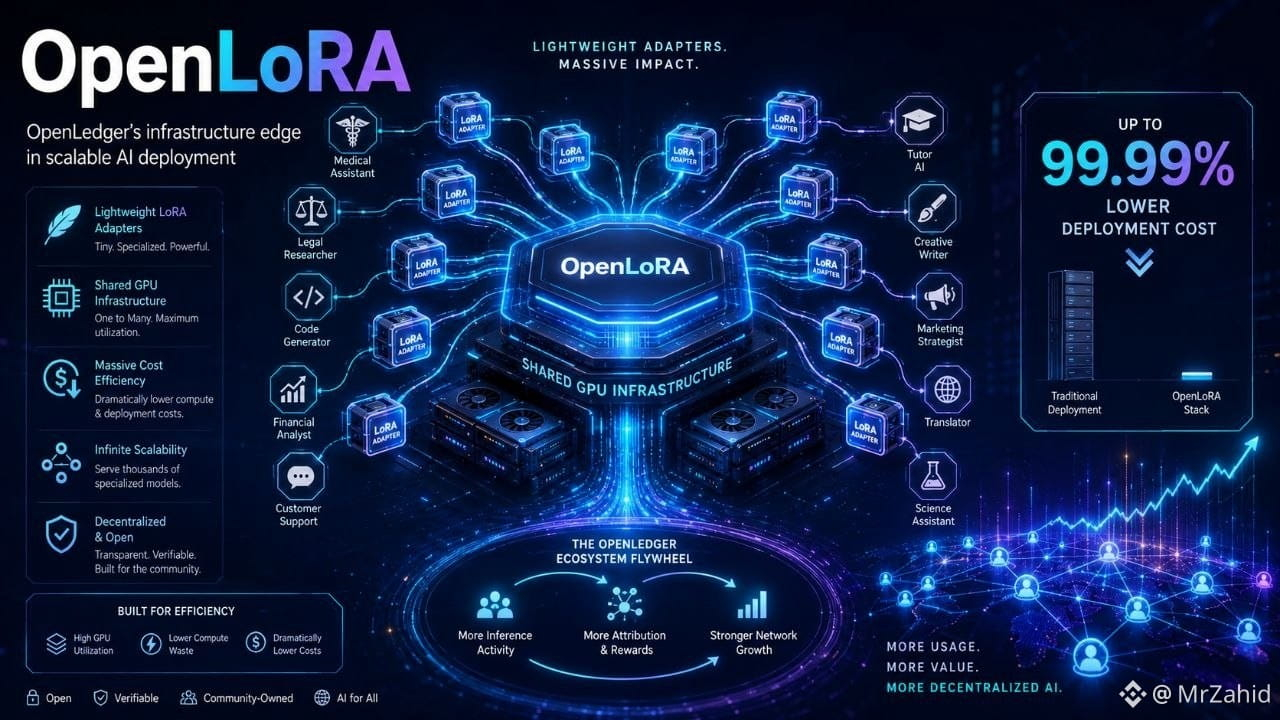
I’ve been digging into OpenLedger’s OpenLoRA stack lately, and ngl, this might be the project’s strongest technical edge right now. Everyone talks about AI agents and decentralized models, but very few people focus on the ugly reality behind them: deployment costs. Running specialized models at scale is insanely expensive if every fine-tuned version needs separate GPU resources.
OpenLoRA attacks that directly. Instead of loading entire models repeatedly, OpenLedger dynamically serves lightweight LoRA adapters on shared infrastructure. The docs and ecosystem reports claim this can reduce deployment costs by up to 99.99%, which honestly sounds wild at first… but the logic checks out when you think about GPU memory efficiency and adapter reuse.
What makes this bullish for me isn’t hype, it’s scalability. If OpenLedger wants thousands of niche AI models running simultaneously, infrastructure efficiency matters more than flashy branding. Otherwise the economics collapse fast.
From a trader perspective, I’m watching whether OpenLoRA adoption actually converts into network activity. More deployed specialized models should theoretically mean more inference calls, more attribution events, and stronger demand around the OPEN ecosystem. That’s the flywheel.
Personally, I think the market still prices OpenLedger mostly as “another AI coin.” But if OpenLoRA becomes reliable infrastructure for specialized AI deployment, the valuation narrative could shift completely. ⚡
@Openledger
#openledger $OPEN
I’ve been digging into OpenLedger’s OpenLoRA stack lately, and ngl, this might be the project’s strongest technical edge right now. Everyone talks about AI agents and decentralized models, but very few people focus on the ugly reality behind them: deployment costs. Running specialized models at scale is insanely expensive if every fine-tuned version needs separate GPU resources.
OpenLoRA attacks that directly. Instead of loading entire models repeatedly, OpenLedger dynamically serves lightweight LoRA adapters on shared infrastructure. The docs and ecosystem reports claim this can reduce deployment costs by up to 99.99%, which honestly sounds wild at first… but the logic checks out when you think about GPU memory efficiency and adapter reuse.
What makes this bullish for me isn’t hype, it’s scalability. If OpenLedger wants thousands of niche AI models running simultaneously, infrastructure efficiency matters more than flashy branding. Otherwise the economics collapse fast.
From a trader perspective, I’m watching whether OpenLoRA adoption actually converts into network activity. More deployed specialized models should theoretically mean more inference calls, more attribution events, and stronger demand around the OPEN ecosystem. That’s the flywheel.
Personally, I think the market still prices OpenLedger mostly as “another AI coin.” But if OpenLoRA becomes reliable infrastructure for specialized AI deployment, the valuation narrative could shift completely. ⚡
@OpenLedger
I’ve been digging into OpenLedger’s OpenLoRA stack lately, and ngl, this might be the project’s strongest technical edge right now. Everyone talks about AI agents and decentralized models, but very few people focus on the ugly reality behind them: deployment costs. Running specialized models at scale is insanely expensive if every fine-tuned version needs separate GPU resources.
OpenLoRA attacks that directly. Instead of loading entire models repeatedly, OpenLedger dynamically serves lightweight LoRA adapters on shared infrastructure. The docs and ecosystem reports claim this can reduce deployment costs by up to 99.99%, which honestly sounds wild at first… but the logic checks out when you think about GPU memory efficiency and adapter reuse.
What makes this bullish for me isn’t hype, it’s scalability. If OpenLedger wants thousands of niche AI models running simultaneously, infrastructure efficiency matters more than flashy branding. Otherwise the economics collapse fast.
From a trader perspective, I’m watching whether OpenLoRA adoption actually converts into network activity. More deployed specialized models should theoretically mean more inference calls, more attribution events, and stronger demand around the OPEN ecosystem. That’s the flywheel.
Personally, I think the market still prices OpenLedger mostly as “another AI coin.” But if OpenLoRA becomes reliable infrastructure for specialized AI deployment, the valuation narrative could shift completely. ⚡
@OpenLedger
1
597
·
--
Article
OpenLedger Is Quietly Building the “Bloomberg Terminal” Layer for AI AgentsMost people still think AI infrastructure is mainly about models. Bigger models, faster models, cheaper inference. But after spending more time researching OpenLedger, I think the more important layer might actually be structured intelligence.
That’s the underrated part of OpenLedger’s vision.
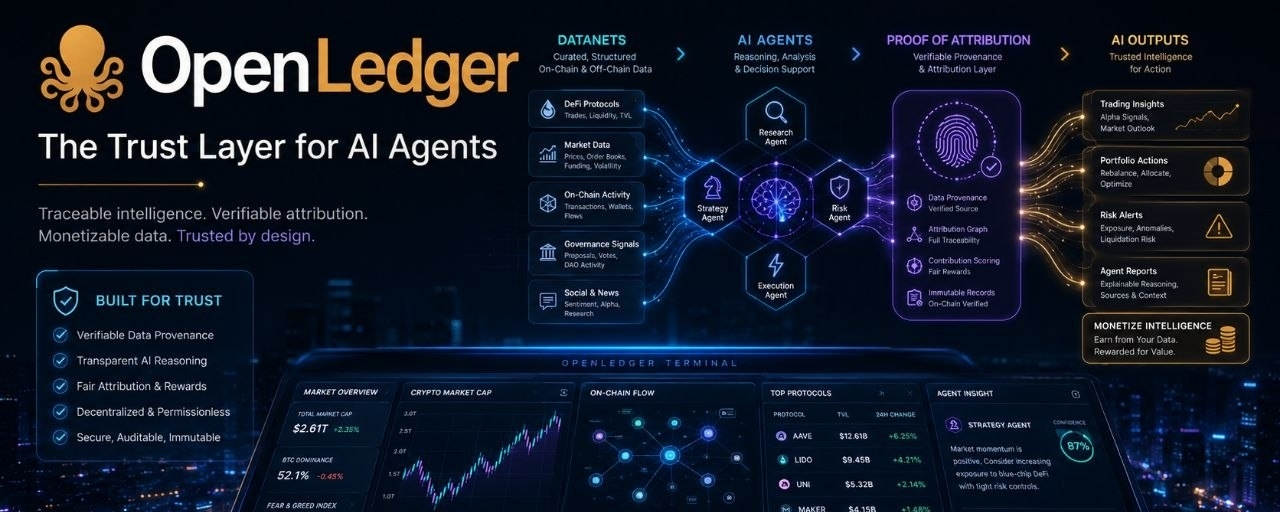
OpenLedger positions itself as an AI blockchain where data, models, and agents become traceable and monetizable through systems like Datanets and Proof of Attribution. Instead of treating datasets like disposable fuel, OpenLedger treats them like economic assets that can continuously generate value when models or agents use them.
And honestly? That changes how I think about AI trading systems completely.
In traditional crypto trading, edge usually comes from information asymmetry. Some traders react faster to governance changes. Others monitor unlocks, liquidity shifts, whale wallets, validator activity, GitHub commits, or social rotations before the market fully prices them in.
But AI agents today mostly scrape generic internet data with weak attribution. That creates two problems:
1. The data quality is inconsistent.
2. Nobody really knows which data actually influenced the output.
OpenLedger’s Datanet structure feels designed to solve this exact issue. Specialized communities can create domain-specific data layers for areas like DeFi, governance, AI tooling, security exploits, or on-chain analytics. OpenLedger explains that contributors upload and validate data inside Datanets, while all contribution history is tracked on-chain.
That’s important because good AI agents are really just context engines.
A strong trading agent shouldn’t only answer:
> “What’s happening?”
It should answer:
> “Why is this happening, which datasets support it, and how reliable are those datasets?”
This is where OpenLedger’s Proof of Attribution becomes more interesting than people realize. Their attribution system links model outputs back to specific data contributions and keeps immutable records of influence and provenance.
For builders, that unlocks a completely different AI economy.
Imagine a DeFi analyst who consistently uploads high-signal governance summaries into a Datanet. If those summaries repeatedly influence successful agent outputs, the contributor can theoretically continue earning from future usage instead of getting paid once and forgotten. That’s closer to owning productive digital infrastructure than selling content.
And from a trader’s perspective, attribution creates something AI desperately lacks right now: confidence scoring with accountability.
Personally, I’d trust an OpenLedger-powered agent more if it showed:
which Datanets influenced the answer,
how recent the supporting data is,
whether the signal historically performed well,
and which contributors consistently produced high-quality insights.
That’s basically the beginning of an AI-native research terminal.
What makes this narrative stronger is that the broader market is moving in the same direction. Recent decentralized AI research is increasingly exploring blockchain-based inference verification and auditable AI execution systems instead of black-box generation alone. OpenLedger’s architecture fits naturally into that shift because it focuses on provenance, attribution, and explainability at the infrastructure layer.
I think people are still underestimating how valuable traceable intelligence will become.
The internet monetized attention. Crypto monetized coordination. AI may monetize verified context.
And if that happens, OpenLedger’s biggest product may not just be AI models. It could become the trust layer that AI agents rely on when money, automation, and decisions are all happening on-chain 🤝
@Openledger $OPEN #OpenLedger
OpenLedger Is Quietly Building the “Bloomberg Terminal” Layer for AI Agents
Most people still think AI infrastructure is mainly about models. Bigger models, faster models, cheaper inference. But after spending more time researching OpenLedger, I think the more important layer might actually be structured intelligence.
That’s the underrated part of OpenLedger’s vision.
OpenLedger positions itself as an AI blockchain where data, models, and agents become traceable and monetizable through systems like Datanets and Proof of Attribution. Instead of treating datasets like disposable fuel, OpenLedger treats them like economic assets that can continuously generate value when models or agents use them.
And honestly? That changes how I think about AI trading systems completely.
In traditional crypto trading, edge usually comes from information asymmetry. Some traders react faster to governance changes. Others monitor unlocks, liquidity shifts, whale wallets, validator activity, GitHub commits, or social rotations before the market fully prices them in.
But AI agents today mostly scrape generic internet data with weak attribution. That creates two problems:
1. The data quality is inconsistent.
2. Nobody really knows which data actually influenced the output.
OpenLedger’s Datanet structure feels designed to solve this exact issue. Specialized communities can create domain-specific data layers for areas like DeFi, governance, AI tooling, security exploits, or on-chain analytics. OpenLedger explains that contributors upload and validate data inside Datanets, while all contribution history is tracked on-chain.
That’s important because good AI agents are really just context engines.
A strong trading agent shouldn’t only answer:
> “What’s happening?”
It should answer:
> “Why is this happening, which datasets support it, and how reliable are those datasets?”
This is where OpenLedger’s Proof of Attribution becomes more interesting than people realize. Their attribution system links model outputs back to specific data contributions and keeps immutable records of influence and provenance.
For builders, that unlocks a completely different AI economy.
Imagine a DeFi analyst who consistently uploads high-signal governance summaries into a Datanet. If those summaries repeatedly influence successful agent outputs, the contributor can theoretically continue earning from future usage instead of getting paid once and forgotten. That’s closer to owning productive digital infrastructure than selling content.
And from a trader’s perspective, attribution creates something AI desperately lacks right now: confidence scoring with accountability.
Personally, I’d trust an OpenLedger-powered agent more if it showed:
which Datanets influenced the answer,
how recent the supporting data is,
whether the signal historically performed well,
and which contributors consistently produced high-quality insights.
That’s basically the beginning of an AI-native research terminal.
What makes this narrative stronger is that the broader market is moving in the same direction. Recent decentralized AI research is increasingly exploring blockchain-based inference verification and auditable AI execution systems instead of black-box generation alone. OpenLedger’s architecture fits naturally into that shift because it focuses on provenance, attribution, and explainability at the infrastructure layer.
I think people are still underestimating how valuable traceable intelligence will become.
The internet monetized attention. Crypto monetized coordination. AI may monetize verified context.
And if that happens, OpenLedger’s biggest product may not just be AI models. It could become the trust layer that AI agents rely on when money, automation, and decisions are all happening on-chain 🤝
@OpenLedger $OPEN #OpenLedger
That’s the underrated part of OpenLedger’s vision.
OpenLedger positions itself as an AI blockchain where data, models, and agents become traceable and monetizable through systems like Datanets and Proof of Attribution. Instead of treating datasets like disposable fuel, OpenLedger treats them like economic assets that can continuously generate value when models or agents use them.
And honestly? That changes how I think about AI trading systems completely.
In traditional crypto trading, edge usually comes from information asymmetry. Some traders react faster to governance changes. Others monitor unlocks, liquidity shifts, whale wallets, validator activity, GitHub commits, or social rotations before the market fully prices them in.
But AI agents today mostly scrape generic internet data with weak attribution. That creates two problems:
1. The data quality is inconsistent.
2. Nobody really knows which data actually influenced the output.
OpenLedger’s Datanet structure feels designed to solve this exact issue. Specialized communities can create domain-specific data layers for areas like DeFi, governance, AI tooling, security exploits, or on-chain analytics. OpenLedger explains that contributors upload and validate data inside Datanets, while all contribution history is tracked on-chain.
That’s important because good AI agents are really just context engines.
A strong trading agent shouldn’t only answer:
> “What’s happening?”
It should answer:
> “Why is this happening, which datasets support it, and how reliable are those datasets?”
This is where OpenLedger’s Proof of Attribution becomes more interesting than people realize. Their attribution system links model outputs back to specific data contributions and keeps immutable records of influence and provenance.
For builders, that unlocks a completely different AI economy.
Imagine a DeFi analyst who consistently uploads high-signal governance summaries into a Datanet. If those summaries repeatedly influence successful agent outputs, the contributor can theoretically continue earning from future usage instead of getting paid once and forgotten. That’s closer to owning productive digital infrastructure than selling content.
And from a trader’s perspective, attribution creates something AI desperately lacks right now: confidence scoring with accountability.
Personally, I’d trust an OpenLedger-powered agent more if it showed:
which Datanets influenced the answer,
how recent the supporting data is,
whether the signal historically performed well,
and which contributors consistently produced high-quality insights.
That’s basically the beginning of an AI-native research terminal.
What makes this narrative stronger is that the broader market is moving in the same direction. Recent decentralized AI research is increasingly exploring blockchain-based inference verification and auditable AI execution systems instead of black-box generation alone. OpenLedger’s architecture fits naturally into that shift because it focuses on provenance, attribution, and explainability at the infrastructure layer.
I think people are still underestimating how valuable traceable intelligence will become.
The internet monetized attention. Crypto monetized coordination. AI may monetize verified context.
And if that happens, OpenLedger’s biggest product may not just be AI models. It could become the trust layer that AI agents rely on when money, automation, and decisions are all happening on-chain 🤝
@OpenLedger $OPEN #OpenLedger
1
363
·
--
#genius $GENIUS
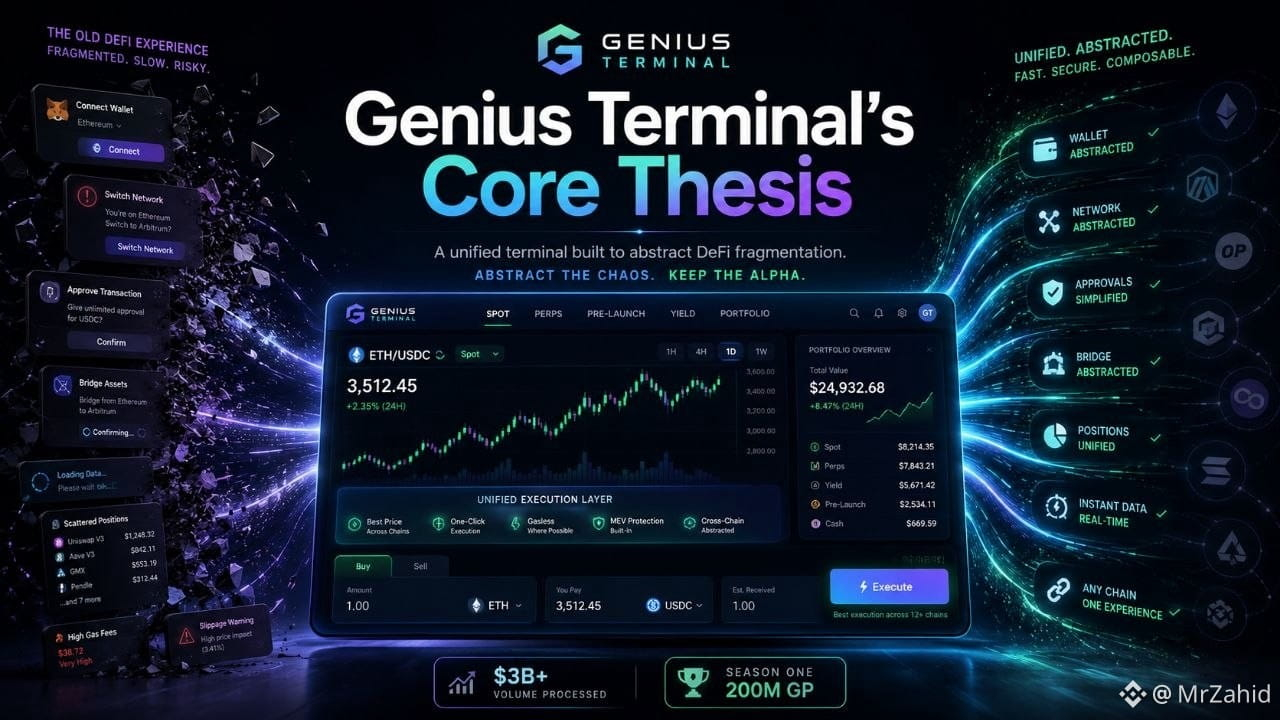
Genius Terminal’s Core Thesis
I just finished digging through the TradeGenius docs, and honestly, the hot take is simple: this isn’t trying to be another DeFi dashboard, it’s trying to make dashboards feel outdated. What stood out to me is how aggressively Genius Terminal attacks the old onchain pain points: wallet popups, network switching, approvals, bridge stress, scattered positions, and the classic “why is this taking forever?” moment every trader knows too well.
The core idea is a single terminal where spot, perps, pre-launch markets, yield, and portfolio actions sit under one cleaner execution layer. That matters because speed isn’t just convenience in crypto; it’s edge. The docs frame DeFi’s problem as fragmentation, not decentralization, and i think that’s the sharpest insight here. Traders don’t really care how many chains are involved when a narrative is moving. They care whether they can enter fast, size properly, and avoid getting clipped.
Data-wise, the rewards page says Genius processed over $3B in volume and built Season One around a fixed 200M GP supply. That tells me there’s real usage, but also a deliberate push toward trader quality, anti-bot design, and long-term participation. It’s not perfect, but the direction feels clear: abstract the chaos, keep the alpha.
Sources used: TradeGenius positions the product as a chain-invisible, signatureless, unified terminal for spot, perps, pre-launch, and yield; its docs also mention over $3B processed volume and 200M Season One GP supply. @GeniusOfficial
#genius $GENIUS
Genius Terminal’s Core Thesis
I just finished digging through the TradeGenius docs, and honestly, the hot take is simple: this isn’t trying to be another DeFi dashboard, it’s trying to make dashboards feel outdated. What stood out to me is how aggressively Genius Terminal attacks the old onchain pain points: wallet popups, network switching, approvals, bridge stress, scattered positions, and the classic “why is this taking forever?” moment every trader knows too well.
The core idea is a single terminal where spot, perps, pre-launch markets, yield, and portfolio actions sit under one cleaner execution layer. That matters because speed isn’t just convenience in crypto; it’s edge. The docs frame DeFi’s problem as fragmentation, not decentralization, and i think that’s the sharpest insight here. Traders don’t really care how many chains are involved when a narrative is moving. They care whether they can enter fast, size properly, and avoid getting clipped.
Data-wise, the rewards page says Genius processed over $3B in volume and built Season One around a fixed 200M GP supply. That tells me there’s real usage, but also a deliberate push toward trader quality, anti-bot design, and long-term participation. It’s not perfect, but the direction feels clear: abstract the chaos, keep the alpha.
Sources used: TradeGenius positions the product as a chain-invisible, signatureless, unified terminal for spot, perps, pre-launch, and yield; its docs also mention over $3B processed volume and 200M Season One GP supply. @GeniusOfficial
Genius Terminal’s Core Thesis
I just finished digging through the TradeGenius docs, and honestly, the hot take is simple: this isn’t trying to be another DeFi dashboard, it’s trying to make dashboards feel outdated. What stood out to me is how aggressively Genius Terminal attacks the old onchain pain points: wallet popups, network switching, approvals, bridge stress, scattered positions, and the classic “why is this taking forever?” moment every trader knows too well.
The core idea is a single terminal where spot, perps, pre-launch markets, yield, and portfolio actions sit under one cleaner execution layer. That matters because speed isn’t just convenience in crypto; it’s edge. The docs frame DeFi’s problem as fragmentation, not decentralization, and i think that’s the sharpest insight here. Traders don’t really care how many chains are involved when a narrative is moving. They care whether they can enter fast, size properly, and avoid getting clipped.
Data-wise, the rewards page says Genius processed over $3B in volume and built Season One around a fixed 200M GP supply. That tells me there’s real usage, but also a deliberate push toward trader quality, anti-bot design, and long-term participation. It’s not perfect, but the direction feels clear: abstract the chaos, keep the alpha.
Sources used: TradeGenius positions the product as a chain-invisible, signatureless, unified terminal for spot, perps, pre-launch, and yield; its docs also mention over $3B processed volume and 200M Season One GP supply. @GeniusOfficial
282
·
--
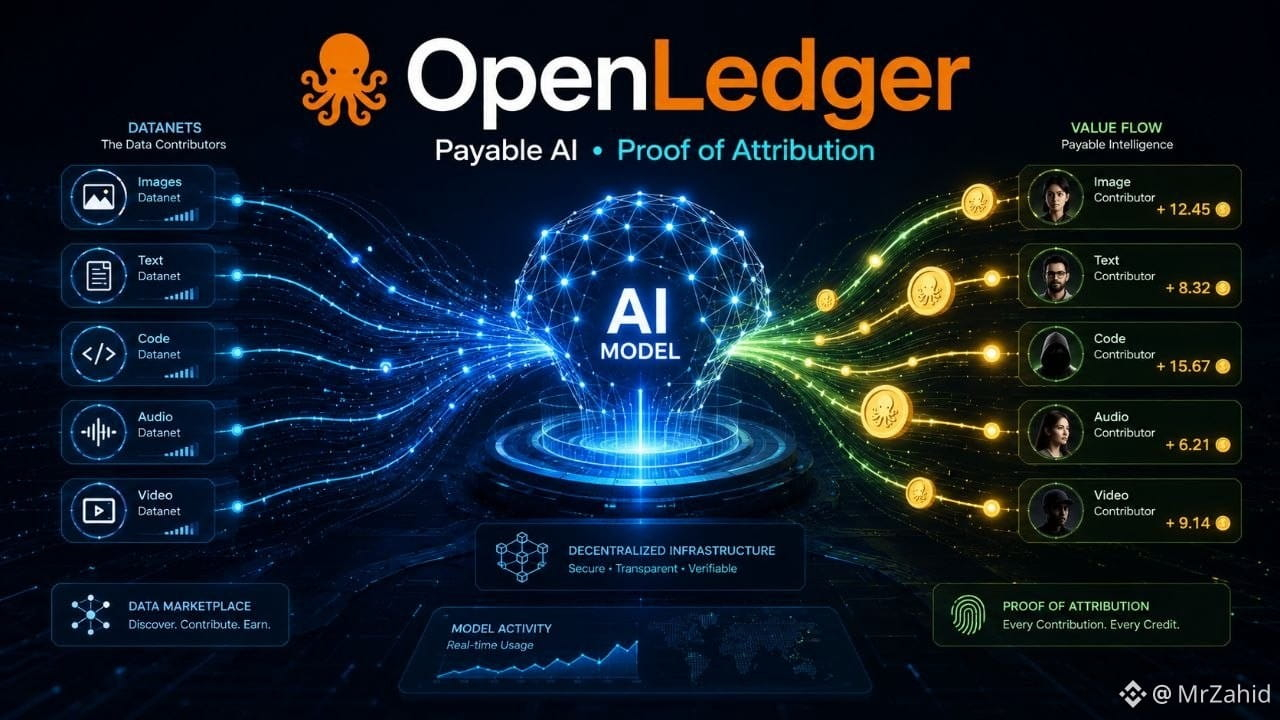
I’ve been looking at OpenLedger’s Payable AI idea, and honestly, this is the angle that feels most underrated to me. Most AI projects talk about compute, agents, or “decentralized intelligence,” but OpenLedger is going after the messy money layer: who actually gets paid when data helps a model perform?
The core piece is Proof of Attribution. Instead of treating datasets like invisible backend fuel, OpenLedger tracks how data contributes across training and inference, then connects that value back to contributors. That’s a pretty big shift. If it works at scale, data stops being a one-time upload and starts acting more like a yield-producing asset.
From a trading view, I wouldn’t just stare at OPEN candles and scream “AI narrative” 😂. I’d watch usage: more Datanets, more model activity, and stronger demand for tools like Model Factory/OpenLoRA. Binance’s live data recently showed OPEN around the $0.18–$0.20 zone with roughly 290.8M circulating supply, so sentiment is clearly cooler than launch hype.
That’s actually where the opportunity is, imo. If OpenLedger turns attribution into real revenue flow, not just a buzzword, the market may eventually reprice it as AI infrastructure, not another random token.
@Openledger #OpenLedger $OPEN
I’ve been looking at OpenLedger’s Payable AI idea, and honestly, this is the angle that feels most underrated to me. Most AI projects talk about compute, agents, or “decentralized intelligence,” but OpenLedger is going after the messy money layer: who actually gets paid when data helps a model perform?
The core piece is Proof of Attribution. Instead of treating datasets like invisible backend fuel, OpenLedger tracks how data contributes across training and inference, then connects that value back to contributors. That’s a pretty big shift. If it works at scale, data stops being a one-time upload and starts acting more like a yield-producing asset.
From a trading view, I wouldn’t just stare at OPEN candles and scream “AI narrative” 😂. I’d watch usage: more Datanets, more model activity, and stronger demand for tools like Model Factory/OpenLoRA. Binance’s live data recently showed OPEN around the $0.18–$0.20 zone with roughly 290.8M circulating supply, so sentiment is clearly cooler than launch hype.
That’s actually where the opportunity is, imo. If OpenLedger turns attribution into real revenue flow, not just a buzzword, the market may eventually reprice it as AI infrastructure, not another random token.
@OpenLedger #OpenLedger $OPEN
The core piece is Proof of Attribution. Instead of treating datasets like invisible backend fuel, OpenLedger tracks how data contributes across training and inference, then connects that value back to contributors. That’s a pretty big shift. If it works at scale, data stops being a one-time upload and starts acting more like a yield-producing asset.
From a trading view, I wouldn’t just stare at OPEN candles and scream “AI narrative” 😂. I’d watch usage: more Datanets, more model activity, and stronger demand for tools like Model Factory/OpenLoRA. Binance’s live data recently showed OPEN around the $0.18–$0.20 zone with roughly 290.8M circulating supply, so sentiment is clearly cooler than launch hype.
That’s actually where the opportunity is, imo. If OpenLedger turns attribution into real revenue flow, not just a buzzword, the market may eventually reprice it as AI infrastructure, not another random token.
@OpenLedger #OpenLedger $OPEN
1
1
321
·
--
Article
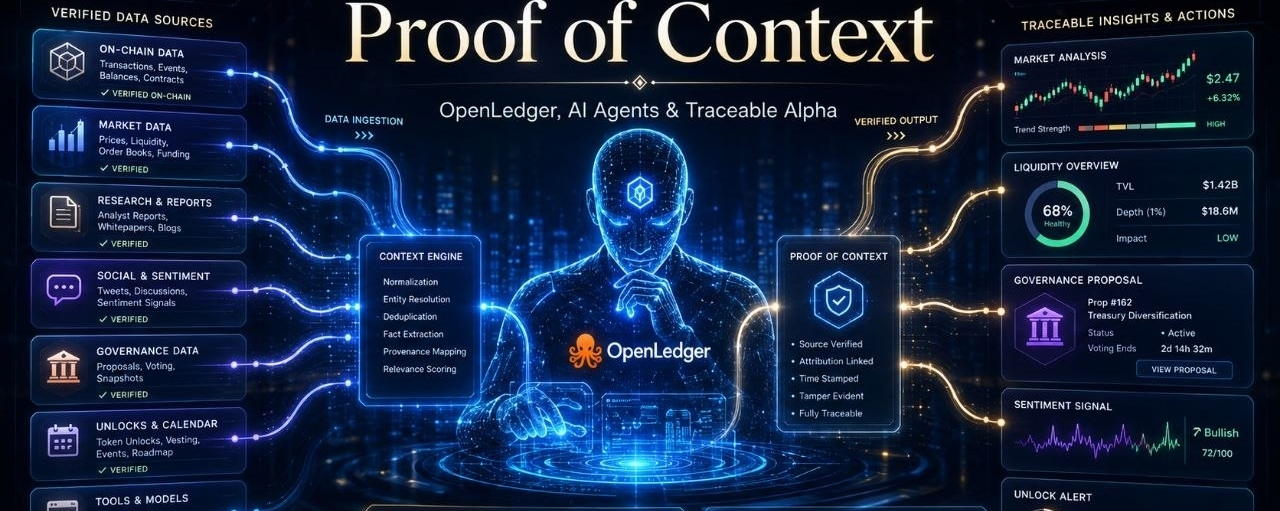
OpenLedger’s Real Edge Might Be “Proof of Context” for AI AgentsOne thing I’ve learned from trading crypto is that raw intelligence isn’t enough. Speed matters, sure. Better models matter too. But context is what usually separates a decent call from a wrecked trade. A model can say “this token looks strong,” but if it misses an unlock, a governance vote, thin liquidity, bad data, or a sudden sentiment shift, that “strong” signal can turn into exit liquidity real quick 😅
That’s why OpenLedger’s AI-agent direction is interesting to me. @Openledger describes itself as AI-blockchain infrastructure for training and deploying specialized models with community-owned datasets called Datanets, while actions like dataset uploads, model training, rewards, and governance happen on-chain. That matters because AI agents need more than prompts. They need trusted context, traceable data, and a reason for people to keep improving the knowledge layer behind them.
The topic I’m watching now is OpenLedger’s Model Context Protocol angle. In its agent-focused materials, OpenLedger explains MCP as a structure for giving models access to external state, tools, files, databases, and executable responses. It uses a client, server, and router flow so models can receive context and interact with tools in a more organized way.
For builders, that’s not just nerdy infrastructure. It’s the difference between a chatbot and a useful agent.
Imagine building a market research agent on OpenLedger. A basic bot might summarize token news. A better bot might pull liquidity data, compare it with social momentum, scan docs, check governance proposals, and flag unlock risk. But the real alpha comes when the agent can explain where its view came from and which data sources shaped the output. That’s where OpenLedger’s Proof of Attribution becomes powerful. OpenLedger positions Proof of Attribution as a way to trace AI outputs back to data sources and contributors, which means contributors can be credited and rewarded instead of disappearing into a black-box training pipeline.
My trading logic here is simple: I don’t want an AI agent that only gives me confidence. I want one that gives me auditability. If an agent says, “high-risk setup,” I want to see whether that came from low liquidity, weak holder distribution, negative dev activity, or a previous pattern in contributed Datanets. Confidence without traceability is just vibes. Traceable confidence is a tool.
There’s also a scalability point. Recent RAG-MCP research found that retrieval-based tool selection can cut prompt tokens by over 50% and more than triple tool-selection accuracy in benchmark tests, which supports the broader idea that agents need smarter context routing, not giant overloaded prompts. OpenLedger’s agent stack fits that direction: specialized datasets, specialized models, context routing, and attribution mechanics all working together.
And market-wise, OPEN is already liquid enough to be watched seriously, with CoinGecko showing roughly $10M+ in 24-hour volume and a 1B max supply at the time of checking. That doesn’t mean “buy.” It means the market is actively pricing the narrative, so builders and traders should evaluate execution, not just hype.
The bigger picture? OpenLedger could make AI agents less like mysterious prediction machines and more like accountable market operators. For trading, research, DeFi risk, and on-chain automation, that’s a huge shift. In crypto, everyone loves alpha. But the next wave may be about proving where the alpha came from. $OPEN #OpenLedger
OpenLedger’s Real Edge Might Be “Proof of Context” for AI Agents
One thing I’ve learned from trading crypto is that raw intelligence isn’t enough. Speed matters, sure. Better models matter too. But context is what usually separates a decent call from a wrecked trade. A model can say “this token looks strong,” but if it misses an unlock, a governance vote, thin liquidity, bad data, or a sudden sentiment shift, that “strong” signal can turn into exit liquidity real quick 😅
That’s why OpenLedger’s AI-agent direction is interesting to me. @OpenLedger describes itself as AI-blockchain infrastructure for training and deploying specialized models with community-owned datasets called Datanets, while actions like dataset uploads, model training, rewards, and governance happen on-chain. That matters because AI agents need more than prompts. They need trusted context, traceable data, and a reason for people to keep improving the knowledge layer behind them.
The topic I’m watching now is OpenLedger’s Model Context Protocol angle. In its agent-focused materials, OpenLedger explains MCP as a structure for giving models access to external state, tools, files, databases, and executable responses. It uses a client, server, and router flow so models can receive context and interact with tools in a more organized way.
For builders, that’s not just nerdy infrastructure. It’s the difference between a chatbot and a useful agent.
Imagine building a market research agent on OpenLedger. A basic bot might summarize token news. A better bot might pull liquidity data, compare it with social momentum, scan docs, check governance proposals, and flag unlock risk. But the real alpha comes when the agent can explain where its view came from and which data sources shaped the output. That’s where OpenLedger’s Proof of Attribution becomes powerful. OpenLedger positions Proof of Attribution as a way to trace AI outputs back to data sources and contributors, which means contributors can be credited and rewarded instead of disappearing into a black-box training pipeline.
My trading logic here is simple: I don’t want an AI agent that only gives me confidence. I want one that gives me auditability. If an agent says, “high-risk setup,” I want to see whether that came from low liquidity, weak holder distribution, negative dev activity, or a previous pattern in contributed Datanets. Confidence without traceability is just vibes. Traceable confidence is a tool.
There’s also a scalability point. Recent RAG-MCP research found that retrieval-based tool selection can cut prompt tokens by over 50% and more than triple tool-selection accuracy in benchmark tests, which supports the broader idea that agents need smarter context routing, not giant overloaded prompts. OpenLedger’s agent stack fits that direction: specialized datasets, specialized models, context routing, and attribution mechanics all working together.
And market-wise, OPEN is already liquid enough to be watched seriously, with CoinGecko showing roughly $10M+ in 24-hour volume and a 1B max supply at the time of checking. That doesn’t mean “buy.” It means the market is actively pricing the narrative, so builders and traders should evaluate execution, not just hype.
The bigger picture? OpenLedger could make AI agents less like mysterious prediction machines and more like accountable market operators. For trading, research, DeFi risk, and on-chain automation, that’s a huge shift. In crypto, everyone loves alpha. But the next wave may be about proving where the alpha came from. $OPEN #OpenLedger
That’s why OpenLedger’s AI-agent direction is interesting to me. @OpenLedger describes itself as AI-blockchain infrastructure for training and deploying specialized models with community-owned datasets called Datanets, while actions like dataset uploads, model training, rewards, and governance happen on-chain. That matters because AI agents need more than prompts. They need trusted context, traceable data, and a reason for people to keep improving the knowledge layer behind them.
The topic I’m watching now is OpenLedger’s Model Context Protocol angle. In its agent-focused materials, OpenLedger explains MCP as a structure for giving models access to external state, tools, files, databases, and executable responses. It uses a client, server, and router flow so models can receive context and interact with tools in a more organized way.
For builders, that’s not just nerdy infrastructure. It’s the difference between a chatbot and a useful agent.
Imagine building a market research agent on OpenLedger. A basic bot might summarize token news. A better bot might pull liquidity data, compare it with social momentum, scan docs, check governance proposals, and flag unlock risk. But the real alpha comes when the agent can explain where its view came from and which data sources shaped the output. That’s where OpenLedger’s Proof of Attribution becomes powerful. OpenLedger positions Proof of Attribution as a way to trace AI outputs back to data sources and contributors, which means contributors can be credited and rewarded instead of disappearing into a black-box training pipeline.
My trading logic here is simple: I don’t want an AI agent that only gives me confidence. I want one that gives me auditability. If an agent says, “high-risk setup,” I want to see whether that came from low liquidity, weak holder distribution, negative dev activity, or a previous pattern in contributed Datanets. Confidence without traceability is just vibes. Traceable confidence is a tool.
There’s also a scalability point. Recent RAG-MCP research found that retrieval-based tool selection can cut prompt tokens by over 50% and more than triple tool-selection accuracy in benchmark tests, which supports the broader idea that agents need smarter context routing, not giant overloaded prompts. OpenLedger’s agent stack fits that direction: specialized datasets, specialized models, context routing, and attribution mechanics all working together.
And market-wise, OPEN is already liquid enough to be watched seriously, with CoinGecko showing roughly $10M+ in 24-hour volume and a 1B max supply at the time of checking. That doesn’t mean “buy.” It means the market is actively pricing the narrative, so builders and traders should evaluate execution, not just hype.
The bigger picture? OpenLedger could make AI agents less like mysterious prediction machines and more like accountable market operators. For trading, research, DeFi risk, and on-chain automation, that’s a huge shift. In crypto, everyone loves alpha. But the next wave may be about proving where the alpha came from. $OPEN #OpenLedger
1
330
·
--
I just finished checking OpenLedger’s docs and site, and the part that actually stuck with me isn't the usual “AI x blockchain” pitch. It's the attribution layer. OpenLedger is building around Datanets, community-owned datasets where uploads, model training, reward credits, and governance sit on-chain. That matters because AI value usually leaks upward: users create data, models absorb it, platforms monetize it, and contributors get vibes.
What OpenLedger flips is the payout logic. If Proof of Attribution can trace which data influenced an inference, then data becomes a tradable productive asset, not just raw fuel. That’s why i’d watch OpenLedger less like a meme chart and more like an infrastructure play: demand should come from builders needing verified data, specialized models, and agent workflows, not only retail hype.
My trading logic is simple: I don't chase green candles blindly. I’d track three signals first: Datanet growth, real app usage from AI Studio/OctoClaw, and whether OPEN volume stays healthy while broader AI tokens cool off. The docs even claim ModelFactory’s LoRA tuning can be up to 3.7x faster than traditional P-Tuning, which is a real efficiency angle.
Hot take: OpenLedger wins only if attribution becomes habit, not a feature. 🚀
Sources used: OpenLedger docs describe Datanets, on-chain actions, attribution, and governance; the site also highlights OctoClaw and AI Studio, while ModelFactory benchmarks mention up to 3.7x faster LoRA tuning.
@Openledger $OPEN #OpenLedger
I just finished checking OpenLedger’s docs and site, and the part that actually stuck with me isn't the usual “AI x blockchain” pitch. It's the attribution layer. OpenLedger is building around Datanets, community-owned datasets where uploads, model training, reward credits, and governance sit on-chain. That matters because AI value usually leaks upward: users create data, models absorb it, platforms monetize it, and contributors get vibes.
What OpenLedger flips is the payout logic. If Proof of Attribution can trace which data influenced an inference, then data becomes a tradable productive asset, not just raw fuel. That’s why i’d watch OpenLedger less like a meme chart and more like an infrastructure play: demand should come from builders needing verified data, specialized models, and agent workflows, not only retail hype.
My trading logic is simple: I don't chase green candles blindly. I’d track three signals first: Datanet growth, real app usage from AI Studio/OctoClaw, and whether OPEN volume stays healthy while broader AI tokens cool off. The docs even claim ModelFactory’s LoRA tuning can be up to 3.7x faster than traditional P-Tuning, which is a real efficiency angle.
Hot take: OpenLedger wins only if attribution becomes habit, not a feature. 🚀
Sources used: OpenLedger docs describe Datanets, on-chain actions, attribution, and governance; the site also highlights OctoClaw and AI Studio, while ModelFactory benchmarks mention up to 3.7x faster LoRA tuning.
@OpenLedger $OPEN #OpenLedger
What OpenLedger flips is the payout logic. If Proof of Attribution can trace which data influenced an inference, then data becomes a tradable productive asset, not just raw fuel. That’s why i’d watch OpenLedger less like a meme chart and more like an infrastructure play: demand should come from builders needing verified data, specialized models, and agent workflows, not only retail hype.
My trading logic is simple: I don't chase green candles blindly. I’d track three signals first: Datanet growth, real app usage from AI Studio/OctoClaw, and whether OPEN volume stays healthy while broader AI tokens cool off. The docs even claim ModelFactory’s LoRA tuning can be up to 3.7x faster than traditional P-Tuning, which is a real efficiency angle.
Hot take: OpenLedger wins only if attribution becomes habit, not a feature. 🚀
Sources used: OpenLedger docs describe Datanets, on-chain actions, attribution, and governance; the site also highlights OctoClaw and AI Studio, while ModelFactory benchmarks mention up to 3.7x faster LoRA tuning.
@OpenLedger $OPEN #OpenLedger
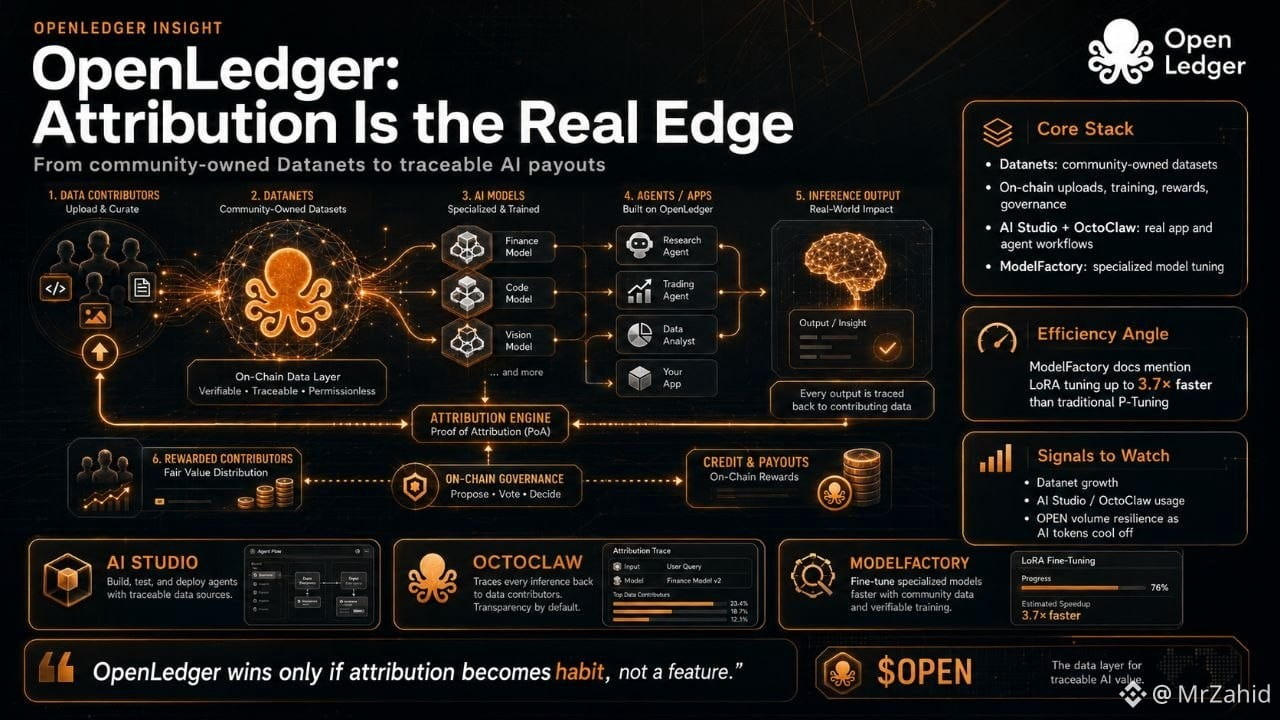
1
410
·
--
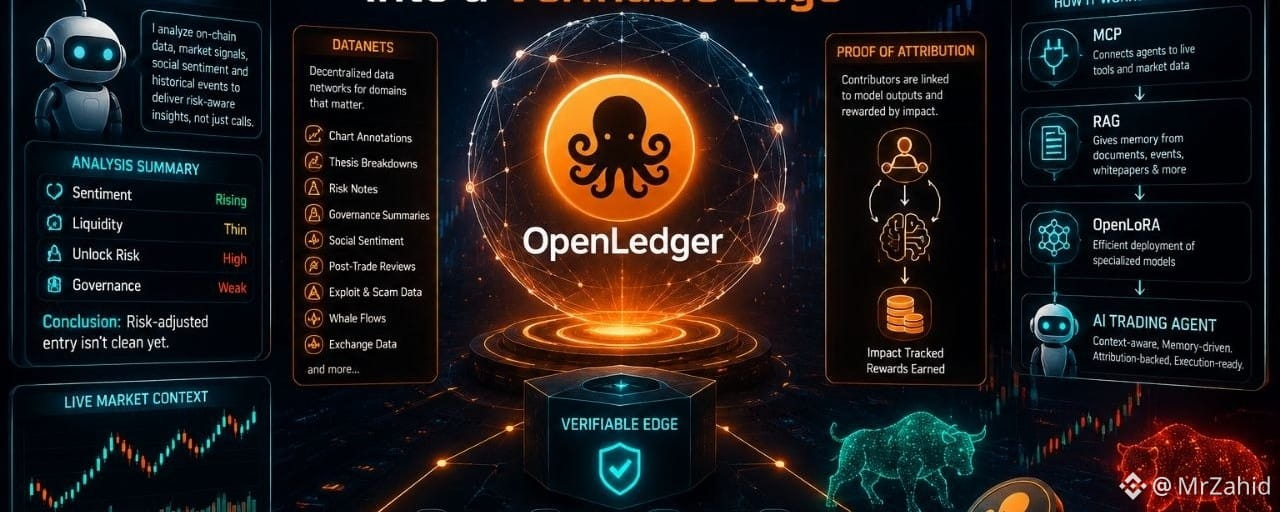
Article
OpenLedger Could Turn Trading AI From a Black Box Into a Verifiable EdgeI’ve tested a lot of “AI trading” narratives, and honestly, most of them feel like fancy wrappers around vague signals. They’ll say “bullish sentiment,” “smart money activity,” or “AI detected momentum,” but when i ask why, what data shaped that answer, or how the model reached that call, the trail usually disappears. That’s exactly where OpenLedger feels different to me.
@Openledger isn’t trying to be just another general-purpose chain. Its core idea is more specific: build an AI blockchain where data, models, agents, and contributors can be tracked, attributed, and monetized. That sounds technical, but the trading angle is simple. In markets, a signal is only as valuable as its source. If an AI agent tells me a token looks strong, i don’t just want the conclusion. I want to know what powered it: liquidity changes, governance history, social mindshare, token unlocks, previous exploit records, whale flows, or real-time exchange data.
This is why OpenLedger’s Datanets matter. A Datanet is basically a decentralized data network where people can contribute domain-specific datasets with verifiable attribution. For trading, that could mean chart annotations, thesis breakdowns, risk notes, token research, Discord sentiment, governance summaries, or post-trade reviews. The hot take? The next great trading model probably won’t come from one secret quant team. It’ll come from thousands of messy but useful human observations, cleaned, validated, and turned into model fuel.
Proof of Attribution is the part that makes this less extractive. In traditional AI, contributors often feed the machine and get nothing back. On OpenLedger, contributions can be linked to model outputs and rewarded based on impact. That’s a big deal because trading intelligence is compounding. One good liquidity warning, one accurate unlock note, one historical scam-pattern dataset-these can shape future decisions. If that influence is traceable, then data finally becomes an asset, not just free labor.
My trading logic here is straightforward: i don’t trust AI that only gives calls; i trust AI that explains constraints. A useful OpenLedger-based trading agent shouldn’t scream “buy.” It should say something like: “sentiment is rising, liquidity is thin, unlock risk is near, governance participation is weak, so risk-adjusted entry isn’t clean yet.” That’s how real traders think. Not hype first. Risk first.
OpenLedger’s MCP and RAG vision makes this even more practical. MCP can connect agents to live tools like exchanges, liquidity sources, or market APIs, while RAG gives the agent memory from documents, proposals, whitepapers, and past events. Add OpenLoRA for lightweight specialized model deployment, and suddenly the agent isn’t a static chatbot. It’s a modular trading system with context, memory, attribution, and execution logic.
So why am i watching OpenLedger closely? Because AI trading doesn’t need more mystery. It needs receipts. OpenLedger’s strongest promise is turning AI outputs into something traders can inspect, question, and price. And in a market full of noise, verifiable intelligence might become the real edge.
$OPEN #OpenLedger
OpenLedger Could Turn Trading AI From a Black Box Into a Verifiable Edge
I’ve tested a lot of “AI trading” narratives, and honestly, most of them feel like fancy wrappers around vague signals. They’ll say “bullish sentiment,” “smart money activity,” or “AI detected momentum,” but when i ask why, what data shaped that answer, or how the model reached that call, the trail usually disappears. That’s exactly where OpenLedger feels different to me.
@OpenLedger isn’t trying to be just another general-purpose chain. Its core idea is more specific: build an AI blockchain where data, models, agents, and contributors can be tracked, attributed, and monetized. That sounds technical, but the trading angle is simple. In markets, a signal is only as valuable as its source. If an AI agent tells me a token looks strong, i don’t just want the conclusion. I want to know what powered it: liquidity changes, governance history, social mindshare, token unlocks, previous exploit records, whale flows, or real-time exchange data.
This is why OpenLedger’s Datanets matter. A Datanet is basically a decentralized data network where people can contribute domain-specific datasets with verifiable attribution. For trading, that could mean chart annotations, thesis breakdowns, risk notes, token research, Discord sentiment, governance summaries, or post-trade reviews. The hot take? The next great trading model probably won’t come from one secret quant team. It’ll come from thousands of messy but useful human observations, cleaned, validated, and turned into model fuel.
Proof of Attribution is the part that makes this less extractive. In traditional AI, contributors often feed the machine and get nothing back. On OpenLedger, contributions can be linked to model outputs and rewarded based on impact. That’s a big deal because trading intelligence is compounding. One good liquidity warning, one accurate unlock note, one historical scam-pattern dataset-these can shape future decisions. If that influence is traceable, then data finally becomes an asset, not just free labor.
My trading logic here is straightforward: i don’t trust AI that only gives calls; i trust AI that explains constraints. A useful OpenLedger-based trading agent shouldn’t scream “buy.” It should say something like: “sentiment is rising, liquidity is thin, unlock risk is near, governance participation is weak, so risk-adjusted entry isn’t clean yet.” That’s how real traders think. Not hype first. Risk first.
OpenLedger’s MCP and RAG vision makes this even more practical. MCP can connect agents to live tools like exchanges, liquidity sources, or market APIs, while RAG gives the agent memory from documents, proposals, whitepapers, and past events. Add OpenLoRA for lightweight specialized model deployment, and suddenly the agent isn’t a static chatbot. It’s a modular trading system with context, memory, attribution, and execution logic.
So why am i watching OpenLedger closely? Because AI trading doesn’t need more mystery. It needs receipts. OpenLedger’s strongest promise is turning AI outputs into something traders can inspect, question, and price. And in a market full of noise, verifiable intelligence might become the real edge.
$OPEN #OpenLedger
@OpenLedger isn’t trying to be just another general-purpose chain. Its core idea is more specific: build an AI blockchain where data, models, agents, and contributors can be tracked, attributed, and monetized. That sounds technical, but the trading angle is simple. In markets, a signal is only as valuable as its source. If an AI agent tells me a token looks strong, i don’t just want the conclusion. I want to know what powered it: liquidity changes, governance history, social mindshare, token unlocks, previous exploit records, whale flows, or real-time exchange data.
This is why OpenLedger’s Datanets matter. A Datanet is basically a decentralized data network where people can contribute domain-specific datasets with verifiable attribution. For trading, that could mean chart annotations, thesis breakdowns, risk notes, token research, Discord sentiment, governance summaries, or post-trade reviews. The hot take? The next great trading model probably won’t come from one secret quant team. It’ll come from thousands of messy but useful human observations, cleaned, validated, and turned into model fuel.
Proof of Attribution is the part that makes this less extractive. In traditional AI, contributors often feed the machine and get nothing back. On OpenLedger, contributions can be linked to model outputs and rewarded based on impact. That’s a big deal because trading intelligence is compounding. One good liquidity warning, one accurate unlock note, one historical scam-pattern dataset-these can shape future decisions. If that influence is traceable, then data finally becomes an asset, not just free labor.
My trading logic here is straightforward: i don’t trust AI that only gives calls; i trust AI that explains constraints. A useful OpenLedger-based trading agent shouldn’t scream “buy.” It should say something like: “sentiment is rising, liquidity is thin, unlock risk is near, governance participation is weak, so risk-adjusted entry isn’t clean yet.” That’s how real traders think. Not hype first. Risk first.
OpenLedger’s MCP and RAG vision makes this even more practical. MCP can connect agents to live tools like exchanges, liquidity sources, or market APIs, while RAG gives the agent memory from documents, proposals, whitepapers, and past events. Add OpenLoRA for lightweight specialized model deployment, and suddenly the agent isn’t a static chatbot. It’s a modular trading system with context, memory, attribution, and execution logic.
So why am i watching OpenLedger closely? Because AI trading doesn’t need more mystery. It needs receipts. OpenLedger’s strongest promise is turning AI outputs into something traders can inspect, question, and price. And in a market full of noise, verifiable intelligence might become the real edge.
$OPEN #OpenLedger
503
Log in to explore more content
Join global crypto users on Binance Square
⚡️ Get latest and useful information about crypto.
💬 Trusted by the world’s largest crypto exchange.
👍 Discover real insights from verified creators.
Email / Phone number
Trending Topics
TrumpRejectsAIRulesForVoluntaryAudits
501 views
68 Discussing
#trumprejectsairulesforvoluntaryaudits
🚨 Huge policy shift! Trump just rejected strict government AI regulations, opting for a "morally binding" pact with tech giants like OpenAI and Meta.
Companies will rely on self-policing and voluntary external audits instead of new federal laws. He also officially rebranded AI to "Super Intelligence" 🤯.
Is self-policing enough for our tech future, or a risky move? 👇
$MOVR
$SOON
$BERA
Crypto With Faisal
·1 Likes
·368 views
BitgetHotWalletBreachTiedToThirdPartySecurityFlaw
264 views
46 Discussing
OpenAIUnveilsAlwaysOnAgentDots
1,351 views
101 Discussing