

Recently, JD.com launched its first RoboBase project for global rollout in Huangpu, Guangzhou.
The project is planned to have an investment of about RMB 1 billion, with a total building area of about 190,000 square meters. It is expected to be fully completed by the end of 2028, begin production in 2029, and reach full capacity in 2030, when the annual output value will be about RMB 1.75 billion.
This is not even the revenue JD.com itself can take in yet, but the annual output value of the entire industrial park. Judging only by financial scale, RoboBase is far from becoming a new growth curve for JD.com.
But it fills a tangible link in JD.com's robot ecosystem: bringing robot enterprises, manufacturing resources, pilot-testing platforms, application scenarios, and industrial services into a single park.
At the 2026 World Artificial Intelligence Conference held last week, JD.com again focused on showcasing its embodied intelligence data plan: involving up to 600,000 people in data collection, accumulating 10 million hours of human real-scenario video and 1 million hours of robot-body data within two years, and building an embodied intelligence data trading platform.
JD.com’s path is already quite clear. It hasn’t rushed to launch a single in-house general-purpose humanoid robot; instead, it first secures the orders, data, scenarios, channels, and after-sales support needed for robot commercialization.
What Liu Qiangdong wants to build is clearly not a robot hardware company, but a second logistics network. The first network keeps goods moving continuously; this next network needs to keep machines working continuously.
01. JD.com wants to be the biggest customer for robots
In 2025, Liu Qiangdong called the previous five years JD.com’s “lost five years.” After that, JD.com returned to an expansion cycle, rolling out on-demand delivery, business travel, home services, and robots one after another.
These businesses share a common logic: JD.com not only competes for transaction entry points, but also moves into the supply chain behind the transactions.
Robots are especially suitable for this logic.
In October 2025, JD Logistics announced that over the next five years it plans to procure 3 million robots, 1 million unmanned vehicles, and 100,000 drones for warehousing, sorting, transportation, and delivery.
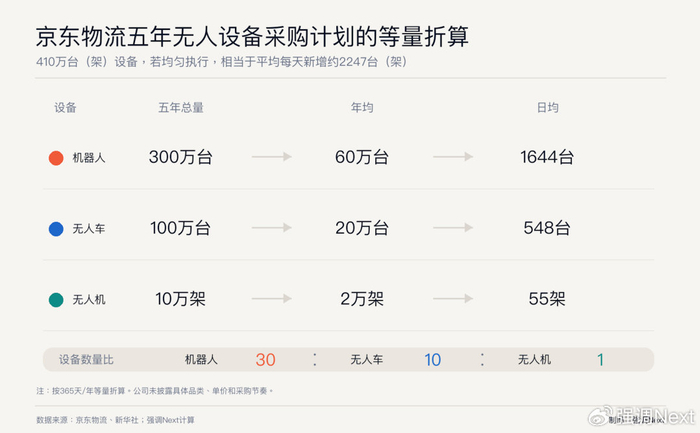
The 3 million robots are not all humanoid robots. JD.com hasn’t disclosed specific categories, procurement amounts, or annual timing, but based on logistics scenarios, they clearly include mobile robots, robotic arms, sorting equipment, and other specialized automation equipment.
But it’s still a rare large order.
The robotics industry is not short of prototypes, financing, or expo performances. What is truly scarce is large-scale real-world scenarios that can operate continuously and support repeated trial and error. Robots only reveal issues once they enter warehouses, stores, delivery stations, and homes—problems such as joint wear, recognition errors, insufficient battery life, and dispatch congestion.
JD.com just happens to have these scenarios.
From May to August 2025, JD.com continuously invested in Unitree Robotics, Pasini, Qianxun Intelligent, Zhujili Dynamics, Zongqing Robotics, and RoboScience—covering robot bodies, tactile sensing, motion control, and embodied models. In June this year, JD.com’s related fund also participated in the Series A angel round financing of Wujie Dynamics, with over $200 million.
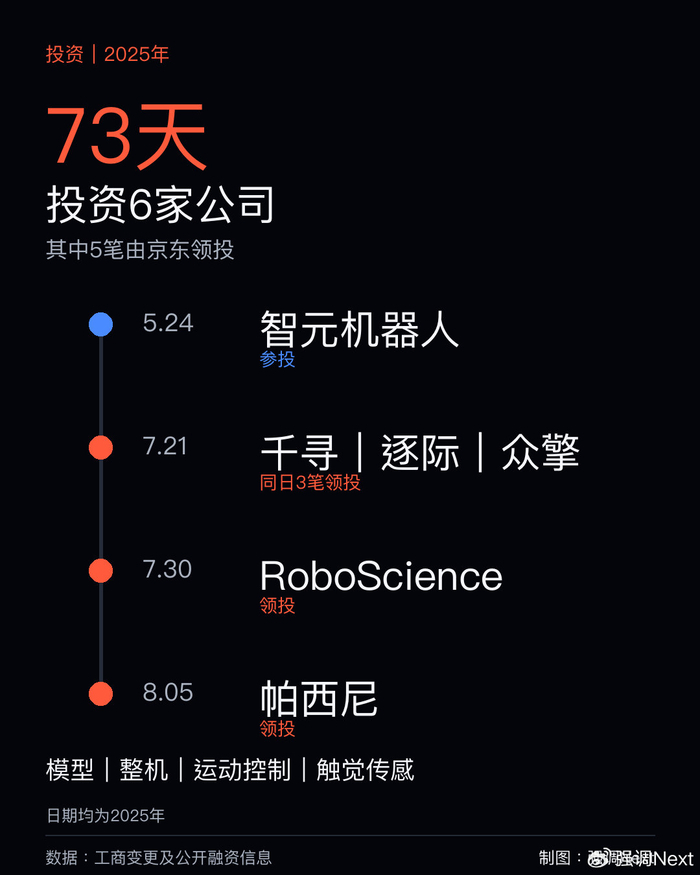
JD.com doesn’t need to bet on a single robot brand. It can collaborate with multiple manufacturers at the same time, test products in its own scenarios, and then filter products using its order, channel, and after-sales service systems.
Robotics companies get orders, data, and an iteration environment; JD.com gets more suppliers and stronger bargaining power in procurement.
In addition to orders, JD.com is also competing for robots’ training data.
There are two publicly disclosed versions of JD.com’s first released EgoLive datasets: the paper disclosures the dataset size as 1,680 hours, 65,866 task video clips, and 346 real tasks. When JD.com releases it publicly, it uses the “first batch of 2,000 hours.”
Even using a paper-based calculation, the 10 million hours target is close to 5,950 times the current scale. If 600,000 people average it, each person needs to contribute about 17 hours of data over two years.
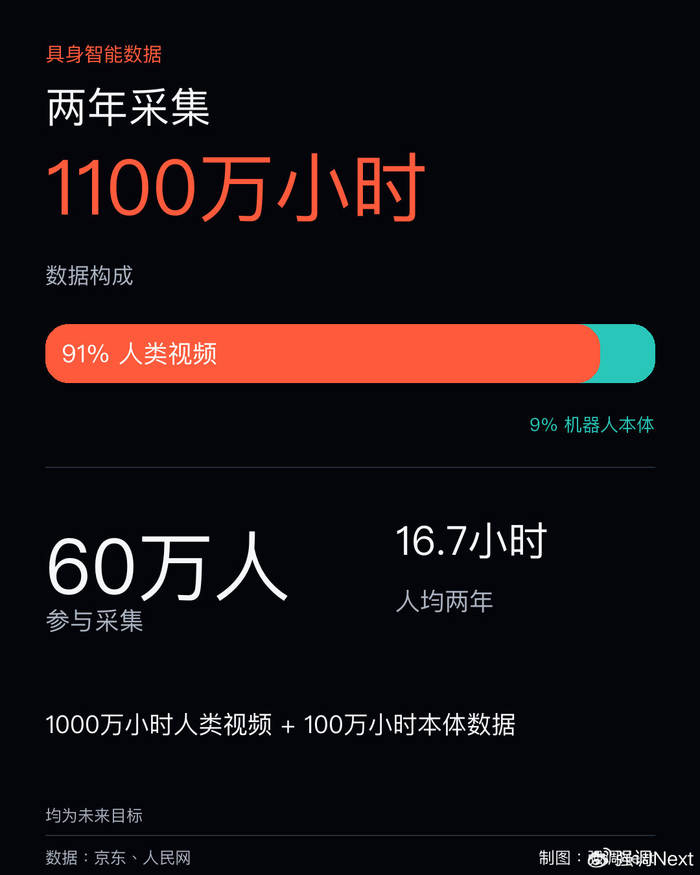
Orders determine what problems the robots should solve, and data determines whether the robots can learn to solve those problems. By taking hold of both ends, JD.com is effectively turning supply-chain scenarios into training grounds for the robotics industry.
Amazon provides a more mature point of reference. Amazon says its global robot fleet has already reached 1 million units, covering more than 300 facilities, with about 75% of customer orders involving robots in the handling process. Its DeepFleet model, trained on warehouse inventory movement data, can improve robot driving efficiency by 10%.
This is precisely the strategic value of JD.com’s plan to procure 3 million robots—and also the risk: buying equipment isn’t hard; keeping it working reliably over the long term is the difficult part.
02. More valuable than selling robots is making sure robots don’t stay idle
Once robots enter real commercial environments, competitive standards will change quickly.
At expos, what’s compared is speed, payload capacity, dexterity, and action capability. But warehouses and factories evaluate uptime rate, failure rate, maintenance response time, spare-parts supply, and total lifecycle cost.
The price of a single robot is only the first cost. Joint wear, sensor failures, battery degradation, and software errors will all happen. Once a robot is down for weeks, the saved labor cost may not be enough to cover the operational losses.
On April 15, JD.com launched the “Robot Ambulance,” providing fault diagnosis, battery swapping and recharging, maintenance and servicing, testing and certification, and equipment recycling services for humanoid robots, quadruped robots, and AI companion robots.
Over the next three years, JD.com plans to expand home maintenance services to more than 50 core cities nationwide, and to recruit more than 10,000 professional robot maintenance service talents. Relevant services have already begun extending to some overseas markets.
This is the most business-like piece in JD.com’s robotics layout.
It’s difficult for a single robot brand to independently build a nationwide maintenance, spare-parts, and reverse-logistics network. The maintenance system JD.com built for phones, computers, and home appliances, however, can be transplanted into the robotics industry—so a service network can support multiple brands at the same time.
JD.com’s standardized robot battery solution released at AWE also follows the same direction. The solution aims to unify battery structure, interfaces, and communication protocols, and has already completed adaptation verification with multiple robotics companies.
This doesn’t mean JD.com has already controlled interface standards in the robotics industry, but at least it has begun to participate in defining equipment interfaces and communication protocols. Whoever can drive more brands to adopt the same set of standards will be more likely to control subsequent procurement, battery swapping, maintenance, and recycling.
RoboBase further fills in the gaps with R&D, pilot production, and manufacturing services. At least based on the actions disclosed so far, JD.com looks more like a platform organizer for the robotics industry than a robot brand betting on a single product.
What it sells is not just a robot, but a commercialized service package covering data, procurement, deployment, and maintenance.
03. What JD.com lacks most is still a cost table
JD.com’s robotics layout has an obvious gap: there are many strategic objectives, but very few unified financial and operational results.
In Q1 2026, JD.com’s revenue grew 4.9% year over year, while fulfillment costs increased 18.5% year over year, reaching RMB 23.4 billion. The ratio of fulfillment costs to revenue rose from 6.6% to 7.4%.
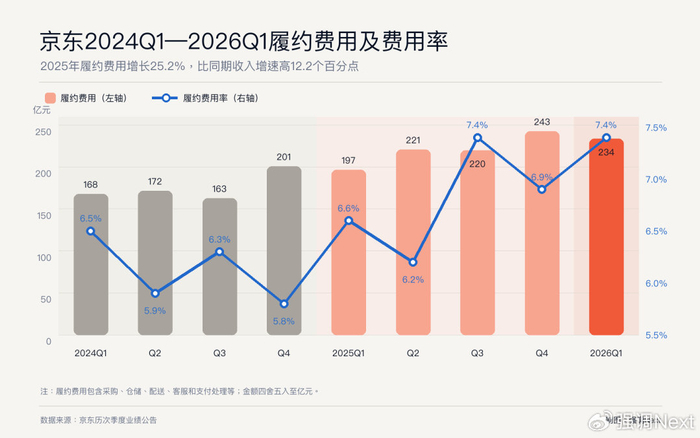
JD.com attributes this to upgrades in fulfillment capability and investments in human capital. Fulfillment costs also include procurement, warehousing, delivery, customer service, and payment processing, so the growth cannot be simply attributed to labor costs, and it cannot be used to judge that robots have produced no effect.
But at least this set of data shows that JD.com is still in an investment stage. Whether robots will lower costs has not yet appeared in the group’s financial data.
JD.com is not completely without published cost-reduction cases from automation. It once disclosed that after Beijing Daxing International Airport’s YIAI Zhilang warehouse applied the “Zhilang goods-to-person system,” the logistics cost per clothing order dropped by 50%, the operating yard productivity reached 2.5 times that of a traditional automated warehouse, and the outbound picking and sorting efficiency improved by 300%.
The problem is that these are single-warehouse, single-product-category cases provided by JD.com, and they can’t be extrapolated to the entire logistics network.
As of Q1 2026, JD.com has not separated the robot business as a standalone reporting segment, and it has also not disclosed related revenue, investment, gross profit, and losses. Equipment utilization, failure rates, maintenance costs, and payback periods also do not have a unified basis.
The 3 million-robot figure is the procurement plan for the next five years; the 10 million hours of data is the collection target for the next two years. RoboBase won’t reach full production until 2030.
What JD.com most needs right now is not to add a few more robot projects, but to produce a comparable cost table: after robots enter the warehouse, how much does the per-order fulfillment cost actually drop. Can the saved labor cost cover the costs of procurement, depreciation, energy, and maintenance. Can robot after-sales service become an independent profit-generating business.
If these questions have no answers, robots will still just be JD.com’s large-scale capital expenditure. Only when the cost structure truly changes can it potentially become the second JD.com logistics network.
04. 700,000 jobs can’t rely only on 10,000 maintenance roles
The more robots JD.com buys, the less it can avoid the employment issue.
As of the end of March 2026, JD.com’s ecosystem workforce exceeded 900,000 people, including company employees, part-time staff, interns, and personnel from affiliated companies. In the past 12 months, total spending on related human resources and external personnel amounted to RMB 166.4 billion.
Labor is both a barrier in JD.com’s supply chain and one of its biggest cost burdens.
This June, Liu Qiangdong proposed the “Rebirth Plan.” JD.com has already partnered with more than 120 schools nationwide and plans to train 700,000 couriers and other blue-collar workers in batches, helping them learn robot repair, maintenance, and operations skills.
The direction is fine, but scaling it to a matching level is difficult.
In the next three years, JD.com plans to recruit more than 10,000 professional robot maintenance talents—the “Rebirth Plan” covers 700,000 blue-collar employees. The two figures are not from the same basis: training is not the same as reassignment, and 10,000 people is not the total number of positions JD.com has prepared for 700,000 employees.
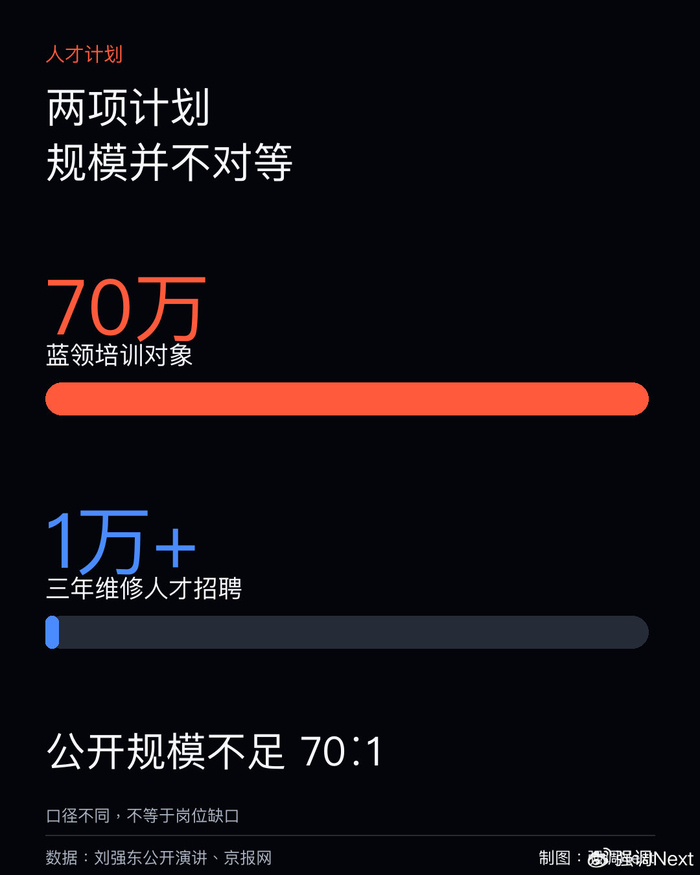
But after training is completed, how many stable, long-term, and income-sustainable technical positions can actually absorb these employees remains an issue JD.com has to face.
What robots may replace are large numbers of physical labor jobs with standardized processes. The newly added maintenance, dispatch, and data jobs may not be of the same scale. Robot maintenance also requires mechatronics, software, and fault diagnosis capabilities—not all couriers can complete the transition in the short term.
For a period of time, JD.com likely bears two costs at once: one is purchasing robots, and the other is continuing to pay a large amount of labor costs—and
Investing training resources to help employees transition to new roles.
This is the most difficult part of Liu Qiangdong’s second logistics network.
In 2007, outsiders asked why JD.com had to deliver its own goods. Building its own logistics ultimately gave JD.com control over delivery timeliness, service quality, and after-sales experience.
Now the question becomes: as more and more goods begin to be moved and delivered by machines, can JD.com put robots, people, and the supply chain into the same network?
But what truly determines the value of this network is whether the machines can keep working, whether costs can genuinely come down, and whether the people who used to deliver can find a place in the new system.