
Robots’ roles are quietly changing. They are no longer just performers that do backflips and dance, but are gradually moving into the corporate front desk, scenic-area pavilions, government service halls—and even beginning to integrate into ordinary households, becoming a new kind of companion carrier.
In home scenarios, emotional companionship has already become a new hotspot in the AI embodied intelligence track. At the 2026 World Artificial Intelligence Conference (WAIC 2026), a number of companion robots were unveiled in a concentrated display. They come in different forms, but their positioning is clear. First, Chiming Technology showcased its ultra-biomimetic interactive robot OriginF1 at the Ziyuan booth, acclaimed as the “most beautiful pseudo-real human” thanks to its exquisitely lifelike facial interaction. Fourier Intelligence focused on lightweight personal companion scenarios and launched its adorable desktop robot GR Nano. With an AI emotional platform boasting hundreds of millions of users, MiniMax’s “Starry Sky” brought the intelligent robot dog Vbot “Big Head BoBo.” This product is powered by the MiniMax M3 model; during the pre-sale period, it accumulated 6,540 orders, and the reservation sales nearly reached 100 million yuan. Meanwhile, companies such as Nubia, JD.com, and Lingda Intelligent also concentrated on showcasing lightweight healing-companion terminals, including AI electronic cute pets and plush smart playmates.
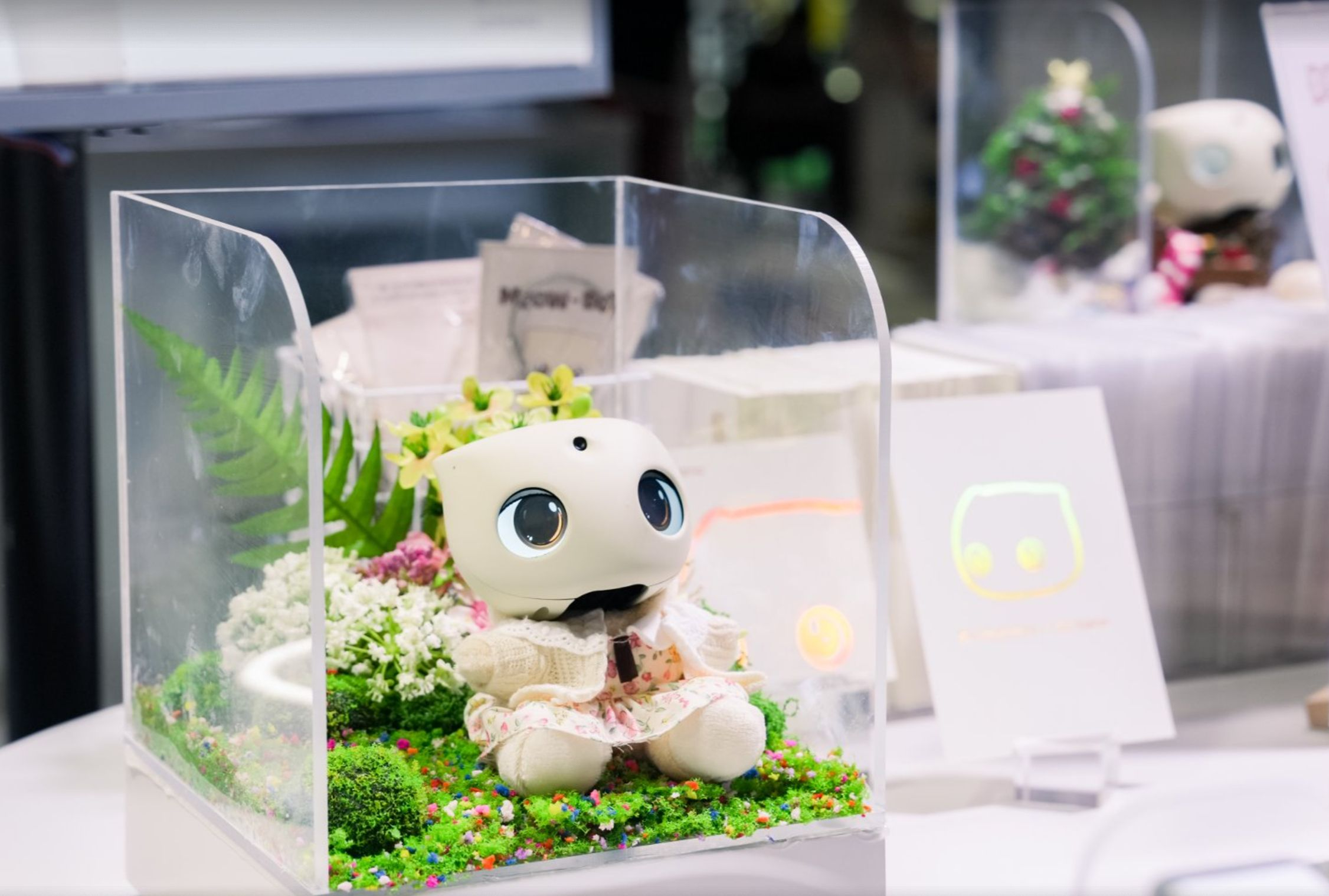
Although form factors, sizes, and pricing vary widely, these new products collectively point to the industry’s core trend: competition among home robots has shifted from mechanical function comparisons to the exclusive emotional value that users are willing to pay for and that can be kept long-term.
The family-facing embodied robots showcased at this WAIC have a very wide price range, from several hundred yuan to tens of thousands of yuan. Among them, bio-mimetic robots generally cost more than 100,000 yuan per unit. Yang Ming, project director of Yunmu Zhizao, told the Economic Daily’s reporter that the main space for cost reduction in bio-mimetic robots is concentrated in the whole-machine mechanical structure and core components. As the industry supply chain continues to mature, there is room for sustained reductions in hardware procurement costs. According to common industry expectations, 5 to 6 years from now, the single-unit price of humanoid robots for the home market is expected to drop to 30,000–50,000 yuan.
Emotional companionship and AI pet—each finds its own path
This WAIC exploration of embodied robots moving into home scenarios can roughly be divided into two paths: First, “emotional companionship robots” centered on humanoid-like forms—aiming for a human-like appearance and natural interaction, emphasizing emotion recognition and deep conversational ability. Second, “AI pet robots” that appear in non-humanoid or pet forms—focusing on lightweight design, low cost, and touchable companionship experiences, with lower user acceptance barriers and easier, faster commercialization.
In the emotional companionship track, companies leverage their own technical foundations to pursue differentiated scenario routes, covering multiple scenarios such as government reception, gallery guidance, home-based elder care, children’s accompaniment, and youth emotional reassurance.
Yunmu Zhizao is one of the earlier companies in China to enter the bio-mimetic humanoid robot sector. Since laying out related business in 2021, the company has completed R&D of ten prototype bio-mimetic robots. Yang Ming told the Economic Daily’s reporter that the company’s revenue was 4.8 million yuan in 2024 and jumped to 34 million yuan in 2025; among that, the culture-and-tourism bio-mimetic customized business contributes about 70% of revenue.
“Our biggest feature is our ability to customize. We have already completed more than 200 character customizations, covering historical figures, mythological figures, second-dimensional IP, and even the customer themselves. At this stage, we are focusing on culture-and-tourism and industrial scenarios to prepare for future entry into home scenarios,” said Yang Ming.
Digital China chooses a half-body bio-mimetic form to enter public service scenarios—such as front-desk reception and gallery guidance—rather than pursuing costly, two-legged walking structures. A company representative said, “The half-body design balances aesthetics and cost-effectiveness. Two-legged robots have thick chests and shoulders; for a front-desk role, the aesthetics aren’t as good, and they cost more.” The person added that the product is expected to be priced at more than 100,000 yuan.
On the AI pet robot track, WAIC 2026 on-site is especially lively. Baboo, an active intelligent companion robot launched by Xin Yan, is representative: it can perform emotion recognition, proactive conversation, photo logging, and teaching functions. It can complete interactive actions such as hugging and holding hands, with battery life around two hours; it can automatically recharge, and the price is expected to be above 10,000 yuan. Interestingly, the soft-cute Baboo, positioned as a family partner, is entering government affairs and elderly-care tracks. Wang Ying, PR director of the Xin Yan Group, told the Economic Daily’s reporter that many government agencies and elderly-care institutions show strong interest in the product. “Some elderly people like to repeatedly talk about things when they were young. Even children with a great temper will get annoyed after hearing it again and again, but the robot can listen endlessly, respond, and provide emotional value.”
The Fourier GR Nano focuses on a desktop-level lightweight form. During a hands-on experience, the Economic Daily’s reporter noticed that the product follows gaze through head-of-freedom movement. When the user moves to different positions, its eyes will keep tracking. Coupled with a rich expression system, it creates a sense of companionship similar to that of a pet or a baby.
Meanwhile, Nubia launched the AI cute pet iMoochi; Lingta Intelligent showcased the full set of twelve zodiac AiMOON models; and in JD.com’s “AI Home” showroom, a robot puppy is placed lying down obediently. These AI pet robots typically use plush or soft materials, discarding complex structures like two-legged walking and mechanical arms, bringing costs down to the thousand-yuan level. The target users are clearly aimed at children’s companionship, the single-economy group, and the older-generation demographic.
Lowering humanoid robot prices is inevitable
Yunxu (Ubtech) founder Zhou Jian said that the most imaginative aspect of family companion robots is that they have the best chance of forming an ecosystem.
At the end of June, the launch of Ubtech’s full-size bio-mimetic robot “You World U1 Series” drew major attention. These “doesn’t do chores, focuses on companionship” bio-mimetic humanoids come in three models in the U1 series, with prices of: Lite at 119,800 yuan, Pro at 169,800 yuan, and Ultra (male/female) at 990,000/880,000 yuan. A price of 990,000 yuan is comparable to a three- or four-bedroom apartment of over 100 square meters in the core area of a second- or third-tier city.
The all-channel presale of the “You World U1 Series” has already exceeded 13,000 units; however, behind this number lies a huge test of delivery capability. According to related statistics, in 2025, China’s total annual sales of humanoid robots were only over 10,000 units, and C-end products account for only about one-tenth.
Yang Ming said that Yunmu Zhizao’s current price for a standard simulation-skin robot is about 250,000 yuan, with a gross margin of 35% to 40%. Custom versions are priced higher due to factors such as manual hair/plants (hair implantation) and second-stage development. In terms of capacity, Yunmu Zhizao’s annual production in 2025 was only 200 units. Although after this year’s production-line expansion it is expected to reach 2,000 units, “our current production capacity is still far from meeting our future technical roadmap.”
Yunmu Zhizao Luoshen IP simulation robot
Besides concerns about production capacity, the high price also dampens buyers’ enthusiasm. “The current cost of humanoid robots is highly concentrated in joint-driven motor modules, high-precision force/visual sensing systems, and computing platforms; these three account for more than 90% of hardware costs.” Xi Wei, Director of Midea’s Humanoid Robot Innovation Center, previously told the Economic Daily’s reporter, “The core key to achieving a 70% cost reduction over the next decade lies in large-scale production supply chains, domestically produced computing chips, and core sensors.”
According to First Finance, Zhou Jian said in a media interview that when the robot’s target user segments are diverse enough, costs and prices will both come down. But for future bio-mimetic robots that “can do household chores, provide emotional value, and also look good,” prices of 100,000 to 200,000 yuan are not considered expensive.
In October 2025, Songyan Power lowered the price of its humanoid robot “Bumi Xiaobumi” to 9,998 yuan. Founder Jiang Zheyuan told the media that price cuts will become a future trend for the humanoid robot industry; in the future, all humanoid-robot companies will lower prices, ultimately converging to a reasonable profit margin and a reasonable price level. Yang Ming also expressed a similar expectation: “When bio-mimetic robots enter homes, the per-unit selling price should be in the range of 30,000–50,000 yuan, which is the price range the general public can accept.”
Home scenarios demand extremely high safety and skill requirements. Consumers won’t pay for a robot that “can do a little of everything but does nothing well.” Accurate scenario definitions and irreplaceable emotional value are the core drivers of purchase decisions. “What value companion robots truly bring to the home is generally a strong, specific functional attribute; it cannot be something universal,” said Dai Wenjun, head of attached intelligent business for Jingdong Technology’s AI innovation business.
While the industry is booming and expanding, regulatory red lines are being implemented in parallel. The (Interim Measures for the Administration of AI-Personified Interactive Service Management), jointly issued by five departments including the Cyberspace Administration of China, officially took effect on July 15. It became China’s first dedicated regulatory rule targeting bio-mimetic humanoid and AI emotional-companionship products, covering key areas such as users’ privacy and personal information protection, preventing emotional addiction and excessive reliance, and technology ethics review. Subsequently, many large-model platforms such as Doubao, Qianwen, and Tencent Yuanbao announced the takedown of emotional-companionship-type custom intelligent agents.
On July 18, Kevin Kelly, the American technology thinker dubbed the “Father of the Silicon Valley Spirit,” said at WAIC 2026’s sub-forum that humanoid robots are the most complex technological creations in human history. Even conservatively, they will still take about a decade to truly become mature and fully deployed. “AI and robots with emotions will build real, deep emotional connections with humans. Even if they are products of artificial intelligence, our bonds and emotional relationships with them will be incredibly real,” Kevin Kelly said.
The calmness of regulation and the enthusiasm for the future—together, they form both sides of how embodied intelligence moves into home settings.