


Source of this article: The Economic Observer Author: Wang Ying
After the “battle of a hundred models” cooled down, a new round of AI gateway battles among big tech companies is in full swing. And this round is mainly centered on the competition for AI agent entry points.
On July 21, according to (Caijing) reports, Alibaba will launch Qianwen Office. It has already integrated three agent (Agent) products: QoderWork, Wukong, and MuleRun. Qianwen Office will be Alibaba’s flagship product for the agent office market. Meanwhile, a reporter from The Economic Observer learned from an insider that Tencent has issued an internal notice to integrate the Workbuddy and QClaw teams.
The competition between the two tech giants also concentrates on the 2026 World Artificial Intelligence Conference and the High-level Meeting on Global AI Governance (referred to as “WAIC 2026”), which closes on July 20. The conference spans four days, with more than 1,100 exhibiting companies bringing over 4,400 technology products. Even the leading tech companies at the frontier of technology are staging a head-on contest at this event.
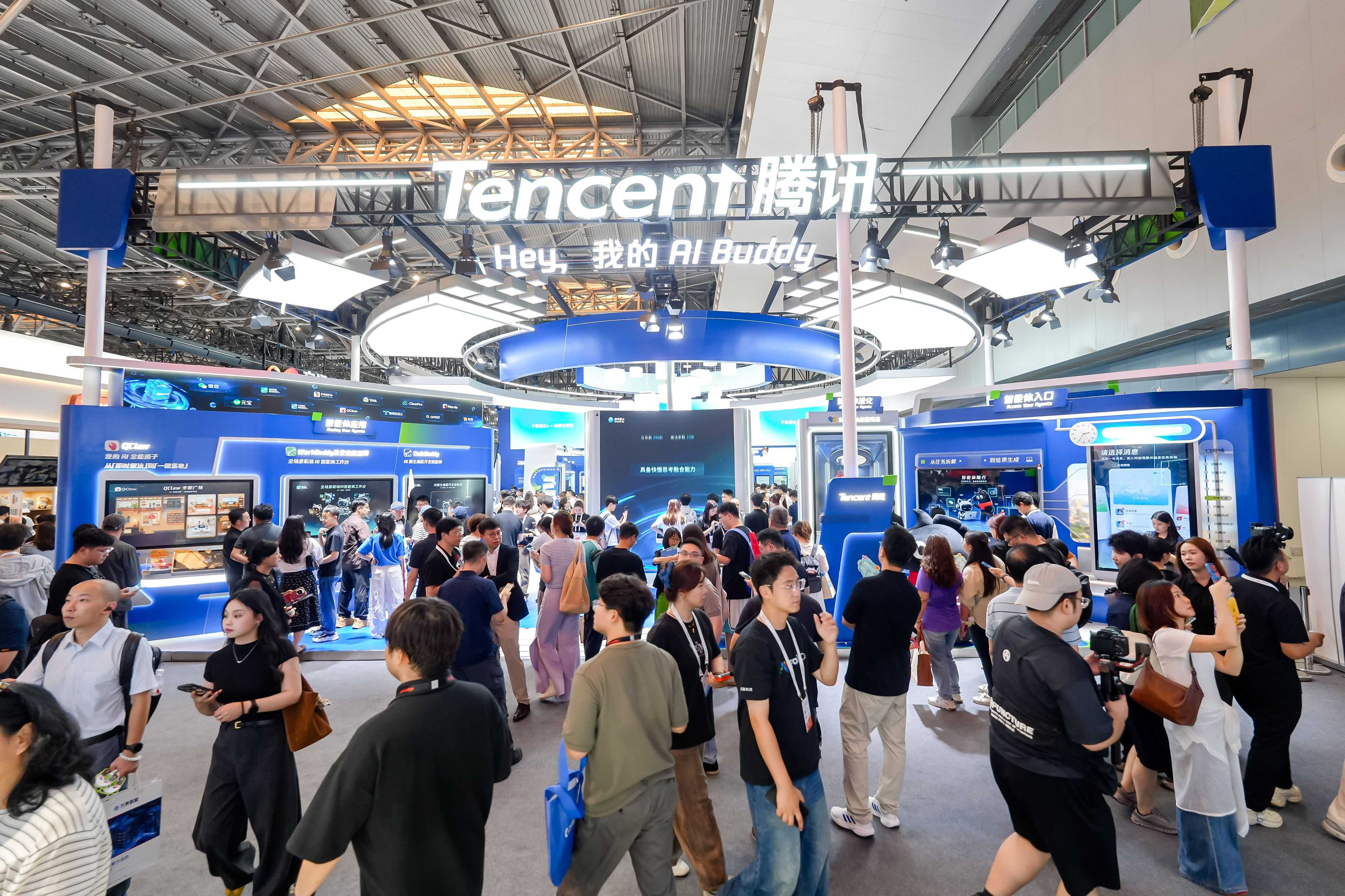
At the Shanghai World Expo Exhibition Center’s H1 hall, the exhibition booths of Alibaba and Tencent face each other directly.
Tencent presented under the theme “Hey, my AI Buddy”—from the currently hot Workbuddy to Qclaw and Ima for individual users, as well as the unveiling of the Hunyuan Hy3 large model. It focused on demonstrating how AI evolves in various fields into capabilities that assist production and daily life. At Alibaba’s booth, a product called “Qianwen Office” has already been exhibited. On-site staff told reporters from The Times Weekly that the product is currently in internal testing and is operated by the DingTalk team.
Not only are desktop agents seeing a direct contest—Alibaba and Tencent are also competing head-on on smart hardware terminal devices. During WAIC, Tencent Cloud WorkBuddy and Li Wei Ke Technology announced a strategic ecosystem cooperation and released the first X-AI memory smart glasses that connect to WorkBuddy. In the same period, Tencent’s in-house efficiency agent WorkBuddy officially launched as a standalone app, with iOS, Android, and HarmonyOS versions going live simultaneously.
During this year’s WAIC, the Qianwen smart glasses directly upgraded AI glasses into agent glasses. After the upgrade, the glasses can strengthen service and decision-making capabilities through agent-based reinforcement services, and can call third-party Skills and Agents on demand. At the same time, Qianwen’s first AI agent earphone made its official debut.
At this year’s WAIC, Ant Group focused on showcasing three aspects of achievements. These include the latest application deployments in fields such as AI health and AI lifestyle, including A Fu and A Bao. It also includes business ecosystem planning for agents around payments. Finally, it includes ongoing investment in the technical foundation: such as Ant Lingbo’s general-purpose robot brain, OceanBase AI database, Ant Misuansuan HOP 3.0, and the native security agent operating system Agent OS, all providing underlying support for AI development. Baidu brought a full lineup of agent “families,” including BaiDu “Dazi” (搭子), BaiDu “Yi Jing” (一镜), the general agent GenFlow 4.0, Baidu Miaoda 3.5 version, Baidu Faimou 2.0, and more.
A report from International Data Corporation (IDC) also confirms the changes taking place in the industry right now. IDC’s shared industry’s first (DAA research report) shows that in 2025, the number of active Agents worldwide will be 28.6 million; it is expected to reach 79.4 million in 2026; and will grow to 2.216 billion by 2030.
As Yin Qi, chairman of Stepwise Starchen (阶跃星辰) and chairman of Qianli Technology (千里科技), judged at WAIC: the AI industry evolves in three stages. The first stage is a pretrained large model plus dialogue applications. The second stage is reinforcement learning inference plus code development assistance. The third stage is industrial transformation brought by embodied agents, whose influence will exceed the combined impact of the PC internet and mobile internet transformations. And general agents in physical scenarios are the core main line of the third wave.
The tide of artificial intelligence keeps surging forward, and a new round of “agent entry” battles is being ignited. Amid this major technological transformation, the primary task for tech companies is to hold onto their positions on the playing field and stay off the sidelines—only then can they sustain competitiveness.
Alibaba and Tencent go head-to-head in the agent arena
Whether it’s Alibaba or Tencent, their competitive paths almost follow the same trajectory: from simple Q&A to autonomous execution. At the core, it’s still a battle over the entry point.
In front of Tencent’s WorkBuddy booth, it attracted a large number of visitors to try it out. This all-scenario workplace AI agent workbench was released in March this year. With just a simple sentence, it can help users complete work and deliver results. Reporters from The Times Weekly experienced WorkBuddy on-site and issued it the command: “Organize a visit guide for the WAIC 2026 conference.” Soon, WorkBuddy didn’t just provide a one-sentence conclusion and five core highlights—it also concurrently delivered a (WAIC 2026 agent special report).
According to Tencent, the core idea of this agent is to move from “one sentence” to “delivery”—no longer limited to dialogue, but able to autonomously break down tasks, plan processes, call tools, complete work, and deliver results.
“Today, AI is shifting from a tool to a partner—from ‘able to generate content’ to ‘able to complete tasks,’ and from a single capability to a system-wide ecosystem.” Li Kan, vice president of Tencent Group and general manager of its East China headquarters, said.
At Alibaba’s booth across the way, a desktop agent labeled “Qianwen Office” attracted many people to try it. Scan a code on-site and leave your information to get priority access to the usage rights for Qianwen Office. Reporters who tried it on-site found that this agent is similar to Tencent WorkBuddy’s core functions: users can both manually choose models and also have models intelligently orchestrated system-wide. On-site staff told reporters from The Times Weekly that the product is currently in internal testing.
A similar path: WorkBuddy is also being embedded into corresponding intelligent hardware terminals. The X-AI memory smart glasses come with the company’s in-house WakeeMemory OS, which can continuously sense real work scenarios; the整理 information is then automatically synced to WorkBuddy. In other words, based on work memory formed through long-term accumulation, WakeeMemory can continuously understand users’ work habits, task priorities, and collaboration relationships—turning fragmented information into action items with full context—then handing them to WorkBuddy to complete subsequent execution.
This means that what the AI receives is no longer a loose, isolated single-point instruction, but a complete workflow that includes context, character relationships, time nodes, and priorities. Unlike traditional AI office tools that mainly rely on users to actively input, Li Wei Ke X-AI memory smart glasses have become the entry point for WorkBuddy to connect to the real world. WorkBuddy is also accelerating the spread of this close-at-hand, non-intrusive intelligent experience into more everyday scenarios.
Qianwen AI glasses upgraded to agent glasses follow a logic similar to this. According to people related to Qianwen, besides service and decision-making capabilities, Qianwen has also introduced a series of new hardware technologies—such as full-duplex voice, eye-tracking, and vital-sign monitoring—to enhance the agent glasses’ perception and interaction capabilities in the physical world. These hardware technologies will be applied to Qianwen AI agent glasses within the year. The already sold Qianwen AI glasses S1 and G1 will also introduce Agent capabilities via OTA, further improving personalized task understanding and task-handling ability.
At WAIC, Wu Jianjun, general manager of Qianwen’s AI hardware products, said: “The starting point for interactions in the AI hardware era lies in the agent’s complete understanding of the user and the environment. Without hardware, an agent can’t reach the real world; without agents, hardware is just a cold tool. But when both are taken to their extremes, it becomes the only answer. We build the best hardware, combine it with the best agent, and that is how we create the best AI assistant for users.”
Is the essence behind agent competition autonomous evolution?
In 2026, the industry sees it as the first year for AI applications to take real root. Richard Sutton, a computer science professor at the University of Alberta—who won the Turing Award and is known as the “father of reinforcement learning”—believes that the core turning point in AI development is the shift from static data to experience-driven learning.
At this year’s WAIC, the shared consensus shown by big-company competition is: as model capabilities continue to improve, relying only on scale expansion is no longer enough to meet the needs of humans in truly using AI. From “can chat with AI” to “can use AI to do work” is becoming the central reflection of current AI iteration.
Sutton said that the stock of manually labeled resources continues to shrink and can’t support long-term model iteration. However, agents rely on autonomous learning generated through interactions with their own environment—producing observation, action, and reward signals. Data expands in parallel with their growing capabilities. AlphaGo and the Olympiad reasoning system AlphaProof have both demonstrated the feasibility of this path. Existing large models lack goal and reward/punishment feedback, so they can’t independently verify whether information is true or false. Experience-based agents can continuously correct cognition through environmental feedback; autonomous evolution is an irreversible technological trend.
At WAIC 2026, Tencent Research Institute together with Tencent Cloud Intelligence and Tencent YouTu released (Co-evolution: the Top Ten Trends in Artificial Intelligence in 2026) (referred to as “the Report”). The report believes that “intelligence as a service” is becoming a new direction for business model upgrades. In the past, companies obtained professional capabilities mainly by hiring personnel, purchasing software, or outsourcing services. Now, they can directly call mature AI intelligence services, and the consumption of underlying computing power is no longer the main focus. The value core becomes tangible, deliverable, and verifiable results.
The report summarizes this new internet form driven by AI agents as “intelligent connectivity.” In other words, AI agents are no longer just tools used by humans; they become new types of participation entities on the internet, able to autonomously invoke services, complete tasks, and carry out multi-party collaboration. Correspondingly, the commercial logic of the internet is shifting—from an attention-driven approach in the past to an outcomes-driven approach step by step. The core of platform competition is moving toward capability orchestration and task delivery efficiency.
However, in an interview with reporters from The Times Weekly, AIGCLink founder Zhan Bingqiang said that the combination of agents with software and hardware is just the surface of the competition. For big tech firms, the core reason they stay at the center of the game table still depends on model capability.
“Today, competition among major tech firms is concentrated at the client side. Behind this is the goal of capturing user data. The accumulation of user data helps these firms iterate their own models. If model capability isn’t strong, no matter how beautiful the client looks, it may still be affected by model updates. It’s like OpenClaw, which was popular for a stretch in the first half of this year.”
In Zhan Bingqiang’s view, the future landscape among big tech firms may also change. It doesn’t have to be Alibaba, ByteDance, or Tencent—companies like Zhipu AI and other large-model firms are also possible.
Zhu Yali, general manager for China at SmartYaa (Zhihuiya), said in an interview with the reporters of The Times Weekly that the real fight among technology giants is essentially about choosing a direction: whether to build “the most general capabilities” or to deliver “the most certain results.” A general route aims to solve all problems with one model—broad coverage, but once it enters professional scenarios, it easily becomes superficial. A vertical route dives deep into specific industries, using domain data and business know-how to fully master a certain category of problems.
Big companies have clearly realized this problem. For example, the WorkBuddy family is very large. It includes versions for professionals, as well as an enterprise WorkBuddy for business users and an office agent suite (Agent Suite), among others. They provide differentiated, personalized agent solutions for different user groups and more than 20 vertical scenarios.
In Zhu Yali’s view, many agents still remain at the stage of single-point efficiency right now. “I’m more optimistic about another path: make agents responsible for business outcomes, and ultimately turn it into the organization’s capability. To judge whether AI implementation is successful, we shouldn’t just look at how much a particular role’s efficiency improves—we should see whether the organization’s overall innovation capability has been raised to a higher level because of AI.”
On July 11, Tang Jie, founder of Zhipu AI, published an internal letter titled “The Great Tide Has Come” (巨浪已来), stating that the evolution of the upper limit of intelligence has a clear path. Artificial intelligence is completing the leap from perception intelligence to cognitive intelligence. Machines are no longer just “seeing” and “hearing”—they are starting to “understand” and “reason.” And the next step is pointing directly to AGI.
(This reporter Xie Silin also contributed to this article.)