

Log in to the Sina Finance app and search for 【information disclosure (信披)】 to view more assessment grade details
(Source: An Amazing ETF)
Today, A-share market dips and then rebounds, with market sentiment significantly improving. In terms of sectors, the semiconductor industry chain collectively became active; the PCB concept strengthened; the CPO concept rose in a bumpy manner; and some technology-related indices saw large gains.
The active market atmosphere also keeps raising investors’ interest in various investment tools. As a commonly used investment instrument, ETFs that people are familiar with are often used to track specific indices; but beyond index tracking, the ETF market may welcome a new type of product: active ETFs.
In June 2026, at the Lujiazui Forum, the CSRC stated that it supports the launch of active ETFs on the Shanghai and Shenzhen exchanges. Subsequently, the Shanghai and Shenzhen exchanges issued relevant business guidelines, providing clear institutional arrangements for the launch of this innovative product.
As product filing work progresses, active ETFs are also moving from the realm of concepts into the market. According to publicly available information, the first batch of 18 active ETF products is about to be formally submitted for filing, and Southern Funds is one of them.
For investors who are used to index ETFs such as the CSI 300 ETF and the CSI 500 ETF, what exactly is an “active ETF”? And how is it different from the ETFs everyone is familiar with?
In short, an active ETF is a fund that is actively managed by a fund manager to manage an investment portfolio, while using an ETF subscription and redemption and exchange-trading mechanism.
First, let’s look at “active”.
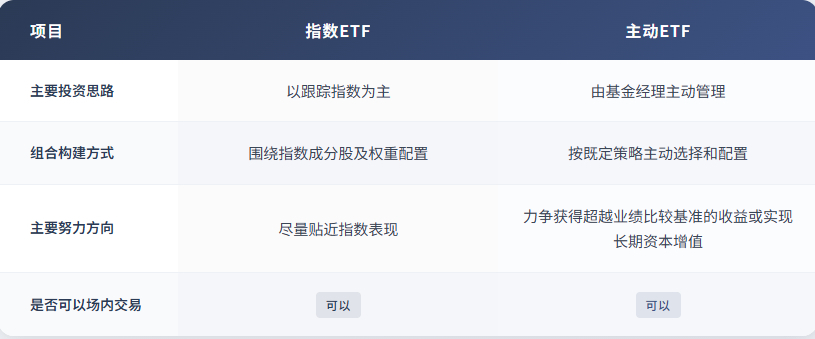
Index ETFs are generally familiar to everyone and usually have tracking a specific index as their primary goal. Taking the CSI 300 ETF as an example, the fund portfolio is allocated around the constituent stocks and their weights in the CSI 300 Index, and an important job of the fund manager is to ensure that the fund’s performance closely matches the index it tracks as much as possible.
Active ETFs are not primarily designed to replicate any specific index. Within the investment scope and strategies stipulated in the fund contract, the fund manager can research, screen, and allocate across industries, individual stocks, and portfolio weights, and adjust the portfolio according to market conditions and investment judgments.
For the same batch of investable stocks, for example, fund managers may focus more on certain industry development trends, or may place more emphasis on a company’s profitability, valuation level, and competitive advantages, and decide the direction and proportion of portfolio allocation accordingly. In other words, index ETFs mainly build portfolios around the rules of the index; active ETFs, by contrast, reflect the research and judgment of fund managers to a greater extent.
Let’s look at “ETFs” again.
Although the investment approach is more active, active ETFs still retain the basic operating characteristics of ETFs. After the product is listed, investors can trade it through their securities accounts during trading hours, just like buying and selling other exchange-traded ETFs. At the same time, the product also operates using the ETF subscription and redemption mechanism.
Therefore, an active ETF is not simply a straightforward “transfer” of a traditional active fund into the exchange-traded environment. Instead, within the product framework of an ETF, it introduces an active management investment approach.
Of course, “active” does not mean “random.” Active ETFs’ investment scope, investment strategies, performance comparison benchmarks, and risk-return characteristics are all specified in legal documents such as the fund contract and prospectus.
Both active ETFs and index ETFs are ETFs, and both can be listed and traded on the exchange. The most core difference between the two is whether tracking a specific index is the primary goal.
The main differences between the two are as follows:
From a global perspective, active ETFs are not a completely new concept. Overseas markets have explored them for years, and product strategies are relatively diverse, including active stock selection, quantitative investment, as well as different directions such as bond investing and return enhancement.
According to statistics by institutions such as ETFGI, as of the end of May 2026, the global size of active ETFs has exceeded $2 trillion. Practices in overseas markets show that ETFs can not only serve index-tracking needs, but can also become the vehicle for implementing active investment strategies. (Data source: Cathay Haitong Securities, 2026.07.20)
With the product filings of the first batch of fund companies such as Southern Funds progressing, active ETFs will gradually come into view for domestic investors. To understand this new product, the key is to grasp two terms: “active” determines how the portfolio is constructed, and “ETF” determines how the product operates.
Risk warning: The views in this article are for reference only and do not constitute investment advice. Funds involve risk, and investors should exercise caution. Please choose a suitable product according to your risk tolerance. The content and opinions contained in this information are provided solely as customer service information and do not serve as a reference for investors to make investment decisions regarding market trends, individual stocks, or funds. Our company makes no guarantee as to the completeness or accuracy of the information, nor does it guarantee that the relevant viewpoints or analytical judgments will not change or be updated. This does not represent our company’s official position. Investing involves risk; decisions should be made cautiously. Regular investment is not equal to saving; it does not guarantee returns; past performance does not represent future results. Before making any investment decision, investors should carefully read the fund contract, the prospectus, and the official announcements and relevant information published by our company through information disclosure media designated by the China Securities Regulatory Commission. Any information appearing in this article (including but not limited to comments, forecasts, charts, indicators, and theories) is for reference only and should not be used as the basis for investors’ investment decisions or fund trading. Investors should process subscription and redemption of fund units at the business premises of fund sales institutions or through other methods provided by the sales institutions. However, a fund is not a deposit or liability of a sales institution, and it is not guaranteed or endorsed by the sales institution. Sales institutions cannot guarantee the fund’s returns or the safety of the principal.