


The first time I saw bStocks—this kind of “on-chain US stocks”—I guess many people would have questions in their minds: do the underlying assets really correspond to real stocks? Or are they just conceptual coins that move along with the stock prices? Are the redemptions and fund inflows/outflows reliable?
In the past couple of years, the RWA concept has been hotly discussed, but there aren’t many products that are truly deployable in practice.
I went through the official rules myself, and also tested it in practice for a while. I’ve gone over the underlying logic, how to use it, how it differs from similar products, common playstyles, and the risks you should pay attention to.
I’ll explain the core details as clearly as possible for everyone’s reference in making their own judgment.
1. First, get the positioning clear: what exactly is it?
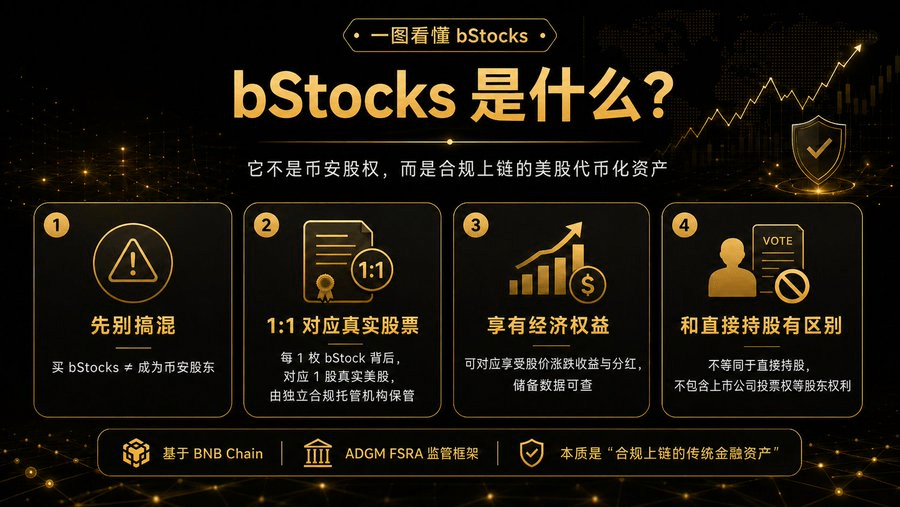
Let’s first correct a point that’s easy to get wrong: bStocks is not an equity stake in Binance. If you buy it, you won’t become a Binance shareholder—please don’t mix this up.
More precisely, it’s a tokenized U.S. stocks product launched by BNB Chain under the regulatory framework of the Abu Dhabi Global Market’s Financial Services Regulatory Authority (FSRA). It runs on BNB Chain and uses the BEP-20 plus BEP-677 dual-protocol standard.
Behind every 1 bStock, there corresponds to 1 share of real U.S. stock. Independent compliant custodial institutions lock it into a dedicated account—it does not belong to the exchange’s own assets.
The economic rights to your holdings belong to token holders. The reserve data can be checked daily. In essence, it’s “traditional financial assets on-chain with compliance,” and has nothing to do with the platform’s own equity.
In plain language, it means:
Let’s also clarify the difference between bStocks and directly buying U.S. stocks: when you hold bStocks, you hold economic rights to the underlying stock—so you can enjoy returns from price movements and dividends. But it’s not the same as holding the stock directly. You don’t have shareholder rights like voting rights in listed companies. The official explanation makes this very clear—don’t make assumptions on your own!
II. First, the most intuitive: how is it smoother to use than traditional U.S. stocks?
When it comes to the basic user experience alone, bStocks clearly shows advantages compared to traditional U.S. stock accounts and similar tokenized products on the market—these are details that ordinary users can feel directly.
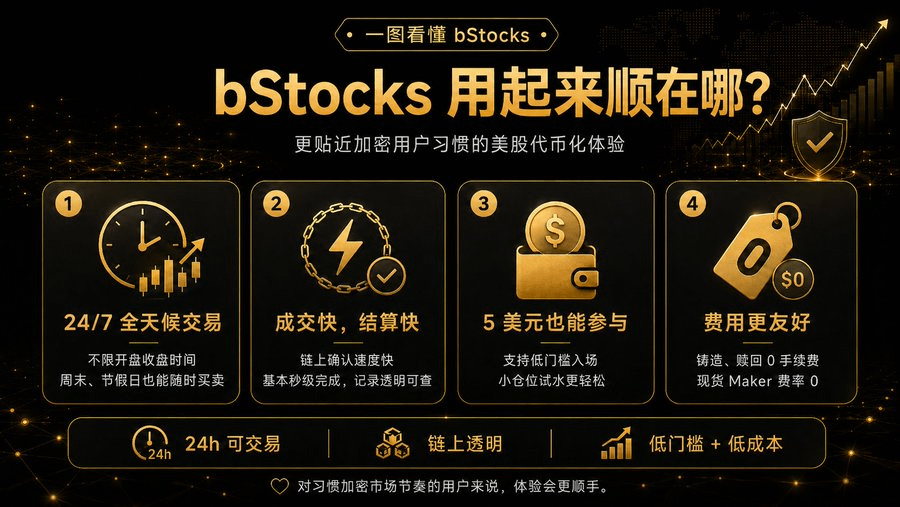
First is trading time and speed: traditional U.S. stocks have fixed market open/close hours. Weekends and holidays are off, and settlement still needs T+1. For people used to the crypto market’s 24/7 flexibility, it always feels restrictive.
bStocks leverages the existing technology of BNB Chain: fast trade confirmations and low latency. You can buy and sell 24/7. Even if there’s a sudden piece of news in the early hours on Saturday, you can adjust your positions anytime. Settlement is completed basically at a near-second level—no need to wait for funds to arrive the next day. All on-chain records can be checked in the browser, and the entire process is fully transparent.
Second is the entry barrier and costs: you can participate with $5—no need to come up with the money for a whole share. Beginners trying with a small position shouldn’t feel much pressure.
More concrete is the fee structure: there are no fees for minting and redemption of assets. For spot limit orders (Maker), the trading fee is also 0. If you frequently rebalance, you should understand this—over the long run, the saved costs are definitely not trivial.
III. Go one step deeper: it fills in the key piece of BNB Chain RWA
Maybe many people haven’t noticed: bStocks isn’t just a new product launched on Binance. It’s an important piece of the broader BNB Chain @BNBCHAIN RWA ecosystem.
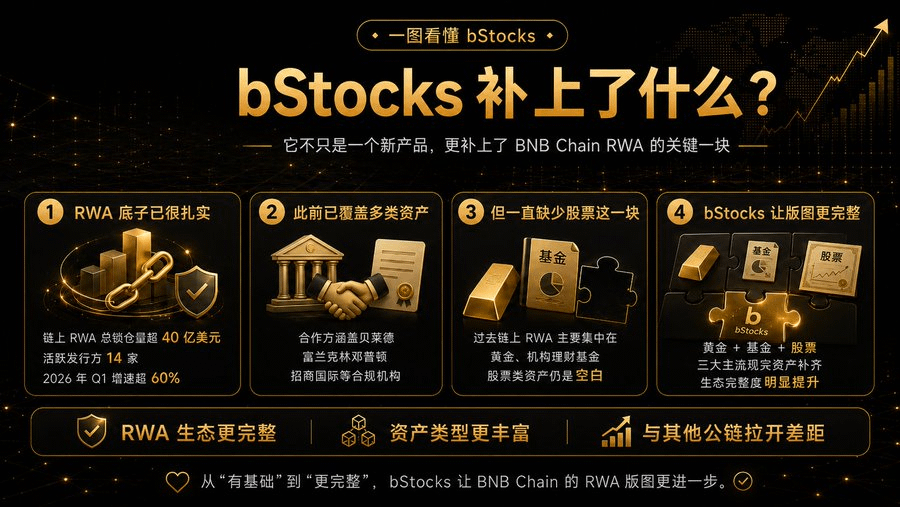
BNB Chain has actually been laying groundwork in the real-world assets track for a long time, and the foundation is very solid:
At present, the total amount of on-chain RWA locked is over $4 billion. There are 14 active issuing parties. Even in Q1 2026 alone, the growth rate exceeded 60%. Partners include top compliance institutions such as BlackRock, Franklin Templeton, and China Merchants International.
But before bStocks came out, on-chain RWA assets mainly focused on gold and various institutional fund/wealth products, and the big category of stocks was always missing.
With this tokenized U.S. stocks rollout, it effectively completes the three major categories of mainstream real-world assets—gold, funds, and stocks—so the product completeness immediately sets it apart from other public chains.
IV. The same “on-chain U.S. stocks”—why is it different from everyone else?
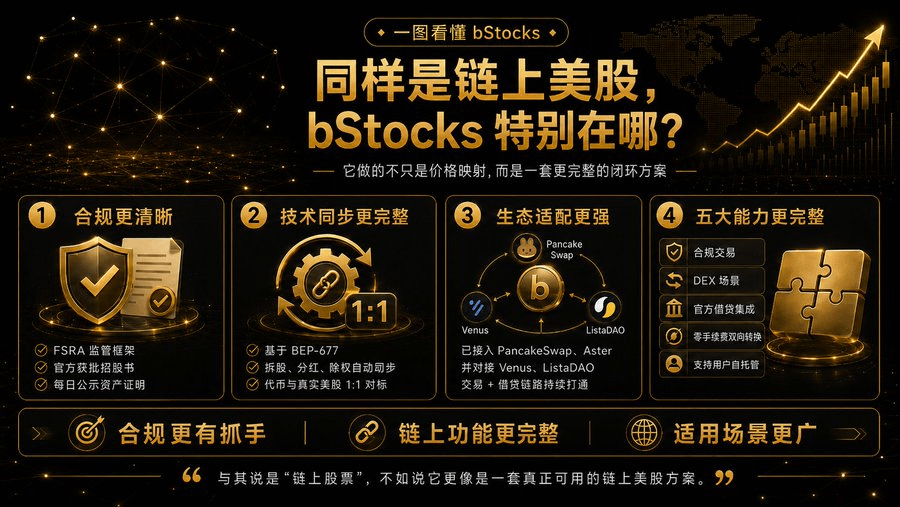
There are quite a few products on the market claiming to be “on-chain stocks.” Whether it’s Backpack in the Solana ecosystem or on-chain Ondo and xStocks on the same chain, most of them only achieve basic price mapping, with relatively single-function forms.
Where bStocks truly pulls ahead is that it builds a complete closed-loop solution—not just moving stock prices onto the chain.
I broke it down from three dimensions, and the differences are very clear:
On the compliance side: it has an official approved prospectus and is formally included in FSRA’s regulated listed roster. Each day, it publishes proof of asset collateralization. Mechanically, it eliminates the risk of over-issuance. And there are safeguards for the authenticity of the underlying assets.
On the technology side: relying on the dedicated BEP-677 protocol, corporate actions like stock splits, dividends, and ex-dividend events are automatically synchronized. Your tokens and real U.S. stocks can always stay perfectly aligned at 1:1, so users don’t have to constantly watch announcements and calculate endlessly.
Ecosystem integration: it has already been connected to two major DEXs, PancakeSwap and Aster, to meet basic trading needs. It also integrates major lending protocols like Venus and ListaDAO. Later, once features like collateralized lending and minting stablecoins are fully live, the complete flow for trading and wealth management will be fully connected.
Compared with the on-chain players like Ondo and xStocks, bStocks is currently the only product that brings together five major capabilities at once—compliant trading, a complete DEX trading scenario, official lending integration, zero-fee two-way conversion, and support for user self-custody.
Others have shortcomings to varying degrees—either they can’t do strict 1:1 tracking, or they don’t have official lending support, or conversion costs fees, or their regulatory qualifications are ambiguous.
When you compare horizontally, the differentiation becomes even clearer: it basically has no obvious weaknesses. Compared with Backpack in the Solana ecosystem, bStocks has verifiable FSRA regulatory qualifications, publishes daily proof of staking, and offers stronger assurances for compliance and asset safety.
At the same time, with the backing of Binance’s global user base and the full BNB Chain ecosystem, the applicable scenarios are much broader.
V. The best value for everyday people: idle “stocks” can finally “start moving.”
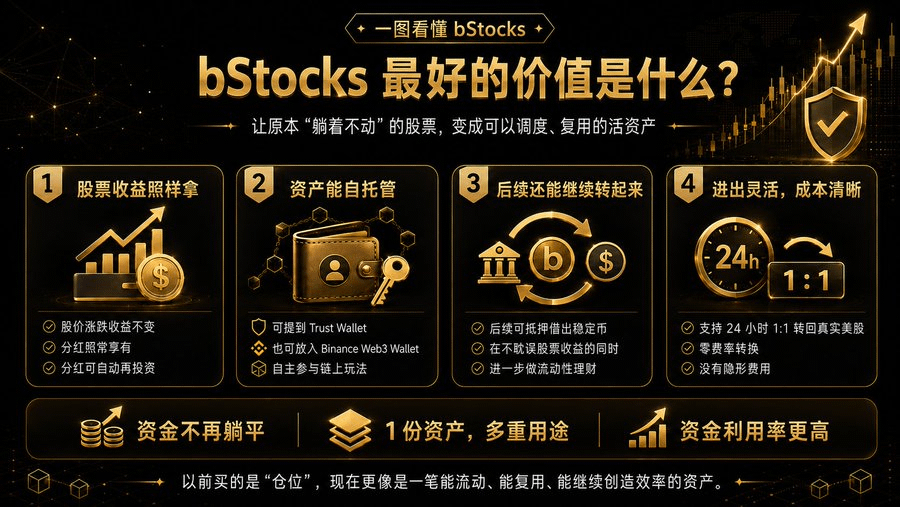
The best part is that it truly solves the problem of “idle stock assets.” This is also the biggest difference between it and traditional U.S. stocks and similar token products.
With traditional U.S. stocks, once you buy them, you basically just leave them there. Your returns rely entirely on price movements and quarterly dividends, with capital staying idle and unable to create additional value.
But bStocks is different. One asset can take care of several things:
While you hold, the stock’s price movements and dividends are not one cent less: dividends automatically get reinvested, helping you compound.
You can move it into self-custody wallets such as Trust Wallet or Binance Web3 Wallet, and participate in on-chain DeFi玩法 without having to keep it in the platform account all the time.
Later, when lending features are fully rolled out, you’ll also be able to collateralize and borrow stablecoins for liquidity wealth management—without delaying stock returns, while earning an extra amount as well.
More importantly, it supports 24-hour 1:1 zero-fee conversion back to real U.S. stocks. Entry and exit are free, with no hidden fees. Both flexibility and safety are in place.
In other words: before, when you bought stocks, that money would be “dead” in your position. Now it becomes a live asset that can be scheduled and reused—your capital efficiency goes up by a whole level.
VI. From beginner to advanced: three-tier gameplay—choose what fits you
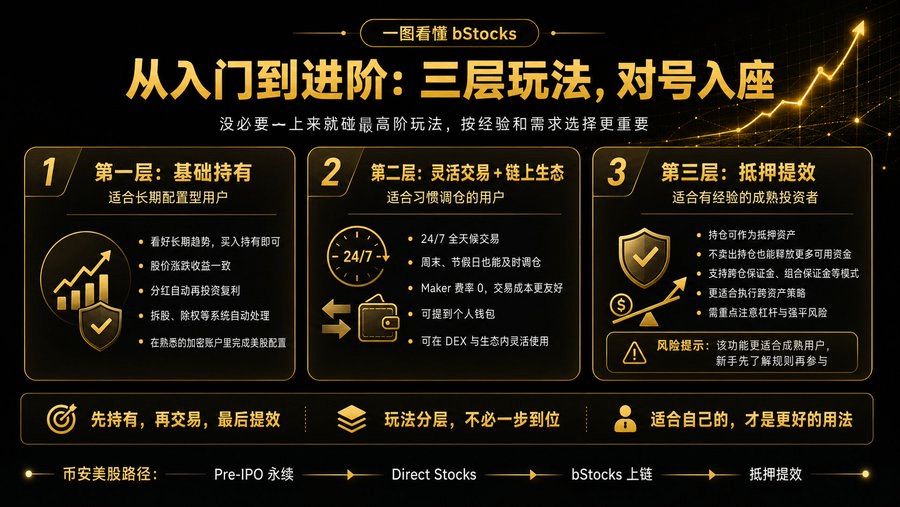
I’ve divided its usage into three tiers. You can choose based on your experience and needs—there’s no need to jump straight into the highest-tier玩法.
First layer: basic holding—suitable for long-term allocation users.
This is the simplest and most steady way to use it: if you believe in the long-term outlook of a particular U.S. stock or a sector, buy bStocks and hold it.
Your returns from stock price gains/losses are consistent with traditional U.S. stocks. Dividends automatically reinvest and compound for you. Things like stock splits and ex-dividend adjustments are handled by the system.
This is especially suitable for friends who want to allocate to U.S. stock assets and don’t have time to constantly monitor charts. You don’t need to open a separate overseas brokerage account or hassle with exchanging and transferring funds. You can complete allocation within your own familiar crypto account—saving a lot of trouble.
Second layer: flexible trading + on-chain ecosystem—ideal for users who are used to rebalancing.
Taking advantage of the 24/7 uninterrupted trading nature, you don’t have to wait for U.S. stock market hours. If major news breaks on weekends or holidays, you can adjust positions promptly.
And with the Maker zero-fee rule, friends who do short-term trades or grid trading also don’t have to worry about trading costs.
For users who like to play on-chain, you can also move assets to your personal wallet, trade on DEXs, or take part in activities within the ecosystem—so the玩法 is much more flexible than traditional brokerages.
The third layer: improving efficiency through collateral—suitable for experienced, mature investors.
This is the most advanced玩法 right now: use the bStocks you hold as collateral assets that count toward margin. Without selling your positions, you can free up more available capital to execute cross-asset trading strategies.
Currently, 25 mainstream underlying assets already support collateralization, covering directions such as tech giants, the AI sector, and core ETFs. It also supports multiple modes like cross-margin collateral and portfolio collateral.
But it’s crucial to remind you here: this is not a risk-free benefit.
Collateral is essentially borrowing with leverage. When the underlying asset’s price drops, the collateral value shrinks in sync. There are also risks such as topping up margin and even forced liquidation.
Also, this feature is currently available only to VIP3 and above users who meet the open legal jurisdiction requirements. Ordinary users can’t use it for now. Friends, don’t rush into it—first understand the basic rules and risks.
One more thing: Binance’s U.S. stock layout is actually a complete connected path:
Starting from the earliest Pre-IPO perpetual contracts, users can get to participate in the price trends of companies that haven’t listed yet;
With Direct Stocks, qualified users can directly buy real U.S. stocks and ETFs;
Then bStocks tokenizes and puts securities assets on-chain;
And now, with the opening of collateral functionality…
It didn’t just release isolated products riding the trend. Instead, step by step, it integrated traditional securities assets into a trading system within crypto accounts.
VII. Who is it for, and who isn’t it for?
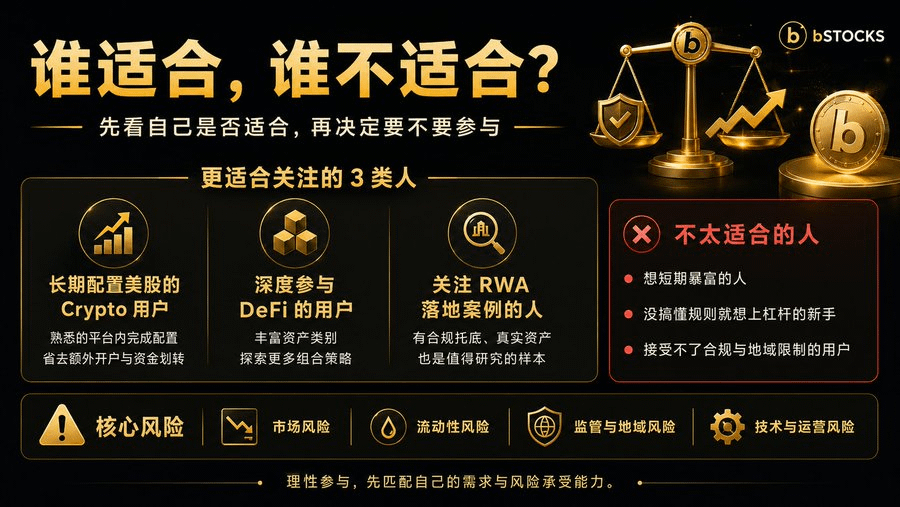
Don’t blindly rush in just because others say it’s good. First, check whether you’re in the target audience it’s meant for.
I think three types of people are especially worth paying attention to:
The first type: Crypto users who already have long-term needs to allocate to U.S. stocks. No extra account opening or funds transfer hassle—just allocate on a familiar platform, enjoy on-chain flexibility, and get a very good cost-performance ratio.
The second type: users who deeply participate in DeFi and want to broaden asset categories. Previously, on-chain assets mainly concentrated in crypto and stablecoins. Now, by adding mature real-world assets like U.S. stocks, you can diversify your holdings and also explore more portfolio strategies.
The third type: friends who focus on the RWA track and want to study real-world implementation cases. Compared with many projects that are still stuck at the concept stage, bStocks has compliant backing, real underlying assets, and a full ecosystem—it’s a very valuable implementation sample worth researching.
If you can’t accept compliance and regional restrictions, you don’t need to force it. It’s not globally and unlimitedly open. U.S. users can’t use it, and many features have qualification barriers. If you don’t meet the criteria, there’s no need to force it.
On the other hand, I also don’t recommend it for a few kinds of people:
If you’re here to get rich quickly in the short term, don’t come. Its underlying is U.S. stocks—its price movement is tied to the fundamentals of listed companies. It won’t jump dozens of times like shady meme coins. Fundamentally, it’s a configuration/allocation-type asset, not a speculation tool.
Beginners who haven’t even understood the basic rules of stocks and just want to use them to offset leverage—don’t. Leverage is a double-edged sword: if you use it poorly, losses will be magnified. It’s safer to start with basic holding to get familiar with the rules.
Finally, let’s spell out the core risks clearly too—don’t just look at returns:
Market risk: U.S. stocks will move the way U.S. stocks move. Going on-chain doesn’t mean you’ll稳赚不赔.
Liquidity risk: trading volumes for niche underlying assets may fluctuate significantly. For larger trades, watch out for slippage.
Regulatory and regional risk: opening policies in different regions may change—everything should follow the latest official announcements.
Technology and operational risk: on-chain products may encounter contract issues or system maintenance. These are objective realities.
VIII. Finally, let’s talk about bStocks’ significance for the industry
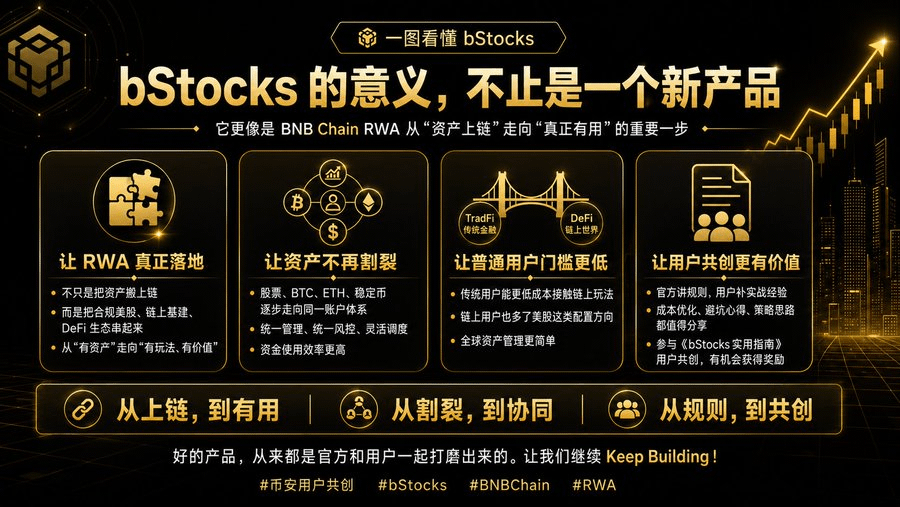
In my view, bStocks launching isn’t just another new product—it’s more like an important turning point for BNB Chain’s RWA efforts: shifting from simply piling assets onto the chain to genuinely delivering something useful and generating real value on the ground.
Before, many public chains that did RWA only moved assets onto the chain and stopped there. They didn’t form a complete gameplay closed loop, so users really don’t get that much benefit.
This time, with bStocks, BNB Chain connects compliant U.S. stocks, mature on-chain infrastructure, and the entire DeFi ecosystem.
Traditional stock traders can access on-chain玩法 at low cost, while people who are already on-chain also gain a low-risk allocation direction.
Looking farther back, our assets used to be completely siloed: stocks were at brokers, crypto was at exchanges, and DeFi assets were in wallets. Moving funds back and forth was troublesome and inefficient, and managing it was also a hassle.
Now we’re gradually seeing products like this—able to put stocks, BTC, ETH, and stablecoins into the same account system, with unified management and risk control, and even allow mutual collateralization and coordinated allocation.
This may be the real value of RWA—not just moving traditional assets onto the chain to trade concepts, but allowing different types of assets to flow freely within the same financial system, lowering the barrier for ordinary people to manage global assets.
Of course, it’s still just getting started. The supported underlying assets are limited, and many features have entry barriers. But I think this direction is worth keeping an eye on long-term.
When I saw Binance initiate (bStocks practical guide) user co-creation, I really felt something.
The official manual can only explain the rules. But the truly useful hands-on tips, avoid-pitfall experience, and strategy thinking are built and refined step by step by ordinary users, in real practice.
Some people are good at shaving trading costs; some people understand collateral strategies inside out; some have stepped on traps and compiled full-on avoid-pitfall guides; and some can explain complex rules so even beginners can understand them.
Everyone writes down the part they’re good at. When you put them together, you get a practical operations handbook that’s even more useful than the official documentation.
And since it’s also included/recognized by the official side, there are corresponding rewards. If you’re already playing bStocks and you have your own thoughts about the product, you really can give it a try.
You don’t need to write something too high-sounding. Just describe your real usage experience—maybe it can help many people. You might even get a reward.
After all, good products are always refined together by the official side and users. Let’s keep building!
For friends who want to dig into the details of bStocks, you can also check Binance’s official guide: from basic concepts to product rules, it explains everything clearly:
https://www.binance.com/en/academy/articles/what-are-bstocks-a-guide-to-tokenized-stocks-on-binance
@binancezh @cz_binance @heyibinance
PS: Information may be incorrect; for reference only! #DYOR
#Binance 9th Anniversary #Binance User Co-Creation