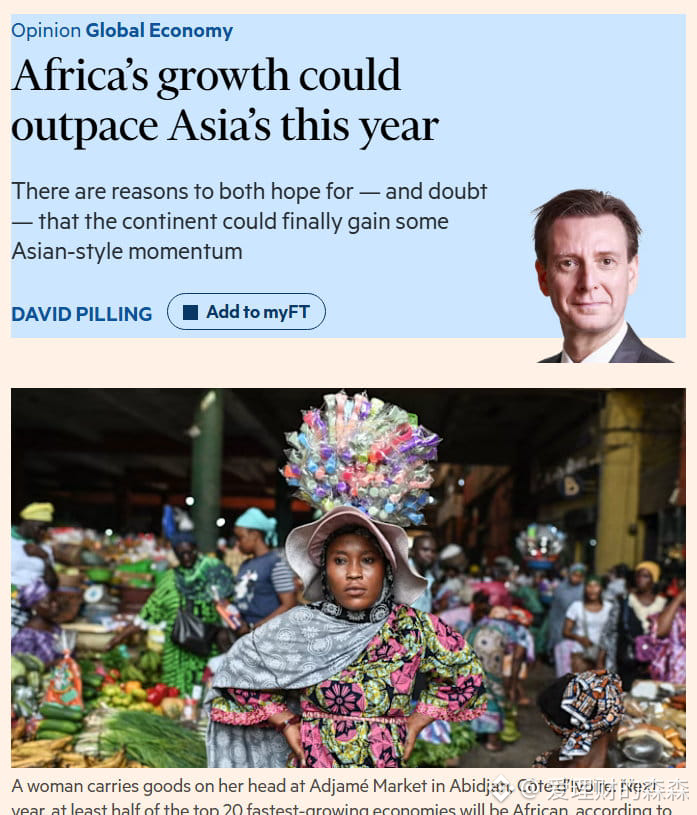
Africa's economic growth rate in 2026 may surpass that of Asia, but the development model relying on population growth and a low base needs improvement.
An article from FT states that Africa's economic growth rate in 2026 is expected to be 4.4%, exceeding Asia's 4.1%. This is due to the significant price rise of mineral resources such as gold and copper, as Africa has abundant resources. Sub-Saharan Africa is projected to have about 4.1% growth in 2025, and even better in 2026. Although there are conflicts, Africa has 54 countries, and most are still growing.
Some African countries have developed well, with Ivory Coast achieving 6% to 7% growth over the past 15 years, aiming to become a middle-income country by 2035. Countries that have maintained strong growth for many years include Ethiopia, Ghana, Mauritius, Rwanda, and Senegal. Even with civil wars, political crises, and defaults, growth has still been achieved.
Half of the 20 fastest-growing countries in the world are in Africa, although Nigeria and Egypt, two of Africa's three largest economies, are only close to the average growth rate, while South Africa is performing worse.
The problem with Africa is that 2% or more of the 4%-5% growth is due to population growth, resulting in a per capita growth of only 2%-3%, which is not impressive. To reach Asia's growth level, Africa needs a growth rate of 7%.
Africa's 'high growth' is merely due to an extremely low base. The three basic conditions of electricity, infrastructure, and a sufficiently literate population remain significant barriers for many African countries. By 2050, Africa's population will exceed a quarter of the global workforce, surpassing the combined total of China and India. It is hard to predict the future; based on the current trajectory, the consequences are unlikely to be good.
(From a relatively optimistic perspective, if Africa develops, Chinese companies overseas will still have significant growth opportunities. With a population exceeding that of China and India, what a huge demand that is! How can they make money from a vast, unreliable, and low-income population? Both Chinese and Indian companies are trying to find ways, each with their own expertise.)
An article from FT states that Africa's economic growth rate in 2026 is expected to be 4.4%, exceeding Asia's 4.1%. This is due to the significant price rise of mineral resources such as gold and copper, as Africa has abundant resources. Sub-Saharan Africa is projected to have about 4.1% growth in 2025, and even better in 2026. Although there are conflicts, Africa has 54 countries, and most are still growing.
Some African countries have developed well, with Ivory Coast achieving 6% to 7% growth over the past 15 years, aiming to become a middle-income country by 2035. Countries that have maintained strong growth for many years include Ethiopia, Ghana, Mauritius, Rwanda, and Senegal. Even with civil wars, political crises, and defaults, growth has still been achieved.
Half of the 20 fastest-growing countries in the world are in Africa, although Nigeria and Egypt, two of Africa's three largest economies, are only close to the average growth rate, while South Africa is performing worse.
The problem with Africa is that 2% or more of the 4%-5% growth is due to population growth, resulting in a per capita growth of only 2%-3%, which is not impressive. To reach Asia's growth level, Africa needs a growth rate of 7%.
Africa's 'high growth' is merely due to an extremely low base. The three basic conditions of electricity, infrastructure, and a sufficiently literate population remain significant barriers for many African countries. By 2050, Africa's population will exceed a quarter of the global workforce, surpassing the combined total of China and India. It is hard to predict the future; based on the current trajectory, the consequences are unlikely to be good.
(From a relatively optimistic perspective, if Africa develops, Chinese companies overseas will still have significant growth opportunities. With a population exceeding that of China and India, what a huge demand that is! How can they make money from a vast, unreliable, and low-income population? Both Chinese and Indian companies are trying to find ways, each with their own expertise.)