

Stable Protocol: Redefining a New Financial Paradigm for Decentralized Privacy Stablecoins
The world’s first privacy-stablecoin protocol, forged by users themselves and based on zero-knowledge proofs, has officially launched.

In 2026, the cryptocurrency market will reach a milestone moment— the Stable Protocol (ST for short) mainnet officially goes live. This decentralized privacy-stablecoin protocol, led by StableDAO and deployed on the Solana blockchain, is trying to address two major challenges that have plagued the industry for years: how to achieve transaction privacy while maintaining stability.
Privacy and Stability: a century-old industry challenge
Before Stable appeared, users were forced to compromise between two approaches. Mainstream cryptocurrencies like Bitcoin and Ethereum are decentralized, but transaction information is fully transparent—anyone can trace fund flows on blockchain explorers. Privacy coins like Monero (XMR) and Zcash protect transaction privacy, but their prices are highly volatile, making them unsuitable as a stable store of value. Meanwhile, stablecoins like USDT and USDC have stable prices but provide no privacy protection: the counterparties, amounts, and time are all publicly visible.
How big is this market gap? The answer is in the trillions.
According to DefiLlama data, the total market capitalization of stablecoins has grown from $198.76 billion a year ago to about $308.45 billion, a year-over-year increase of roughly 55%. At the same time, the demand for privacy protection is also growing rapidly. In a recent $120 million USDT money-laundering incident, Tether urgently froze about $72 million, but around $48 million still successfully transferred through privacy channels such as Monero, highlighting the fatal shortcomings of traditional stablecoins in privacy protection.
Stable Protocol: Deconstructing stability and privacy through dual innovation
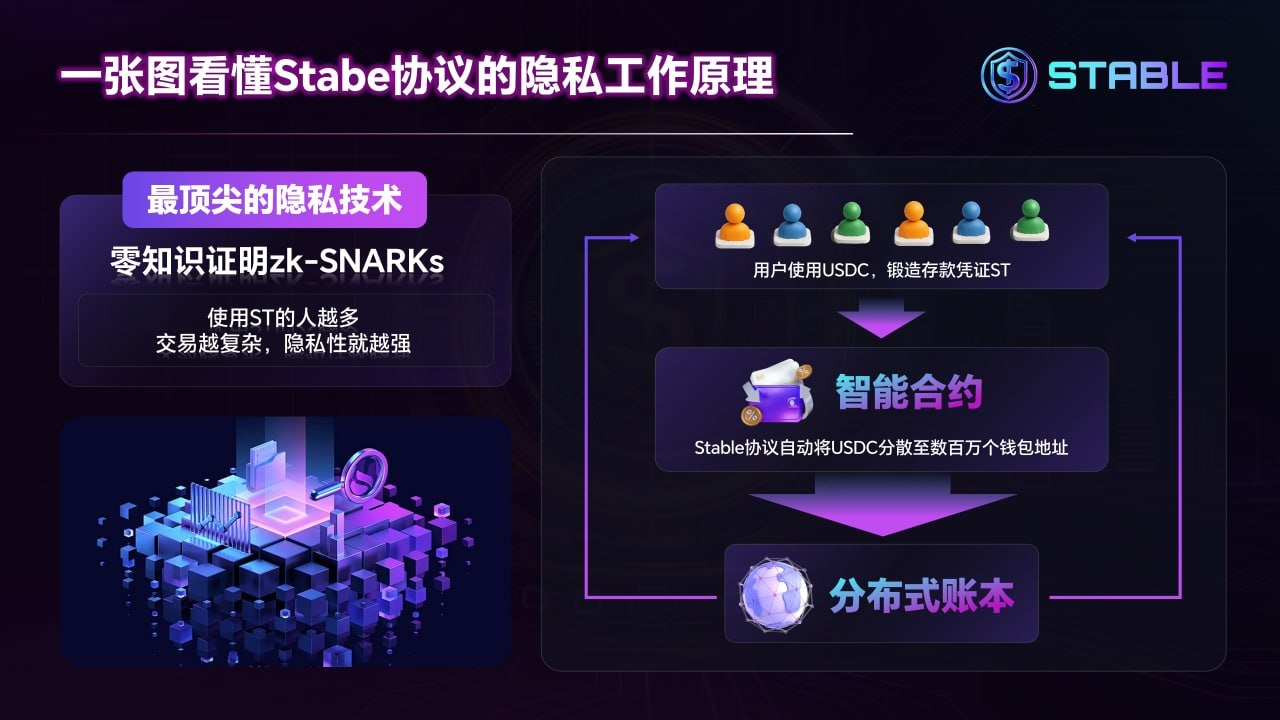
Stable achieves the integration of stability and privacy through two key technologies: the 1:1 USDC-peg mechanism + a zero-knowledge proof (zk-SNARKs) privacy layer.
I. The four-token cyclic economy model
Stable has built a complete four-layer token ecosystem, forming a closed-loop cycle of economic value:
USDC: an externally-anchored asset, serving as the protocol’s value entry and exit
ST: a privacy-stable token, maintaining a 1:1 peg with USDC
STA: a primary derivative token, minted by locking ST for 1 day to earn a 0.8% return
STB: a secondary derivative token, minted through STA for 1 week to earn an 8.0% return
The minting path is: USDC → ST → STA → STB → USDC, completing a full cycle in 8 days, with a single-cycle return of 8.864% and an annualized simple interest rate of about 404%. All minting and burning are automatically executed by smart contracts, publicly transparent, and tamper-proof.
II. Privacy protection based on zk-SNARKs
The zero-knowledge proof technology used by Stable is one of the strongest privacy-preserving solutions in the field of cryptography. When users deposit USDC, the smart contract generates an encrypted deposit commitment. When withdrawing, users use a zero-knowledge proof to prove to the network that “I know the secret of a certain deposit commitment and have never used it,” without revealing which specific commitment it is. After verification passes, the funds are withdrawn to a brand-new address that is completely unrelated to the deposit address.
The entire deposit/withdrawal linkage is彻底切断, making transactions untraceable. Moreover, the more people use ST, the more complex the transactions become and the larger the anonymity set—therefore the stronger the privacy. This is Stable’s privacy flywheel effect.
Security and technical safeguards
The Stable Protocol builds multiple layers of defense for security:
1. Fully open source: the code is publicly available on GitHub for auditing, and any developer can review and verify it
2. Formal verification: the core code is formally verified at the mathematical level, logically proving that the contract behavior matches expectations
3. Audited by multiple security institutions: multiple rounds of code audits performed by globally leading security teams
5. Permission revocation: Contract permissions have been permanently revoked, and no one can modify the rules or transfer assets
6. Bug bounty program: encourages white-hat hackers to discover and report potential vulnerabilities
Decentralized governance and long-term planning
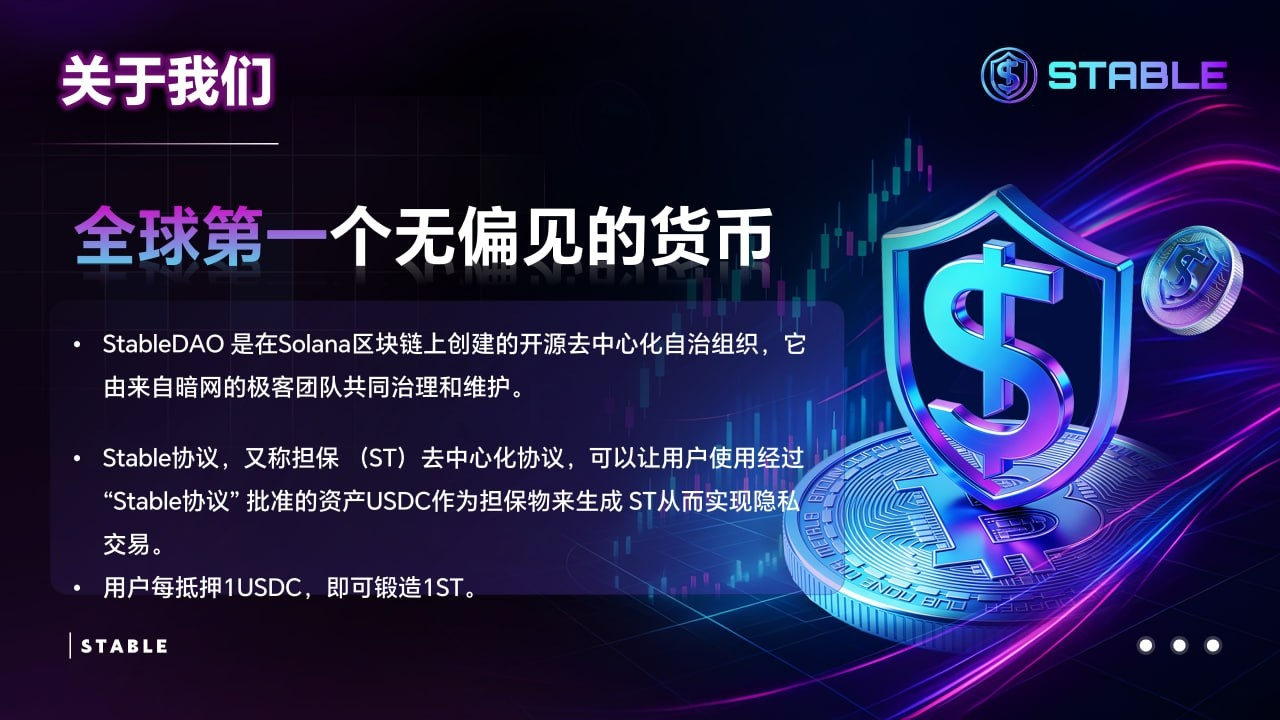
Stable is governed by StableDAO, an open-source decentralized autonomous organization maintained by a global technical community. Everyone has voting governance rights, and everyone is a minter and issuer. Even if a DApp front end can’t be accessed, users can still mint and redeem directly through contract addresses, truly delivering censorship resistance.
In the next 12 months, Stable plans to expand to more high-quality collateral (USDT, DAI, etc.) and deploy on Ethereum Layer2 networks and other high-performance chains. In the long run, the ecosystem will incubate derivative protocols built on ST for privacy payments and privacy lending, creating a complete privacy finance ecosystem.