


Futures tied to the main U.S. indexes are trading higher, with a slate of major tech company results scheduled for this week. The U.S. and Iran exchange new retaliatory attacks, threatening to further restrict the flow of supplies through the Strait of Hormuz and pushing Brent crude prices back above US$90 per barrel. China’s Moonshot AI is reportedly preparing for an initial public offering in Hong Kong, while SpaceX says it plans to launch the thirteenth test flight of its Starship still this week. $ACE
1. Futures rise
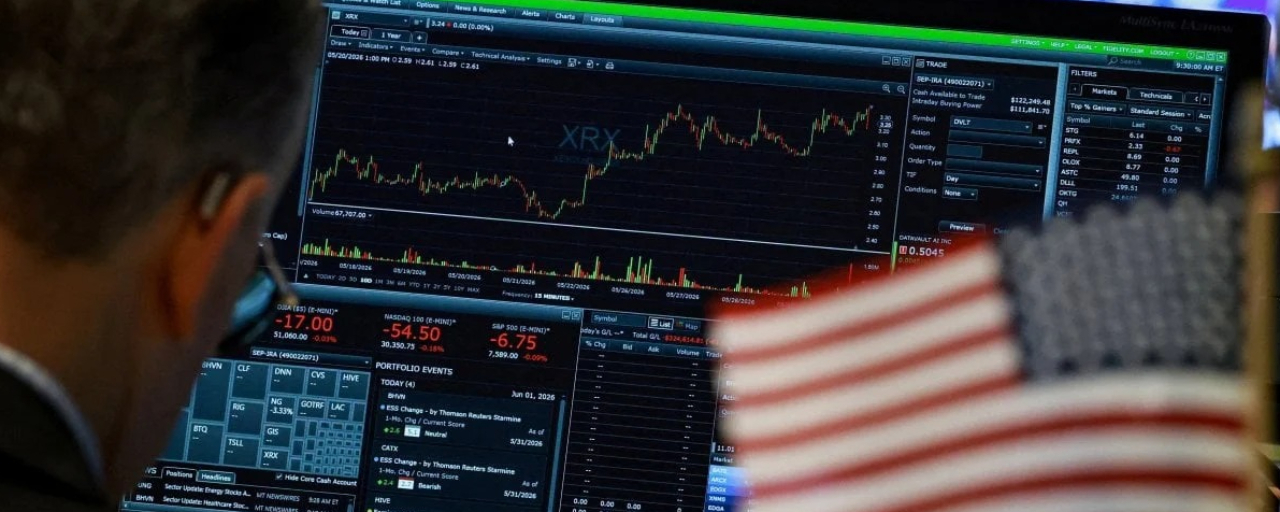
U.S. stock index futures pointed higher on Monday as investors monitored ongoing geopolitical tensions in the Middle East and prepared for a week of trading packed with major technology-sector earnings.
At 04:33, the Dow Jones futures contract had risen by 50 points, or 0.1%; the S&P 500 futures were up 17 points, or 0.2%; and the Nasdaq 100 futures gained 129 points, or 0.5%.
Wall Street’s main indexes closed lower on Friday. Concerns have been growing around the artificial intelligence boom which, despite driving much of the gains in markets this year, is facing questions about the sustainability of the massive investments in still-developing technology. According to Reuters, some active fund managers have begun reducing their exposure to AI-linked assets.
Semiconductor manufacturers, which provide essential tools for the AI era, were particularly affected by this rise in risk aversion. The Philadelphia Semiconductor Index closed more than 20% below the level recorded on June 22, meaning the sector index entered bear-market territory.
"For tech investors, the pessimists won the week overwhelmingly, although the drop was more the result of a shift in narrative and technical distortion—extremely concentrated and complacent positioning, plus an optimistic sentiment that was nonetheless lagging—than incremental negative news," analysts at Vital Knowledge said in a note.
The highlight of this week’s agenda will be a series of corporate earnings reports from major technology names, including chipmaker Intel, Alphabet—Google’s parent company—and electric-vehicle maker Tesla.
2. U.S. and Iran trade rising attacks
U.S. military forces attacked Iran for the ninth consecutive day on Monday, further raising doubts about when the Strait of Hormuz will reopen to commercial ship traffic.
The attacks occurred after Iran said that two tankers had been hit and immobilized. Iran’s Islamic Revolutionary Guard Corps, the country’s paramilitary force, added that it launched attacks against U.S. aircraft at an airport in Jordan, and also targeted U.S. military assets and equipment in Kuwait and Syria.
Bahrain’s Ministry of the Interior also warned that sirens sounded on Monday morning.
A cycle of retaliatory attacks has taken hold between the U.S. and Iran, just weeks after the two sides signed a ceasefire agreement—fragile at its core. Markets are closely watching whether exchanges of attacks will continue to escalate and whether they will cut off the flow of essential supplies through the Strait of Hormuz, a vital maritime waterway along Iran’s southern coast.
3. Brent again tops $90 $BANK
Against that backdrop, Brent oil futures—the global benchmark for oil prices—have returned to rising above $90 per barrel.
Volatility has been a striking feature of the contract since the start of the joint U.S.-Israel attack on Iran at the end of February. Brent briefly surpassed US$110 per barrel shortly after the conflict began, before retreating to levels close to those seen before the war, around US$70 per barrel, after the ceasefire agreement was signed in June.
However, the resumption of hostilities has reignited upward pressure on oil in recent days. At 04:21, Brent was up 2.8%, at $90.56 per barrel, while U.S. WTI (West Texas Intermediate) oil futures rose 2.3%, to $84.39 per barrel.
Rising oil costs fueled fears of a global inflation surge, which could lead central banks to raise interest rates in response.
4. Moonshot considers a fundraising round
China’s Moonshot AI is preparing for an initial public offering in Hong Kong that could take place within up to six months, seeking to capitalize on investor interest after the launch of its AI model Kimi K3, Bloomberg News reported on Sunday.
The startup based in Beijing sent a resolution to shareholders seeking approval for a potential listing, Bloomberg reported, citing people familiar with the preparations.
Moonshot is also wrapping up a private fundraising round that may value the company—three years since its founding—at more than US$30 billion. The financing terms have not yet been finalized.
Interest in Moonshot has grown since the company launched Kimi K3, an open-weights model that showed strong performance compared with several of the main U.S. systems, though Moonshot acknowledged it is still behind Anthropic’s Claude Fable 5 and OpenAI’s GPT-5.6 in overall capability.
5. SpaceX targets Starship test flight by Thursday $AVAAI
SpaceX said it plans to launch the thirteenth test flight of its Starship as early as Thursday, after a test flight last week was canceled minutes before launch.
The rocket maker said in a statement released on Sunday that Starship—the company’s largest and most powerful rocket—will have as its main goals a successful launch, the ascent phase, stage separation, engine re-entry burn, and landing burn at an offshore point. The spacecraft will carry Starlink V3 satellites.
Last week’s test flight was aborted moments before launch after some of the spacecraft’s engines failed to fire. The twelfth Starship test flight also had engine problems, prompting an investigation by the Federal Aviation Administration (FAA).
Shares of SpaceX, which fell last week below the price set in its long-awaited initial public offering, were up more than 1% in extended-hours trading.




#news #BurnhamToBecomeUKPrimeMinister #USStrikesIranForNinthStraightNight #WTICrudeRises2%To$84 #war