



The terms "bull market" and "bear market" are often used to describe the performance of the stock market - whether it is appreciating or depreciating. In this case, a rising market is called a bull market, while a falling market is called a bear market.
Given that crypto markets are typically volatile and fluctuate on a daily basis, these terms are used to refer to longer periods of mostly upward or downward movement. Likewise, market changes are manifested by large moves (at least 20%) in either direction.
In this article, we will focus on how these trends apply to cryptocurrencies. Specifically, we will discuss: What is a bull or bear market? What are the characteristics of a bull market vs a bear market? How do we know if we are in a bull or bear market? The main differences between bull and bear markets, and how to invest in bear and bull markets.
What is a bull market?
A bull market refers to generally favorable economic conditions. This means the market is rising and is usually accompanied by positive investor sentiment about the current upward trend.
A bull market is one in which asset prices continue to rise and is accompanied by a strong economy and high employment levels.
This applies to both cryptocurrency and traditional markets. However, in cryptocurrency, stronger and more consistent bull crypto phases are more common.
What does a bull run in crypto typically look like? A 40% price increase in one to two days is common. This is because crypto markets are relatively smaller than traditional markets and therefore more volatile.
The term "bull market" is thought to originate from the way bulls fight, striking their opponents with their horns pointed upward. Today, a "bullish" market or investor generally denotes optimism that an asset's value will continue to rise.
In the crypto market, a bull market signals a bullish phase for cryptocurrencies. This is where you’ll see cryptocurrencies grow in value amid generally favorable economic conditions and optimistic investors looking to make the most of their growing crypto portfolios.
In short, investors start a bull market by buying securities. This can also be done with fiat currencies, as bull markets generally increase security prices. Bull markets will continue as long as supply exceeds demand. After a while, the bull market gets tired, so to speak, and the market turns and enters a bear market.
What causes a bull market?
As mentioned before, investors are the ones who start a bull market. When they feel that prices will start to rise and continue to rise for a longer period of time, they start buying stocks (at low prices) and are optimistic about the return on investment (ROI). The increase in investor optimism also causes stock prices to continue to rise.
There are other factors that contribute to bull runs. These include strong gross domestic product (GDP) and low unemployment. Generally speaking, favorable market conditions increase investor confidence. Likewise, cryptocurrency bull runs are influenced by similar factors as traditional markets.
However, the crypto market is still relatively new compared to traditional securities that have been around for hundreds of years. Cryptocurrencies may also be driven by factors unique to their niche due to the smaller overall number of investors.
For example, a crypto bull run could be driven by:
Mainstream and pop culture support: Think of the 2017 bull run influenced by Paris Hilton and DJ Khaled, and shows like The Big Bang Theory.
Bringing in institutional capital: A great example is MicroStrategy’s $650 million Bitcoin ( BTC ) investment (over 70,000 BTC).
Optimism grows in traditional finance: JPMorgan strategists say Bitcoin could rally to as high as $146,000.
Unique events that threaten traditional finance: For example, COVID-19 has prompted many to turn to cryptocurrencies amid the stress caused by the pandemic in traditional financial markets.
Characteristics of a Cryptocurrency Bull Market
Typical attitudes and behaviors of a bull market are:
Prices rise over a sustained period;
Despite weak supply, demand is strong;
Increase investors' confidence in the market;
Some items are overpriced;
Insert discussions about cryptocurrency in mainstream media and social media;
General interest in cryptocurrencies among celebrities, influencers, and other sectors that may not have been interested in cryptocurrencies before;
Prices soar when there is good news;
Prices fell slightly in case of bad news.
What is a 'bull run' in cryptocurrency?
A bull market is a long period of time when a large number of investors buy cryptocurrencies. It has the above-mentioned characteristics of rising prices, insufficient supply, and high market confidence.
Investor confidence often drives a positive feedback loop that further prolongs the bull market (more investment, continued price increases). For cryptocurrencies in particular, the price of a given cryptocurrency is largely influenced and driven by public confidence in the asset.
What is a bear market?
A bear market, on the other hand, is one in which the value of cryptocurrencies has dropped by at least 20% and continues to fall. An example includes the famous cryptocurrency crash in December 2017, when investors saw Bitcoin fall from $20,000 to $3,200 in a matter of days.
A bear market is characterized by a drop of 20% or more from a previous high. As a result, prices are low and keep falling. A downward trend can also affect investors' outlook and perpetuate a further downward trend. The word "bear" is believed to be derived from the way a bear fights - starting from high up, then striking down with its claws and pressing down with all its weight.
During a bear market, economic growth is slow and unemployment is high. These conditions can result from bad economic policies, geopolitical crises, market bubble bursts, or even natural disasters.
Bear markets also lack the general optimism and confidence that most investors have during bull markets.
Typically, cryptocurrency traders aim to buy assets during bear markets, especially during troughs. However, it’s difficult to know exactly when a bear market will end, making it difficult for investors to take the risk of buying low-value cryptocurrencies that may or may not recover.
When the market receives news about unfavorable conditions for a particular cryptocurrency or stock, the price typically drops. The downward spiral causes more people to hold off on investing because they believe more bad news will soon arrive and that they need to prepare for the worst.
Some even sell their holdings out of panic, further contributing to the downward trend. The bear market eventually calms down, and investors slowly gain confidence, starting a new bull market cycle again.
What caused the cryptocurrency bear market?
A downward trend in prices usually leads to the start of a bear market. As prices continue to fall, investors simultaneously lose confidence that prices will recover, leading to a further downward trend.
Generally speaking, factors such as war, politics, epidemics, and economic slowdowns can trigger the start of a bear market. Government intervention can also cause a bear market to start. However, in cryptocurrencies, it is much more difficult to predict when a bear market will start based on previous trends. While the stock market has decades of data for investors and analysts to refer to, the crypto market is relatively young.
Although the causes of a bear market vary, there are some common indicators that suggest a bear market is about to begin. Some indicators of an emerging cryptocurrency bear market are:
Lower trading volume: This usually means that people are starting to hold on to their coins due to market uncertainty.
Negative sentiment in traditional finance: One example is when JPMorgan Chase CEO Jamie Dimon called Bitcoin a fraud in 2017, just months before Bitcoin reached $20,000 per unit and then promptly crashed.
Death Cross: A technical indicator regarding the crossover of an asset from its 50-day moving average to its 200-day moving average.
Backwardation: When the price of an asset in the futures market is lower than the current market price.
Changes in the Federal Funds Rate: The interest rate banks pay to lend/borrow excess reserves overnight.
Intervention by regulators: An example of this is the Chinese government’s restrictions on crypto software and mining. This intervention has forced many mining operations offline, creating widespread uncertainty.
Characteristics of a Crypto Bear Market
Typical attitudes and behaviors of bears are:
Prices continue to fall;
Supply exceeds demand;
Investors lack confidence in the market;
Not talking about cryptocurrencies (or talking about them negatively) in mainstream media and social media;
Economists, analysts, and the traditional financial community generally distrust cryptocurrencies;
lower highs when good news comes;
Lower the lows in case of bad news.
Bull and Bear Markets: Key Differences
So, the question many people ask is, how do you determine if it's a crypto bull or bear market? While both are largely marked by the direction of cryptocurrency prices, there are some key differences that investors can watch out for. Bull and bear trends affect cryptocurrencies in much the same way they do stocks.
However, with cryptocurrencies, trends are different due to cryptocurrencies’ sensitivity to volatility. Therefore, once a bull or bear trend takes hold, crypto markets tend to move faster. Bull and bear markets are also easier to spot in stocks. This may not be the case with cryptocurrencies because the feedback given by crypto investors affects crypto differently compared to stocks.
For example, let's say the crypto market is recovering from a bear market. Therefore, investors usually go into bull investor mode at the bottom of a bear market. As a result, this will push crypto prices up faster. Crypto bull markets tend to come and go quickly compared to stocks. They also tend to be shorter-lived, lasting only a few days to a month.
Then, as the bull market continues to gain strength, investors will slowly fall afterwards as they are likely to sell the currency and cash out. For this reason, bull and bear markets affect cryptocurrencies differently than stocks because they increase volatility and transaction speed.
Some notable differences between a bull market and a bear market are:
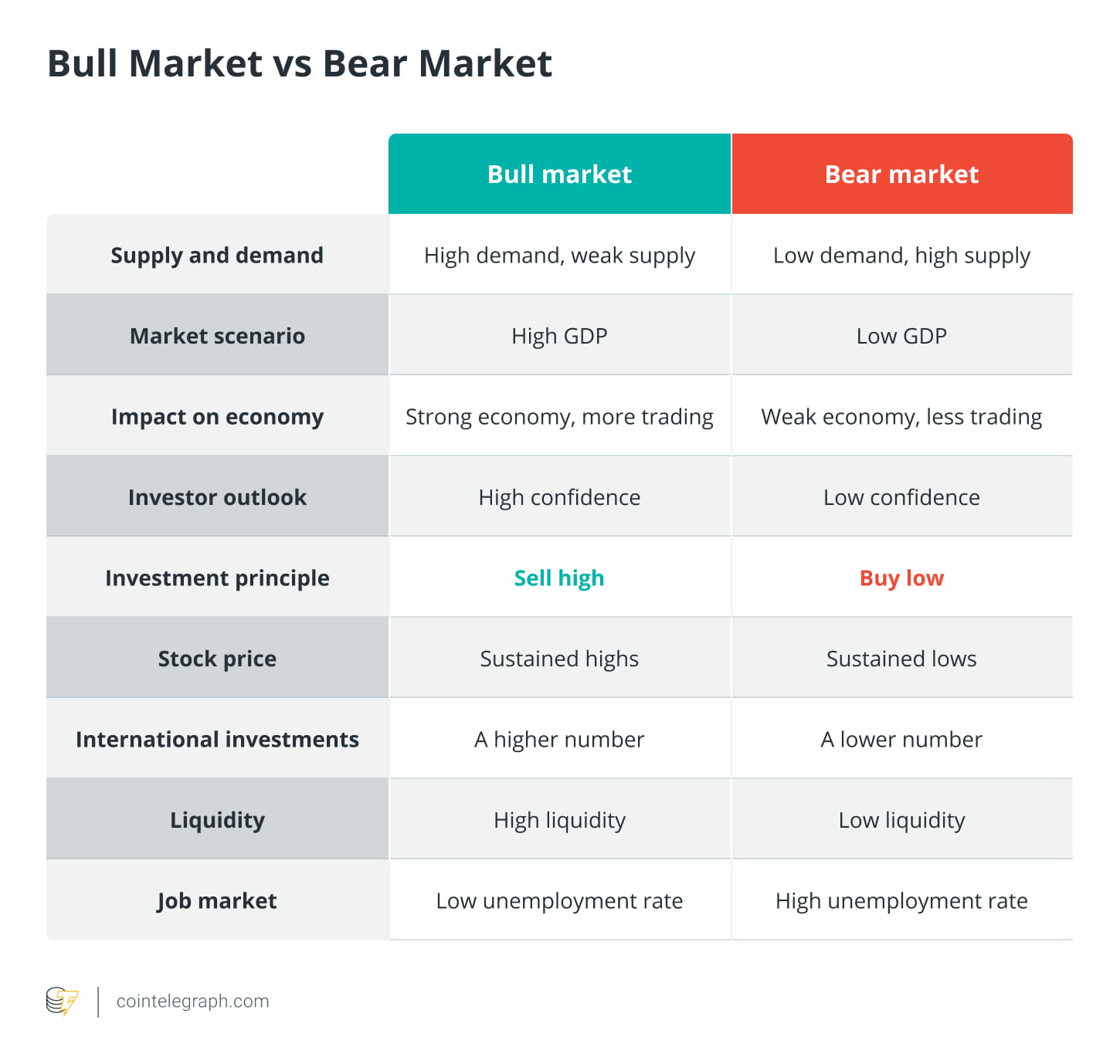
supply and demand
In a bull market, demand for cryptocurrencies is strong amid weak supply. Many investors want to buy cryptocurrencies, but few are willing to give them up. This drives up prices further as investors race to buy existing products.
However, in a bear market, more people are selling than buying (the opposite of an investing principle). Demand is lower than supply, causing prices to fall further.
Market scenario
Rising GDP signals a bull market, while falling GDP signals a bear market. That’s because GDP typically increases as companies earn more revenue and employees receive more wages. Together, they contribute to increased consumer spending.
On the other hand, GDP falls when corporate revenues are weak and wages are low or stagnant. As a result, bear markets are usually followed by recessions, with GDP falling for two consecutive quarters.
Impact on the economy
Bear markets are associated with a weak economy. When businesses fail to meet revenue targets and consumers don’t spend enough, profits fall and have a negative impact on the economy. The same attitude is reflected in cryptocurrencies and stocks, with people hesitating to trade or invest because of the situation.
On the other hand, a bull market is associated with a strong economy, during which consumer spending is higher and profits are more profitable. Trading stocks and cryptocurrencies also increases during a bull market.
Investor Outlook
Investor psychology and cryptocurrency market performance are closely related. In a bull market, the rise in cryptocurrency prices further boosts investor confidence. Therefore, more investors are encouraged to invest in the market in the hope of making good profits.
In a bear market, investor sentiment towards cryptocurrencies is typically negative. As a result, some sell their holdings out of panic, further pushing prices down and more investors take similar actions.
Stock Price
Looking at the current cryptocurrency price is one of the quickest ways to determine whether the market is in a bull or bear market. Furthermore, rising asset prices indicate market confidence and an upcoming bull market. Conversely, falling asset prices indicate a lack of confidence and an upcoming bear market.
fluidity
Bull markets have higher liquidity, and stocks can be traded with lower transaction costs as investors are confident of quick and steady returns. On the other hand, bearish markets have lower liquidity due to a lack of confidence in the overall market conditions.
International Investment
A bull market is characterized by a continuous rise in prices. As a result, more investors are confident that the upward trend will continue and are more willing to take risks. In contrast, a fall in prices in a bear market is also accompanied by a decline in investor confidence.
Talent Market
The unemployment rate is also closely tied to changes in market trends. In a bull market, unemployment is falling as the economy is stronger and consumers have more purchasing power. However, during a bear market, companies tend to lay off employees, which drives up the unemployment rate. This also tends to prolong the bear market because people are earning less and companies are also earning less.
Is it better to buy in a bull market or a bear market?
Cryptocurrency traders usually buy during bearish markets to take advantage of lower cryptocurrency prices. Hence, they have a higher chance of making a solid profit when a bull run emerges.
However, there are also benefits to buying during a bull market. Buying during a bull market can contribute to the uptrend, thereby increasing your profits as the market strengthens.
Both of these strategies come with risks, just like any other strategy in trading. Therefore, the key is to really be able to understand historical trends and stay up to date with cryptocurrency news. As long as you invest in cryptocurrencies, you will likely experience several bull and bear markets, so it is best to consider investing in both.
How to invest in a bull market?
When investing in a bull market, it’s best to recognize the trend early so you can buy in early as well. Later, you can sell at a higher price when the market reaches its peak. Bull markets tend to last a long time, so any losses are usually minimal and temporary.
But what if things take an unexpected turn (such as a crisis or regulatory intervention) and you sense that a bear market is emerging? In this case, the best strategy is to reduce your positions, especially in less mature cryptocurrencies. You may want to temporarily move your assets into precious metals, cash, or similar assets. This is because they have a better chance of withstanding a crash.
Cryptocurrencies also tend to sell at lower prices at the end of a bull run, so keep an eye out and take advantage of the possibility of increasing your investment.
How to invest in a bear market?
Investing in a bear market naturally involves more risk because prices are lower and investor confidence in cryptocurrencies is low to zero. However, this risk also comes with the possibility of higher returns in the future. Therefore, you can buy cryptocurrencies when prices are lower and sell them at the peak of the next bull market.
Another strategy used by investors is to sell existing holdings as soon as they spot a downtrend and then buy them back at a much lower price as the market continues to fall.
There is no way to tell how long a bear market will last, especially if it is driven by a recession or similar situation. The problem, therefore, is not knowing how long the decline will last and how much further prices can fall. As a result, you could buy too early or miss out on a good investment.
Final Thoughts
Bull and bear markets in crypto markets are driven by a variety of factors. As we’ve discussed, the cryptocurrency market has fewer investors than the stock market and is more volatile, so there are some differences when considering trading during bull and bear markets.
Cryptocurrency investors often buy when prices are lower during bear markets and hold on to make big profits when the next bull run arrives. There are still plenty of other strategies used by professional traders, such as looking for "rectangle patterns" during bullish trends.
A helpful tip is to keep observing market patterns from past bull and bear trends. This can help you predict upcoming changes or at least give you a strategy to deal with market shifts. Another good habit is to stay up to date with the latest cryptocurrency news, as well as learn from the experts by reading their tips and tricks.
Whether you are investing in a bull or bear market, it is important to remember that every strategy always carries risk. Therefore, we encourage you to do your own research to ensure you are making the best decision for your specific situation.
If you want to read more about the basics of crypto, you can always check out our How to Crypto guide which contains a ton of resources like this excellent beginner’s article on how to get involved in crypto.
We also have a wealth of material resources that delve deeper into the details of Bitcoin, Ethereum, Dogecoin, and more. Reading through helpful resources will help you become familiar with industry terminology, as well as the best strategies for dealing with different types of cryptocurrencies.