


0.07252.
It’s up 0.14%, and rounded it’s basically unchanged. Over the past full seven days, DOGE has been hovering back and forth within that three-cent range of 0.071 to 0.074—up one day, down the next, down one day, up the next. The theme is pure "moving nowhere."
DOGE has basically turned itself into a stablecoin, folks.
Futures trading volume is 159 million, and spot is 103 million. Price isn’t moving, and neither is volume—the market feels like someone hit the pause button. If I didn’t occasionally check my account, I might’ve almost forgotten I even hold Dogecoin.

Market cap? Holdings? Circulating supply? When the numbers are just going sideways, staring at them for too long makes you want to fall asleep. Anyway—nothing’s changed. Really, nothing.
Take another look at the long-versus-short data.
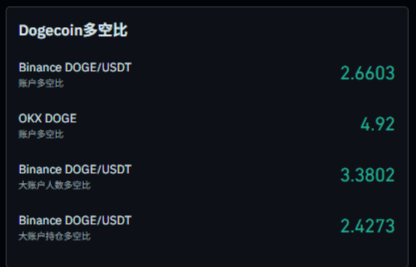
On Binance, the long-to-short ratio is around 2.5; on OKX it has climbed to 4.69, and for large accounts the long-to-short ratio is 3.28. The number of people bullish still overwhelmingly leads—retail “bottom-catching” enthusiasm is like summer mosquitoes: you can’t kill them, you can’t drive them away.
In terms of large-account positioning, the long-to-short ratio is 2.33.
It’s the familiar recipe again: by number of people, the longs are getting more and more; but in terms of positions, they’re getting more and more timid. This “scissor gap” has been going on for nearly two weeks now. Retail is frantically bottom-fishing, while big players quietly stop reaching.
To put it bluntly, every time this signal appears, the outcome is that the longs get buried. But will it be different this time? History tells us—history is always surprisingly similar, but the retail crowd always thinks this time is different.
Today’s liquidation data is so quiet it makes you want to fall asleep. In the past 24 hours, liquidations across the whole network are under 500,000—both longs and shorts have some, but it’s basically negligible. Compared with the liquidation volumes of over a million from a few days ago, today is truly a peaceful day in the long river of time.
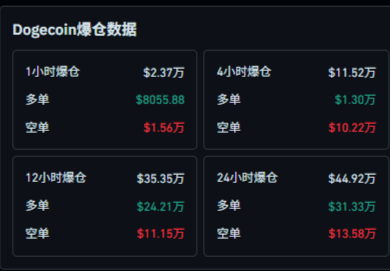
But this kind of calm is like the lull before a storm—so quiet it makes your stomach turn. The longer it goes sideways, the bigger the breakout. Right now, DOGE is like a spring compressed to its limit—either it rebounds up, or it snaps down.
Technically, DOGE is still ranging between 0.07 and 0.075. MA7 is around 0.073, MA25 is 0.078, and MA99 is 0.084—short positions are lined up perfectly, and there are no signs of a trend reversal.
The good news is that the RSI is around 45, having moved away from the oversold zone. The MACD histogram is shrinking below the zero line, suggesting the downside momentum has weakened. But these are basically what “a typical sideways consolidation looks like”—nothing particularly special.
At 0.072, it has been moving sideways for a full week. The Bollinger Bands are starting to tighten extremely, and volatility compression has been pushed to the limit—when volatility is compressed to the extreme, it means an explosion is coming. As for whether it will break upward or downward, nobody can know in advance.
Honestly, at this current position, both the long and short sides have already run out of steam.
The longs don’t dare to push it up, because the moment they do it gets smashed. The shorts don’t dare to dump either, because the 0.07 support is indeed solid. Both sides are waiting for a catalyst—good news or bad news, as long as it gives a direction, the market will move.
On the external environment, the US military actions against Iran are still ongoing. BTC is struggling around 64,000. US stock index futures are slipping slightly. This geopolitical “bomb” hasn’t fully detonated yet.
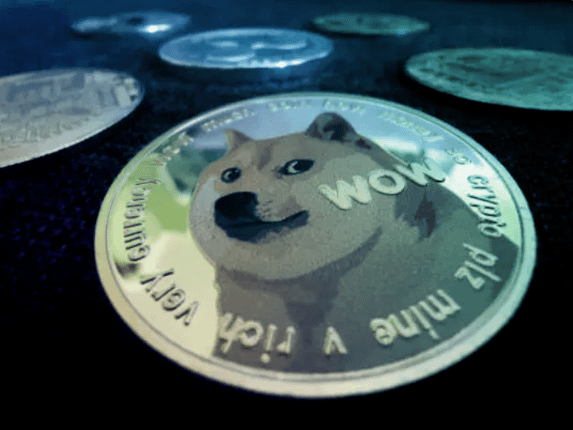
On the news front there’s a small stir: on July 18, BlockTower Capital bought 3.62 million DOGE on-chain, worth about $250,000. For an institution to act at this position means at least someone is gradually laying out a plan.
But the difference between retail and institutions is this: institutions can build their positions over three months—when it drops 10%, they add again; if it drops again, they add more. Retail often goes all-in with one shot, then prays that it will rise tomorrow.
You see the institutions buy 250,000, and you rush in to buy 25,000 with them. Result: they’re only buying 1% of their total position, and you go all-in. If an institution drops 10% and adds again, you drop 10% and get liquidated. That’s the difference.
Here’s some honest advice for you who’s reading these words:
If you have DOGE spot, hold it as long as 0.07 hasn’t broken—consider running only after it breaks. Don’t mess around randomly during a sideways range— the more you fiddle during consolidation, the more you’ll lose.
If you’re flat and want to bottom-fish, wait until a direction becomes clear. If it breaks upward through 0.075, you can chase a bit; if it breaks down below 0.07, don’t rush to catch the falling knife.
Leverage players—at this spot, doing more with leverage is a mistake, doing less is a smaller mistake; not doing anything is the best. When the market is going sideways, trading futures is like crossing the street with your eyes closed—you might get lucky and be fine, but if you don’t get lucky, you’ll instantly get sent flying to short near the small apartment building prices.

【Risk Warning】This article is only an industry viewpoint整理 and strategic interpretation, and does not constitute any investment advice. For reference only for fans. The crypto market carries extremely high investment risk; regulatory policies are uncertain. Please be sure to comply with local laws and regulations, invest rationally, and make cautious decisions.
