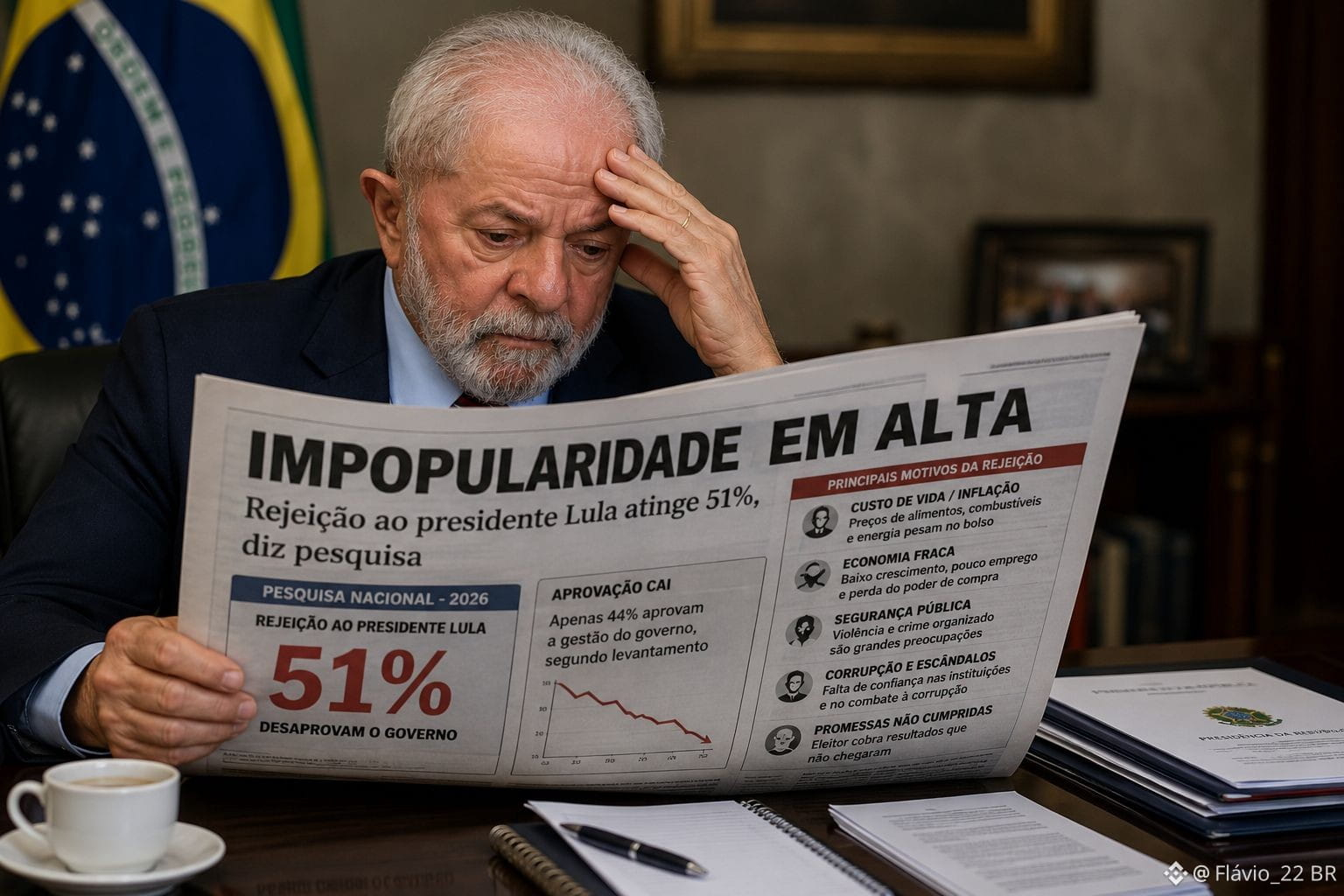
3 MONTHS BEFORE ELECTIONS, LULA’S UNPOPULARITY INCREASES, REJECTION REACHES 51%.
The most recent polls show that rejection (disapproval) of President Luiz Inácio Lula da Silva rises again after the new additional 25% tariffs from the United States on Brazilian products. Many Brazilian business groups blame the government for its lack of dialogue with the U.S. government regarding the new tariffs being applied. Factors such as high interest rates, inflation above the cap, and runaway government spending also contribute to the unpopularity of the current administration.
Some recent surveys indicate:
Quaest (July 2026): about 48% disapprove of the government, the highest figure of the year according to this institute.
Ipsos-Ipec (June 2026): 44% approve of the government, while 38% rate the administration as bad or very bad.
BTG/Nexus (April 2026): 45% approve and 51% disapprove of the president’s performance.
PoderData (March 2026): recorded 61% disapproval, the highest figure in this time series up to then.
As for the main reasons cited by voters who reject Lula’s re-election, opinion research and institute analyses indicate that the most frequently mentioned factors are:
Cost of living and inflation, especially the prices of food and energy.
Perception of the economy, including income growth, employment, and purchasing power.
Public security and combating organized crime.
Corruption cases and trust in institutions, a recurring topic among voters who are critical of the government.
Political polarization, which leads part of the electorate to reject the president for ideological reasons, regardless of the evaluation of specific policies.
The most recent polls show that rejection (disapproval) of President Luiz Inácio Lula da Silva rises again after the new additional 25% tariffs from the United States on Brazilian products. Many Brazilian business groups blame the government for its lack of dialogue with the U.S. government regarding the new tariffs being applied. Factors such as high interest rates, inflation above the cap, and runaway government spending also contribute to the unpopularity of the current administration.
Some recent surveys indicate:
Quaest (July 2026): about 48% disapprove of the government, the highest figure of the year according to this institute.
Ipsos-Ipec (June 2026): 44% approve of the government, while 38% rate the administration as bad or very bad.
BTG/Nexus (April 2026): 45% approve and 51% disapprove of the president’s performance.
PoderData (March 2026): recorded 61% disapproval, the highest figure in this time series up to then.
As for the main reasons cited by voters who reject Lula’s re-election, opinion research and institute analyses indicate that the most frequently mentioned factors are:
Cost of living and inflation, especially the prices of food and energy.
Perception of the economy, including income growth, employment, and purchasing power.
Public security and combating organized crime.
Corruption cases and trust in institutions, a recurring topic among voters who are critical of the government.
Political polarization, which leads part of the electorate to reject the president for ideological reasons, regardless of the evaluation of specific policies.