

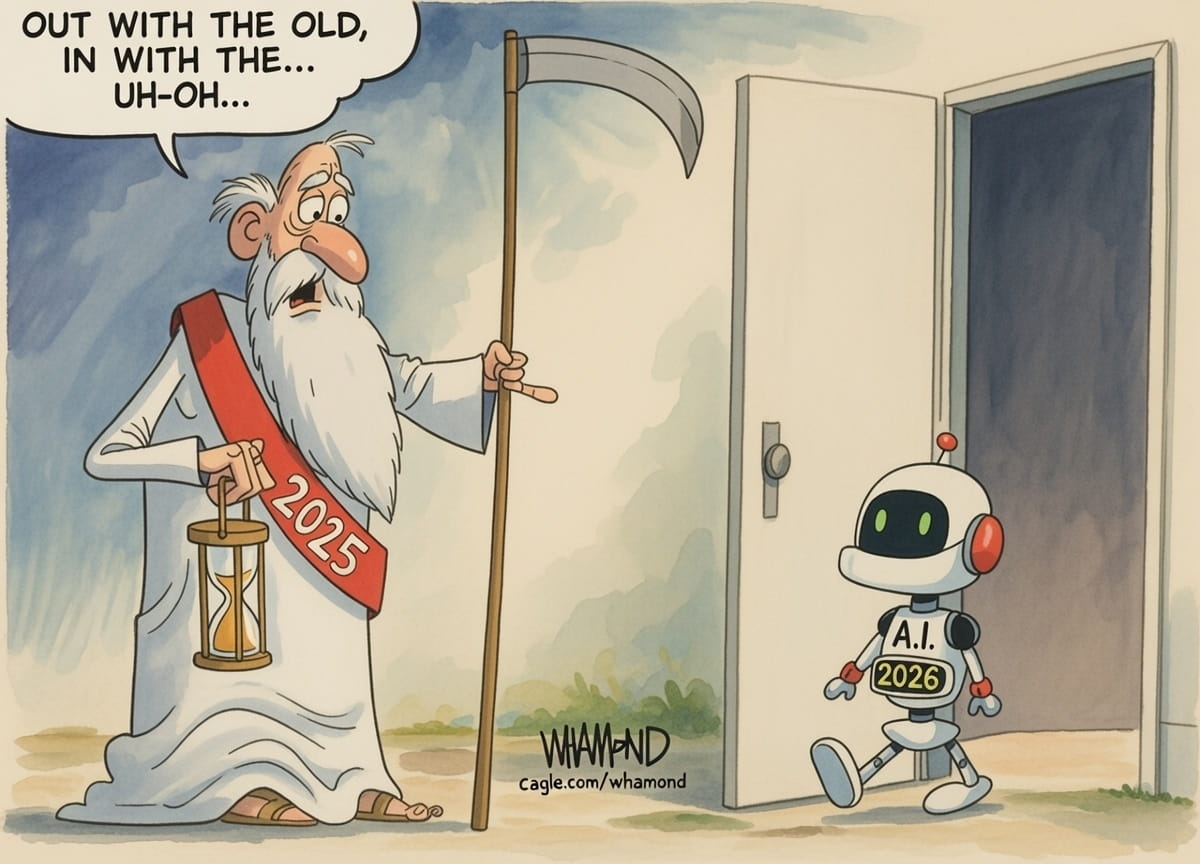
The short holiday has finally come to an end. Although holidays are supposed to be a time for rest and recovery, many people, including the author, return to work feeling more fatigued than when the holiday started. On one hand, entering the holiday with a 'sleep debt' accumulated from long-term work means that once the pace of life slows down, the body will take the opportunity to demand rest. On the other hand, a sudden change in routine can disrupt the biological clock and affect sleep structure. It seems necessary to adapt to the state of Workation (work travel), balancing work and travel, which can enhance happiness while providing more inspiration for work.
To get back on track, entering 2026, the crypto market appears to be welcoming the new year with a positive outlook, with total market cap reaching approximately $3.15 trillion and a 24-hour gain exceeding 2%. Bitcoin (BTC) price has remained above $91,000, breaking through $91,300, rising about 1.4% in 24 hours, and posting a weekly gain of over 4%. Ethereum (ETH) price hovers around $3,100, showing solid performance with significant weekly gains. XRP has broken the $2 barrier, surpassing BNB to become the fourth-largest cryptocurrency.
This rally stands in stark contrast to the capital outflows seen at the end of 2025, when regulatory uncertainty led to nearly $1 billion in weekly outflows from crypto investment products. Today, market sentiment has turned optimistic, with strong net inflows into ETFs. Bitcoin and Ethereum ETFs have contributed significantly to this capital inflow, partly driven by the 'January effect'—the return of funds after tax-loss selling pressure subsides, along with investors buying at low points.
This strong start is no accident but rather the result of a combination of macro conditions, economic data, and emerging trends. After three rate cuts in 2025, policymakers are expected to remain on hold through early 2026, with only 1 to 3 more cuts possible depending on inflation and labor data. Although the labor market has weakened (only about 670,000 new jobs added in 2025), there has been no large-scale layoffs, providing policy buffer. AI-driven productivity gains may suppress inflation but also limit employment growth, further influencing interest rate planning.
Fiscal stimulus and trade policies under the Trump administration are injecting liquidity, supporting medium-term economic growth near 3%, which benefits risk assets such as cryptocurrencies. The CLARITY Act (Digital Asset Market Transparency Act) has become a focal point. The bill has passed the House, and the Senate plans to mark up and review it in January. Under Trump's push, it is expected to pass in the first quarter, clarifying regulatory分工 between the SEC and CFTC, asset classification, and the path for DeFi. This will mark the beginning of the 'institutional era,' driving Bitcoin to new highs in the first half of the year and expanding real-world asset (RWA) tokenization from hundreds of billions to a much larger scale.
Global regulatory momentum (such as the EU's MiCA framework) is increasing pressure on the U.S. to act, to avoid talent outflow. If the bill passes smoothly, it will unlock institutional capital and further boost the market.
Looking ahead to the 2026 outlook, the crypto market is expected to continue its年初 rebound and transition toward structural growth, with the four-year cycle pattern gradually fading. As the core asset, Bitcoin set a foundation at $91,000 at the start of the year and is expected to break historical cycles, targeting $150,000 or higher. Drivers include sustained ETF inflows, institutional adoption, and the strengthening of Bitcoin's status as 'digital gold' amid concerns over dollar depreciation. If $88,500 is held as support in the short term, significant upside potential remains; in an optimistic scenario, Bitcoin could reach above $100,000 by the end of the first quarter.
At the macro level, uncertainty surrounding the Federal Reserve leadership (Powell's term expires in May) and hawkish voices could amplify market volatility. If labor market stagnation turns into a recession, crypto will face pressure; conversely, if uncertainty is resolved and hiring rebounds, it will support a bull market.
Fiscal policy (e.g., tariff impacts) and liquidity injections will play a larger role, with potential stimulus plans benefiting risk assets. Risks remain: regulatory delays could extend the integration phase; geopolitical events may cause short-term disruptions; most altcoins lack real demand and are prone to becoming worthless. Privacy technologies and ZK proofs may emerge as new moats.
Overall, 2026 marks a shift toward maturity in the crypto market: institutional accumulation replacing retail speculation, and real-world integration driving growth. If the CLARITY Act passes in sync with stable Federal Reserve policy, the probability of a new bull market is high; otherwise, the market may consolidate amid volatility. Investors should continue monitoring January data releases (e.g., job openings, consumer confidence) and legislative progress to capture key turning points. The strong start sets a positive tone for the year, but execution speed and actual adoption will determine the ultimate peak.