


Original|Odaily Planet Daily (@OdailyChina)
Author|Wenser (@wenser 2010 )
 At the beginning of the new year, the crypto market has welcomed a rare upward breakthrough. BTC has successfully broken free from the crucial level of 90,000 USD, and mainstream coins like ETH and SOL have finally risen above 3,100 USD and 130 USD, respectively. What is even more surprising, prompting exclamations of 'the bull is back,' are the many altcoins with a rapid rebound—coins like PEPE, IP, and WLFI have seen their increase over the past three days jump to over 20%.
Of course, the time is still short, and it is still uncertain whether the 'beginning of the year altcoin season' will play out again as in previous years. However, under the complex macro political and economic situation, whether cryptocurrencies can, as usual, take over from precious metals to create a 'miraculous surge' is already worth looking forward to. Odaily Planet Daily will briefly sort out and analyze the current market situation and representative views in this article.
Three major market indicators analysis: the altcoin season has not truly arrived yet; it is currently a 'localized rebound'.
Excluding the overall market trends, it is actually difficult to determine that the 'altcoin season has returned' based on the current overall data. When looking at the exchange's ranking of gains, many of the tokens that are currently rebounding have previously been significantly undervalued or are highly controlled meme coins, well-established meme coins, or hot concept tokens. From the following three major data points, the crypto market is still in a slow 'price correction phase'.
Indicator one: the overall market capitalization of cryptocurrencies has not yet shown a significant rebound.
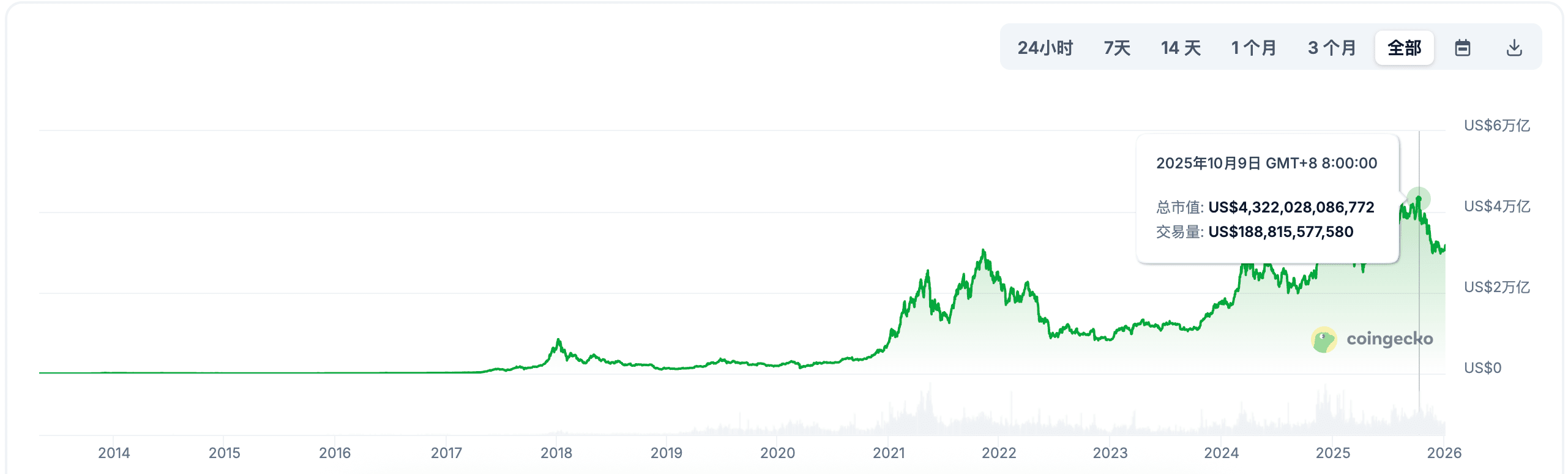
According to Coingecko data, the total market capitalization of the cryptocurrency market is currently $3.19 trillion, with BTC accounting for 57% and ETH accounting for 11.9%.
There is still a gap of over $1 trillion from the previous market capitalization peak of over $4.3 trillion. This is certainly due to the significant decline of mainstream coins such as BTC, ETH, SOL, and BNB from their peaks, but the fact that many altcoins are facing price declines and trading cooling under the background of shrinking liquidity and continuous loss of on-site funds is also indisputable.
It can be seen that the overall environment of the crypto market has not changed significantly.
Indicator two: the altcoin season index remains at a low level.
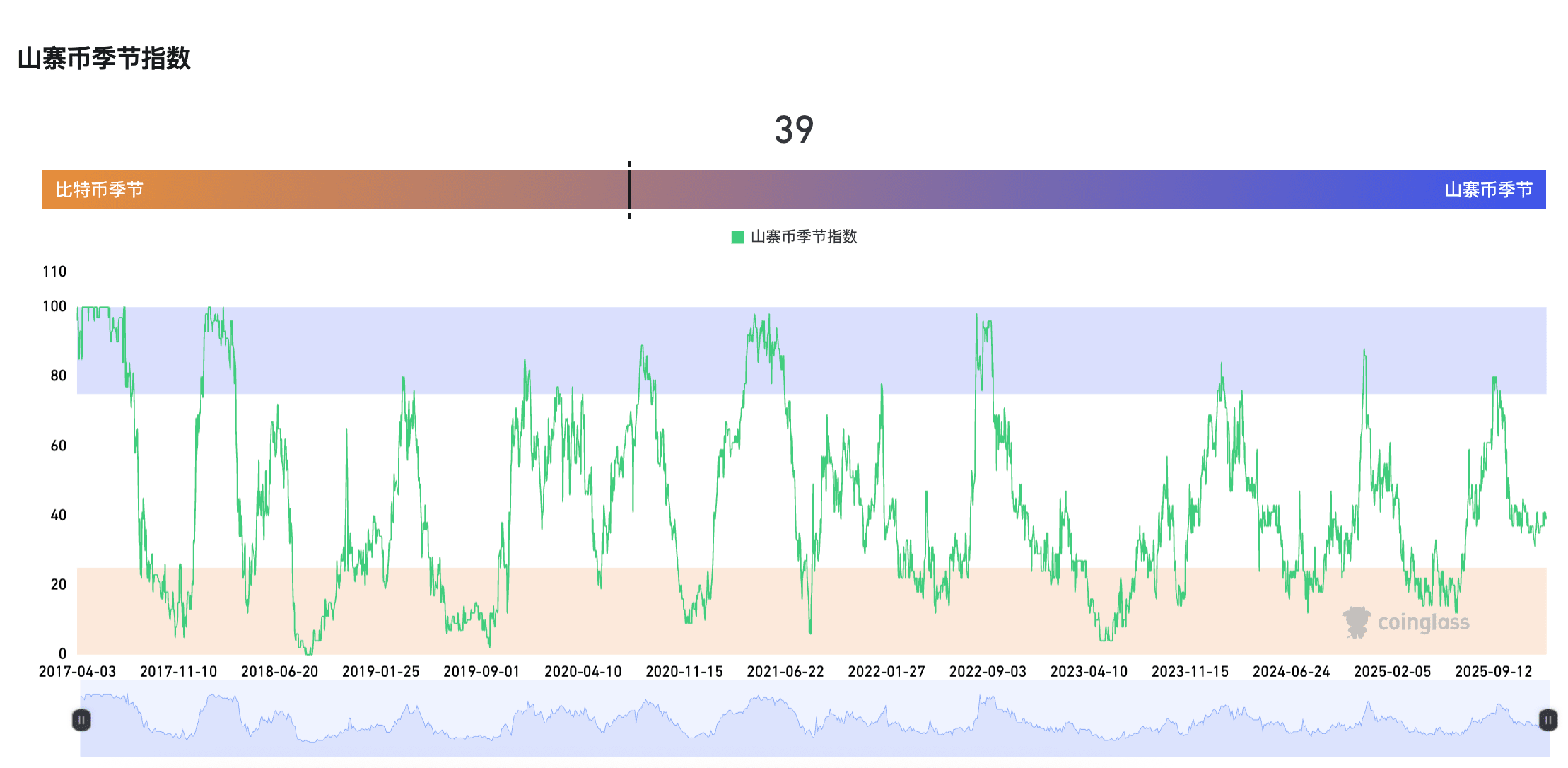
According to the Coinglass Altcoin Season Index, the current market altcoin season index is 39, which is in the same range as the market index in mid-July last year, when the market was still on the eve of the DAT treasury company's explosion, and various mainstream coins and altcoins were at relatively low points. Of course, with the continuous expansion of the DAT treasury listed company camp, ETH was the first to reach a new high. Compared to the incremental buying brought by listed companies at that time, the market liquidity has shrunk to a certain extent.
Indicator three: market sentiment remains in the fear zone.
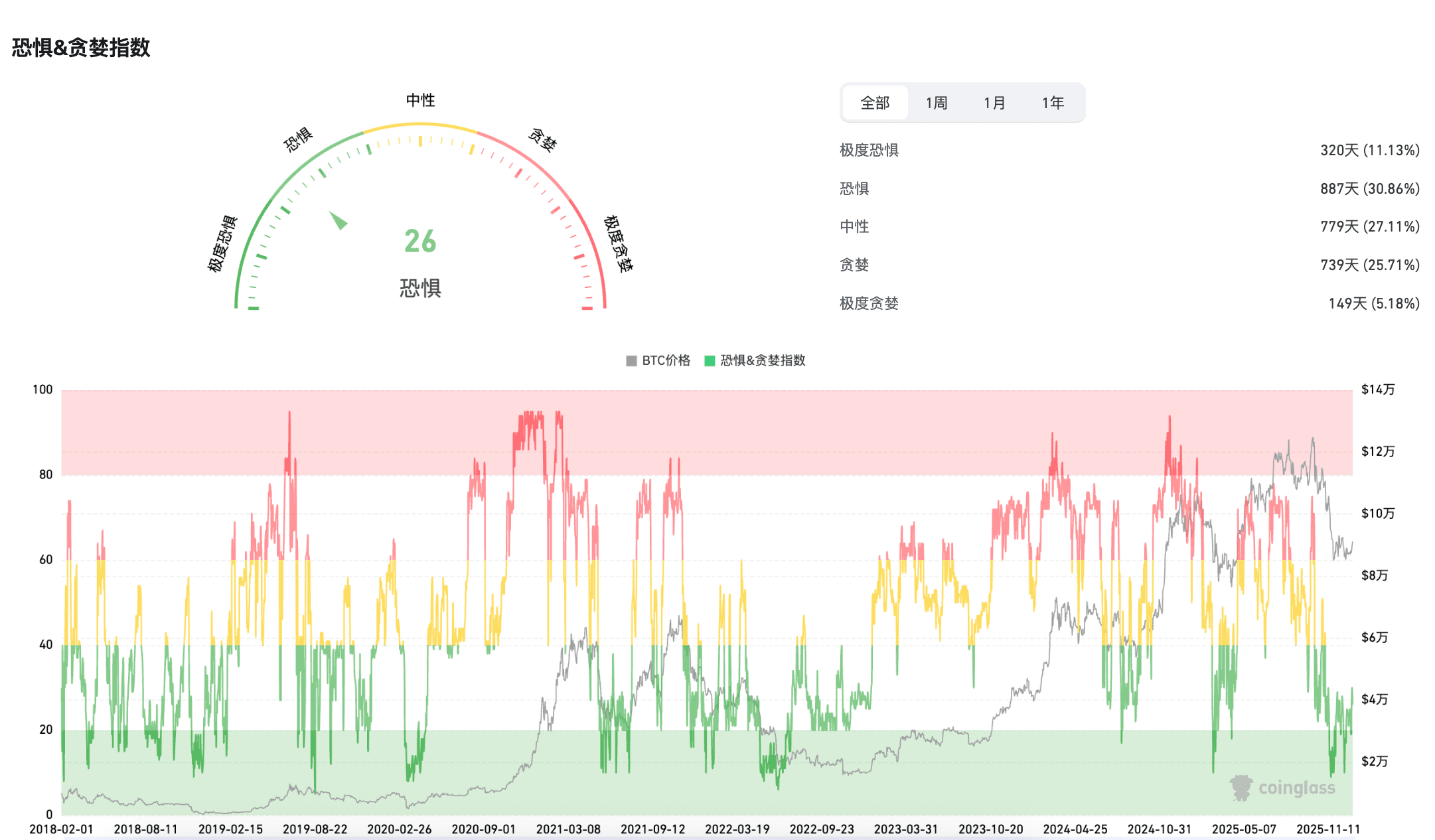
According to information from the Coinglass website, the current fear and greed index in the crypto market is 26, which is in the fear zone; this zone is also the stage with the largest share of market sentiment, accounting for a total time share of 30.86%, which aligns with the bearish sentiment in the market.
Based on the above indicators, the market is still in a cold phase, but does this mean that there are no opportunities for wealth creation? The mainstream view in the market clearly does not think so; on the contrary, many institutions and individuals point out that this may be a good opportunity to bottom-fish. Their main supporting logic is that improving liquidity and progress in the macro-political and economic landscape will come. As the saying goes, be greedy when others are fearful, but of course, the premise is to choose the right targets.
Three major signs of a market turning point: improvement in liquidity, BTC taking over the rise of precious metals, and retail sentiment remaining rational.
Currently, the mainstream view in the market shows a certain consensus on a short-term bottoming rebound, but the real turning point may rely on increased market liquidity, BTC's market performance, and a shift in retail sentiment. Below is an overview of the representative views in the current market:
Global market liquidity may rebound next week, with on-site games giving rise to short-term rebounds.
Danske Bank's forex and interest rate strategist Jens Naervig Pedersen stated in a report that global market liquidity is expected to remain thin this week, but may rebound next week with more economic data being released. During the year-end period, many market participants take vacations or close positions, leading to typically low market liquidity.
Next week's key data includes important figures from the U.S. labor market, such as the December non-farm payroll report to be released on January 9 and the ISM survey.
CoinKarma stated that the cryptocurrency market has returned to the stage of on-site games, with on-site factors becoming the key direction for short-term fluctuations. In the absence of clear external incremental funds, the crypto market is primarily driven by the circulation of on-site funds, and short-term price fluctuations are derived from the flow of on-site funds and changes in overall liquidity.
Additionally, by observing USDC/USDT Premium (which measures the premium status of USDC relative to USDT) and Overall LIQ (overall market weighted liquidity indicator), it can be seen that when USDC/USDT Premium turns positive, it reflects a decrease in active selling behavior of dominant funds in BTC/USDT. Currently, USDC/USDT Premium and Overall LIQ are resonating again, with a high likelihood of forming a bottoming rebound in the short term. CoinKarma also pointed out that compared to previous phases, the current medium to long-term trend is still bearish, and potential selling pressure needs to be monitored.
Precious metal prices are adjusting, and BTC may take the lead in rising.
After gold and silver reached new highs last month, many market players and analysts began to identify cryptocurrencies, including BTC, as liquidity contenders after their price adjustments.
TD Securities senior commodity strategist Daniel Ghali stated that it is expected that within the next two weeks, up to 13% of the total open interest in the Comex silver market will be sold off, which will lead to a significant revaluation and drop in prices, and low liquidity after the holiday may amplify price fluctuations.
Delphi Digital stated in an article that gold prices have risen 120% since the beginning of 2024, marking one of the strongest historical increases. As gold historically leads Bitcoin by about three months at liquidity turning points, this trend is of reference significance to cryptocurrencies. Gold has completed re-pricing against the easing cycle, while Bitcoin sentiment is still affected by previous cycle simulations and recent pullbacks. The performance of precious metal assets is signaling policies of easing and fiscal dominance. When precious metals outperform stocks, the market tends to price in currency devaluation rather than growth collapse; the volatility of the precious metals market may signal the future movements of other risk assets.
The '10·11 Insider Whales' agent Garrett Jin also stated in an article that, as previously analyzed, the prices of gold and silver have peaked. After the U.S. market opened today, funds have begun to shift to the cryptocurrency market. Even if the stock market faces selling after opening, cryptocurrencies continue to rise. The inflow of funds may continue, and the upward momentum may accelerate, leading to a short squeeze without a pullback.
Retail sentiment will become an important indicator of market changes.
Blockchain analysis platform Santiment analyst Brian Quinlivan pointed out that the sentiment of cryptocurrency market participants on social media showed strong performance at the beginning of the year, but also warned that whether the market can move further up depends on whether retail investors can remain rational. He stated that Santiment's social media data indicates that current retail sentiment is very positive, saying, 'This is usually a bit concerning, but this time it may just be a normal rebound after the holiday return.'
Quinlivan stated that he is not overly worried about a 'surge of FOMO sentiment', but added that if Bitcoin quickly rises to $92,000, such sentiment may flood the market. When market excitement is too high, the cryptocurrency market often moves in the opposite direction of what most people expect.
Market expectations diverge, with on-site and off-site funds going their separate ways.
Considering the current market conditions, the attitude towards ETF trading remains cautious, which is in stark contrast to the optimistic attitude of funds in the crypto market.
In the past three weeks, Bitcoin ETFs have seen a net outflow of over $900 million.
Yesterday, the price of Bitcoin rose above $90,000 today, reaching a nearly three-week high. However, the capital flow of derivatives and spot ETFs shows that traders remain cautious, indicating limited confidence in further price increases. Data shows that despite the price rebound, the demand for Bitcoin leveraged long positions remains stable, and the Bitcoin futures basis rate is below the neutral threshold, with the current annualized premium at 4%. Since December 15, Bitcoin spot ETFs have recorded a net outflow of over $900 million. Additionally, Bitcoin put options traded at a premium on Saturday, indicating increased demand from professional traders for downside risk protection.
DOGE and PEPE have driven a general rise in meme coins, with IP, ZEC, and WLFI leading the rebound in the oversold sector.
Recently, Dogecoin and PEPE led a wave of meme coin rallies at the beginning of the year, with analysts suggesting that momentum traders are chasing a familiar pattern: once liquidity is restored, speculative funds will flow from major coins into meme coins. Currently, major meme coins are rising in price, including PEPE, DOGE, SHIB, WIF, and FLOKI.
Tokens like IP, ZEC, and WLFI, categorized as 'hot concept tokens', experienced a rebound after significant declines, coinciding with relevant news and market fundamentals after the New Year.
Among AI concept tokens, RENDER, PIPPIN and others are still actively traded, with both spot and futures showing impressive increases of over 15%.
Based on the existing information, the biggest variable in the crypto market remains focused on this month's macroeconomic data and Trump's nominee for the new Federal Reserve chairman. Before this, bottom-fishing is possible, but it is advisable to choose short-term operations and avoid getting too carried away.
BTC year-end price prediction competition has begun, with the main range being 120,000 to 170,000.
Finally, we will conclude the article with the existing BTC price predictions, which also serve as our expectations for this year's rise.
The Hong Kong Commercial Daily published an article (Speculative Attributes Diminish, Bitcoin Volatility Tends to Stabilize), pointing out that Bitcoin's surge in 2025 is different from previous years, mainly due to the widespread rollout of ETFs. The recent price correction is not significant compared to the past four or five years. This change may be related to the impact of macroeconomic factors on traditional capital operating logic. There are two voices in the market regarding Bitcoin's trend in 2026: one believes that Bitcoin may face a significant correction and even return to lower price ranges, while the other group of investors is optimistic about Bitcoin's challenge of $150,000 by the end of the year, expecting it to challenge $250,000 in 2027.
Forbes published an article (Bitcoin's Price Prediction for 2026), noting that the current publicly available Bitcoin price predictions for 2026 are quite broad. Analysts from Tom Lee, Standard Chartered Bank, and Bernstein are bullish, while some institutions are bearish. Although there is currently no single target price for Bitcoin in the market, predictions are concentrated in the range of $120,000 to $170,000, indicating that Bitcoin's price discovery is increasingly influenced by ETF capital flows, corporate treasury assets, and other structural factors. If macro-positive factors strengthen and institutional participation accelerates, the potential upside could reach $250,000 or higher. How institutions choose to deploy capital will be a key factor in Bitcoin's price rise.