

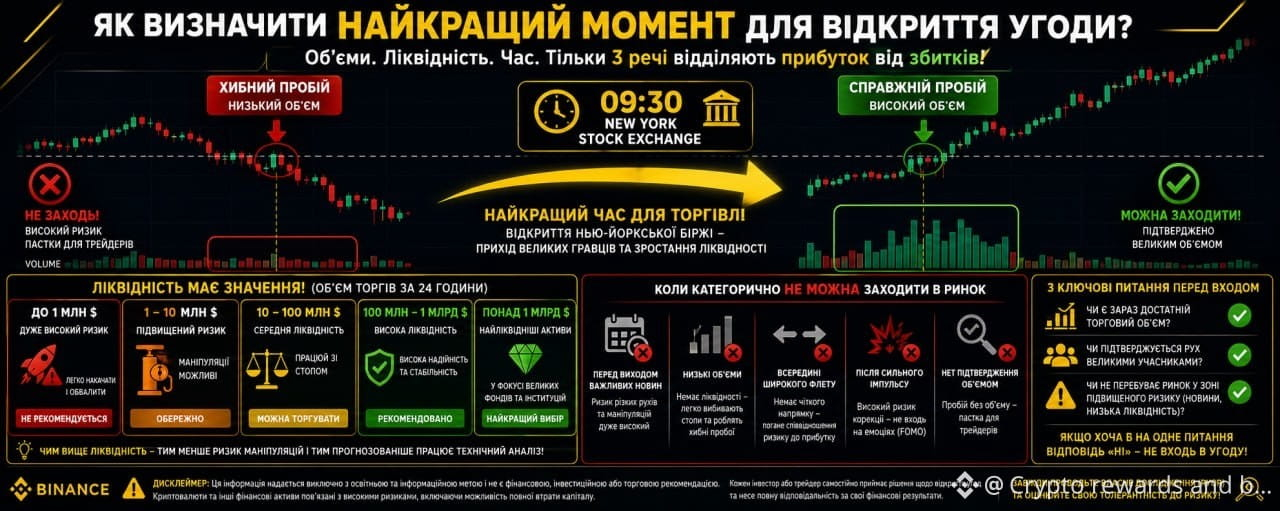

Volumes don’t lie: how big players show the direction of the market and why a beautiful chart can lead to losing money
Many beginners believe that the main thing in trading is to find the “right” indicator or buy signal. In reality, profitable traders primarily focus on liquidity and trading volume.
In a previous article, I already explained why the time when the New York Stock Exchange opens is very important for the crypto market. It’s exactly during this period that big participants come to the market, liquidity increases, and price movements become more predictable.
Now let’s figure out how to identify the moment when big money enters the market, and under what conditions opening trades is absolutely not worth it.
For example, a coin rises by 40% in a day.
The chart looks perfect.
In Telegram, everyone writes “to the moon”.
You buy an asset, and within a few hours it drops by 25%.
Most of the time, the reason isn’t bad luck. Just before entry, liquidity and trading volume weren’t checked.
How to find the best moment to open a trade: volume, liquidity, and the main mistakes traders make
Why volumes matter more than most indicators
The price can move in any direction, but without sufficient volume, such a move often turns out to be false.
Volume shows how many contracts, coins, or shares were bought and sold over a certain period of time. In simple terms, it reflects the real interest of market participants in the current move.
If the price breaks an important level on low volume, there’s a high risk of a quick reversal.
If the breakout is accompanied by a sharp increase in volume, the probability of the move continuing is much higher.
How to identify big volumes
The simplest way is to use the Volume indicator, which is available on practically all trading platforms.
On the chart, it looks like a histogram of vertical bars under the price.
What to look out for:
the current volume significantly exceeds the average over the last 20–50 candles;
abnormally large volume bars appear;
during a breakout of a resistance or support level, volume sharply increases;
after a long sideways move, a spike in activity occurs.
Situations where the price breaks out of consolidation on increased volume are especially valuable. That’s often when strong trend moves start.
The best time to open trades
Even a good signal may fail if the market is in a period of low activity.
For the crypto market, the highest liquidity is usually observed during the overlap of the European and American trading sessions.
Traders pay special attention to the opening of the New York Stock Exchange (NYSE), when big institutional players come to the market and trading volumes increase significantly.
It’s exactly during this time that daily highs and lows are often formed, key level breakouts occur, and the day’s main trend moves begin.
When you should absolutely not enter the market
1. Before major news releases
Even a technically perfect entry point can be ruined within a few seconds after the release of economic data or regulators’ statements.
This is especially true for:
U.S. Federal Reserve decisions on interest rates;
inflation data (CPI);
U.S. labor market reports;
important news about ETFs or crypto regulation.
2. During low volumes
If the market is barely moving and volumes remain below average, opening a trade is dangerous.
Under these conditions, large players can easily trigger false breakouts and knock out stop-losses of smaller traders.
3. Inside a wide range (flat);
When the price moves between support and resistance without a clear direction, the risk-to-potential-profit ratio usually worsens.
It’s much safer to wait for the price to exit the range and for confirmation via volume.
4. After too strong of a momentum move
One of the most common mistakes is entering a trade out of fear of missing out on profit (FOMO).
If the asset has already moved a significant distance in a short time and is showing extreme growth or decline, the risk of a correction increases sharply.
5. When there’s no volume confirmation
Any level breakout without support from volume should be viewed with increased caution.
These kinds of moves often turn out to be traps for traders. About the common traps involving large capital, I’ve already written in the article How Not to Catch “Falling Knives” in Crypto Trading. Which trading volumes you shouldn’t ignore.
Special attention should be paid to the asset’s liquidity. Even the prettiest chart doesn’t guarantee safe trading if the coin has low daily trading volume.
In the crypto market, situations often occur where small tokens show a rapid increase of 50–200% in a short time. However, such a move is often created by a few large players or organized groups of traders.
After the “pump” ends, liquidity quickly disappears, and the price can drop by dozens of percent within a few hours.
To reduce risks, many professional traders pay attention to daily trading volume:
up to $1 million — very high risk of manipulation;
$1–10 million — increased risk; additional verification is needed;
$10–100 million — medium liquidity;
over $100 million — high liquidity;
over $1 billion — the most liquid assets that large funds and institutional investors follow.
This doesn’t mean you need to buy an asset only because the trading volume is high. But coins with high liquidity are usually harder to artificially pump or dump, so technical analysis works more predictably on them.
How to spot rising volumes earlier than others
Many traders make the same mistake: they react to exchange alerts or a news channel only after the move has already happened to a significant extent.
At the moment when the exchange sends a notification about a 10–20% increase in activity, some traders have already taken profit, and the risk-to-potential-profit ratio may become less attractive.
Instead of tracking only price changes, you should pay attention to changes in trading volume.
For this, you can use:
CoinMarketCap (sorted by 24h Volume);
CoinGecko;
TradingView Volume Scanner;
CoinGlass;
built-in Binance screeners.
Pay special attention to situations when:
✅ trading volume has increased by 2–5 times compared to the average value;
✅ the price hasn’t shown a significant move yet;
✅ the asset is near an important support or resistance level;
✅ volume growth is observed for several candles in a row, not just in a single abnormal candle.
At exactly such moments, many traders do additional technical analysis and only then decide whether to potentially enter the market.
Many professional traders don’t look for assets that have already increased by 20–30%. Instead, they look for coins where trading volume over the last hour or 4 hours has increased several times, but the price hasn’t yet broken out of consolidation. This kind of behavior sometimes indicates rising interest in the asset before the main move starts.
Successful trading isn’t about finding a magic indicator—it’s about knowing how to spot moments when liquidity is present in the market and big participants are active.
Before opening a trade, it’s worth asking yourself three questions:
Is there enough trading volume right now?
Is the move confirmed by big participants?
Is the market in a heightened-risk zone due to news or low liquidity?
If the answer to at least one of these questions is “no,” then the best trade might be the one you decide not to open.
Disclaimer
Important: The information in this article is provided strictly for educational and informational purposes and is not financial, investment, or trading advice. Cryptocurrencies and other financial assets involve high risks, including the possibility of total capital loss. Each investor or trader independently decides whether to open trades and is fully responsible for their financial results. Before making investment decisions, it’s recommended to do your own research (DYOR) and assess your own risk tolerance.
P.S. If you like my content and crypto market analysis, I’d be grateful for your support for my Crypto Rewards & Bonus Finder project in the Web3 Laboratory of Resilience competition—an national initiative created with participation from Binance, the Ministry of Digital Transformation of Ukraine, and Lviv IT Cluster to support Ukrainian Web3 projects https://www.binance.com/uk-UA/events/resiliencelabvotingforprojects
#CryptoTrading #TradingStrategy #VolumeTrading #VolumeAnalysis #Liquidity #TechnicalAnalysis #BreakoutTrading #BitcoinTrading #AltcoinTrading #CryptoMarket #SmartMoney #NYSE #RiskManagement #CryptoEducation #DYOR