
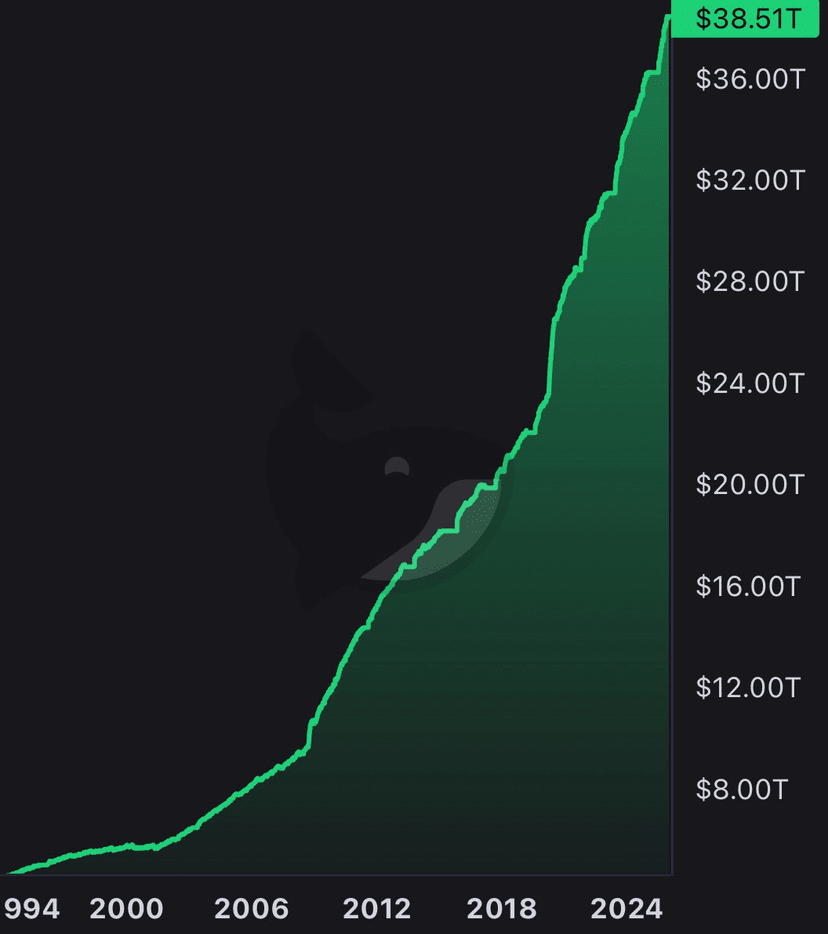
 This is not an ordinary financial news piece, but another milestone of long-term pressure on the U.S. financial system. Many people will just scroll past after a brief 'wow', but what does it really indicate behind the scenes?
What impact does this have on the cryptocurrency market and the stock market? Today, let's break it down systematically.🧵
1/9
First, let's look at the data:
U.S. public debt has risen from 1994 to today's 38.5 trillion, growing more than 8 times in over 30 years.
Especially after 2020, the curve has nearly become vertical: the pandemic stimulus + continuous deficits have caused annual growth to often exceed 2-3 trillion.
The fiscal year 2026 has just started for two months, and the deficit has already exceeded 400 billion, with interest expenses expected to exceed 1 trillion dollars for the first time this year.
2/9
Why are interest rates so terrifying?
Because the scale of debt is too large, even if the interest rate is only around 4%, the interest compounds like a snowball.
The interest paid every year has now exceeded the defense budget, the homeland security budget, and is even close to social security expenditures.
This means: taxpayer money is increasingly being used to pay off debts rather than invest in the future.
3/9
What core issue does this illustrate?
The US fiscal path heavily relies on 'borrowing to pay off old debts'.
Tax revenue cannot cover expenditures, so debt is continuously issued.
The US dollar, as the world's reserve currency, allows the US to borrow money at a low cost (the world buys US Treasury bonds), but this is not an infinite game.
Once investor confidence is shaken (for example, when 'bond vigilantes' appear), yields skyrocket, and the crisis arises.
4/9
What does it mean for the traditional stock market?
Negative pressure is dominant.
High debt → more Treasury supply → pushes up US Treasury yields (currently the 10-year yield has exceeded 4.2%).
It has become more expensive for companies to borrow money, which compresses stock valuations (especially tech growth stocks).
In 2026, the Federal Reserve is likely to continue cutting interest rates or holding steady, but the room for maneuver is limited, and high debt will restrict the degree of easing.
The bull market might still continue, but volatility will be greater.
5/9
What does it mean for the crypto market?
In the long term, this is a big positive.
The crypto community loves this news because it perfectly reinforces the narrative that 'fiat currency is unsustainable':
Unlimited government borrowing → potential inflation/devaluation → need to hedge with hard assets.
Bitcoin's fixed supply of 21 million perfectly counters 'unlimited money printing'.
Institutions like BlackRock and Grayscale have reported that the debt crisis will accelerate Bitcoin being viewed as 'digital gold' or a strategic reserve.
In 2026, institutional inflows are expected to continue to expand.
6/9
Of course, in the short term, crypto is still a risk asset and will fluctuate along with the stock market.
If yields rise rapidly, funds may flow into US Treasuries, and crypto will also correct.
But in the long run, the higher the debt, the more dazzling Bitcoin's relative scarcity becomes.
7/9
Is this the doomsday prophecy that 'it will collapse tomorrow'?
The US still has the dollar hegemony, the world's strongest economy, technological leadership, and other trump cards, so the probability of a short-term crisis is low.
But this is a chronic issue: debt/GDP has exceeded 120%, and if this continues, there will inevitably be a bill to settle in 10-20 years.
Japan and Europe are similar; everyone is in the same boat.
What do you think? Should we continue to be bullish on US stocks, or start being bullish on the crypto market? Let's discuss in the comments 👇
#US Treasury #Bitcoin #US stocks #Macroeconomics #加密货币