


Original | Odaily Planet Daily (@OdailyChina)
Author|jk
In the cryptocurrency industry, compensation is always a topic that is frequently mentioned but is the hardest to obtain reliable conclusions about. Whether it is founders establishing internal compensation frameworks or candidates assessing whether an offer is reasonable, the reality often lacks data support. Industry discussions often rely on scattered cases, anonymous sharing, or emotional judgments rather than a universal compensation structure.
Against this backdrop, the top venture capital firm in the cryptocurrency industry, Dragonfly, released its first annual cryptocurrency compensation report in 2023, conducting a large-scale survey to summarize a universal cryptocurrency compensation data. Two months ago, Dragonfly released the 2025 version. This report collected feedback from 85 cryptocurrency companies and expanded the research scope for the first time to companies outside Dragonfly's portfolio, bringing the data closer to a true industry cross-section.
Data collection covers the end of 2024 to the first quarter of 2025, introducing approximately 3,400 deduplicated employee and candidate level data points. Although the data is not so current, fortunately, salaries do not fluctuate as dramatically as cryptocurrency prices. The report shares detailed salary data for each function, level, and region, no longer limited to "average position" or "rough range." Compared to the 2023 report, this research not only answers "how much does the cryptocurrency industry pay," but also starts to present "how money is distributed, and how certainty and risk flow within organizations."
Let's take a look at what highlights are worth referencing. Whether you are a fresh graduate ready to enter Web3 or a mid-level manager exploring the cryptocurrency industry, this report should have plenty of data for you to draw on.
All salary units in this article are in USD/USDT, and all salaries are cash salaries, excluding token rights/equity.
1. Overall Market Summary
TL;DR: Here are the top ten summaries from Dragonfly's official report.
Most cryptocurrency companies are in growth mode, rather than in a high-speed expansion phase.
Cryptocurrency recruitment has been global from the start; almost no cases exist where recruitment is limited to the U.S.
Europe has become the primary international recruitment hub.
Salaries and token compensation have declined across almost all levels and regions.
Remote work still dominates, and companies have no plans to change this situation.
The threshold for entering the cryptocurrency industry is high, with entry-level positions accounting for less than 10%.
Engineering positions remain core. Product roles typically start from senior levels, while design roles emphasize individual contributors rather than management.
U.S. salary levels have become the global pricing standard for engineering management.
From an overall perspective, salaries in the cryptocurrency industry from 2024 to 2025 show a clear characteristic: this is a market in a downward adjustment phase, but gradually stabilizing. Although mainstream cryptocurrency asset prices remain strong, U.S. policy environments have intermittently released positive signals for the industry, these macro changes have not rapidly transmitted to recruitment and salary levels. Companies still maintain caution in hiring and pricing, with positions and salaries undergoing comprehensive contraction.
In terms of recruitment geography, the globalization of the cryptocurrency industry is further solidified. There are almost no teams that recruit solely in the U.S.; cross-regional collaboration has been the default configuration from the start. Europe has significantly risen in this cycle, becoming one of the most important international recruitment centers, especially in engineering and product-related functions.
Remote work is a very clear long-term trend in this report. Most companies have not shown a clear plan to return to office-based work, which directly undermines the single logic of "location determines salary." Salary differences increasingly reflect an individual's influence, rarity, and responsibility boundaries within the organization, rather than geographic location itself.
Entry-level positions are the most visibly impacted, with salaries and tokens dropping significantly, partially compensated by a higher proportion of equity. U.S. entry-level positions still have an advantage in cash compensation, but equivalent international positions often receive 2-3 times the equity and higher token rewards. Mid-level positions are generally under pressure, with limited growth space; senior positions perform relatively stably, with smaller salary reductions, more stable equity, and tokens increasingly concentrated at higher levels. The most noticeable salary increases are seen in Senior Individual Contributors (Senior IC) and executives, forming a clear "barbell structure," especially prominent in product and engineering roles.
Engineering remains at the core of the entire industry, but non-engineering functions are showing clearer hierarchical differentiation, with returns concentrated among senior talents and executives, while mid-level and junior positions are under greater compression pressure. Product roles almost always require senior experience from the start, while design functions clearly lean towards high-level individual contributors rather than management paths. In design roles, the value of management is less than that of senior designers. Senior individual contributors in the U.S. exceed design managers and even some executives in total compensation.
Finally, from a year-on-year perspective, bosses, i.e., founders, are raising the salaries they pay themselves annually. The larger the funding size, the higher the founders' salaries, while their equity holdings decrease. U.S. founders are generally higher than their international counterparts in terms of salary, equity, and tokens.
Overall, almost all levels of salaries and token grants have declined. U.S. positions still lead in cash compensation, while international teams have narrowed the gap through a higher proportion of equity and token allocations.
2. Two Major Positions Deep Dive
2.1 Software Engineer: Industry Cornerstone
As the technical backbone of the cryptocurrency industry, software engineers have consistently maintained salary levels at the forefront of the industry.
Salary progression paths in the U.S. market:
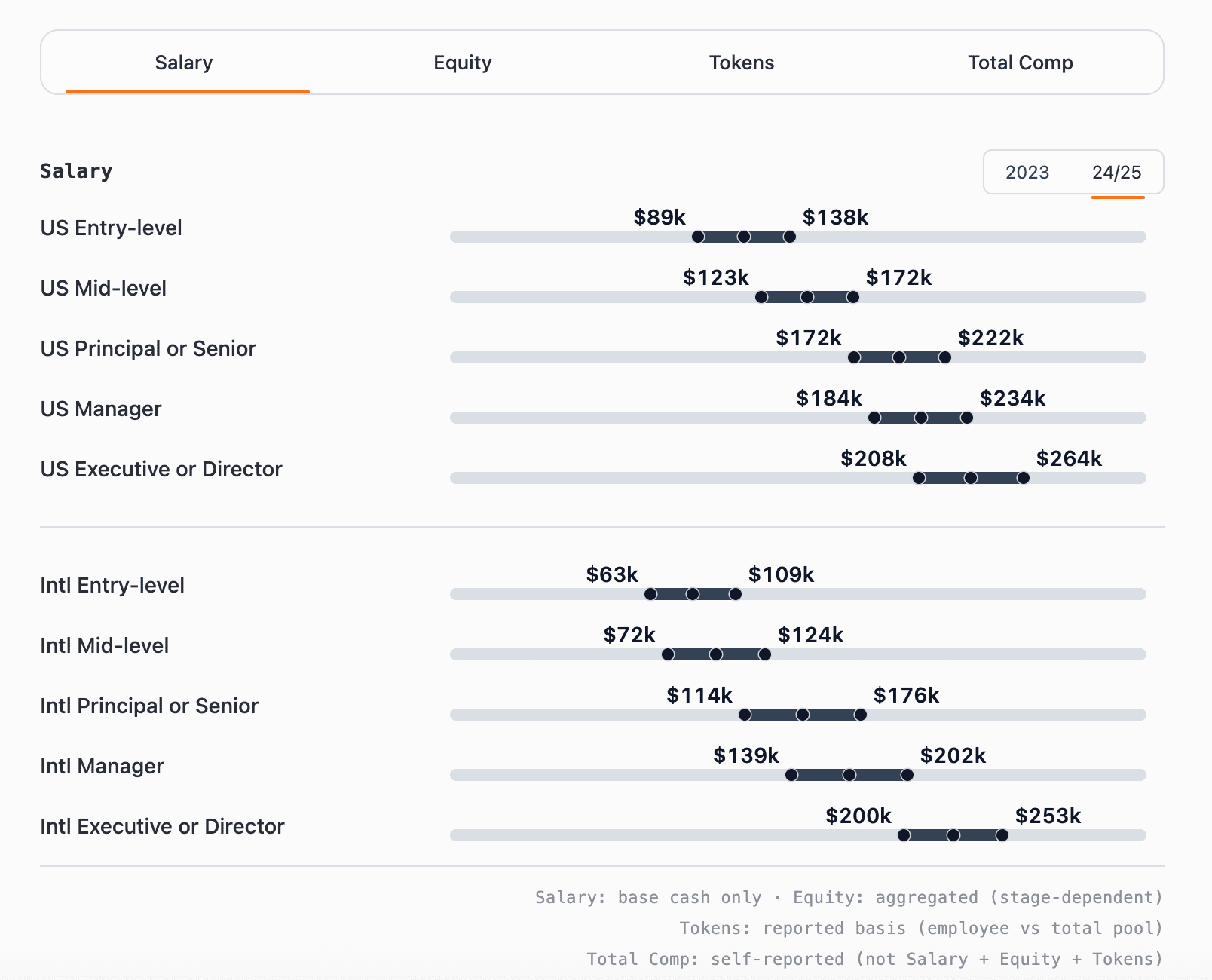
Data shows that the career development path for software engineers is quite clear. The salary range for entry-level positions is $89k-$138k, averaging about $113k. As they progress to mid-level, salaries increase to $123k-$172k, averaging around $147k. When promoted to Principal or Senior level, after about 7-8 years of work, salaries experience a significant jump, reaching $172k-$222k, averaging around $197k.
Software Engineer Salaries
Once reaching Executive or Director levels, salaries can reach $208k-$264k, averaging around $236k. From entry-level to executive level, salaries grow nearly 3 times.
Notably, the leap from mid-level to senior engineer is the most significant, specifically from 3-5 years of experience to 7-8 years in Senior positions, where salary increases exceed 40%. Companies are willing to pay a premium for engineers who can truly solve complex problems.
International Market:
Although salaries for software engineers in the international market are relatively low, they still possess considerable attractiveness. Entry-level salaries are $63k-$109k, roughly equivalent to 400,000-700,000 RMB, which is already quite a considerable income in many countries, especially in regions with lower living costs like Eastern Europe and Southeast Asia.
Meanwhile, salaries for high-level positions are rapidly catching up to U.S. levels. Executive or Director level can reach $200k-$253k, already approaching U.S. salaries at the same level. This means that with the popularization of remote work and intensified global talent competition, regional differences are gradually narrowing. For capable engineers, choosing where to work has become more flexible.
It is clear how important it is for engineers to learn English.
2.2 Cryptocurrency Engineer: Specialized Returns
Cryptocurrency engineers, or as we commonly refer to them, smart contract engineers, exhibit a unique salary pattern as a position unique to the industry.
U.S. Market:
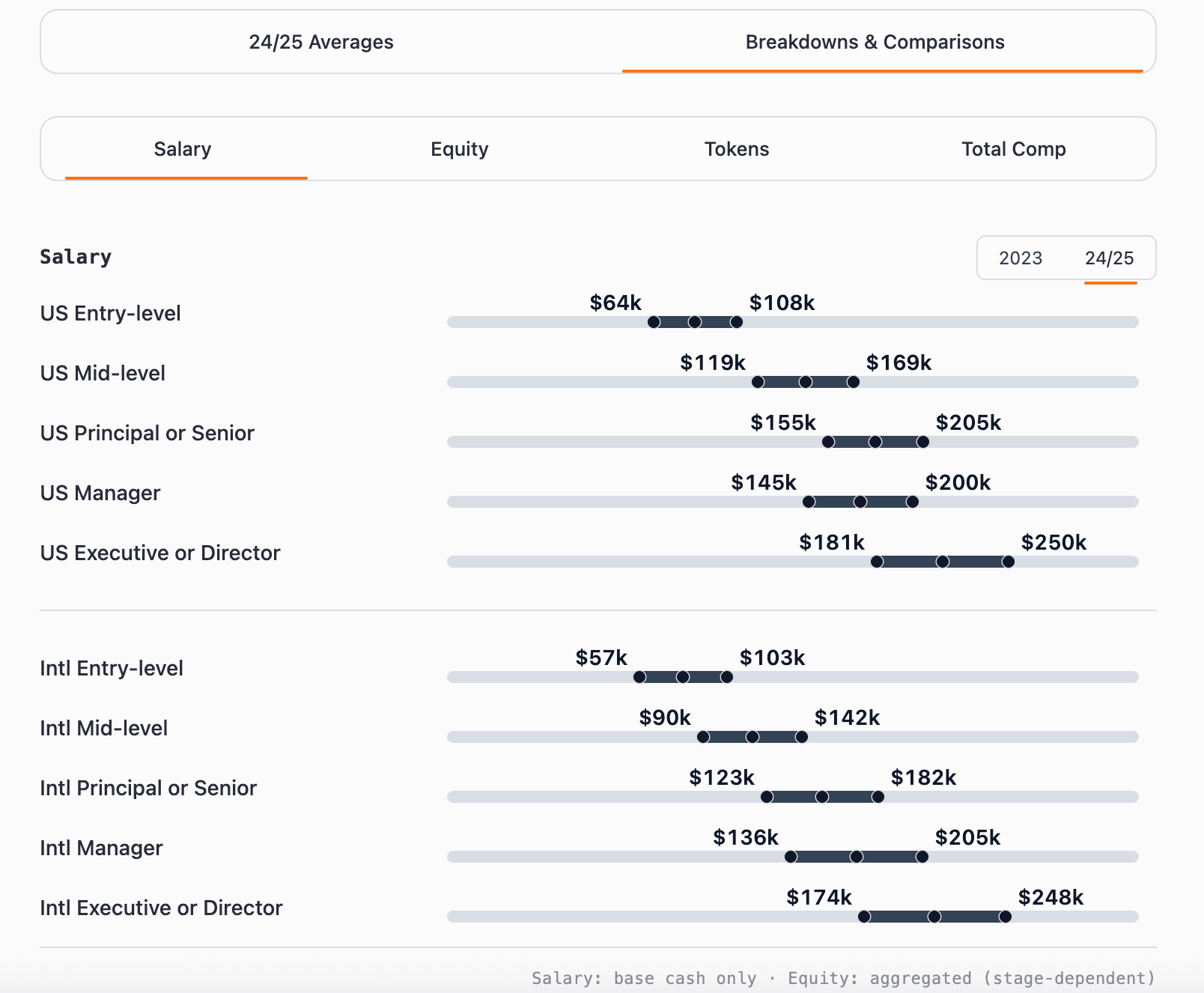
In the U.S. market, the salary trajectory of cryptocurrency engineers shows an interesting phenomenon. Entry-level salaries ($64k-$108k) are actually lower than those of traditional software engineers, possibly because newly entered cryptocurrency engineers need more time to accumulate field-specific knowledge, such as a deep understanding of various consensus mechanisms and learning Solidity.
However, at the Mid-level ($119k-$169k), professional advantages begin to show, with salary increases reaching an astonishing 85%. Continuing to develop to Senior level ($155k-$205k), salaries continue to maintain strong growth. This steep growth curve indicates an important fact: once you master the core cryptocurrency technologies, your value will dramatically increase.
Smart Contract Engineer Salaries
Interestingly, salaries for managers (Manager: $145k-$200k) in cryptocurrency engineering are slightly lower than those in pure technical tracks. This may reflect a characteristic of the industry: compared to management skills, deep technical expertise is more valued in this field, and talent that can truly understand and improve zero-knowledge proofs or optimize Layer 2 solutions is extremely scarce.
International Market:
In the international market, mid-level cryptocurrency engineers perform particularly well. Their salaries ($90k-$142k, 600,000-1,000,000 RMB) even exceed some traditional senior positions. The reason behind this phenomenon is simple: talent possessing specialized skills in blockchain, smart contracts, etc., is extremely scarce globally. Whether in Silicon Valley or Singapore, excellent Solidity developers are the target of competition among companies.
2.3 Product Manager: The Dark Horse of Salary Explosion
Product managers have shown astonishing salary growth in the 2024/25 fiscal year, especially at senior-level positions.
U.S. Market:
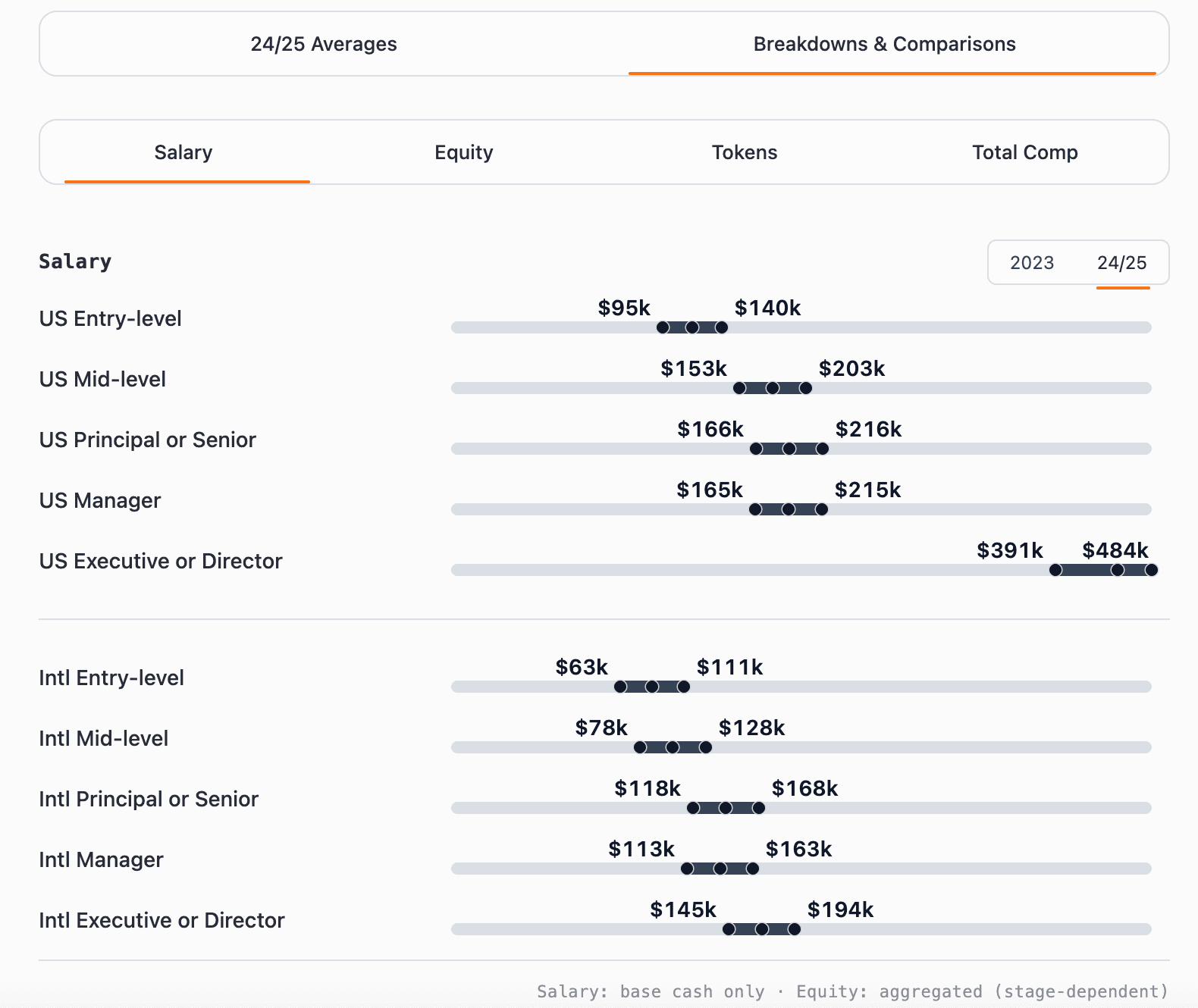
The most striking data point is undoubtedly the Executive level product manager salary, reaching an astonishing $391k-$484k, far exceeding all other positions. This figure has even led many to question whether there was a data error. However, upon reflection, this extraordinarily high salary actually reflects several important pieces of information.
First, the complexity of Web3 products far exceeds that of traditional internet products. Not only must one understand user needs, but also deeply understand token economics, on-chain data, cross-chain interactions, and other technical details. Second, PMs who can truly grasp technology and translate it into user value are extremely scarce in the market. Finally, a successful cryptocurrency product can bring substantial business value; a successful DeFi protocol or NFT platform can see transaction volumes in the tens of billions.
In other words, if you are determined to walk this path to the end, there are great opportunities.
For product managers who are just entering or at mid-career, entry-level PM salaries ($95k-$140k) are second only to software engineers, while at mid-level ($153k-$203k), PM salaries have already surpassed all technical positions, becoming the highest-paying position at the same level.
But this is only the case in the U.S.
International Market:
Compared to the craziness of the U.S. market, PM salaries in the international market appear more rational and significantly lower. Executive level salaries are $145k-$194k, not nearly as exaggerated as in the U.S.; moreover, entry-level PMs have similar salaries to entry-level smart contract engineers and software engineers, where remote work allows those earning an average of 750,000 RMB to live well.
2.4 Designer: Underestimated but Rising
Design roles have long been undervalued in the cryptocurrency industry, but data shows that the situation is changing.
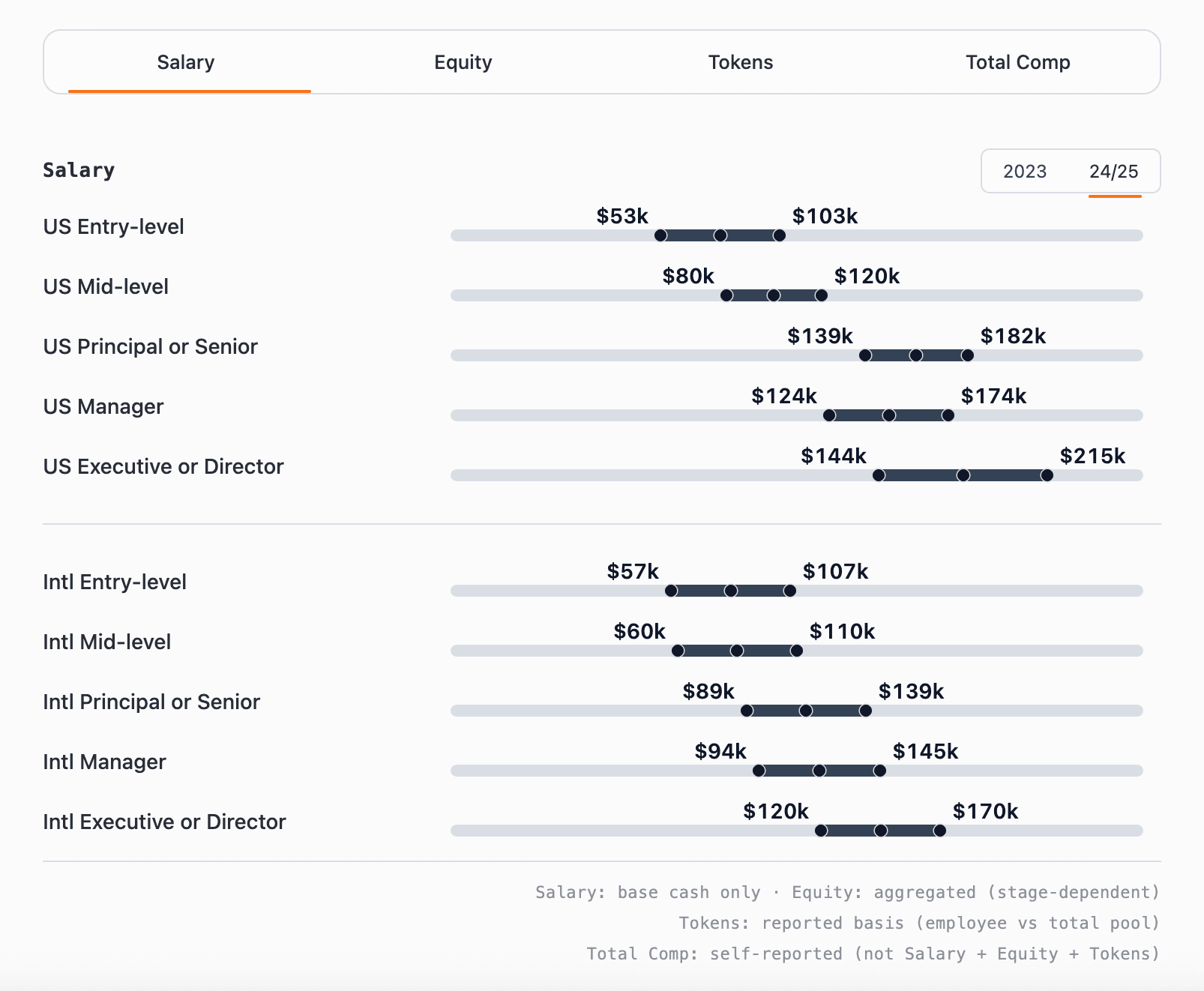
U.S. Market:
The salary trajectory for designers is an interesting story. Entry-level starting salaries ($53k-$103k) are among the lowest, which aligns well with the state of the cryptocurrency industry: for a long time, cryptocurrency projects have focused more on technical implementation at the expense of user experience, resulting in many early DApps having terrible interfaces, even for projects with tens of millions in funding, interactions and other experiences are often subpar.
However, the situation is changing rapidly. When designers grow to Senior level ($139k-$182k), salaries experience a significant leap. This leap indicates that the market has finally recognized the importance of an experienced designer with 7-8 years of experience who can lead a team for product success.
However, mid-level designers face the biggest challenges among all positions. Their salaries ($80k-$120k) grow slowly, increasing by only about 30% compared to entry-level. This "mid-career crisis" may lead talented designers to leave for other industries or shift to other functions.
International Market:
Interestingly, designer salaries in the international market are relatively more balanced. Particularly at mid to senior levels, the salary gap between designers and other functions is relatively small. This provides designers with a fairer development environment. If you are a designer, consider opportunities in the international market when choosing a workplace.
2.5 Marketing: The Backbone of Steady Growth
Marketing plays an increasingly important role in the cryptocurrency industry, and salary data reflects this trend.
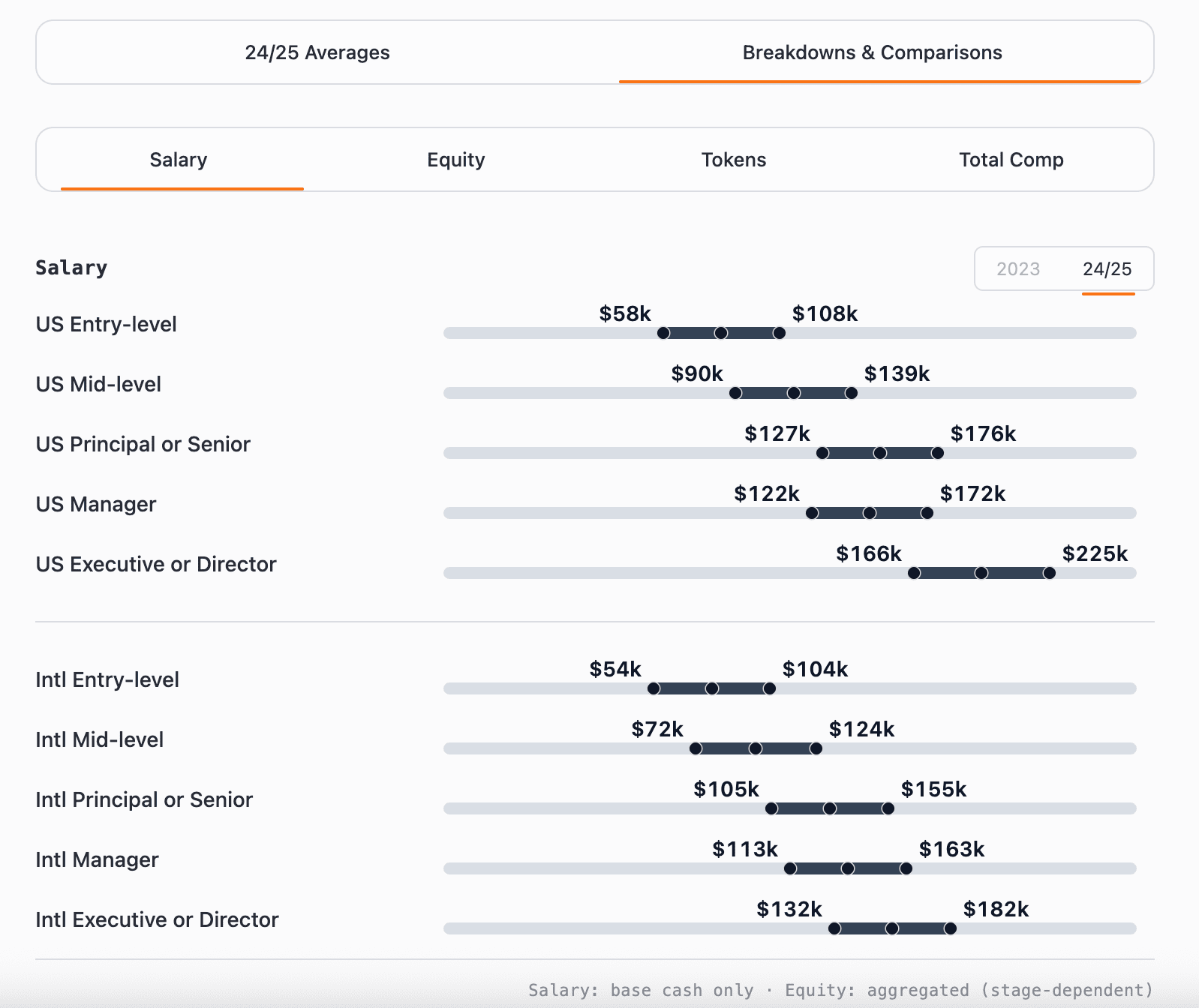
U.S. Market:
Salaries for marketing positions exhibit a steady and balanced growth pattern. Entry-level salaries ($58k-$108k) provide a reasonable starting point, neither the highest nor the lowest. By mid-level ($90k-$139k), salaries achieve a stable increase of about 55%. Senior level salaries are $127k-$176k, while Executive level reaches $166k-$225k. In other words, when marketing professionals transition from executing marketing strategies to formulating them, their value in the cryptocurrency industry is significant.
Characteristics of the International Market:
Marketing positions in the international market exhibit a more standardized salary structure, with relatively small differences between levels, reflecting a steady growth trend.
2.6 Business Development (BD/Go to Market): Growth Engine
BD/GTM roles play a key role in the success of cryptocurrency projects, and salary data reflect this importance.
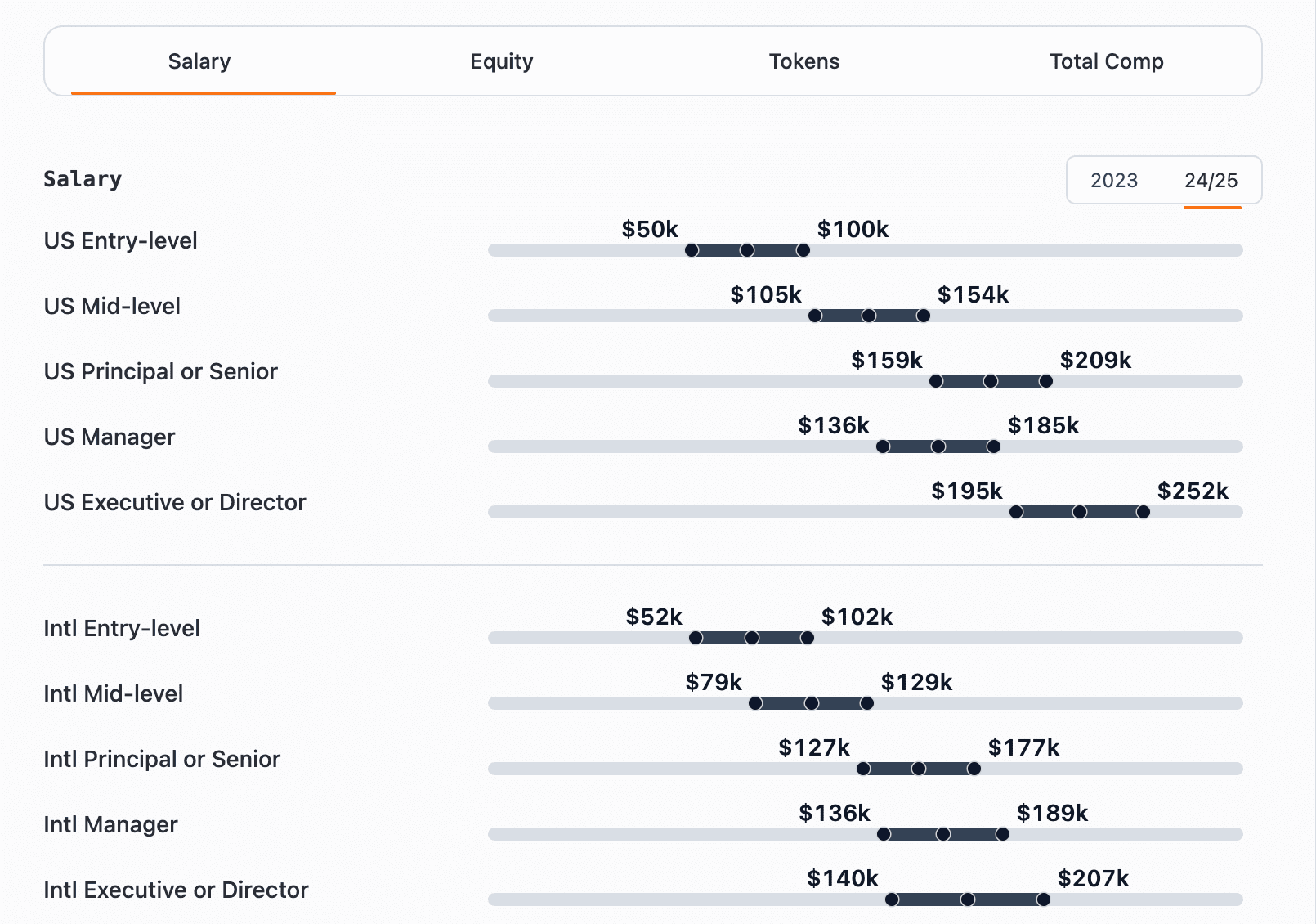
U.S. Market:
The salary story for BD positions may be the most inspirational. Entry-level ($50k-$100k) starting salaries are the lowest among all positions, but don't be put off by this number. Look at the mid-level data ($105k-$154k), where salaries have doubled! In other words, after working 3-5 years, salaries can double, the largest increase among all positions. By the time they reach the Executive level ($195k-$252k), excellent BD leaders' salaries prove their key role in company growth.
Newly entered BDs may only be sending cold emails, attending meetings, and conducting preliminary market research. However, once you establish your network and understand how the ecosystem operates, your value will increase dramatically.
Think about it, an excellent BD can help projects connect with major exchanges, establish key partnerships, and open new markets. In the current market environment of "building in the bear market, harvesting in the bull market," BD talents who can deliver actual business growth are naturally highly valued. They not only need to understand business but also grasp token economics, understand the characteristics of various public chains, and be familiar with the operational mechanisms of DeFi protocols. Such composite talents are in high demand everywhere.
International Market:
There is an interesting phenomenon regarding BD salaries in the international market. Principal/Senior level ($127k-$177k) performs exceptionally well in the international market, while Manager level salaries ($136k-$189k) even exceed those in the U.S. at the same level.
The reason behind this is not hard to understand: international markets rely more on localized business development capabilities. If you can help U.S. projects land in Asia or assist Asian projects in entering the European and American markets, your value is immense.
It can be seen that U.S. positions lead in cash compensation and total compensation across almost all levels.
2.6 Founder Salaries: How Much Do Bosses Pay Themselves?
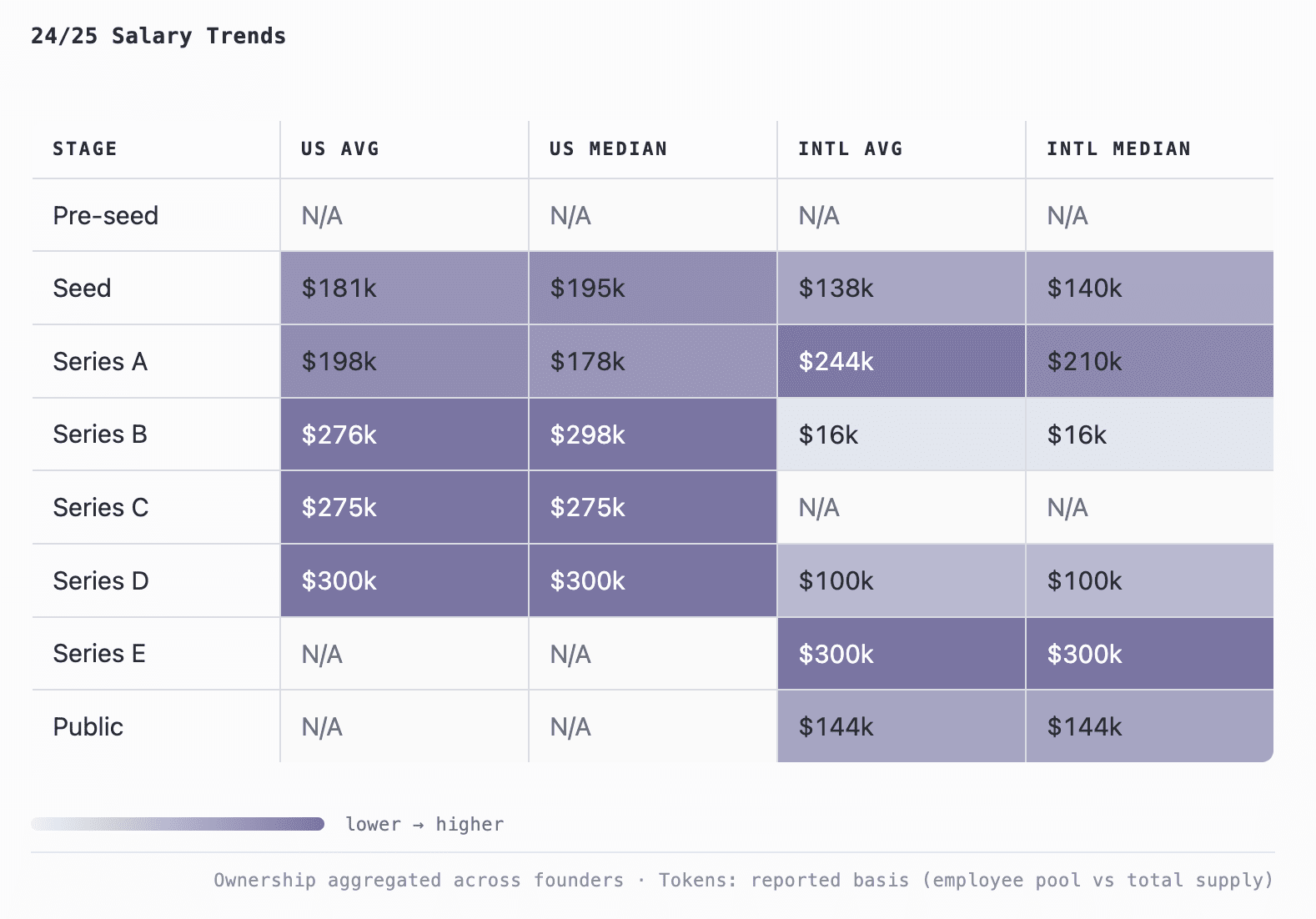
We can observe a very interesting phenomenon: founder salaries show a significant positive correlation with the company's financing stage, but this growth is not linear, and the U.S. and international markets exhibit starkly different patterns.
U.S. Market:
In the U.S. market, founder salaries show a stepwise increase as financing rounds progress. Starting from $181k (median $195k) in the Seed round, rising slightly to $198k in Series A, this growth is relatively moderate. A significant leap occurs in Series B, where average salaries skyrocket to $276k (median $298k), an increase of over 40%.
This leap point is interesting. Series B is usually when a company truly begins to scale, product-market fit has been validated, and the business model is essentially mature. At this point, the founder transitions from "entrepreneur" to "CEO," needing to manage larger teams and handle more complex businesses. The significant salary increase reflects this role transition and increased responsibilities.
By Series C and D, salaries continue to stabilize in the range of $275k-$300k. Series C salaries ($275k) are even slightly lower than Series B, while Series D rises to $300k.
International Market:
Data from the international market presents a completely different picture. Salaries for founders in the early stages (Seed to Series A) are relatively reasonable, growing from $138k-$140k (Seed) to $210k-$244k (Series A). However, by Series B, the data shows only $16k, which may be due to either a too small sample size or some founders in certain regions choosing extremely low salaries to keep the company running.
Even more surprising is the data from Series E: founders' salaries in the international market reach $300k, comparable to U.S. Series D levels. This may reflect a trend: companies able to raise Series E funds in the international market are usually unicorns or quasi-unicorns in their respective regions, and their founders' salaries naturally align with international standards.
Salaries for founders of publicly traded companies ($144k) are relatively low, as after going public, founders' main source of wealth shifts to equity/token value rather than cash compensation.
Where Are Employees Working?
Dragonfly's data shows that Western Europe is the main international recruitment hub.
Regional recruitment changes typically occur as companies enter Series B and later stages. As companies mature and the demand for local operational capabilities increases, teams begin to expand into regions such as Asia, Canada, and Eastern Europe.
At the same time, this may also reflect that this data report is significantly different from the Asian cryptocurrency projects we usually see that benchmark against domestic salary standards; within these thousands of data points, the vast majority of salaries are likely offered at European levels, which leads to overall increases.
However, not looking also means not knowing; these people are indeed living quite well!
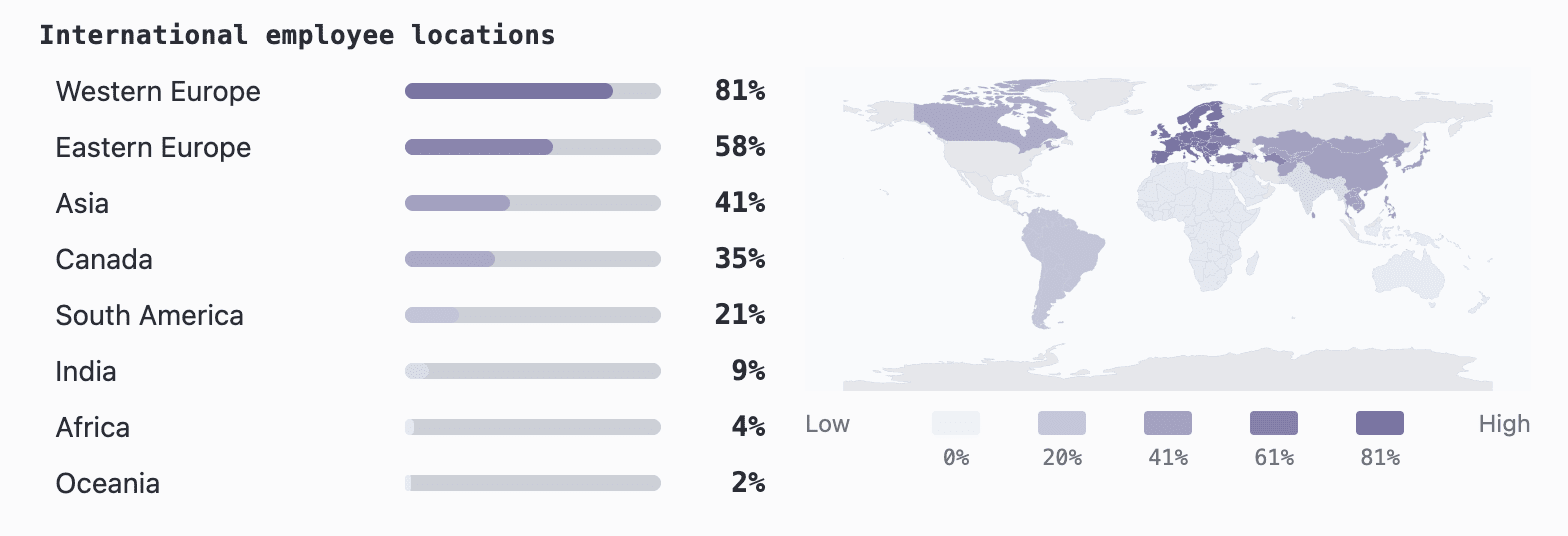
Dragonfly's official summary tells us:
Among companies in the Series B to Series E stages, 84% employ staff in Western Europe; this ratio is also roughly the same among companies with funding exceeding $40M.
In later-stage companies, 63% recruit in Eastern Europe, mainly benefiting from the strong supply of engineers and relatively cost-effective talent.
The layout in the Asian region has almost doubled year-on-year, from 20% to 41%, to adapt to stronger user adoption and market demand. Thus, the number of employees in the Asian region does not actually dominate.
Among companies in the Series B to Series E stages, 38% have expanded to Canada, leveraging its geographical advantage adjacent to the U.S., a relatively friendly regulatory environment, and a mature developer ecosystem as a form of risk hedging.
In the Series B to Series D stages, only 13% of companies have expanded to South America.
Relatively rare exception regions include: India (9%), Africa (4%), and Oceania (2%).
4. What Can We Learn?
3.1 Entry-level Talent
If you have a technical background, congratulations, you have already won at the starting line. Software engineers, smart contract engineers, and product managers have the highest starting salaries; even at entry-level, annual salaries can reach six figures in the U.S. market. This may require several years of experience in traditional industries to achieve.
But here’s a suggestion: don’t just focus on starting salaries. More importantly, look for learning opportunities and growth potential. Choosing a team that allows you to grow quickly is more valuable than a slightly higher starting salary, because the salary leap from entry-level to mid-level is significant, and the key is how quickly you can make that transition.
Although the starting salaries for BD and Marketing are relatively low, don't be discouraged. Look at their growth curves, especially for BD, where the salary can double from entry-level to mid-level. If you are good at building relationships and understanding business logic, BD could be an excellent choice. The first one or two years might be tough, with low pay, but once you establish a reputation and network in the circle, your value will grow exponentially.
3.2 Mid-level Talent
Mid-level PM salaries surpass all other positions, and this is not a coincidence. The market is frantically seeking "tech-savvy + user-savvy" composite talents. If you are an engineer but find yourself constantly thinking, "Do users really need this feature?" or "This product logic is problematic," then transitioning to product management could be a good choice.
For BD, the mid-level stage is simply a golden period. By this stage, you have accumulated enough experience and connections to independently drive important collaborations. You know how to deal with different stakeholders and understand the operation of the ecosystem. In the cryptocurrency industry, industry reputation is everything. Participate in industry events, share your insights on Twitter, and build your professional image in specific areas. These investments will yield significant returns when seeking your next opportunity.
3.3 Regional Strategy
Choosing where to work is not just about salary. Salaries in the U.S. market are indeed high, but don't forget the cost of living. Earning $150,000 in San Francisco may not be as comfortable as earning €80,000 in Berlin. Moreover, competition in the U.S. market is exceptionally fierce, and work pressure is often greater.
The international market offers a better balance of quality of life. Many European cryptocurrency companies provide more flexible work arrangements, longer vacations, and a relatively relaxed work atmosphere. If you value work-life balance, the international market may be more suitable for you.
Most importantly, remote work is changing the game. More and more U.S. companies are willing to hire international remote employees; while salaries may adjust, they remain attractive.
Here’s an interesting arbitrage opportunity: obtaining international market salaries in low-cost areas. For example, you live in Eastern Europe or Southeast Asia and work remotely for a company paying "international market" salaries. Even if the salary is lower than U.S. standards, your quality of life might be higher.
Regional differences for some positions are rapidly narrowing, especially for senior engineers. If you are a Senior-level engineer, you may earn quite a decent salary regardless of where you are. Companies care more about whether you can solve problems than where you sit while coding.
Conclusion
The 2025 salary data for the cryptocurrency industry showcases a market full of opportunities but also challenges. Technical talents continue to enjoy a premium, product managers rise rapidly, while growth roles like BD and marketing show huge potential.
For job seekers, choosing the right position and development path is more important than simply pursuing a high salary. The rapid development of the industry means that today's entry-level employees may become field experts in a few years. The key is to keep learning, build networks, and find your unique value in this exciting industry.
For companies, establishing a fair and competitive compensation system is just the first step. The real challenge lies in creating an environment that attracts, nurtures, and retains top talent. In this industry where talent defines success, investing in human capital will yield the highest returns.
As the cryptocurrency industry continues to mature and develop, we can expect to see more segmented positions, more specialized skill requirements, and a more globalized talent market. Those individuals and organizations that can adapt to these changes and continue to learn and grow will occupy the most favorable positions in this digital future.