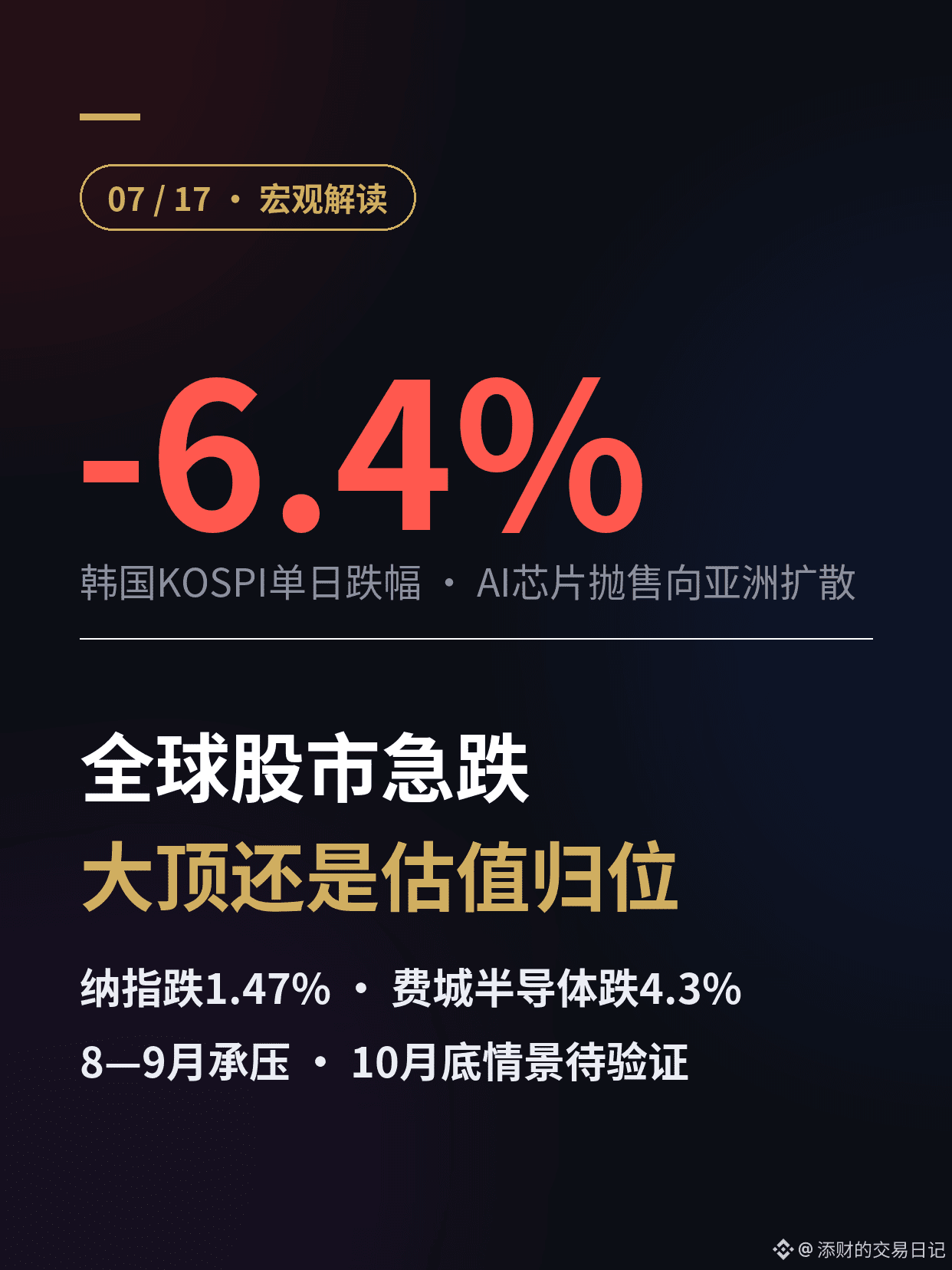
Global Stocks Plunge: Is This More Like a Major Top, or Valuations Coming Back to Earth?
The recent sell-off has spread from the U.S. tech sector to Asia—and it’s happening fast. My view is that this round isn’t just about “killing leverage”; it looks more like AI and high-valuation chip-related trades are entering a phase of repricing. That said, we still can’t say with confidence that this market has already topped.
Global tech trading is cooling in sync
🔹 On July 16, the Nasdaq fell 1.47%, and the Philadelphia Semiconductor Index dropped 4.3%
🔹 South Korea’s KOSPI fell 6.4% in a single day
🔹 On July 17’s Asian early session, Japan’s Nikkei 225 at one point neared a 5% decline, while Taiwan stocks fell more than 5%
🔹 Even though TSMC’s profit grew 77% year over year, it still saw heavy selling. Micron fell 5.6% the same day, though it was still up nearly 199% earlier in the year
The core isn’t that the AI thesis suddenly vanished—it’s that expectations got too full
When a company delivers strong results yet the stock still falls, the market is usually signaling two things: first, that the good news has already been priced in; and second, that investors are beginning to reassess whether AI capital expenditure, the speed of profit realization, and valuations are actually aligned.
However, according to Schwab statistics, about 62% of S&P 500 constituents are still above their 50-day moving averages. This suggests that pressure is currently more concentrated in overvalued tech and semiconductors, and we can’t directly equate a localized valuation compression with a full-blown bear market.
My scenario analysis
If valuation digestion isn’t finished, August through September could see further declines and volatility. The U.S. midterm elections are on November 3. Around late October, it’s worth watching whether policy expectations and election-related uncertainty start to ease.
But this isn’t a certainty script. Policy tailwinds may not materialize, and geopolitical tensions, oil prices, interest rates, and earnings downgrades could also make the correction last longer.
Strategy perspective
A sharp sell-off in the short term may trigger a violent rebound, but I won’t go all-in prematurely, nor will I keep looking only at the downside to the very end. Next, I’ll focus on tracking chip stocks, earnings expectations, market breadth, U.S. Treasury yields, and oil prices and geopolitical risks—then adjust position sizes based on the evidence.
The above is only my personal view and does not constitute investment advice.
#USStocks #GlobalStockMarket #Semiconductors #MacroAnalysis
The recent sell-off has spread from the U.S. tech sector to Asia—and it’s happening fast. My view is that this round isn’t just about “killing leverage”; it looks more like AI and high-valuation chip-related trades are entering a phase of repricing. That said, we still can’t say with confidence that this market has already topped.
Global tech trading is cooling in sync
🔹 On July 16, the Nasdaq fell 1.47%, and the Philadelphia Semiconductor Index dropped 4.3%
🔹 South Korea’s KOSPI fell 6.4% in a single day
🔹 On July 17’s Asian early session, Japan’s Nikkei 225 at one point neared a 5% decline, while Taiwan stocks fell more than 5%
🔹 Even though TSMC’s profit grew 77% year over year, it still saw heavy selling. Micron fell 5.6% the same day, though it was still up nearly 199% earlier in the year
The core isn’t that the AI thesis suddenly vanished—it’s that expectations got too full
When a company delivers strong results yet the stock still falls, the market is usually signaling two things: first, that the good news has already been priced in; and second, that investors are beginning to reassess whether AI capital expenditure, the speed of profit realization, and valuations are actually aligned.
However, according to Schwab statistics, about 62% of S&P 500 constituents are still above their 50-day moving averages. This suggests that pressure is currently more concentrated in overvalued tech and semiconductors, and we can’t directly equate a localized valuation compression with a full-blown bear market.
My scenario analysis
If valuation digestion isn’t finished, August through September could see further declines and volatility. The U.S. midterm elections are on November 3. Around late October, it’s worth watching whether policy expectations and election-related uncertainty start to ease.
But this isn’t a certainty script. Policy tailwinds may not materialize, and geopolitical tensions, oil prices, interest rates, and earnings downgrades could also make the correction last longer.
Strategy perspective
A sharp sell-off in the short term may trigger a violent rebound, but I won’t go all-in prematurely, nor will I keep looking only at the downside to the very end. Next, I’ll focus on tracking chip stocks, earnings expectations, market breadth, U.S. Treasury yields, and oil prices and geopolitical risks—then adjust position sizes based on the evidence.
The above is only my personal view and does not constitute investment advice.
#USStocks #GlobalStockMarket #Semiconductors #MacroAnalysis