


The original concept of a public ledger started with a simple promise. The promise was that anyone could participate. It promised that nobody could interfere with the system. The network would operate completely without central authorities. Users held absolute control over their digital wealth.
Recent events shattered this foundation.
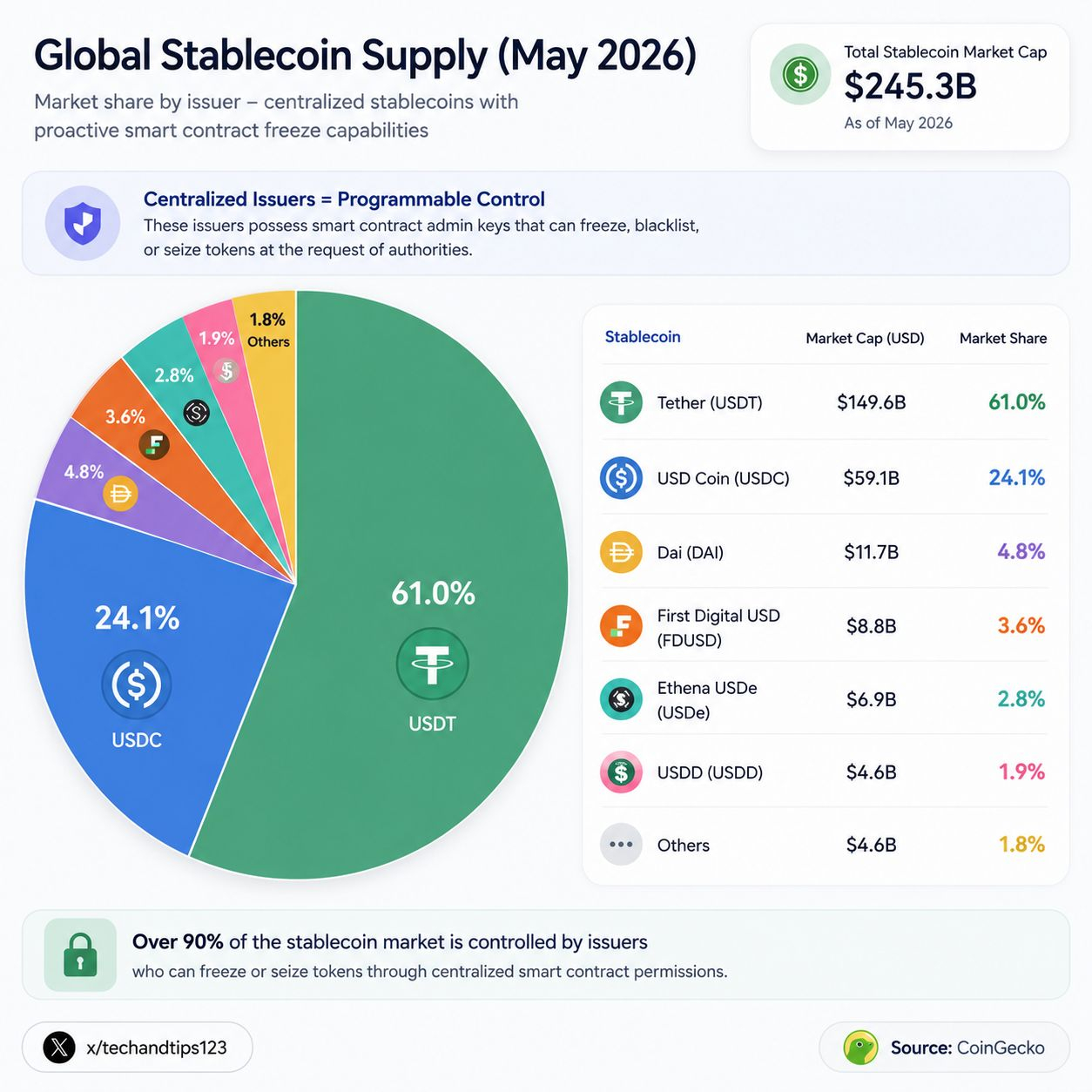
The network remains public today. The assets remain visible to everyone. However, the control mechanisms are now entirely centralized. Stablecoin issuers dictate who can transact. These companies hold the power to freeze assets globally. They can destroy tokens inside private wallets. This reality questions the fundamental nature of decentralization.
I. The Trigger Event: April 23, 2026
The command took only seconds to execute. A single transaction broadcasted across the Tron blockchain altered the reality of digital finance forever.
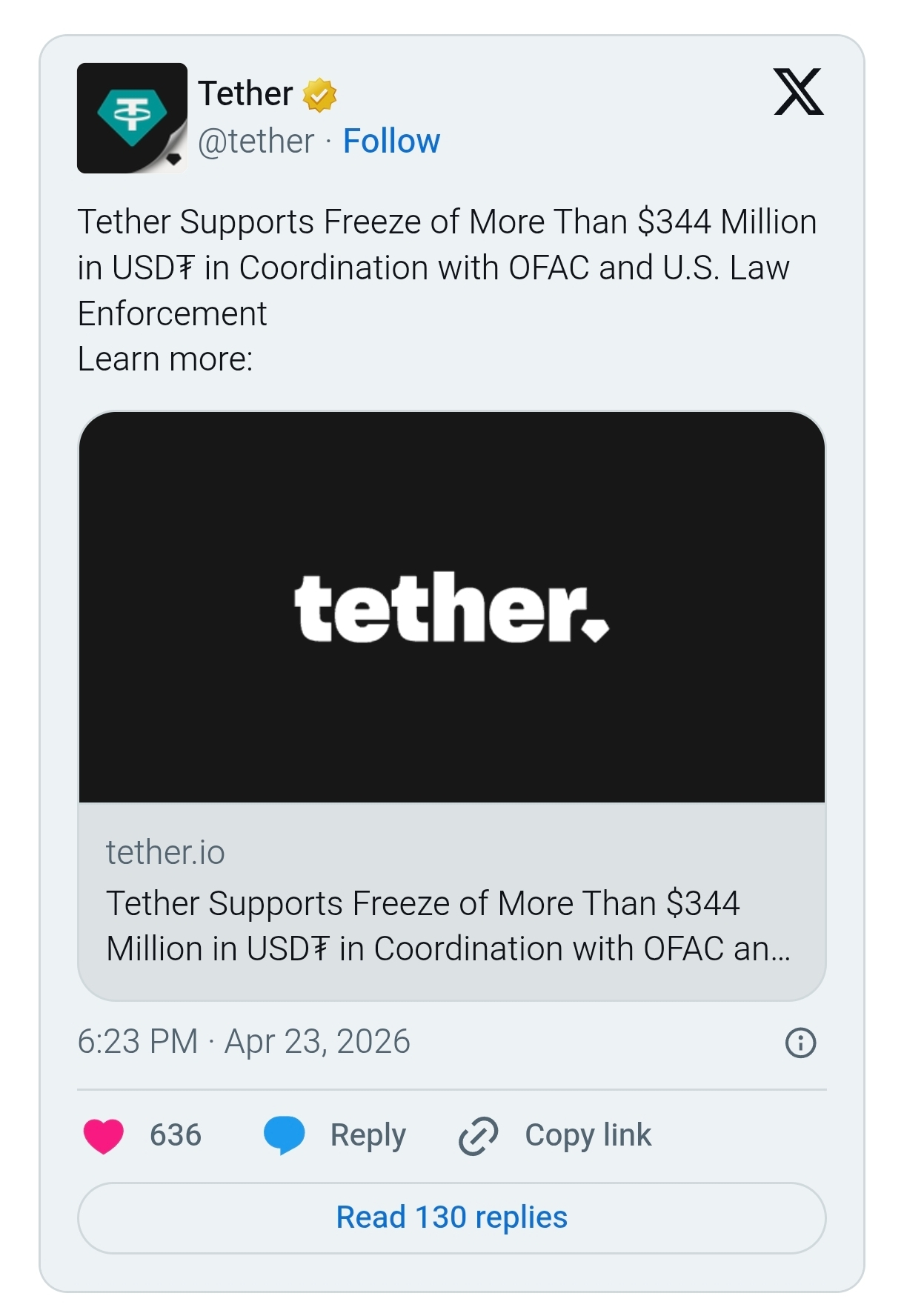
The monetary value involved was staggering. Exactly $344 million vanished from circulation. Two specific digital wallets held these funds.
One wallet contained $212.9 million.
The second wallet held $131.3 million.
The owners of these wallets opened their interfaces to find their balances intact. However, the funds were completely immobilized. The owners could not send the funds. They could not swap the funds. The money was trapped behind an invisible cryptographic wall.
Tether authorized this action. This company issues the world's largest stablecoin. Tether acted upon direct intelligence from United States authorities. The Office of Foreign Assets Control provided the targeting data. Investigators linked the specific addresses to active sanctions evasion networks. These networks supported illicit finance. They also supported international criminal syndicates. The freeze stopped the capital before it could reach traditional fiat off-ramps.
This event marks a profound shift in the architecture of global money. The April 2026 intervention is a permanent structural reality. Centralized issuers now dictate the flow of value on decentralized networks. The blockchain ledger remains public. Transactions remain transparent. Yet the control layer is highly centralized. Authorities do not need to seize a physical server to stop a payment. They simply order the stablecoin issuer to flip a digital switch.
This is the new paradigm of public ledgers. The promise of borderless money now carries strict conditions. Digital cash is traceable. It is controllable. It is entirely reversible.
The speed of the April 23 freeze demonstrates the immense power of this system. Law enforcement agencies historically spent months tracking wire transfers across offshore banks. They navigated complex mutual legal assistance treaties. Now, a single verified request to Tether achieves immediate global enforcement. The funds freeze instantly. The target loses access completely. Meanwhile, the network continues to operate normally for everyone else.
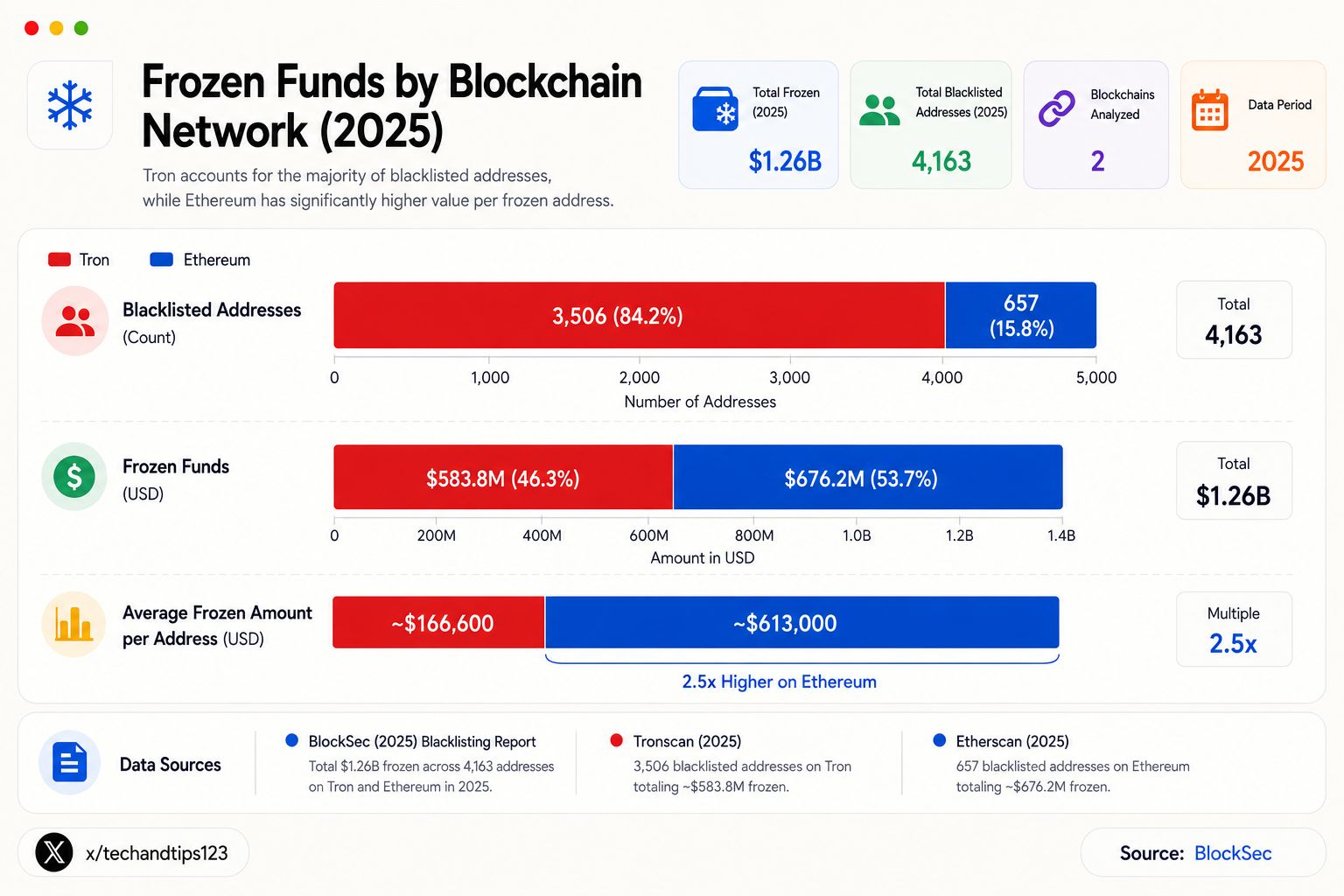
Tether maintains a strict zero-tolerance policy for illicit activity. The company works directly with more than 340 law enforcement agencies worldwide. They operate across 65 different countries. This cooperation supported more than 2,300 global cases by early 2026. Over 1,200 of these cases tied directly to United States agencies. The total value of frozen assets exceeded $4.4 billion. Over $2.1 billion of that total connected directly to American enforcement actions.
The industry must accept this reality. Stablecoins are programmable liabilities. They embed legal compliance directly into their code. The technology allows immediate asset seizure at an unprecedented scale.
II. The Mechanics of Control: How the Freeze Really Works
The mechanism of censorship relies entirely on smart contract architecture. A stablecoin is simply a computer program running on a blockchain. The issuer writes the rules of this program. The rules dictate how tokens move. They also dictate who can move them.
Tether operates smart contracts on multiple blockchains. The Tron and Ethereum networks host the vast majority of this liquidity. These contracts contain privileged administrative functions. Only the contract owner can execute these specific functions. The owner is Tether. The most critical function is the address blacklist command. The code defines this as the addBlackList() function.
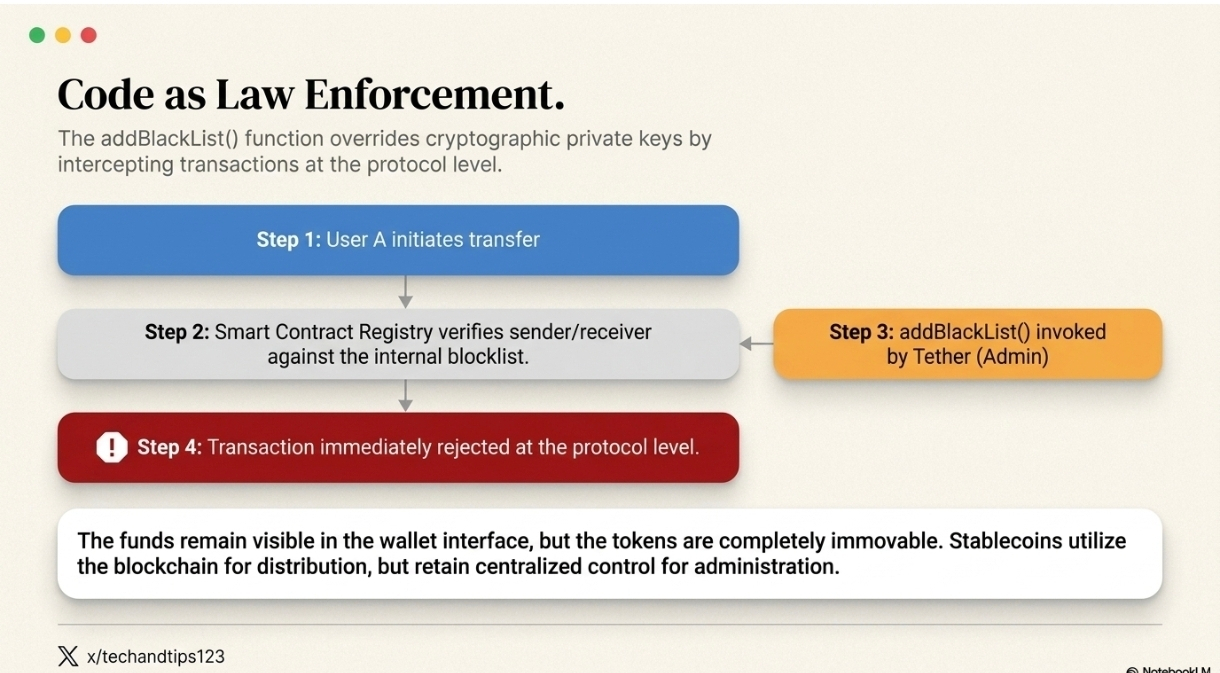
When Tether invokes this function, the target wallet immediately loses its privileges. The smart contract updates an internal registry. It marks the specific address as restricted. Every subsequent transaction attempt triggers an automated check. The contract verifies the status of the sender. It verifies the status of the receiver. The contract immediately rejects the transaction if either address appears on the blacklist. The transaction fails at the protocol level. The user sees an error message. The funds remain visible in the wallet application. However, the tokens are completely immovable.
This reality contrasts sharply with original cypherpunk ideals. Early blockchain pioneers championed immutable code. They believed that code is law. They built systems to resist external interference. Bitcoin operates on this principle. No central administrator can stop a Bitcoin transfer. A user holding the correct private keys possesses absolute authority over their funds. Stablecoins fundamentally reject this model. They utilize the blockchain for distribution. They retain centralized control for administration.
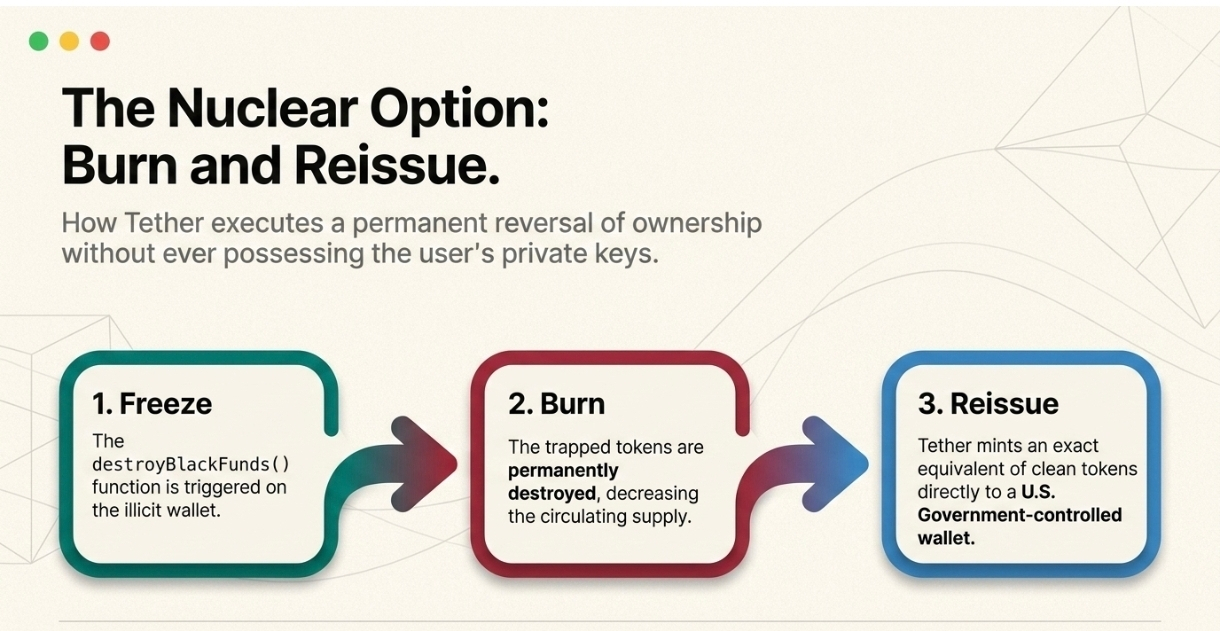
Tether possesses an even more extreme capability. The smart contract includes a destroyBlackFunds() function. This is the nuclear option for asset control. This function permanently burns the tokens held in a blacklisted address. The tokens cease to exist. The total circulating supply decreases by the destroyed amount.
Tether frequently uses this mechanism during law enforcement seizures.
The company freezes the illicit wallet.
They destroy the trapped tokens.
They then mint an equivalent amount of new tokens.
They send these clean tokens to a government-controlled wallet.
This process executes a permanent reversal of ownership. It completely bypasses the need for the original user's private keys.
The compliance engine drives these technical actions. Issuers do not randomly freeze accounts. They follow strict internal policies. Tether actively monitors the Specially Designated Nationals list published by the Office of Foreign Assets Control. The company instantly blacklists any address appearing on this list. They also collaborate with blockchain intelligence firms. Tools from Chainalysis and TRM Labs flag suspicious wallets. The T3 Financial Crime Unit identifies terrorist financing and ransomware nodes. Tether restricts these assets before formal requests even arrive.
Circle issues the USDC stablecoin. They utilize a different compliance model. Circle maintains the technical ability to freeze funds. Their smart contracts include similar blocklist functions. Circle operates reactively. They wait for formal court orders or direct sanctions designations. Circle generally does not destroy and reissue funds. Frozen USDC remains locked in the target wallet indefinitely.
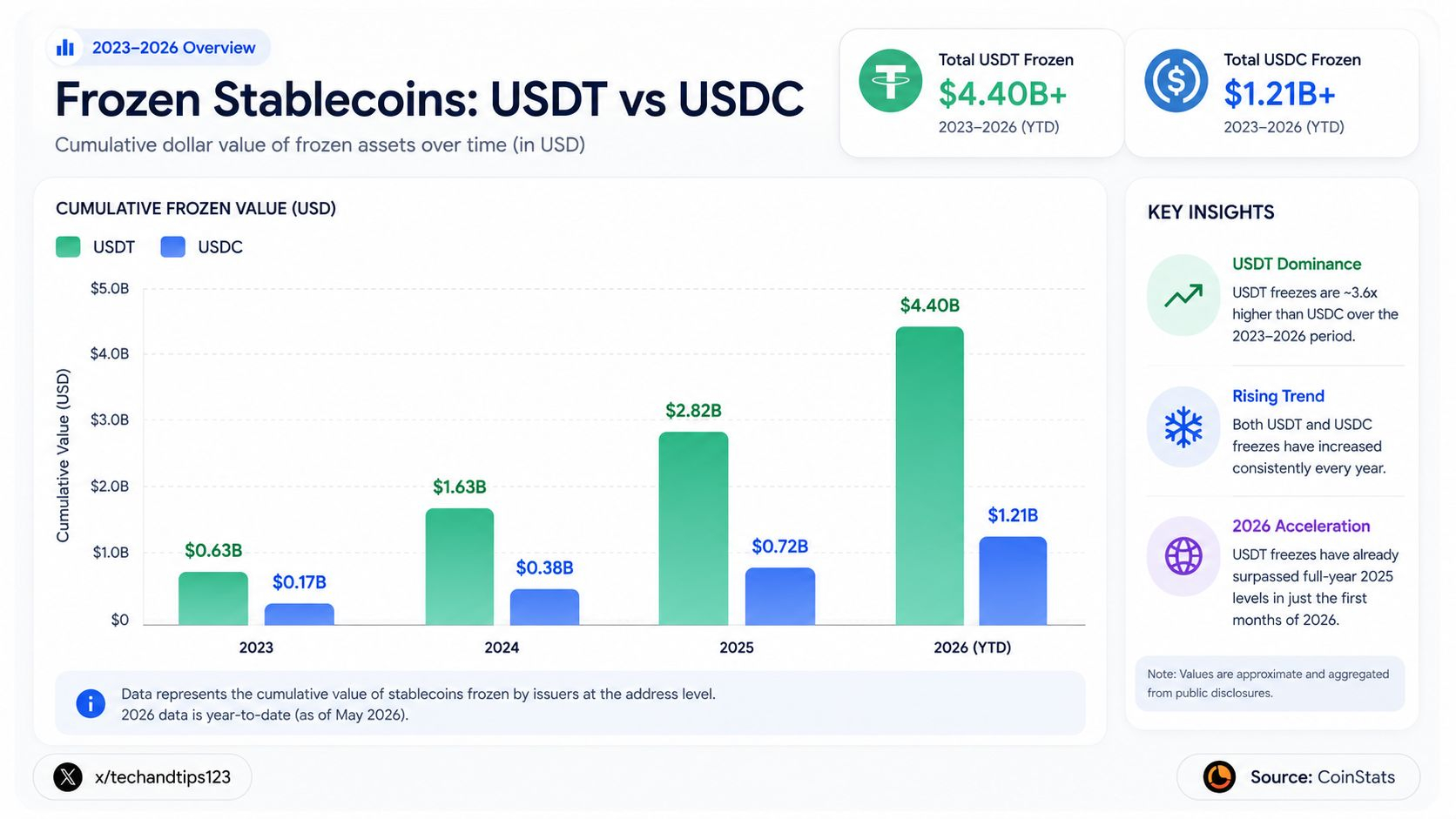
Data reflects actions from 2023 through 2025. Tether exercises its power frequently. Circle reserves it for strict legal mandates. Tether's proactive strategy aligns closely with emerging legislative demands.
Circle also implemented the Cross-Chain Transfer Protocol. The industry calls this CCTP V2. This protocol changes how stablecoins move between different blockchains. Users previously relied on vulnerable bridge contracts. These bridges locked tokens on one chain and minted wrapped versions on another.
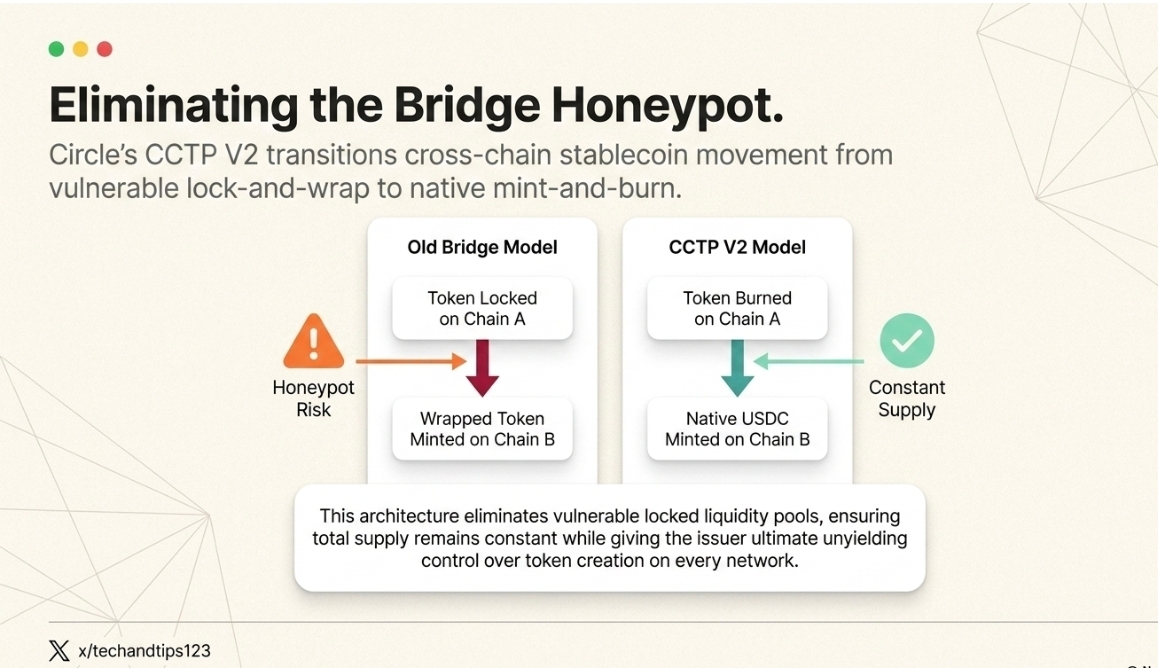
CCTP V2 eliminates this risk. It uses a pure mint and burn mechanism. The protocol destroys USDC on the source chain. It mints fresh native USDC on the destination chain. This architecture eliminates honeypots of locked liquidity. It ensures that total supply remains constant. It also ensures that Circle maintains ultimate control over token creation across all networks.
III. The Legal Superstructure: From Code to Compliance
Technology alone did not create this era of censorship. The law forced the code to adapt. Legislators worldwide now demand absolute control over digital fiat. They encode the kill switch into the legal definition of a stablecoin.
The United States enacted the GENIUS Act in July 2025. This landmark legislation created the first comprehensive federal framework for digital money. The law established the concept of a Permitted Payment Stablecoin Issuer. Only these permitted entities may issue payment stablecoins within the United States.
The law imposes strict reserve requirements. Issuers must hold liquid assets on a one-to-one basis. The reserves must consist of cash or short-term United States Treasuries. Issuers must publish monthly audits of these reserves.
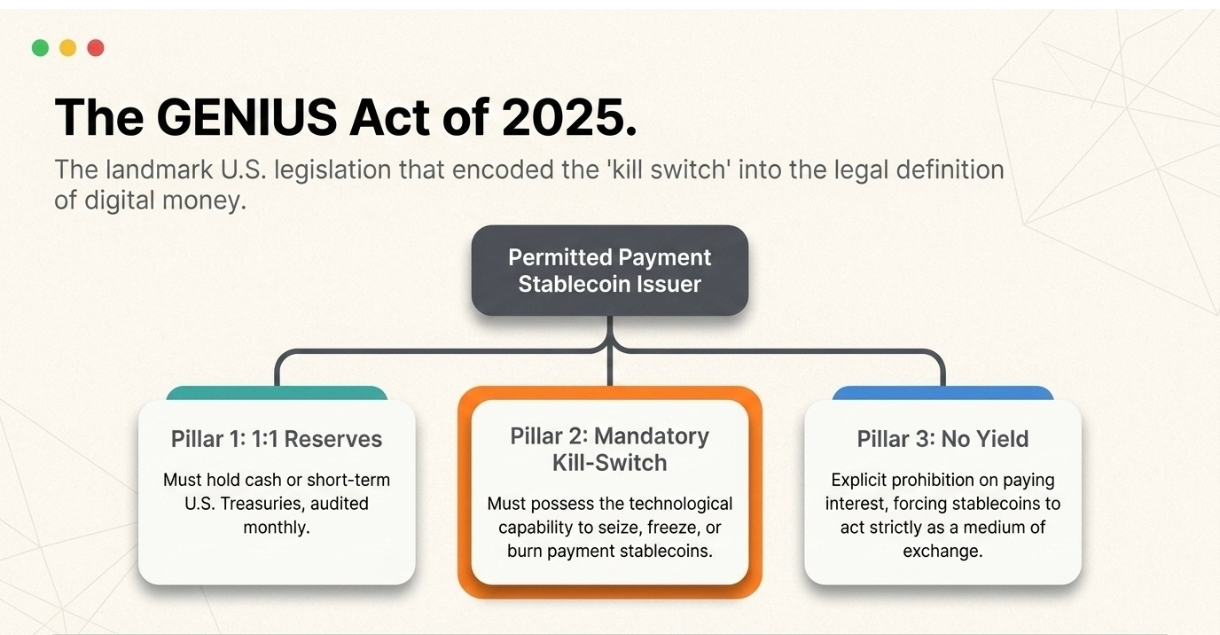
The GENIUS Act contains a critical technical mandate. Every permitted issuer must possess the technological capability to seize, freeze, or burn payment stablecoins. They must comply with lawful orders to prevent the transfer of outstanding tokens. The law transforms stablecoin issuers into active financial enforcement agents. They must monitor transactions. They must maintain compliance programs aligned with the Bank Secrecy Act. They must file suspicious activity reports. The April 2026 Tether freeze demonstrates this exact legal requirement in action. The government issues the order. The issuer executes the code.
The GENIUS Act explicitly prohibits stablecoin issuers from paying interest to users. This rule prevents stablecoins from functioning as investment vehicles. The law forces stablecoins to act strictly as a medium of exchange. It protects traditional bank deposits from massive capital flight.
The CLARITY Act complements this framework. The House passed this bill in July 2025. The legislation separates digital assets into clear categories. It defines the boundaries between digital commodities and payment stablecoins. A digital commodity derives its value from the operation of a blockchain network. The Commodity Futures Trading Commission regulates these assets. Payment stablecoins fall under the jurisdiction of banking regulators.
The CLARITY Act also introduces the first statutory definition of staking. It distinguishes three distinct legal treatments.
Self-staking occurs when the owner operates the node without transferring custody.
Self-custodial staking with a third party allows the owner to retain control while another entity operates the node.
Custodial staking involves transferring control to a third party.
This final category triggers strict registration requirements. This division solidifies the role of stablecoins as regulated payment infrastructure while protecting decentralized protocols.
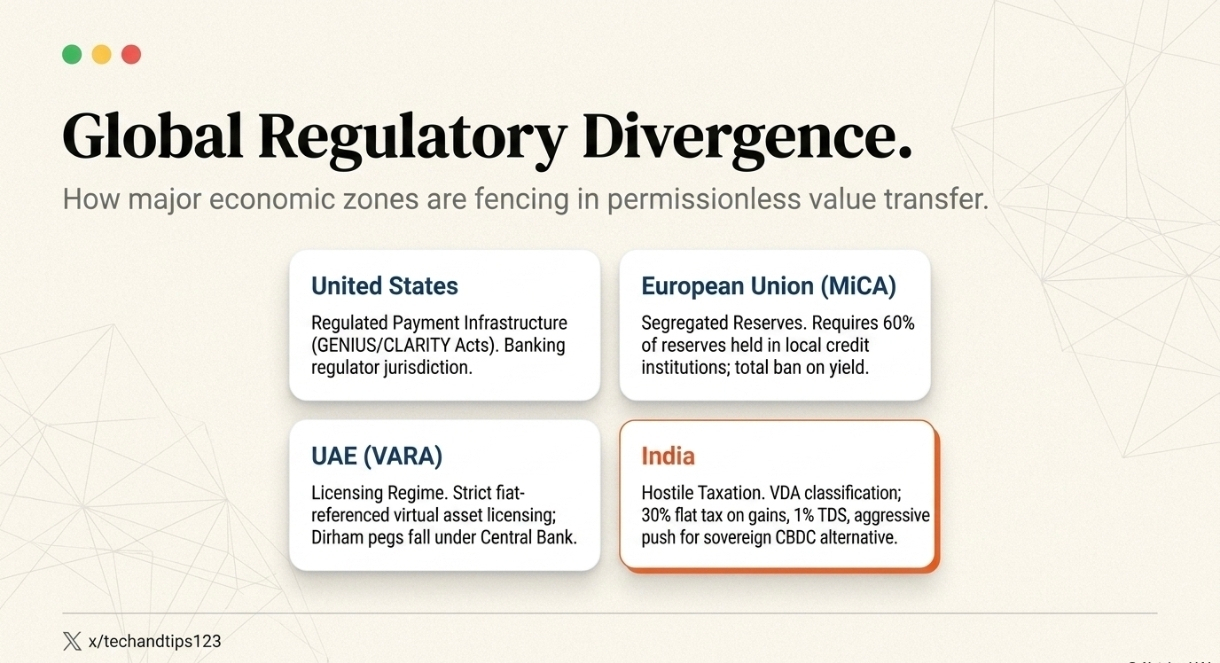
Global regulators follow a similar path. The European Union enforces the Markets in Crypto-Assets regulation. This framework is widely known as MiCA. MiCA imposes strict rules on electronic money tokens. Issuers must secure authorization from national competent authorities. They must hold segregated reserves in European credit institutions. The European rules force companies to hold at least sixty percent of their reserves in local banks. MiCA also implements a total ban on yield-bearing stablecoins.
Singapore manages a parallel regime. The Monetary Authority of Singapore regulates single-currency stablecoins. Issuers must maintain full backing in the reference currency. They must guarantee redemption within five business days. Base capital requirements are high.
The United Arab Emirates relies on the Virtual Assets Regulatory Authority. This Dubai-based agency licenses fiat-referenced virtual assets. Any token pegged to the Dirham falls under the jurisdiction of the UAE Central Bank. Everything else belongs to VARA.
India presents a highly complex regulatory environment. The Reserve Bank of India refuses to recognize stablecoins as legal tender or authorized payment instruments. The central bank views private digital currencies as threats to macroeconomic stability. They fear these assets could undermine the sovereign control of the domestic money supply. The Indian government categorizes stablecoins as Virtual Digital Assets. The Reserve Bank aggressively promotes its own Central Bank Digital Currency. This digital rupee functions as a centralized alternative to private stablecoins.
The Virtual Digital Asset classification triggers an aggressive tax regime. The Finance Act of 2022 imposes a flat thirty percent tax on all digital asset gains. A one percent tax is deducted directly at the source for major transactions. Investors cannot offset their losses against other assets. A daily fine applies to entities that fail to file accurate transaction statements. The Income Tax Department utilizes artificial intelligence analytics to flag unreported transactions.
The Financial Intelligence Unit oversees all registered crypto exchanges in India. These platforms must enforce strict identity verification. They must report suspicious activities under the Prevention of Money Laundering Act. Despite these hurdles, stablecoin adoption in India remains massive. Businesses use stablecoins for rapid cross-border settlements.
This utility clashes violently with the Foreign Exchange Management Act. This law requires all foreign exchange transfers to pass through authorized banking channels. Stablecoins bypass these channels entirely. An Indian exporter receiving USDT operates outside the recognized repatriation system.
The consequences of this clash emerged clearly in June 2026. The Enforcement Directorate launched massive raids in Bengaluru. Officers descended on multiple premises linked to cryptocurrency payment firms. They accused these firms of operating an unlicensed remittance network. The network allegedly routed over $300 million abroad using stablecoin transfers. The state froze substantial bank assets during the operation.
This enforcement action triggered an immediate market shock. The price of USDT on Indian exchanges skyrocketed. The local premium for the stablecoin jumped above eight point five percent. The usual premium hovers around three percent. Market makers halted their overseas purchases of USDT. They feared sudden regulatory exposure. The arbitrage mechanisms broke down. The local supply of stablecoins collapsed.
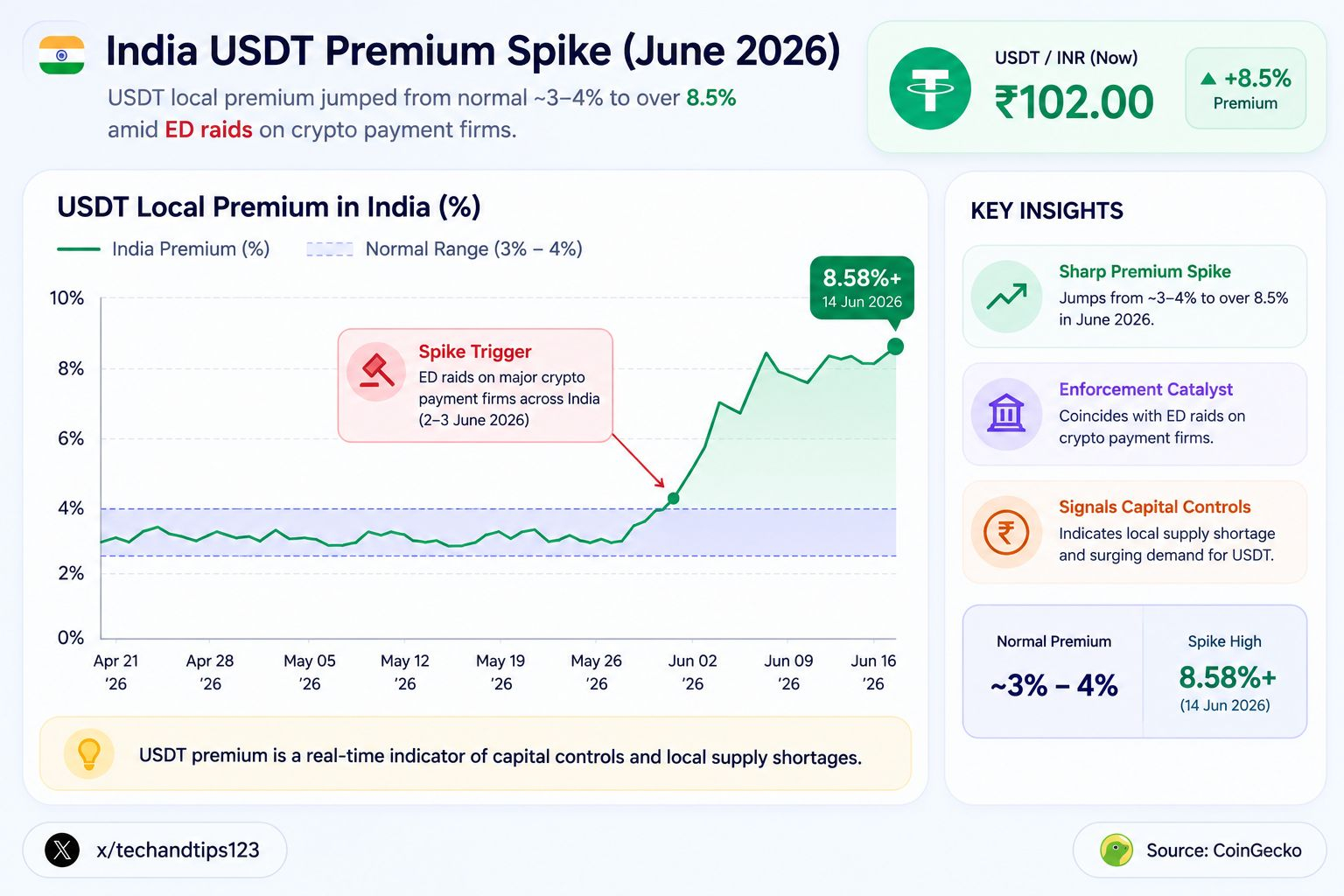
This premium serves as a real-time indicator of sovereign capital controls. It shows what happens when a state aggressively defends its borders against permissionless value transfers. The Indian state lacks a dedicated stablecoin law. They use tax codes and money laundering statutes to enforce compliance instead.
IV. The On-Chain Evidence: Mapping the Frozen Funds
The transparency of a public blockchain acts as a digital autopsy table. Every transaction leaves an indelible mark. Investigators reconstruct the exact flow of illicit capital. They identify the participating nodes. They isolate the tainted funds. The April 2026 freeze provides a perfect case study in on-chain forensics.
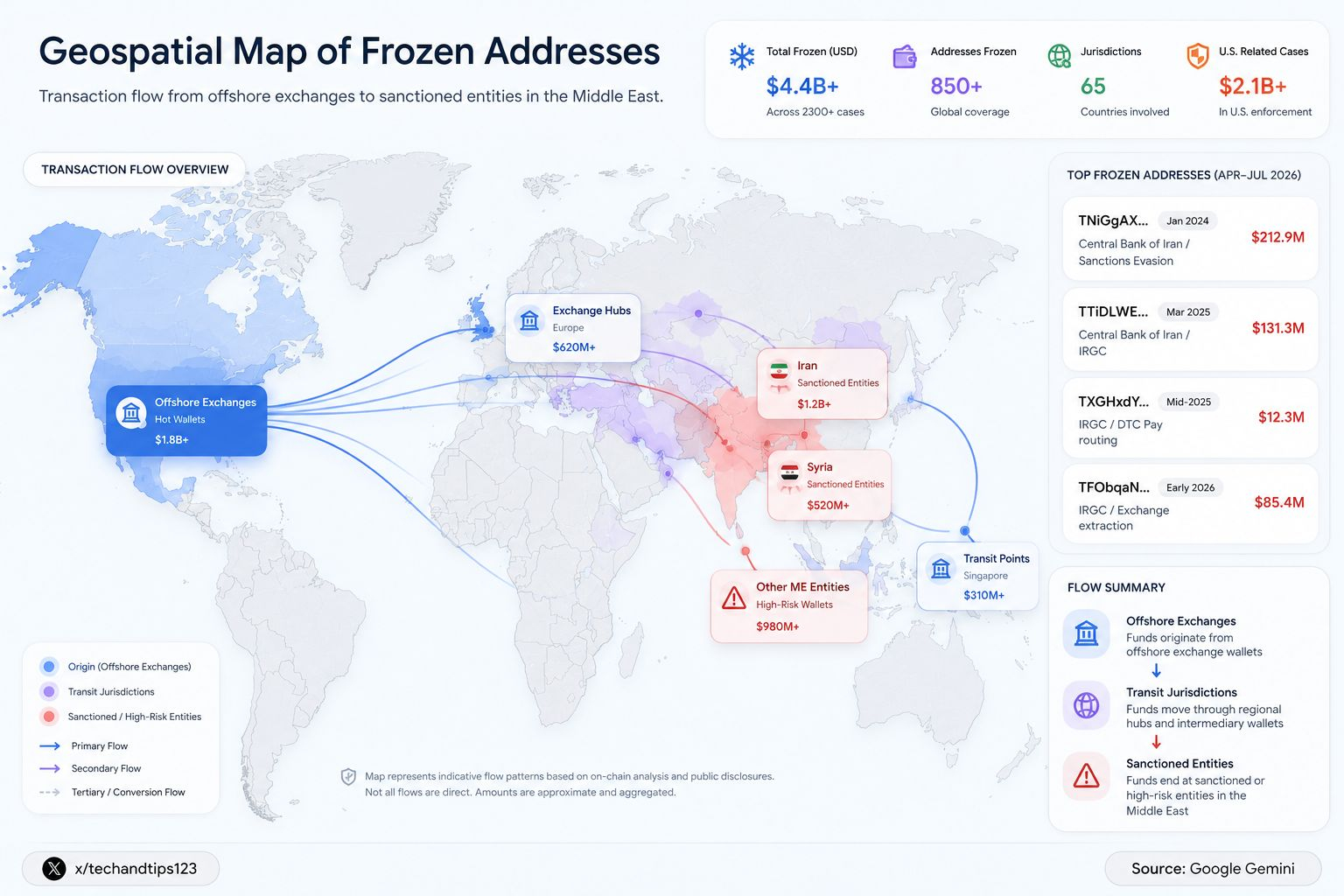
Tether executed the initial freeze across two massive Tron network addresses. The first address held an astonishing $212.9 million. The blockchain identifies this wallet as TNiq9AXBp9EjUqhDhrwrfvAA8U3GUQZH81. The second address held $131.3 million. The blockchain identifies this wallet as TTiDLWE6fZK8okMJv6ijg42yrH6W2pjSr9. Chainalysis researchers identified these wallets as critical infrastructure for the Central Bank of Iran.
The Islamic Republic operates under intense global economic sanctions. The Iranian regime desperately needs access to dollar-denominated assets. They utilize complex networks of intermediaries to acquire stablecoins. The regime uses these digital dollars to fund military procurement and bypass traditional banking restrictions. The two targeted wallets functioned as high-velocity liquidity hubs. They aggregated funds from regional payment providers and offshore exchanges.
The April action was merely the opening salvo. United States authorities escalated their financial pressure campaign throughout the summer. This campaign operates under the internal designation Operation Economic Fury. On July 14, 2026, Tether executed another massive freeze. This action targeted four additional Tron wallets. The combined balance of these new targets totaled $131 million.
On-chain analysts quickly mapped the new addresses. One wallet contained $12.3 million. This address starts with TXGHxdYbGy574z5hBu4LNzq9NzjZQ9bhUf. Another wallet held nearly $85.5 million. The tracing data revealed clear patterns. The funds largely originated from withdrawals at DTC Pay and the Bitso exchange. The wallets exhibited classic layering techniques. The operators distributed funds across multiple addresses to avoid detection. They kept individual balances relatively low before sudden aggregations.
The United States Treasury directly confirmed the nature of these addresses. Secretary Scott Bessent announced the sanctions publicly. He stated the Treasury would aggressively disrupt the Iranian regime's abuse of digital assets. The intelligence indicated deep ties between the wallets and the Islamic Revolutionary Guard Corps. The IRGC utilizes these shadow networks to finance regional operations.
The ripple effect of a major freeze damages the broader ecosystem. Blockchain analytics firms monitor the flow of tainted assets. A wallet that receives funds from a sanctioned address immediately becomes suspect. This creates a phenomenon known as contagion risk. Innocent merchants or centralized exchanges can unknowingly receive illicit stablecoins. Automated compliance tools flag these incoming deposits. The receiving institution must quarantine the funds to avoid regulatory penalties. Businesses must segment their digital asset holdings. They must separate deposit wallets from sweeping wallets and cold storage.
The scale of the asset destruction is immense. By May 2026, Tether had immobilized roughly $475 million tied specifically to Iranian operations. The frozen assets generally face a standardized legal process. The United States government files a civil forfeiture action. A federal judge issues a formal seizure order. Tether receives the order. The company destroys the frozen tokens using the burn function. They reissue the exact monetary value to a government-controlled wallet. The funds are permanently confiscated. The original holders lose all recourse.
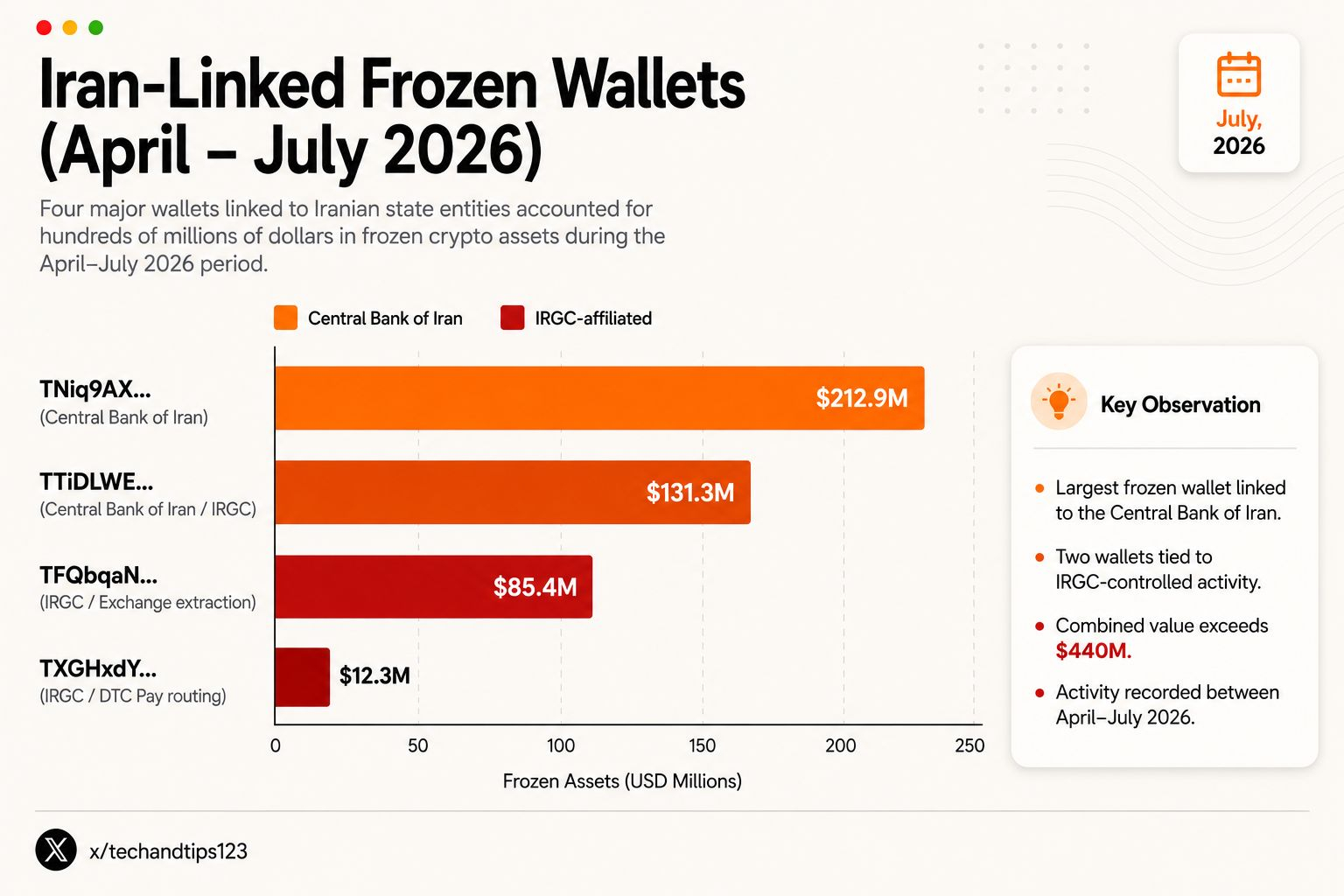
Data snapshot reflects targeted actions across April and July 2026.
V. The End of Permissionlessness: Conceptual Implications
The integration of programmable compliance shatters the foundational myth of cryptocurrency. The original axiom of the industry stated a simple rule. Your keys equal your coins. If a user holds the cryptographic private key to a digital wallet, no external force can touch the assets inside. This remains true for pure commodity tokens like Bitcoin. It is entirely false for centralized stablecoins.
Holding a stablecoin in a non-custodial wallet creates an illusion of sovereignty. The user controls the local software. They authorize the transaction signatures. However, the token contract owner holds the ultimate authority. The issuer controls the freeze function. They can revoke access instantly. Permissioned stablecoins constitute an entirely new asset class. They are centrally administered liability tokens operating on distributed rails. The blockchain merely provides a highly efficient settlement layer.
This reality marks a decisive defeat for early cypherpunk philosophy. Activists like Eric Hughes argued strongly for digital privacy. They believed anonymous electronic cash was essential for an open society. The current trajectory of digital finance moves in the exact opposite direction. Freeze functions turn public ledgers into instruments of total surveillance. Physical cash was the last truly anonymous medium of exchange. Digital cash is infinitely traceable. It is subject to real-time algorithmic control.
The network effects of censorship extend beyond the stablecoin issuers. The underlying blockchain validators also face immense pressure to comply with global sanctions. This creates a severe structural vulnerability for decentralized networks. Ethereum validators process the transactions that power decentralized finance. Many validators rely on specialized software to maximize their staking yields.
This software includes MEV-Boost. The system separates block building from block proposing. Specialized builders create highly profitable blocks of transactions. They pass these blocks through relay networks to the validators. Certain major relays actively filter transactions. They drop any transaction involving an OFAC-sanctioned address. They refuse to process transactions linked to privacy mixers like Tornado Cash.
The statistics reveal a troubling trend for network neutrality. Shortly after the Ethereum network transitioned to Proof-of-Stake, the percentage of OFAC-compliant blocks surged. At one point, nearly eighty percent of all blocks on the network complied strictly with sanctions filtering. This metric eventually fell to roughly twenty-seven percent as validators switched to neutral relays like Ultra Sound Money and Agnostic.
The threat of protocol-level censorship persists. Analysts simulated a scenario where ninety-nine percent of Ethereum validators became OFAC-compliant. A censored transaction would still eventually process. It would take roughly three hours to achieve finality. The network would not stop the transaction completely. It would simply degrade the service severely. A network that actively delays marginalized users ceases to be a neutral public utility.
VI. The Industry Response: Adaptation or Capitulation?
The blockchain ecosystem reacts to this new era in distinctly different ways. Some entities embrace the compliance mandates. They build massive businesses by serving as regulatory enforcement arms. Circle and Tether dominate this category. They prove to governments that digital ledgers are superior tools for tracking illicit wealth. Major centralized exchanges adopt identical postures. Platforms like Binance and Coinbase integrate extensive blockchain surveillance tools into their infrastructure. They actively block deposits from tainted addresses. They quarantine funds upon receiving automated alerts.
A smaller faction of the industry fights to preserve the original decentralized vision. They reject the concept of the administrative kill switch. These developers build censorship-resistant stablecoins. These assets do not rely on fiat currency in bank accounts. They maintain their value through algorithmic incentives and cryptocurrency collateral.
The DAI stablecoin leads this category. The MakerDAO protocol issues DAI. The system utilizes over-collateralization to maintain a dollar peg. No central administrator can freeze a DAI token. However, DAI relies heavily on USDC collateral through its Price Stability Module. This creates an indirect censorship vector.
LUSD offers a stricter model. The Liquity protocol issues LUSD. The smart contracts are entirely immutable. The protocol only accepts Ethereum as collateral. There is zero governance risk. There is zero freeze risk. FRAX operates as a hybrid algorithmic stablecoin. It offers strong resistance to censorship.
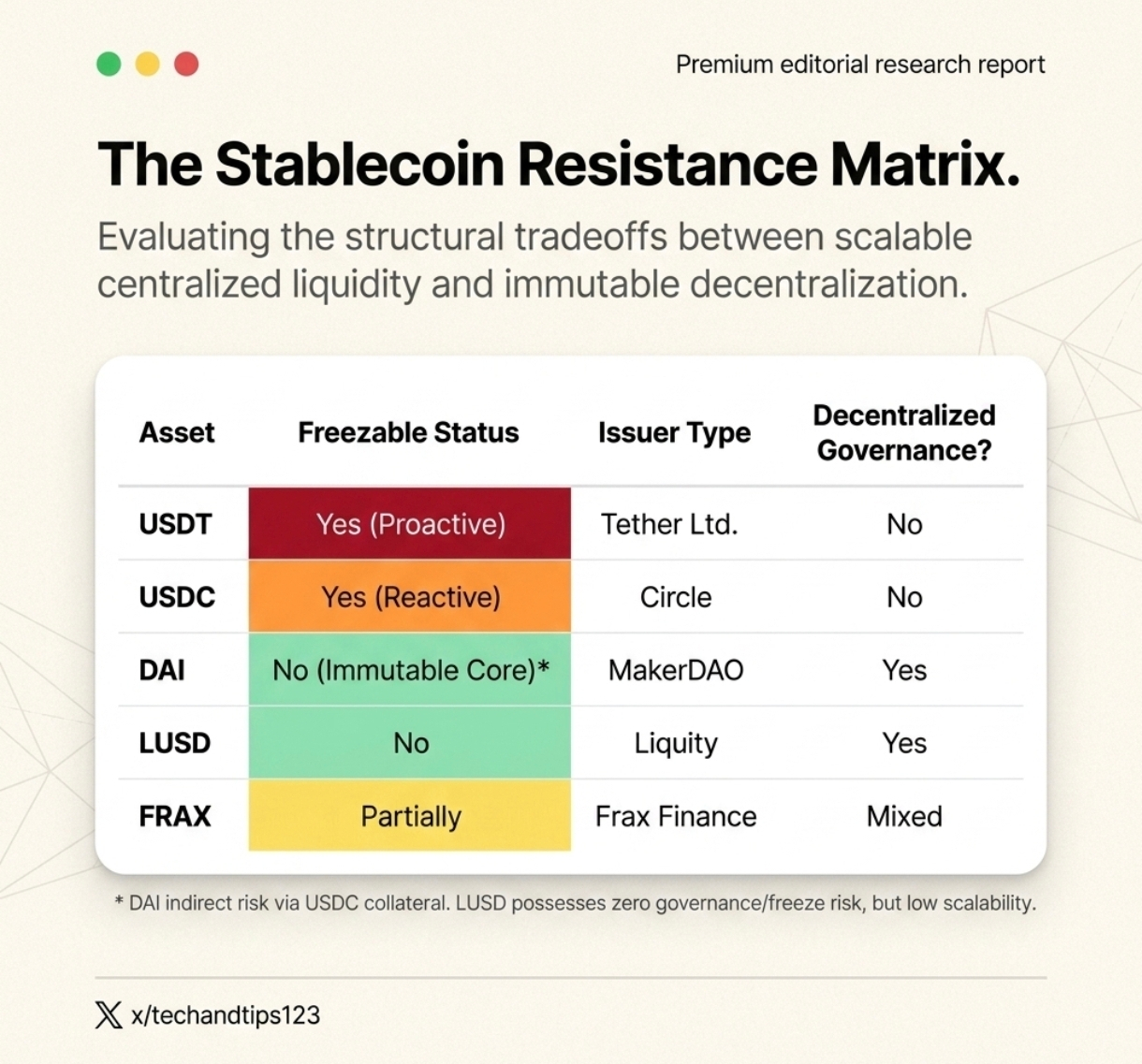
Data reflects consensus protocol structures as of 2026. These decentralized alternatives suffer from scalability issues. They require massive amounts of capital to generate small amounts of stable supply. They cannot meet the global demand for digital dollars alone.
Technologists approach the problem from a different angle. They build full-chain privacy solutions. Networks like Aleo and Aztec use zero-knowledge proofs. These advanced cryptographic tools allow users to prove a transaction is valid without revealing the underlying data. Aleo embeds this privacy directly into its Layer-1 consensus using the Zexe architecture. Aztec operates as a permissionless privacy layer on Ethereum. The network hides the sender. It hides the receiver. It encrypts the transaction amount. This breaks the chain of surveillance. Regulators view these privacy networks with extreme suspicion. Fully anonymous transfers enable unchecked money laundering.
A compromise emerges in the form of dynamic compliance tokens. Developers created the ERC-7518 token standard. The industry calls this the DyCIST standard. It stands for Dynamic Compliant Interoperable Security Token. This code tokenizes real-world assets like private credit and real estate. The standard utilizes a unique partitioning system based on the ERC-1155 framework. It assigns specific rules to specific investor groups.
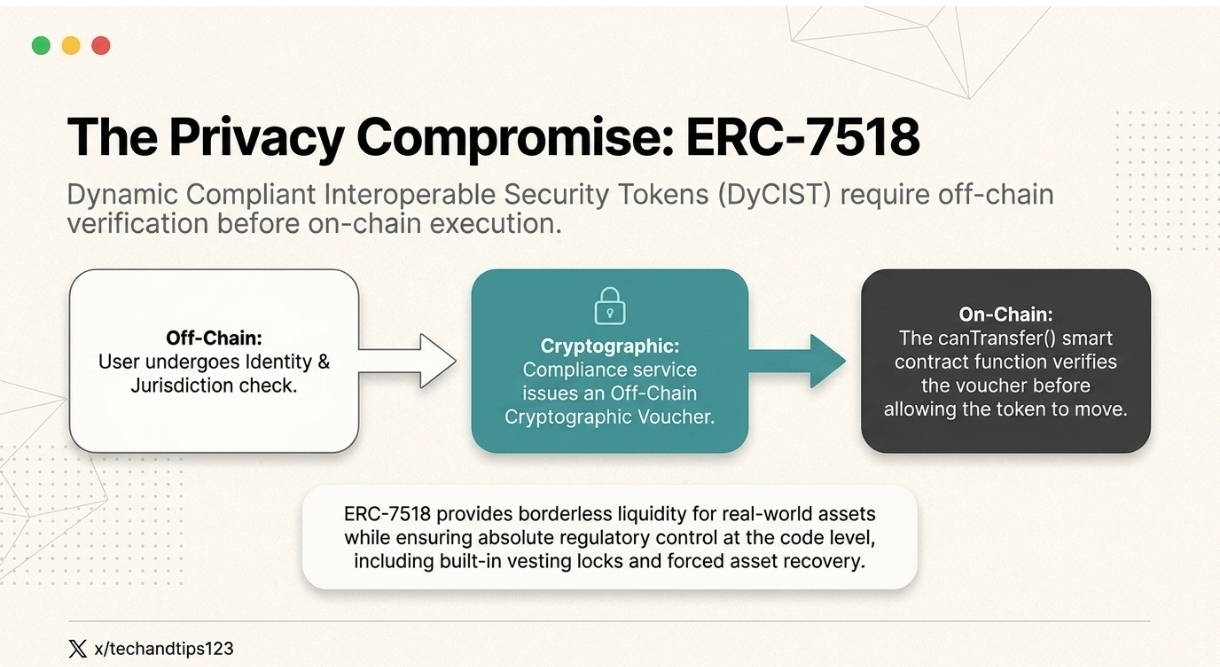
ERC-7518 completely reimagines on-chain compliance. The smart contract requires an off-chain cryptographic voucher before any transfer executes. A compliance service verifies the user's identity. It checks their regulatory jurisdiction. It issues a digital voucher. The canTransfer function in the smart contract validates this voucher. The token only moves if the transaction is completely legal.
The standard also includes powerful administrative tools. An issuer can freeze specific addresses. They can lock tokens for vesting periods. They can execute forced transfers to recover lost assets. This standard satisfies the demands of institutional finance. It provides borderless liquidity. It ensures absolute regulatory control at the code level.
VII. The Future of Public Ledgers: Prediction and Open Questions
The expansion of freeze mandates is inevitable. The success of the GENIUS Act provides a blueprint for global regulators. Future legislation will likely target blockchain infrastructure layers. Authorities may require sidechains and Layer-2 scaling networks to integrate native freeze functions. The concept of the legal-encoded token will become the standard for all institutional assets.
Standards like ERC-7518 prove that programmable compliance is highly efficient. This trajectory points toward a severe bifurcation of the digital asset ecosystem. The blockchain universe will split into two distinct realms.
One set of ledgers will cater exclusively to regulated economic activity. These chains will feature native identity verification. They will support reversible transactions. They will capture the vast majority of global liquidity. Major banks and corporations will operate exclusively in this environment.
The second realm will consist of truly permissionless value transfer networks. These chains will preserve the original cypherpunk ethos. They will reject central administration. They will offer absolute finality and strong privacy. These networks will face relentless regulatory hostility. Traditional financial institutions will refuse to interact with them. They risk significant liquidity fragmentation and may face de-banking pressures. However, they are unlikely to disappear entirely. They will likely serve niche use cases, high-value peer-to-peer transfers, politically sensitive jurisdictions, and ideological proponents of decentralization. Regulated chains will capture the vast majority of mainstream commercial activity and institutional liquidity.
The human element of centralized control remains a critical vulnerability. Mistakes occur constantly in traditional banking. Accounts are frozen in error. Legitimate businesses suffer devastating operational shocks. The asymmetry of stablecoin control exacerbates this risk. A single automated alert can trigger a multi-million dollar freeze. An algorithm flags a wallet. The smart contract executes the blocklist command. The funds instantly trap innocent capital. Reversing this action requires immense effort.
The user cannot appeal to the smart contract. They must navigate a complex bureaucracy. They must contact the issuer. They often need formal court intervention to lift an erroneous freeze. The technology acts instantly. The legal remedy takes months.
The April 2026 Tether freeze stands as a historical landmark. It dismantled the illusion of decentralized finance. It proved definitively that public blockchains are not beyond the reach of the state. They are the most efficient financial enforcement tools ever constructed.
The digital ledger remembers everything. The issuer holds the master key. The question is no longer whether censorship exists on public blockchains. The question is exclusively about who holds the keys.