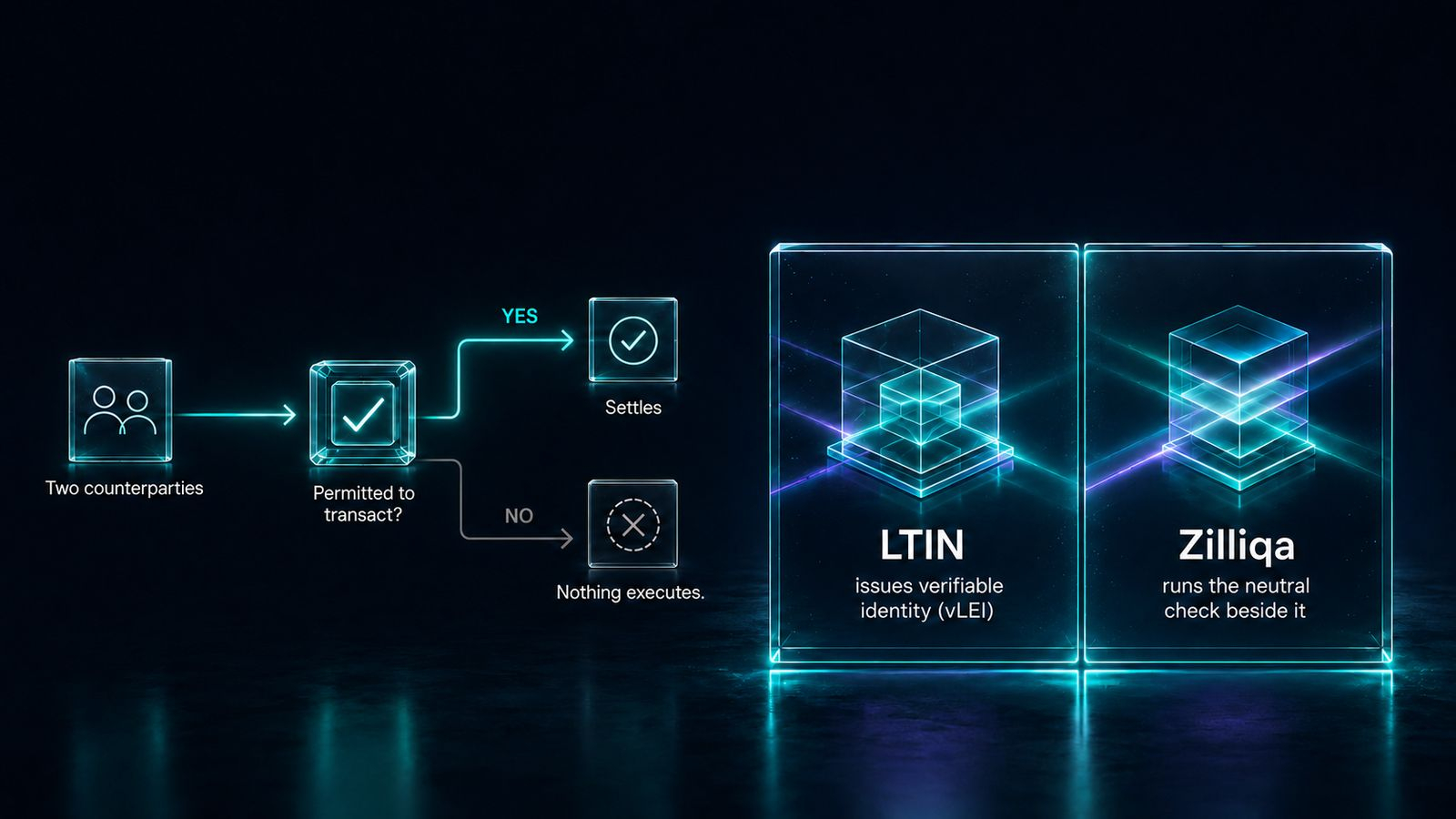

Mediation is the step that confirms that two parties are authorized to carry out transactions before any exchange of value occurs. It is not compliance monitoring, which reads a ledger after entries have been recorded; nor is it a settlement network, which transfers value between accounts. Mediation comes before both: it verifies that both counterparties have valid credentials and are authorized to transact according to the applicable policy, and only authorizes the operation if they meet these requirements. Otherwise, no transaction is executed. The verification is performed on the blockchain, in an automated and cryptographically verifiable way.
Two organizations, Two jobs:
Verification cannot run until a question is answered: who is this counterparty, in a verifiable way? Zilliqa has no authority to provide that answer. It is issued by LTIN, the sovereign fiduciary infrastructure, majority-owned by Telecom Liechtenstein, as a verifiable organizational identity (vLEI). LTIN issues the identity; Zilliqa performs the verification alongside it. They do not impose one another; they complement each other. The identity belongs to the sovereign issuer; the verification belongs to the neutral layer. LTIN is in the process of obtaining GLEIF accreditation as a qualified vLEI issuer.
A public chain, not a permissioned one:
Verification is additive, not restrictive; it does not limit access to the network. Zilliqa remains a public blockchain. The mediation layer confirms permission and enables settlement across any settlement network, whether EVM, SVM, or another chain, without custodizing assets or managing its own ledger. It simply clears the path; it does not take sides in transactions.
Why does it have to be first, and why can’t it be adapted later?
In a chain designed for settlement, the validity of a transaction is defined by settlement rules: valid signature, sufficient balance, and correct nonce. Settlement is the state transition. If permission were to be a prerequisite, you would have to redefine what a valid state transition is, so that a transfer without permission would never be valid. A chain that already settles first cannot move that step ahead without redesigning its own state transition. Order is the architecture. The layer is under active development; the architecture specification will be published in Phase 01.