
CL莉姐
2.5k Posts

CL莉姐
 Square Verified
打狗博主👀
672 Following
36.6K+ Followers
19.7K+ Liked
Posts
All
Quotes
Live
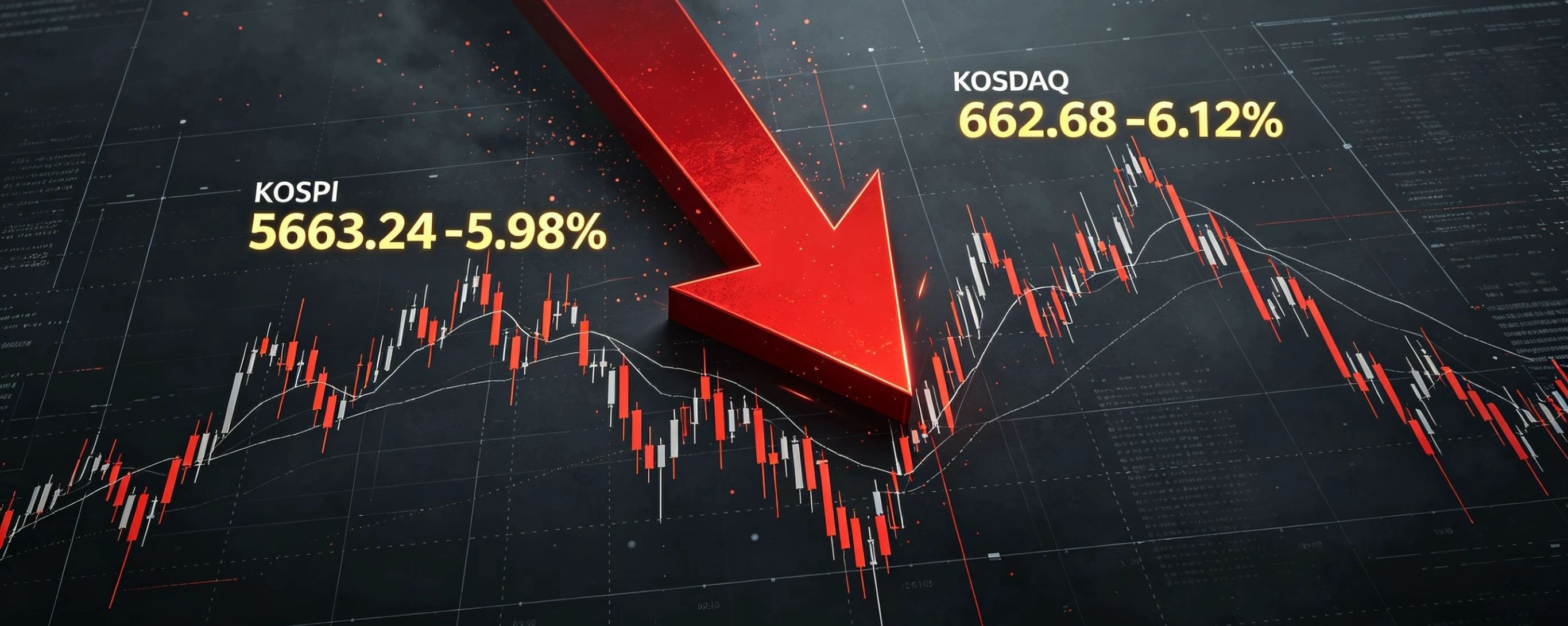
Yesterday morning’s rush-hour crowding got me stuck at the metro turnstiles. The guy in front swiped his QR code three times and nothing happened. Behind him, the line only tightened—people shouted things like “move forward a bit,” and others shouted “go back and try again.” I glanced at his phone: full signal bars, but I couldn’t tell which step was stuck. We held there for almost a minute before the turnstile finally let out a “ding” and opened. When I squeezed through, I shook my head—wasn’t this just a snapshot of congestion at the public-chain network layer?
I noticed that most public chains use the Gossip protocol, and its logic is pretty similar to that turnstile system. When a message arrives, it’s told to whoever it can reach—broadcast a block, have each node forward it to its neighbors, and the amplification happens hop by hop. The more nodes you have, the more messages explode, and bandwidth gets hammered harder and harder. A turnstile that stalls for a minute might mirror a blockchain that stalls due to forks, rollbacks, or transaction delays. Research cited in white papers shows that under high load, this kind of broadcast approach creates an extremely large bandwidth redundancy.
But I found that Dusk doesn’t use this. Under the hood it runs Kadcast, a structured routing mechanism based on a Kademlia DHT. Nodes are organized into a tree based on XOR distance, and messages are directed along specific paths instead of being pushed through the big “megaphone” approach. The data is convincing: the white paper claims that Kadcast can reduce bandwidth consumption by 25% to 50% compared with Gossip, and in faster block-production scenarios, the rate of stale blocks can drop by 10% to 30%. Even more extreme: in simulations where 30% of nodes are cut off, Kadcast can still complete route reconfiguration within milliseconds.
Let me be blunt—I’ve seen too many projects pile all kinds of flashy mechanisms into the consensus layer, yet nobody pays attention to the network layer’s dirty work. Even if consensus is strong, if blocks can’t get through, it’s all for nothing. That day there was a staff member next to the turnstiles who manually reset the QR code for that guy, but the one minute of congestion had already happened. Dusk is willing to put effort into “invisible” places like Kadcast, and that’s more practical than those projects that just brag about TPS. #dusk $DUSK @Dusk
I noticed that most public chains use the Gossip protocol, and its logic is pretty similar to that turnstile system. When a message arrives, it’s told to whoever it can reach—broadcast a block, have each node forward it to its neighbors, and the amplification happens hop by hop. The more nodes you have, the more messages explode, and bandwidth gets hammered harder and harder. A turnstile that stalls for a minute might mirror a blockchain that stalls due to forks, rollbacks, or transaction delays. Research cited in white papers shows that under high load, this kind of broadcast approach creates an extremely large bandwidth redundancy.
But I found that Dusk doesn’t use this. Under the hood it runs Kadcast, a structured routing mechanism based on a Kademlia DHT. Nodes are organized into a tree based on XOR distance, and messages are directed along specific paths instead of being pushed through the big “megaphone” approach. The data is convincing: the white paper claims that Kadcast can reduce bandwidth consumption by 25% to 50% compared with Gossip, and in faster block-production scenarios, the rate of stale blocks can drop by 10% to 30%. Even more extreme: in simulations where 30% of nodes are cut off, Kadcast can still complete route reconfiguration within milliseconds.
Let me be blunt—I’ve seen too many projects pile all kinds of flashy mechanisms into the consensus layer, yet nobody pays attention to the network layer’s dirty work. Even if consensus is strong, if blocks can’t get through, it’s all for nothing. That day there was a staff member next to the turnstiles who manually reset the QR code for that guy, but the one minute of congestion had already happened. Dusk is willing to put effort into “invisible” places like Kadcast, and that’s more practical than those projects that just brag about TPS. #dusk $DUSK @Dusk
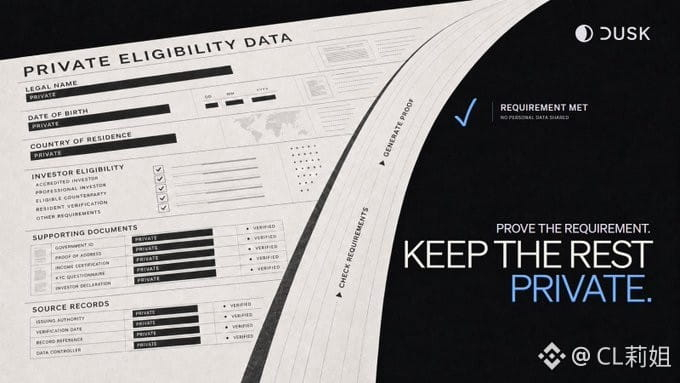
受这次台风“沙德尔”影响,我在机场等延误航班,广播每隔十分钟播一次“抱歉通知”,从“预计延误一小时”改到“两小时”,最后直接变成“请您耐心等待”。旁边大哥气得给客服打电话:“到底飞不飞?”客服说:“天气原因,我们也在等最新指令。”我坐在那儿忽然觉得——这种“永远在等最终结果”的状态,不就是很多区块链的最终性困境吗?
绝大多数PoS链的交易确认,说白了也是“等等看”——等更多区块接上来,等分叉概率降到足够低,才敢说这笔钱真的到账了。问题是你不知道要等多久。
Dusk白皮书里描述的Rolling Finality(滚动最终性),把这件事拆成了四档状态:Accepted(已接受)、Attested(已见证)、Confirmed(已确认)、Final(最终)。Accepted只是有成功证明,但还可能被低轮次区块替换掉;Attested意味着前面所有迭代都失败了,这区块已经不可被同轮次替换;Confirmed是后面接的区块足够多,除非祖先被回滚,否则基本稳了;Final才是彻底锁死,任何情况都不可逆。
数据支撑这个设计的必要性:理论上一个区块最多可以跑50次迭代,如果连续16次失败,协议自动进入紧急模式——所有超时关闭,迭代无限持续直到产出区块。50次是最终配置上限,但紧急模式下开放路径会继续运行。
说句实话,以前看别的项目讲“最终性”,总觉得像机场广播一样——说了等于没说。 Dusk这套四档状态让我第一次觉得,最终性是可以被量化和预期的。Accepted到Final的每一档,都有明确的数学条件,不是“等等看”三个字糊弄过去。
今天这趟航班最后延误了四小时才飞。如果区块链的最终性也像机场那样靠“等”,谁敢拿它做金融结算?Dusk把“不可逆”拆成了四个台阶,每个台阶都有明确规则——这种确定性,才是金融级该有的样子。#dusk $DUSK @Dusk
绝大多数PoS链的交易确认,说白了也是“等等看”——等更多区块接上来,等分叉概率降到足够低,才敢说这笔钱真的到账了。问题是你不知道要等多久。
Dusk白皮书里描述的Rolling Finality(滚动最终性),把这件事拆成了四档状态:Accepted(已接受)、Attested(已见证)、Confirmed(已确认)、Final(最终)。Accepted只是有成功证明,但还可能被低轮次区块替换掉;Attested意味着前面所有迭代都失败了,这区块已经不可被同轮次替换;Confirmed是后面接的区块足够多,除非祖先被回滚,否则基本稳了;Final才是彻底锁死,任何情况都不可逆。
数据支撑这个设计的必要性:理论上一个区块最多可以跑50次迭代,如果连续16次失败,协议自动进入紧急模式——所有超时关闭,迭代无限持续直到产出区块。50次是最终配置上限,但紧急模式下开放路径会继续运行。
说句实话,以前看别的项目讲“最终性”,总觉得像机场广播一样——说了等于没说。 Dusk这套四档状态让我第一次觉得,最终性是可以被量化和预期的。Accepted到Final的每一档,都有明确的数学条件,不是“等等看”三个字糊弄过去。
今天这趟航班最后延误了四小时才飞。如果区块链的最终性也像机场那样靠“等”,谁敢拿它做金融结算?Dusk把“不可逆”拆成了四个台阶,每个台阶都有明确规则——这种确定性,才是金融级该有的样子。#dusk $DUSK @Dusk
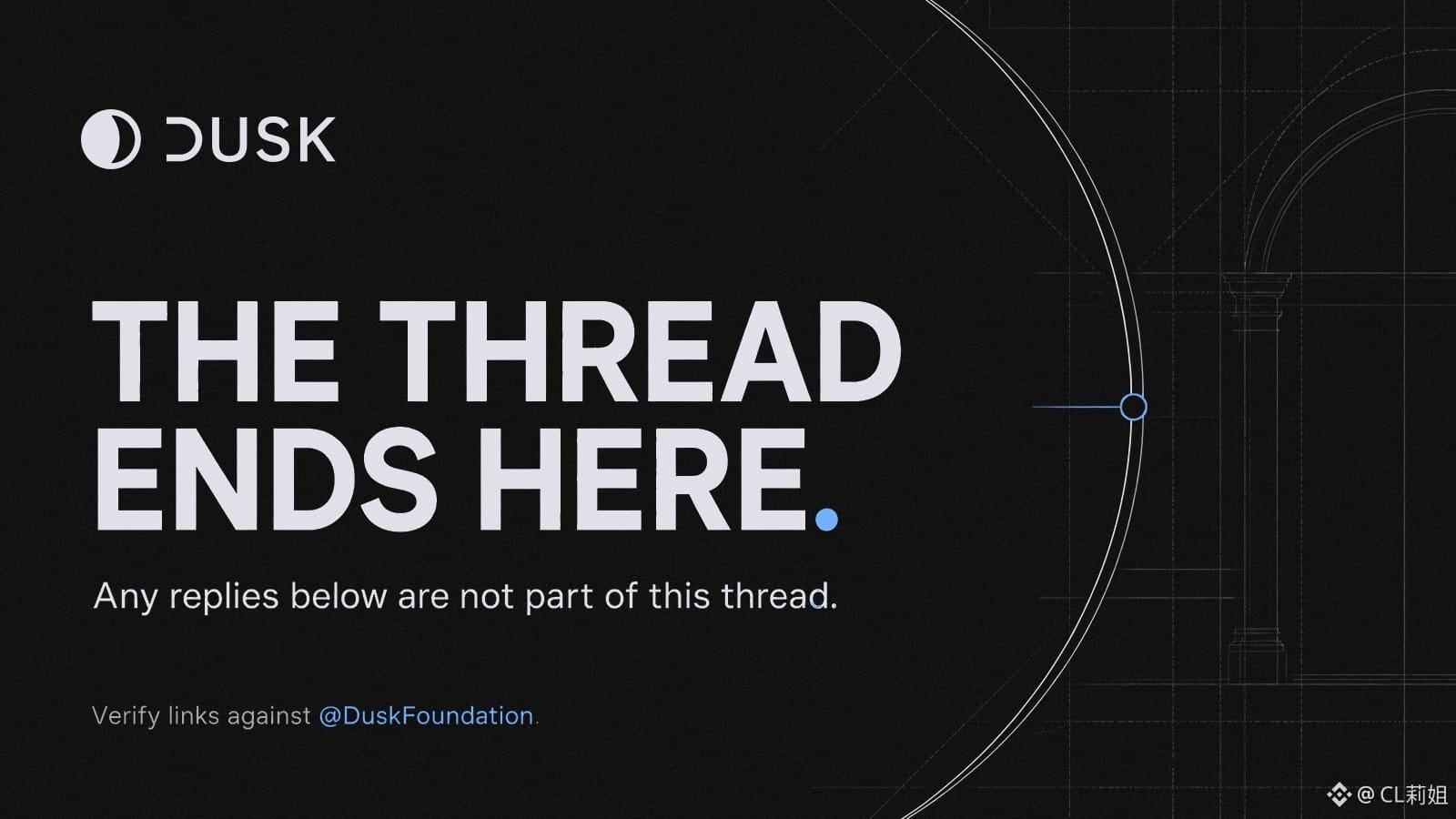
Under the RWA tokenization wave, the awkwardness for most public chains lies in this: privacy and compliance are like the two ends of a seesaw. Ethereum is transparent yet “runs naked,” while Zcash is anonymous but hard to audit. Dusk’s whitepaper offers another answer—not by bolting compliance onto an existing chain, but by natively stitching privacy and regulation together at the protocol layer.
Its core weapon is a parallel dual-transaction model: Moonlight uses a transparent account system where balances and transfers are publicly verifiable, meeting basic needs for reconciliation and auditing; Phoenix is built on UTXO, relying on zero-knowledge proofs to validate transaction legitimacy, with amounts and counterparty details hidden by default. More importantly, it introduces a controlled viewing mechanism—users can delegate viewing rights to a trusted third party (such as a regulator). This is not a post-hoc compromise, but a clearly designed “selective disclosure” path in the whitepaper, ensuring privacy doesn’t become a compliance black box.
At the compliant-assets layer, the Zedger contracts are custom-built for securities-style assets, supporting enterprise behaviors such as forced transfers and dividends, and using zero-knowledge proofs to establish ownership—balancing confidentiality with auditability and traceable responsibility. Meanwhile, the consensus layer employs SA (Succinct Attestation), delivering second-level transaction finality—an exact response to the financial-sector need that “settlement is final.”
Dusk didn’t invent a new narrative; it simply welded together the two things institutional finance cares most about—confidentiality and auditability—from the very first line of code. When others are still using zero-knowledge proofs as a “fig leaf,” Dusk makes compliance the underlying genetic makeup. This is not just another privacy chain; it’s the foundation built for finance on the compliance chain. #dusk $DUSK @Dusk
Its core weapon is a parallel dual-transaction model: Moonlight uses a transparent account system where balances and transfers are publicly verifiable, meeting basic needs for reconciliation and auditing; Phoenix is built on UTXO, relying on zero-knowledge proofs to validate transaction legitimacy, with amounts and counterparty details hidden by default. More importantly, it introduces a controlled viewing mechanism—users can delegate viewing rights to a trusted third party (such as a regulator). This is not a post-hoc compromise, but a clearly designed “selective disclosure” path in the whitepaper, ensuring privacy doesn’t become a compliance black box.
At the compliant-assets layer, the Zedger contracts are custom-built for securities-style assets, supporting enterprise behaviors such as forced transfers and dividends, and using zero-knowledge proofs to establish ownership—balancing confidentiality with auditability and traceable responsibility. Meanwhile, the consensus layer employs SA (Succinct Attestation), delivering second-level transaction finality—an exact response to the financial-sector need that “settlement is final.”
Dusk didn’t invent a new narrative; it simply welded together the two things institutional finance cares most about—confidentiality and auditability—from the very first line of code. When others are still using zero-knowledge proofs as a “fig leaf,” Dusk makes compliance the underlying genetic makeup. This is not just another privacy chain; it’s the foundation built for finance on the compliance chain. #dusk $DUSK @Dusk
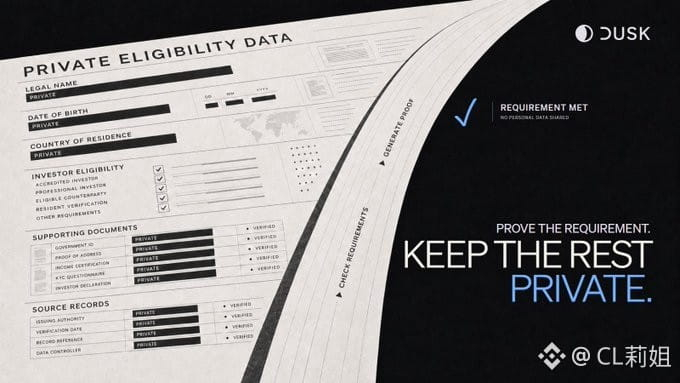
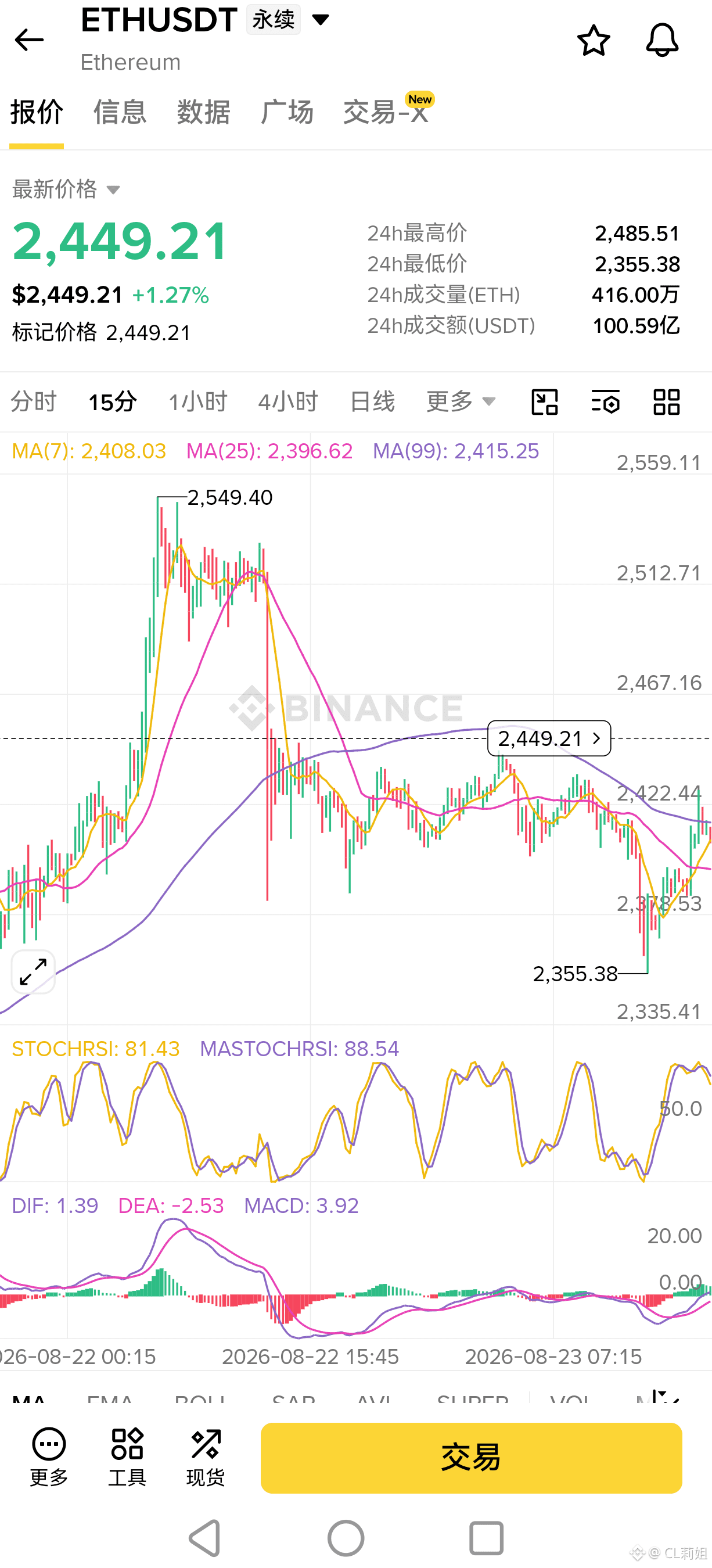
In the past 24 hours, the entire cryptocurrency market saw a total of $405 million in liquidations across all crypto perpetual contracts, including $246 million from long liquidations and $159 million from short liquidations. The total liquidation amount for BTC was approximately $94.6720 million, while for ETH it was approximately $132 million. In the past 24 hours, there were 86,989 people worldwide who were liquidated. The largest single liquidation order occurred on Binance — ETHUSDT, valued at $11.7289 million. This biggest liquidation was what died on this cascade, wasn’t it?🥹#ETH走势分析 $ETH
Thank you for the福利送 from @币安Binance华语 , stay tuned for @币安Binance华语 🥳🥳福利 won’t get lost 🎁🎁


币安Binance华语
·
--
🎉 Congratulations to the following 5 users for winning a 30U cash reward:
@刚总 @CL莉姐 @小新抄底日记 @Meizc @mzyyy
🎁 Follow the Binance Chinese-language account and join the weekly activity raffle!
🧧 Winners do not need to send us a private message—we will deposit it into your UID spot account~
@刚总 @CL莉姐 @小新抄底日记 @Meizc @mzyyy
🎁 Follow the Binance Chinese-language account and join the weekly activity raffle!
🧧 Winners do not need to send us a private message—we will deposit it into your UID spot account~
Last week when I went back to my hometown to visit family, I ran into Uncle Wang, a neighbor, installing a “message horn” in the hallway—one call from the first floor and everyone on the third floor can hear it. He was so proud: “So convenient—no need to climb the stairs and knock on doors.” The next day, though, something happened. Downstairs Aunt Li shouted, “I’m stewing spare ribs tonight—come eat at my place!” By the time it reached the fifth floor, it had turned into, “Uncle Wang’s ribs have gone bad—don’t go!” It turned into a big joke. Standing in the hallway, listening to all the different versions of the message, I couldn’t help thinking: isn’t this exactly what everyday public-chain P2P broadcasting looks like?
Most public chains use the Gossip protocol. The logic is exactly the same as Uncle Wang’s horn: when a message arrives, it’s “told to whoever it reaches.” A block gets broadcast to everyone, and then each node forwards it to all its neighbors—amplified step by step. The message volume grows on the order of the square of the number of nodes. Research cited in the whitepaper shows that this kind of broadcasting consumes extremely high bandwidth, and the more nodes there are, the more it bogs down. Worst of all, the message itself may get distorted: network delay, packet loss, and malicious nodes mean that by the time the message reaches its destination, it might already have “lost its meaning.”
I didn’t see Dusk use this approach. At the bottom layer, it uses Kadcast—structured routing based on a Kademlia DHT. Nodes are organized into a tree based on XOR distance, and messages are directed along specific paths rather than using a big-horn broadcast.
Data doesn’t lie: the whitepaper cites research stating that Kadcast reduces bandwidth usage by about 25% to 50% compared with traditional broadcast protocols. In scenarios where blocks are produced faster, the stale-block rate can also drop by another 10% to 30%. Even more extreme, in a simulation where 30% of nodes are cut off, Kadcast still completes route reconfiguration at millisecond-level speed. It’s like suddenly closing one-third of the roads in the hallway—then the message route automatically reroutes, ensuring the message gets delivered on time.
Honestly, I’ve seen too many projects compete by adding all kinds of flashy mechanisms in the consensus layer, yet nobody wants to touch the dirty work in the network layer. No matter how great the consensus is, it’s pointless if the blocks can’t get transmitted. Uncle Wang’s horn gets dismantled and replaced by smart doorbells at each household’s entrance: messages are sent only to the intended recipients—no broadcast, no rerouting chaos. The effort Dusk puts into Kadcast feels like precisely this evolution—from the “big horn” to “targeted delivery.” This direction, I’m on board with. #dusk $DUSK @Dusk
Most public chains use the Gossip protocol. The logic is exactly the same as Uncle Wang’s horn: when a message arrives, it’s “told to whoever it reaches.” A block gets broadcast to everyone, and then each node forwards it to all its neighbors—amplified step by step. The message volume grows on the order of the square of the number of nodes. Research cited in the whitepaper shows that this kind of broadcasting consumes extremely high bandwidth, and the more nodes there are, the more it bogs down. Worst of all, the message itself may get distorted: network delay, packet loss, and malicious nodes mean that by the time the message reaches its destination, it might already have “lost its meaning.”
I didn’t see Dusk use this approach. At the bottom layer, it uses Kadcast—structured routing based on a Kademlia DHT. Nodes are organized into a tree based on XOR distance, and messages are directed along specific paths rather than using a big-horn broadcast.
Data doesn’t lie: the whitepaper cites research stating that Kadcast reduces bandwidth usage by about 25% to 50% compared with traditional broadcast protocols. In scenarios where blocks are produced faster, the stale-block rate can also drop by another 10% to 30%. Even more extreme, in a simulation where 30% of nodes are cut off, Kadcast still completes route reconfiguration at millisecond-level speed. It’s like suddenly closing one-third of the roads in the hallway—then the message route automatically reroutes, ensuring the message gets delivered on time.
Honestly, I’ve seen too many projects compete by adding all kinds of flashy mechanisms in the consensus layer, yet nobody wants to touch the dirty work in the network layer. No matter how great the consensus is, it’s pointless if the blocks can’t get transmitted. Uncle Wang’s horn gets dismantled and replaced by smart doorbells at each household’s entrance: messages are sent only to the intended recipients—no broadcast, no rerouting chaos. The effort Dusk puts into Kadcast feels like precisely this evolution—from the “big horn” to “targeted delivery.” This direction, I’m on board with. #dusk $DUSK @Dusk
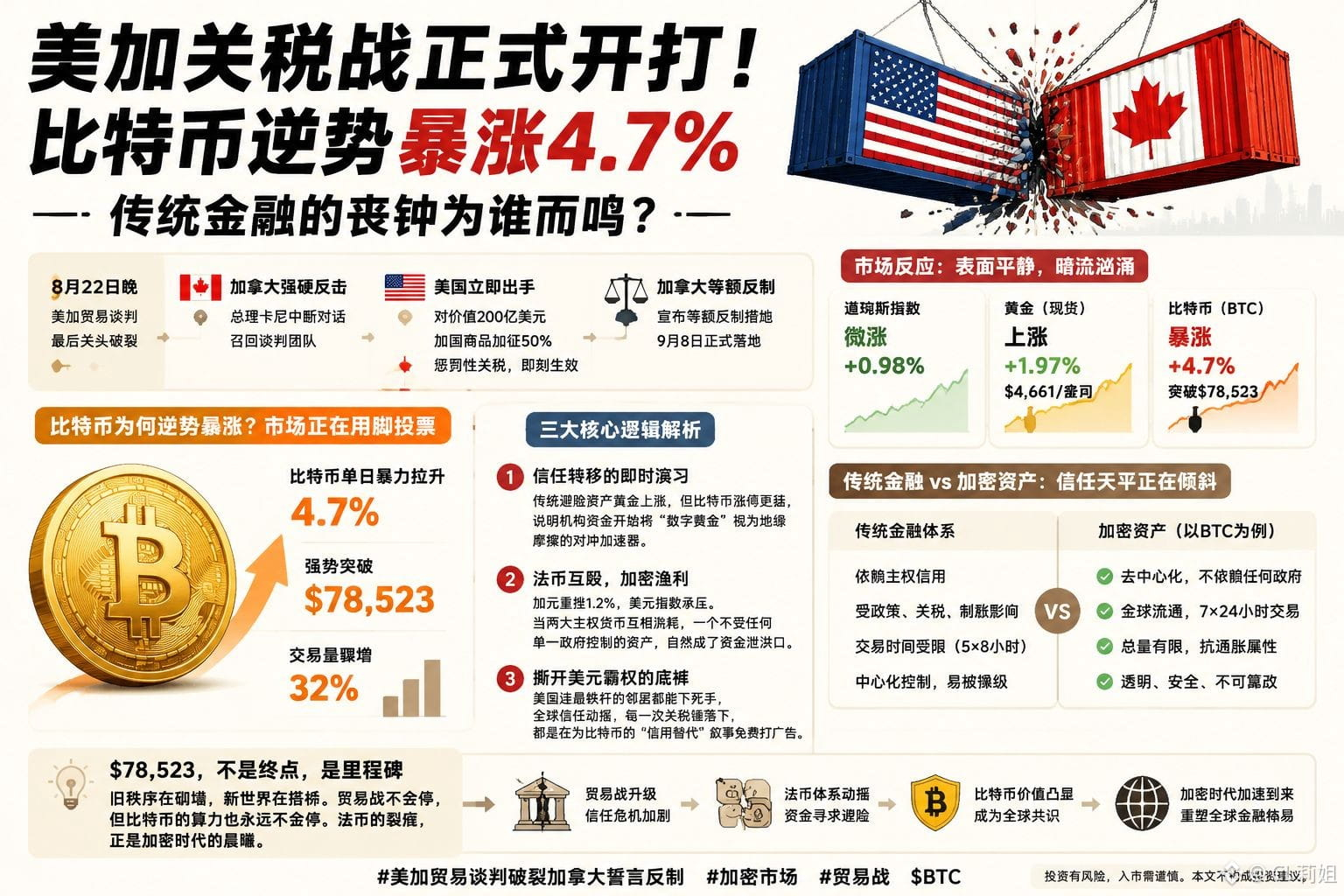
🔥The U.S.-Canada tariff war officially kicks off! Bitcoin surges against the trend, up 4.7%—for whom does the death knell of traditional finance toll?
On the evening of August 22 (Washington time), U.S.-Canada trade talks abruptly collapsed at the very last moment. Canadian Prime Minister Chrystia Freeland directly cut off the dialogue and recalled the negotiating team; the U.S. immediately imposed a 50% punitive tariff on Canadian goods worth $20 billion, effective immediately. Ottawa would not yield an inch, announcing an equal-value retaliatory response to take effect on September 8.
The news hit, and the Dow edged up 0.98%, while gold jumped 1.97% to $4,661—seemingly calm on the surface. But the real disturbance was hidden in the deep waters of the crypto market: Bitcoin violently surged 4.7% in a single day, breaking strongly above $78,523, while trading volume spiked by 32%. The reason for this phenomenon is that the market is voting with its feet, peeling off the old label of BTC as a “high-risk speculation.”
First, this is an immediate drill of “trust transfer.” Traditional safe-haven assets like gold rose, but Bitcoin rose even more sharply—suggesting institutional funds are beginning to see digital gold as an “accelerator” for hedging amid geopolitical frictions. A report from BlackRock last month already issued a warning: when the G7 tears into itself, Bitcoin’s “non-sovereign” status may shift from theory to urgent necessity. Today’s data is simply the first fulfillment of that forecast.
Second, when fiat currencies batter each other, crypto reaps the benefits. The Canadian dollar fell sharply by 1.2% during the day, and the U.S. dollar index faced simultaneous pressure. When two major sovereign currencies consume each other, an asset that isn’t controlled by any single government—circulating globally 24/7—naturally becomes a pressure-release valve for liquidity. This is not mysticism; it’s liquidity physics.
More dangerously, this tariff war has torn open the underbelly of U.S. dollar hegemony. If the U.S. can even strike the most steadfast neighbor this hard, who would dare stake everything on U.S. Treasuries or greenback bills? Each time the tariff hammer falls, it’s free advertising for the narrative of Bitcoin as a “credit substitute.”
$78,523 is not an endpoint—it’s a milestone. The old order is building walls, and the new world is building bridges. The trade war won’t stop, but Bitcoin’s computing power will never stop either. And when people in the future look back on this day, they’ll realize: the fractures in fiat currency are precisely the dawn of the crypto era.
#美加贸易谈判破裂加拿大誓言反制 #加密市场 #贸易战 $BTC
On the evening of August 22 (Washington time), U.S.-Canada trade talks abruptly collapsed at the very last moment. Canadian Prime Minister Chrystia Freeland directly cut off the dialogue and recalled the negotiating team; the U.S. immediately imposed a 50% punitive tariff on Canadian goods worth $20 billion, effective immediately. Ottawa would not yield an inch, announcing an equal-value retaliatory response to take effect on September 8.
The news hit, and the Dow edged up 0.98%, while gold jumped 1.97% to $4,661—seemingly calm on the surface. But the real disturbance was hidden in the deep waters of the crypto market: Bitcoin violently surged 4.7% in a single day, breaking strongly above $78,523, while trading volume spiked by 32%. The reason for this phenomenon is that the market is voting with its feet, peeling off the old label of BTC as a “high-risk speculation.”
First, this is an immediate drill of “trust transfer.” Traditional safe-haven assets like gold rose, but Bitcoin rose even more sharply—suggesting institutional funds are beginning to see digital gold as an “accelerator” for hedging amid geopolitical frictions. A report from BlackRock last month already issued a warning: when the G7 tears into itself, Bitcoin’s “non-sovereign” status may shift from theory to urgent necessity. Today’s data is simply the first fulfillment of that forecast.
Second, when fiat currencies batter each other, crypto reaps the benefits. The Canadian dollar fell sharply by 1.2% during the day, and the U.S. dollar index faced simultaneous pressure. When two major sovereign currencies consume each other, an asset that isn’t controlled by any single government—circulating globally 24/7—naturally becomes a pressure-release valve for liquidity. This is not mysticism; it’s liquidity physics.
More dangerously, this tariff war has torn open the underbelly of U.S. dollar hegemony. If the U.S. can even strike the most steadfast neighbor this hard, who would dare stake everything on U.S. Treasuries or greenback bills? Each time the tariff hammer falls, it’s free advertising for the narrative of Bitcoin as a “credit substitute.”
$78,523 is not an endpoint—it’s a milestone. The old order is building walls, and the new world is building bridges. The trade war won’t stop, but Bitcoin’s computing power will never stop either. And when people in the future look back on this day, they’ll realize: the fractures in fiat currency are precisely the dawn of the crypto era.
#美加贸易谈判破裂加拿大誓言反制 #加密市场 #贸易战 $BTC
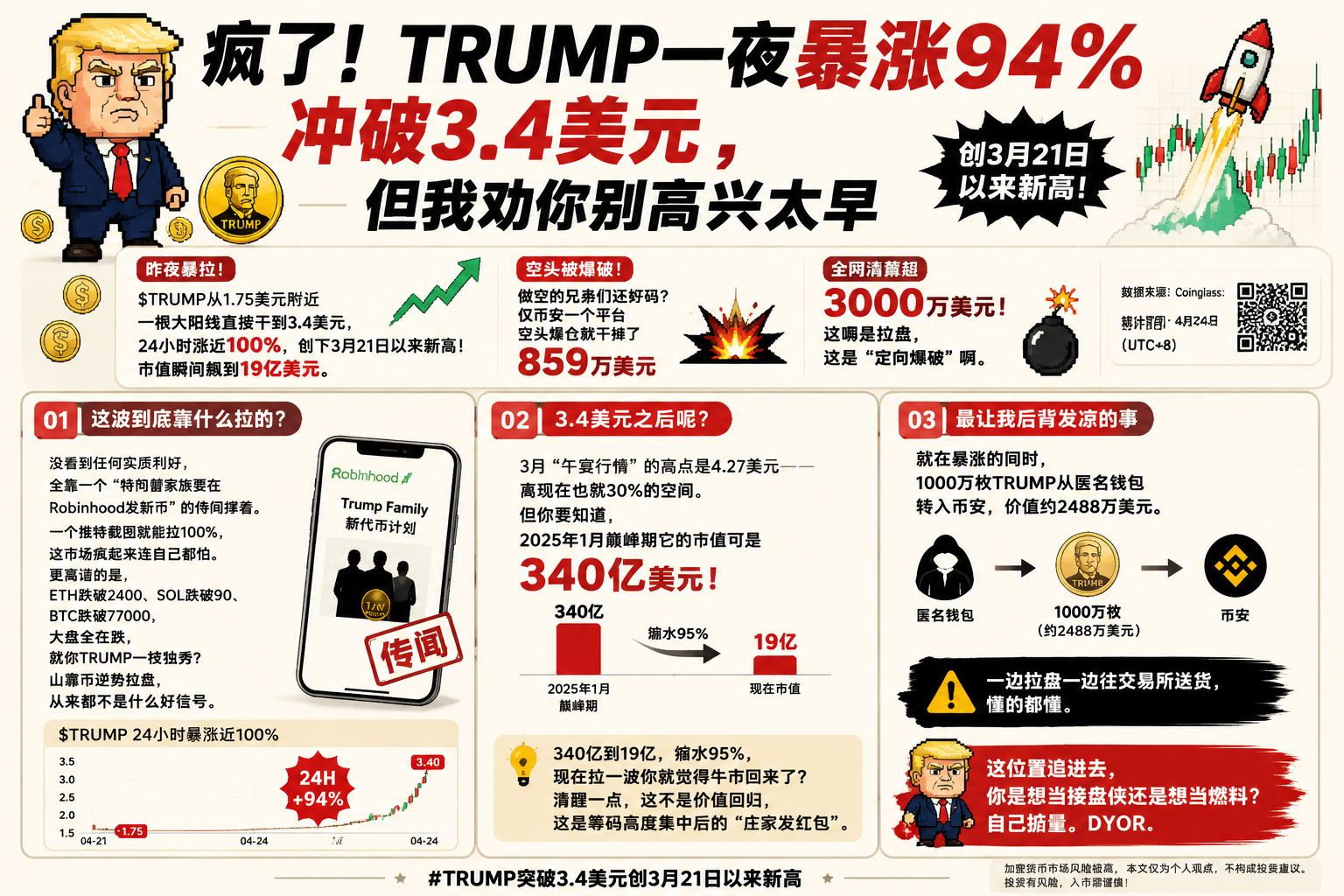
💥It’s gone crazy! TRUMP surges 94% overnight and breaks through $3.4—but I’d advise you not to get too excited yet
Just yesterday, $TRUMP shot from around $1.75 straight up to $3.4 with a big bullish candle. In 24 hours it rose nearly 100%, hitting a new high since March 21. Market cap instantly jumped to $1.9 billion. How are the shorting brothers doing? On just Binance alone, liquidations from shorts wiped out $8.59 million—over $30 million in total liquidations across the whole network! This isn’t a pump—this is “targeted demolition.”
But don’t FOMO just yet. I have a few questions I want to ask—
First, what exactly is driving this rally?
I don’t see any solid positive news. It’s all propped up by a rumor that the Trump family will issue a new coin on Robinhood. A single Twitter screenshot can pump it by 100%—when this market gets this crazy, it even scares itself. Even more absurd: while ETH breaks below $2400, SOL falls below $90, and BTC slips below $77,000, the whole market is down—yet you TRUMP stands out alone? Pumping alts against the trend has never been a good signal.
Second, what happens after $3.4?
The high of the March “lunch meeting” run was $4.27—that’s only about 30% upside from here. But you need to remember: at the peak in January 2025, its market cap was $34 billion. From $34B to $1.9B—a 95% shrink. Now you pump it and think the bull market is back? Wake up—this isn’t a return to value. It’s “the operator handing out bonuses” after extremely concentrated float.
Third—and this is the part that makes my back go cold—
Right alongside the surge, 10 million TRUMP tokens were transferred from an anonymous wallet into Binance, worth about $24.88 million. Pumping while also shipping inventory to the exchange—if you understand, you understand. #
#TRUMP突破3.4美元创3月21日以来新高
Just yesterday, $TRUMP shot from around $1.75 straight up to $3.4 with a big bullish candle. In 24 hours it rose nearly 100%, hitting a new high since March 21. Market cap instantly jumped to $1.9 billion. How are the shorting brothers doing? On just Binance alone, liquidations from shorts wiped out $8.59 million—over $30 million in total liquidations across the whole network! This isn’t a pump—this is “targeted demolition.”
But don’t FOMO just yet. I have a few questions I want to ask—
First, what exactly is driving this rally?
I don’t see any solid positive news. It’s all propped up by a rumor that the Trump family will issue a new coin on Robinhood. A single Twitter screenshot can pump it by 100%—when this market gets this crazy, it even scares itself. Even more absurd: while ETH breaks below $2400, SOL falls below $90, and BTC slips below $77,000, the whole market is down—yet you TRUMP stands out alone? Pumping alts against the trend has never been a good signal.
Second, what happens after $3.4?
The high of the March “lunch meeting” run was $4.27—that’s only about 30% upside from here. But you need to remember: at the peak in January 2025, its market cap was $34 billion. From $34B to $1.9B—a 95% shrink. Now you pump it and think the bull market is back? Wake up—this isn’t a return to value. It’s “the operator handing out bonuses” after extremely concentrated float.
Third—and this is the part that makes my back go cold—
Right alongside the surge, 10 million TRUMP tokens were transferred from an anonymous wallet into Binance, worth about $24.88 million. Pumping while also shipping inventory to the exchange—if you understand, you understand. #
#TRUMP突破3.4美元创3月21日以来新高
Verified
I went to the bank in July to apply for a mortgage. The reviewer stared at the delinquency records on my credit report from three years ago. His tone was as flat as if he were reading a menu: “Delinquent for three consecutive months—interest rate up 0.5%.” I explained that I had forgotten that time because I was away on business. He didn’t even look up: “The system only looks at the outcome.”
Sitting there at the counter, I suddenly thought—this credit scoring approach that the bank uses, which only considers results and doesn’t ask for reasons, isn’t it basically a clone of the logic behind blockchain slashing and confiscation?
For many PoS chains, slashing is just a single “burn” word: bad actors burn money. If big players lose a bit, it doesn’t hurt much; but a small user’s one mistake could get them kicked out immediately. The slashing mechanism in the Dusk whitepaper made me feel it breaks the whole thing down more carefully. Soft penalties target non-malicious behavior like going offline—not directly burning money, but moving active staked funds into a locked state, pausing consensus eligibility while the money still remains in your name. There’s a first warning, and each offense moves 10% away. Hard penalties are what truly cut—invalid blocks or repeated signatures can burn up to 60% of the stake.
To be honest, I used to think slashing was just about fining you until it’s done. But Dusk’s design made me realize: soft penalties deal with “capability issues”—if you go offline, you can come back. Hard penalties deal with “character issues”—if you commit wrongdoing, you’re out immediately. That’s far more humane than the bank’s “only look at the outcome” system. It gives you a chance to correct yourself.
What also struck me as particularly smart is the 10% floating reward: the more votes included by the block producer, the more they get; any voting rewards that aren’t distributed are destroyed on the spot. It blends rewards and penalties together. If you’re not actively collecting votes, not only do you not get the full amount—you lose that part of the money immediately.
For the bank’s 0.5% interest rate increase, I’ve been carrying it for three years. Now when I look back, if the rules were layered the way Dusk does—minor mistakes reduce your standing first and let you recover, while serious wrongdoing is what triggers the real punishment—there would be far fewer unjust “get knocked out” cases in the financial system. Slashing isn’t the goal. Making the rules clear and predictable is. I agree with this way of thinking.
#dusk $DUSK @Dusk
Sitting there at the counter, I suddenly thought—this credit scoring approach that the bank uses, which only considers results and doesn’t ask for reasons, isn’t it basically a clone of the logic behind blockchain slashing and confiscation?
For many PoS chains, slashing is just a single “burn” word: bad actors burn money. If big players lose a bit, it doesn’t hurt much; but a small user’s one mistake could get them kicked out immediately. The slashing mechanism in the Dusk whitepaper made me feel it breaks the whole thing down more carefully. Soft penalties target non-malicious behavior like going offline—not directly burning money, but moving active staked funds into a locked state, pausing consensus eligibility while the money still remains in your name. There’s a first warning, and each offense moves 10% away. Hard penalties are what truly cut—invalid blocks or repeated signatures can burn up to 60% of the stake.
To be honest, I used to think slashing was just about fining you until it’s done. But Dusk’s design made me realize: soft penalties deal with “capability issues”—if you go offline, you can come back. Hard penalties deal with “character issues”—if you commit wrongdoing, you’re out immediately. That’s far more humane than the bank’s “only look at the outcome” system. It gives you a chance to correct yourself.
What also struck me as particularly smart is the 10% floating reward: the more votes included by the block producer, the more they get; any voting rewards that aren’t distributed are destroyed on the spot. It blends rewards and penalties together. If you’re not actively collecting votes, not only do you not get the full amount—you lose that part of the money immediately.
For the bank’s 0.5% interest rate increase, I’ve been carrying it for three years. Now when I look back, if the rules were layered the way Dusk does—minor mistakes reduce your standing first and let you recover, while serious wrongdoing is what triggers the real punishment—there would be far fewer unjust “get knocked out” cases in the financial system. Slashing isn’t the goal. Making the rules clear and predictable is. I agree with this way of thinking.
#dusk $DUSK @Dusk
Recently I found a new job, and when moving, I called a Huolala freight truck. When the driver arrived, he held the slip and walked building to building, looking for the house numbers. He circled three times and still couldn’t find it. I went downstairs to meet him. Watching his phone on the map, I saw that blue dot keep spinning in that alley. He said, “The building numbering in your compound is like a maze. If they just made an announcement over the loudspeakers, it’d be better than using navigation.”
While I waited at the roadside for him to reverse, it suddenly occurred to me—that’s how blockchain’s network layer seems to be, too.
Most public-chain P2P broadcasting uses the Gossip protocol: once a message comes in, it’s basically “tell whoever you can catch,” just like the property management using a megaphone to shout, “Whose car is blocking the way?” It’s simple and brutal, but the sense of efficiency is impressive. Each message has to pass through a bunch of intermediate nodes to reach the entire network. The more nodes there are, the more it bogs down. Ethereum has tolerated this for years, and I think it’s simply because everyone has gotten used to it.
In the Dusk whitepaper, there was something I had to read twice—Kadcast. It doesn’t use that megaphone approach. Instead, it uses Kademlia’s algorithm for structured routing: messages are only sent in specific directions, and the broadcast complexity drops from O(n) to O(log n). The official data claims it can save 25% to 50% bandwidth compared to Gossip. Even more brutal, in a simulation where 30% of nodes are cut off, Kadcast can still complete route reconfiguration at millisecond-level speed. It’s like the compound suddenly blocks off a third of the roads—yet the delivery guy still reroutes instantly and delivers on time.
Honestly, I’ve seen too many projects obsess and compete at the consensus layer, yet nobody wants to touch the messy, exhausting work of the network layer. Even if consensus is amazing, if messages can’t get through, it’s all for nothing. Dusk is willing to put effort into “invisible places” like Kadcast—far more practical than those that just brag about TPS. On moving day, the driver finally said, “When navigation isn’t accurate, you’ve got to find the route yourself.” Blockchain is the same: if the underlying architecture isn’t rebuilt, then no matter how many tricks you stack on top, it’s just castles in the air.
#dusk $DUSK @Dusk
While I waited at the roadside for him to reverse, it suddenly occurred to me—that’s how blockchain’s network layer seems to be, too.
Most public-chain P2P broadcasting uses the Gossip protocol: once a message comes in, it’s basically “tell whoever you can catch,” just like the property management using a megaphone to shout, “Whose car is blocking the way?” It’s simple and brutal, but the sense of efficiency is impressive. Each message has to pass through a bunch of intermediate nodes to reach the entire network. The more nodes there are, the more it bogs down. Ethereum has tolerated this for years, and I think it’s simply because everyone has gotten used to it.
In the Dusk whitepaper, there was something I had to read twice—Kadcast. It doesn’t use that megaphone approach. Instead, it uses Kademlia’s algorithm for structured routing: messages are only sent in specific directions, and the broadcast complexity drops from O(n) to O(log n). The official data claims it can save 25% to 50% bandwidth compared to Gossip. Even more brutal, in a simulation where 30% of nodes are cut off, Kadcast can still complete route reconfiguration at millisecond-level speed. It’s like the compound suddenly blocks off a third of the roads—yet the delivery guy still reroutes instantly and delivers on time.
Honestly, I’ve seen too many projects obsess and compete at the consensus layer, yet nobody wants to touch the messy, exhausting work of the network layer. Even if consensus is amazing, if messages can’t get through, it’s all for nothing. Dusk is willing to put effort into “invisible places” like Kadcast—far more practical than those that just brag about TPS. On moving day, the driver finally said, “When navigation isn’t accurate, you’ve got to find the route yourself.” Blockchain is the same: if the underlying architecture isn’t rebuilt, then no matter how many tricks you stack on top, it’s just castles in the air.
#dusk $DUSK @Dusk
📈 The big pie breaks above 78,000—“Have the bulls really arrived?” My fingers hover over the keyboard, and my mind keeps looping one thought: is this the call of a new cycle, or a carefully planned hunt for the shorts? People who missed out are slapping their thighs, holders are纠結 whether to sell, and the shorts are already so blown out they can’t even speak—this market, it seems, leaves everyone uncomfortable.
Three days ago it was 64,100. In 72 hours it surged 18.2%, directly punching through 78,000. Total liquidations across the market hit 841 million, with short positions accounting for 671 million. Nearly 200,000 people were forced out. But what really sends a chill down my spine isn’t the liquidation figure—it’s another set of data: long-term holders are holding 83% of the circulating supply, the highest proportion since the end of 2023. There are fewer and fewer coins on the market that can be used to dump. So what are the shorts supposed to dump with? Put another way, the more concentrated the chips are, the easier it is to push the rally—dumping becomes more hidden too. Can you guarantee these “long-term holders” won’t collectively take profits and dump at some particular price?
The scale of U.S. Treasury buybacks rose from 2 billion to 4 billion. ETF net inflows over three days exceeded 1 billion. BlackRock alone gobbled up 285 million. In the second quarter, institutions added 7.5% against the trend when the big pie was down 14%. By the time retail traders react, low-price chips have already been picked clean. The Greed Index jumped from 46 to 72 in three days, and the RSI also entered the overbought zone—this heat is real. But the cost of chasing is something even old hands know.
77,500 to 79,000 is the chip-dense zone, and 80,000 is the psychological line in the sand. Standard Chartered is calling for 100,000 by year-end, but I can’t ignore the sweat in my own palm. The logic behind this rally is more complex than in the first half of the year—U.S. Treasuries, ETFs, on-chain data, and macro expectations all get mixed together. The louder the “the bulls are here” chorus gets, the more I remind myself: the market isn’t short of opportunities—it’s short of clarity.
So is this an institutional bull run, or a liquidity trap? Let’s talk in the comments. I’ll make my coffee and wait to see your answers.#比特币日内触及75500美元 $BTC #加密货币 #加密市场
Three days ago it was 64,100. In 72 hours it surged 18.2%, directly punching through 78,000. Total liquidations across the market hit 841 million, with short positions accounting for 671 million. Nearly 200,000 people were forced out. But what really sends a chill down my spine isn’t the liquidation figure—it’s another set of data: long-term holders are holding 83% of the circulating supply, the highest proportion since the end of 2023. There are fewer and fewer coins on the market that can be used to dump. So what are the shorts supposed to dump with? Put another way, the more concentrated the chips are, the easier it is to push the rally—dumping becomes more hidden too. Can you guarantee these “long-term holders” won’t collectively take profits and dump at some particular price?
The scale of U.S. Treasury buybacks rose from 2 billion to 4 billion. ETF net inflows over three days exceeded 1 billion. BlackRock alone gobbled up 285 million. In the second quarter, institutions added 7.5% against the trend when the big pie was down 14%. By the time retail traders react, low-price chips have already been picked clean. The Greed Index jumped from 46 to 72 in three days, and the RSI also entered the overbought zone—this heat is real. But the cost of chasing is something even old hands know.
77,500 to 79,000 is the chip-dense zone, and 80,000 is the psychological line in the sand. Standard Chartered is calling for 100,000 by year-end, but I can’t ignore the sweat in my own palm. The logic behind this rally is more complex than in the first half of the year—U.S. Treasuries, ETFs, on-chain data, and macro expectations all get mixed together. The louder the “the bulls are here” chorus gets, the more I remind myself: the market isn’t short of opportunities—it’s short of clarity.
So is this an institutional bull run, or a liquidity trap? Let’s talk in the comments. I’ll make my coffee and wait to see your answers.#比特币日内触及75500美元 $BTC #加密货币 #加密市场

Verified
Last month I had my home renovated. The electrician reported a one-price quote, and I said “okay.” He worked for three days, then told me that material prices had risen and that I needed to add money. I got furious on the spot!
The contractor looked innocent: “If market prices went up, what can I do?” In the end, after arguing for half a day, we settled by adding 2,000 yuan. It wasn’t a lot of money, but that feeling of “the deal wasn’t honored,” more unbearable than having to spend extra.
Later I thought: isn’t the “floating interest rate” in DeFi exactly like the renovation contractor’s “materials price increase”? Today you borrow a sum of money at an interest rate of 4% and think it’s worth it. The next day the market moves, and the interest rate jumps straight to 9%. You didn’t do anything wrong, yet your costs get out of control. What’s even more absurd is that in real life nobody would accept mid-renovation price hikes, but on-chain we somehow default to treating it as “normal.”
TermMax’s whitepaper made one thing clear to me: it isn’t just building a lending protocol—it’s adding a “fixed-price contract” to the funds. Its core mechanism is a three-token model: FT is a zero-coupon bond. You buy it at a discount price, redeem it at face value at maturity, and the yield is locked in the moment you enter. XT is a yield certificate—1 FT plus 1 XT equals 1 complete debt position. GT is an NFT that packages your collateral and leveraged position. If you want to exit early, you can sell the GT. One loan broken into three tradable blocks—want stable returns? Hold FT. Want to play the interest-rate spread? Trade XT. Want to run whenever you want? Sell GT—each gets what they need.
But there’s one part of this system that makes me feel a bit uneasy: it increases both professionalism and the barrier to entry. Users have to spend time figuring out what FT, XT, and GT are. Also, FT pricing depends on AMM liquidity. If a certain maturity has insufficient market depth, the “fixed interest rate” you lock in may not be exactly what you expected. However, the V2 Curator mechanism is a亮点—professional institutions like Keyrock and AlphaPing manage liquidity and set the pricing curve. Idle funds are automatically deployed into Aave and Morpho to earn floating returns. The idea of “keeping waiting-period funds from sitting idle” really does address the pain point.
In the renovation case, I ultimately accepted the added charge because the construction schedule couldn’t be delayed. But in DeFi, I don’t need to accept the default option of “interest rates changing anytime.” TermMax offers another possibility: before you enter, fix the price. For me, that’s more valuable than any high APY.#termmax @TermMax
The contractor looked innocent: “If market prices went up, what can I do?” In the end, after arguing for half a day, we settled by adding 2,000 yuan. It wasn’t a lot of money, but that feeling of “the deal wasn’t honored,” more unbearable than having to spend extra.
Later I thought: isn’t the “floating interest rate” in DeFi exactly like the renovation contractor’s “materials price increase”? Today you borrow a sum of money at an interest rate of 4% and think it’s worth it. The next day the market moves, and the interest rate jumps straight to 9%. You didn’t do anything wrong, yet your costs get out of control. What’s even more absurd is that in real life nobody would accept mid-renovation price hikes, but on-chain we somehow default to treating it as “normal.”
TermMax’s whitepaper made one thing clear to me: it isn’t just building a lending protocol—it’s adding a “fixed-price contract” to the funds. Its core mechanism is a three-token model: FT is a zero-coupon bond. You buy it at a discount price, redeem it at face value at maturity, and the yield is locked in the moment you enter. XT is a yield certificate—1 FT plus 1 XT equals 1 complete debt position. GT is an NFT that packages your collateral and leveraged position. If you want to exit early, you can sell the GT. One loan broken into three tradable blocks—want stable returns? Hold FT. Want to play the interest-rate spread? Trade XT. Want to run whenever you want? Sell GT—each gets what they need.
But there’s one part of this system that makes me feel a bit uneasy: it increases both professionalism and the barrier to entry. Users have to spend time figuring out what FT, XT, and GT are. Also, FT pricing depends on AMM liquidity. If a certain maturity has insufficient market depth, the “fixed interest rate” you lock in may not be exactly what you expected. However, the V2 Curator mechanism is a亮点—professional institutions like Keyrock and AlphaPing manage liquidity and set the pricing curve. Idle funds are automatically deployed into Aave and Morpho to earn floating returns. The idea of “keeping waiting-period funds from sitting idle” really does address the pain point.
In the renovation case, I ultimately accepted the added charge because the construction schedule couldn’t be delayed. But in DeFi, I don’t need to accept the default option of “interest rates changing anytime.” TermMax offers another possibility: before you enter, fix the price. For me, that’s more valuable than any high APY.#termmax @TermMax
Back when SHE was popular, my favorite member was Selina—I think she’s the best-looking. The tomboy Ella back then is actually the best-looking now 🥹 Does working make you look younger?


Verified
Last month’s department team-building, and the finance senior brother had too much to drink and started complaining: “Do you know what? My mortgage interest rate finally dropped to 3.8%. The day I signed the contract, it felt like a whole mountain had been lifted off my shoulders.” Next to him, the intern Xiao Liu chimed in: “If borrowing in the crypto market could also lock the interest rate, that would be great. Every time I borrow, the rate changes the next day—like opening a blind box.” Everyone at the table laughed, but I couldn’t—what he said was just too real.
Later, after I finished reading TermMax’s whitepaper, the first thought that popped into my head was: they aren’t building a lending agreement—they’re dismantling a house. Traditional lending is like a whole unfinished house: when you borrow a lump sum, the interest rate, the term, whether you can repay early—all of it is bundled together, and you can only passively accept what you get. What TermMax does is split this house into three blocks. FT is a zero-coupon bond—you buy it at a discount, redeem at par at maturity, and the yield is effectively locked in as soon as you enter; XT is a yield note, and together with FT it always equals 1 unit of value; GT is an NFT that packages your collateral and your debt. A single loan is broken into three components that can be traded separately—sell GT if you want to run early, take FT if you want stable returns, and play with XT if you want to profit from interest-rate spreads—everyone gets what they need.
But there’s one part of the design that makes me a bit uncomfortable: it shifts complexity from the protocol side to the user side. With FT, XT, and GT, for ordinary users, even figuring out what each one does can take half a day. Also, FT pricing depends on AMM liquidity—if the market depth for a certain maturity isn’t sufficient, your “fixed interest rate” might not turn out the way you expected. The physical delivery and settlement mechanism does solve the settlement issue for low-liquidity assets, but lenders might end up receiving a bunch of collateral they don’t actually want to hold—it's just a different form of the same anxiety that comes with floating rates.
TVL exceeding 100 million, and daily active users second only to Aave—the numbers really are impressive. Recently they even included Ondo’s tokenized stocks as collateral, clearly pointing toward RWA and institutional directions. But to be honest, I’ve always been cautious about projects that “bring traditional finance logic on-chain”—the direction is right, but that doesn’t mean the execution is flawless.
After that dinner party ended, I planned to move part of my stablecoin position into TermMax. Xiao Liu asked why. I said: “You can’t trade out real returns with a homophone pun, but a fixed interest rate can.” #termmax @TermMax
Later, after I finished reading TermMax’s whitepaper, the first thought that popped into my head was: they aren’t building a lending agreement—they’re dismantling a house. Traditional lending is like a whole unfinished house: when you borrow a lump sum, the interest rate, the term, whether you can repay early—all of it is bundled together, and you can only passively accept what you get. What TermMax does is split this house into three blocks. FT is a zero-coupon bond—you buy it at a discount, redeem at par at maturity, and the yield is effectively locked in as soon as you enter; XT is a yield note, and together with FT it always equals 1 unit of value; GT is an NFT that packages your collateral and your debt. A single loan is broken into three components that can be traded separately—sell GT if you want to run early, take FT if you want stable returns, and play with XT if you want to profit from interest-rate spreads—everyone gets what they need.
But there’s one part of the design that makes me a bit uncomfortable: it shifts complexity from the protocol side to the user side. With FT, XT, and GT, for ordinary users, even figuring out what each one does can take half a day. Also, FT pricing depends on AMM liquidity—if the market depth for a certain maturity isn’t sufficient, your “fixed interest rate” might not turn out the way you expected. The physical delivery and settlement mechanism does solve the settlement issue for low-liquidity assets, but lenders might end up receiving a bunch of collateral they don’t actually want to hold—it's just a different form of the same anxiety that comes with floating rates.
TVL exceeding 100 million, and daily active users second only to Aave—the numbers really are impressive. Recently they even included Ondo’s tokenized stocks as collateral, clearly pointing toward RWA and institutional directions. But to be honest, I’ve always been cautious about projects that “bring traditional finance logic on-chain”—the direction is right, but that doesn’t mean the execution is flawless.
After that dinner party ended, I planned to move part of my stablecoin position into TermMax. Xiao Liu asked why. I said: “You can’t trade out real returns with a homophone pun, but a fixed interest rate can.” #termmax @TermMax
I recently came across the meme “wild dog milk.” A blogger made a prank drink, and the shelf life on the bottle said “permanent.” Netizens went wild, saying, “Everything fears time, but time fears wild dog milk.” I couldn’t help laughing—what do you mean “permanent” in real life? At that moment, I found myself thinking that if blockchain’s finality were just as “permanent,” that would be great.
Later, I went to look up Dusk’s whitepaper. Its Succinct Attestation (SA) consensus gave me the feeling of chasing “wild dog milk-style permanence” in the blockchain world. Each block goes through three rounds of selection: proposing, validating, and approving. Random participants are chosen to produce blocks and to vote. The coolest part is the deterministic ordering seed: it uses the previous block’s seed plus the round number to compute a hash to select who gets to be involved, while the seed itself is a signature made by the block producer using their private key over the previous seed. Before the producer signs, they don’t even know what the next round’s seed will be. What does that amount to? It’s like drawing surprise blind boxes from a Pop Mart—nobody knows what kind of surprise is hidden inside.
What I especially want to say is that I’m increasingly convinced the security issue with PoS chains has never been about “punishment or not,” but about “whether you can predict it in advance.” If you can predict who will produce a block ahead of time, you can plan and manipulate ahead of time—whether through bribery, targeted attacks, or collusion. By the time you realize what’s happening and punish them, it’s already too late—like after the flowers have wilted. Dusk’s SA effectively kills “predictability” at the mathematical level. That’s the real skill.
Many people think “the one who stakes more gets to decide” is the fate of PoS, and I used to think that way too. But after looking at Dusk’s design, I realized there’s a very essential difference: most projects shift the burden of security to punishment-and-slashing mechanisms as a fallback—if something goes wrong, you punish afterward. In other words, it’s still accountability after the fact. Dusk instead puts effort into the election algorithm itself, so you can’t get up to mischief beforehand. Slashing is “deterrence,” and unpredictability is “immunity.” Deterrence always has loopholes to exploit; immunity is what prevents the virus from entering in the first place.
My own assessment is that Dusk’s approach is far more advanced than simply adding a punishment mechanism. It isn’t patching a PoS vulnerability—it’s redefining PoS’s underlying logic. Maybe in the future, what PoS chains will compete on won’t be whose slashing quota is higher, but whose election algorithm is more unpredictable. #dusk $DUSK @Dusk
Later, I went to look up Dusk’s whitepaper. Its Succinct Attestation (SA) consensus gave me the feeling of chasing “wild dog milk-style permanence” in the blockchain world. Each block goes through three rounds of selection: proposing, validating, and approving. Random participants are chosen to produce blocks and to vote. The coolest part is the deterministic ordering seed: it uses the previous block’s seed plus the round number to compute a hash to select who gets to be involved, while the seed itself is a signature made by the block producer using their private key over the previous seed. Before the producer signs, they don’t even know what the next round’s seed will be. What does that amount to? It’s like drawing surprise blind boxes from a Pop Mart—nobody knows what kind of surprise is hidden inside.
What I especially want to say is that I’m increasingly convinced the security issue with PoS chains has never been about “punishment or not,” but about “whether you can predict it in advance.” If you can predict who will produce a block ahead of time, you can plan and manipulate ahead of time—whether through bribery, targeted attacks, or collusion. By the time you realize what’s happening and punish them, it’s already too late—like after the flowers have wilted. Dusk’s SA effectively kills “predictability” at the mathematical level. That’s the real skill.
Many people think “the one who stakes more gets to decide” is the fate of PoS, and I used to think that way too. But after looking at Dusk’s design, I realized there’s a very essential difference: most projects shift the burden of security to punishment-and-slashing mechanisms as a fallback—if something goes wrong, you punish afterward. In other words, it’s still accountability after the fact. Dusk instead puts effort into the election algorithm itself, so you can’t get up to mischief beforehand. Slashing is “deterrence,” and unpredictability is “immunity.” Deterrence always has loopholes to exploit; immunity is what prevents the virus from entering in the first place.
My own assessment is that Dusk’s approach is far more advanced than simply adding a punishment mechanism. It isn’t patching a PoS vulnerability—it’s redefining PoS’s underlying logic. Maybe in the future, what PoS chains will compete on won’t be whose slashing quota is higher, but whose election algorithm is more unpredictable. #dusk $DUSK @Dusk


Last September, I used ETH as collateral to borrow some USDC, planning a three-month mid-term arbitrage. Back then, the variable interest rate was only 3.2%, and the profit margin looked really comfortable. But within less than two weeks, the market went into a choppy swing, and the borrowing rate shot up to 7.8%. Every day, the first thing I did after waking up was check whether the rate had fallen—no, it kept climbing, eventually above 9%. In the end, all the profits were eaten by interest, and I had to top up the collateral. It was humiliating. After that, I thought: if only I had locked in a rate back then—even if it was higher, I would’ve been willing to do it.
So when I saw TermMax’s whitepaper, that knot in my chest suddenly loosened. It does exactly what I needed most: fixed-rate interest. You buy a Fixed-rate Token at a discounted price, redeem it at face value at maturity, and the yield is locked in the moment you buy—no more guessing whether tomorrow’s rate will go up or down. The other Gearing Token packages the leveraged position into an NFT, recording your collateral and debt—crystal clear.
Of course, the data also supports this direction: TVL has broken 100 million, and daily active users are second only to Aave. But what convinces me even more is that this mechanism borrows the AMM liquidity design thinking from Uniswap V3. It’s not just a patchwork; it blends fixed-income, leverage, and liquidity mining into a single market—that’s what DeFi should look like.
I also know it still has issues with liquidity depth and liquidation friction, but I recognize the direction. Having learned the hard lesson from that sudden interest-rate surge, I know better than anyone that certainty is the first prerequisite for managing big money. TermMax is paving this path, and I’m willing to move my position over. #termmax @TermMax
So when I saw TermMax’s whitepaper, that knot in my chest suddenly loosened. It does exactly what I needed most: fixed-rate interest. You buy a Fixed-rate Token at a discounted price, redeem it at face value at maturity, and the yield is locked in the moment you buy—no more guessing whether tomorrow’s rate will go up or down. The other Gearing Token packages the leveraged position into an NFT, recording your collateral and debt—crystal clear.
Of course, the data also supports this direction: TVL has broken 100 million, and daily active users are second only to Aave. But what convinces me even more is that this mechanism borrows the AMM liquidity design thinking from Uniswap V3. It’s not just a patchwork; it blends fixed-income, leverage, and liquidity mining into a single market—that’s what DeFi should look like.
I also know it still has issues with liquidity depth and liquidation friction, but I recognize the direction. Having learned the hard lesson from that sudden interest-rate surge, I know better than anyone that certainty is the first prerequisite for managing big money. TermMax is paving this path, and I’m willing to move my position over. #termmax @TermMax
Last week, when I went back to my hometown and rummaged through my grandfather’s old safe, I found it packed with yellowed bank passbooks, bond certificates, and a stack of handwritten IOUs. He pointed at those papers and said, “These things—besides you and me—no one else can make sense of.” I suddenly realized that this is what privacy is most simply: information is stored, but not everyone can read it.
When I came back and reviewed the Dusk whitepaper, and looked at its double-transaction model, all I could think about was that safe of my grandfather’s. Moonlight is like the bank passbooks: accounts are public, and it’s obvious at a glance who sent what to whom. Phoenix is more like that stack of IOUs—transaction data is encrypted, and only someone holding the corresponding “keys” can understand the contents. But what’s smarter about Dusk than a stack of IOUs is this: the sender can be linked to the recipient, yet everything is hidden from the public. It’s like my grandfather telling me the details of the IOU, while outsiders only see an ordinary note.
But what truly makes it interesting is its Succinct Attestation (SA) consensus. Each block has to go through three rounds of filtering: proposal, verification, and approval. The coolest part is deterministic ordering—computing a hash to select proposers by mixing the previous block’s seed with the current round, and the seed itself is signed by the proposer’s private key over the previous block’s seed. Before signing, the proposer doesn’t even know what the next round’s seed will be. So what is that, exactly? It’s like shuffling the deck again every round at the card table—so even the dealer doesn’t know what the next card will be. Want to calculate in advance who will propose a block and coordinate plots? From a mathematical perspective, that gets sealed shut.
To be frank, I’ve always felt that “absolute anonymity” in blockchain is a flawed premise. If something really goes wrong, you may not be able to find anyone to hold accountable—so this kind of privacy isn’t worth it. Dusk manages to run two sets of models—transparent and anonymous—at the protocol layer, and pairs them with this unpredictable consensus mechanism. That shows the team understands the words “finance-grade” more pragmatically than most projects. Privacy isn’t the same as vanishing, and security isn’t the same as paying fines. Compliance and privacy have never been a binary choice—the key is where you draw the boundary of “who should be able to see what.” I respect the way Dusk thinks about this. As for whether it can work in practice, let time be the judge. @Dusk #dusk $DUSK
When I came back and reviewed the Dusk whitepaper, and looked at its double-transaction model, all I could think about was that safe of my grandfather’s. Moonlight is like the bank passbooks: accounts are public, and it’s obvious at a glance who sent what to whom. Phoenix is more like that stack of IOUs—transaction data is encrypted, and only someone holding the corresponding “keys” can understand the contents. But what’s smarter about Dusk than a stack of IOUs is this: the sender can be linked to the recipient, yet everything is hidden from the public. It’s like my grandfather telling me the details of the IOU, while outsiders only see an ordinary note.
But what truly makes it interesting is its Succinct Attestation (SA) consensus. Each block has to go through three rounds of filtering: proposal, verification, and approval. The coolest part is deterministic ordering—computing a hash to select proposers by mixing the previous block’s seed with the current round, and the seed itself is signed by the proposer’s private key over the previous block’s seed. Before signing, the proposer doesn’t even know what the next round’s seed will be. So what is that, exactly? It’s like shuffling the deck again every round at the card table—so even the dealer doesn’t know what the next card will be. Want to calculate in advance who will propose a block and coordinate plots? From a mathematical perspective, that gets sealed shut.
To be frank, I’ve always felt that “absolute anonymity” in blockchain is a flawed premise. If something really goes wrong, you may not be able to find anyone to hold accountable—so this kind of privacy isn’t worth it. Dusk manages to run two sets of models—transparent and anonymous—at the protocol layer, and pairs them with this unpredictable consensus mechanism. That shows the team understands the words “finance-grade” more pragmatically than most projects. Privacy isn’t the same as vanishing, and security isn’t the same as paying fines. Compliance and privacy have never been a binary choice—the key is where you draw the boundary of “who should be able to see what.” I respect the way Dusk thinks about this. As for whether it can work in practice, let time be the judge. @Dusk #dusk $DUSK
Niu lai gan shang alpha le, ma~ma~
I didn't get on the train 😭
I didn't get on the train 😭

Log in to explore more content