
Updated on July 15, 2026
Based on the Hyperliquid platform CXMT-USDC contract price: US$7.51
Conclusion first
The current price isn’t worth buying.
An implied valuation: US$7.51 corresponds to ChangXin Technology exceeding US$500 billion.
At this price, in essence, you are bringing forward a low-probability, long-cycle optimistic endgame in a way that is close to “zero discounting,” while also adding:
Domestic substitution premium
China's only DRAM leading stock premium
Successful expectations for HBM
Channel scarcity premium brought by the STAR Market entry threshold
Sentiment premium due to insufficient liquidity in pre-IPO contracts
Of course, Changxin is a company with strategic value, but whether a company is valuable and whether this current price is worth buying are completely different things.
Below is a detailed breakdown.
1. First convert $7.51 into market cap
On July 15, Changxin Technology deployed and launched the pre-IPO perpetual contract CXMT-USDC via the HIP-3 framework on Hyperliquid, with a current price of about $7.51.
Changxin’s issue price on the STAR Market is:
RMB 8.66/share, roughly $1.29.
Total shares outstanding after issuance are approximately:
6.6881 billion shares.
Equivalent to official issuance market capitalization of:
$8.55 billion, roughly 57.92 billion RMB.
Calculated at Hyperliquid’s price of $7.51:
6.6881 billion shares × $7.51
≈ $502.3 billion
Using an exchange rate of $1 to 6.76 RMB, this is equivalent to:
Approximately 3.40 trillion RMB
This is equivalent to the valuation of Changxin’s official issuance of:
about 5.9×.
Note that at this point, Changxin is not even officially listed yet:
STAR Market subscription begins on July 16
Trading officially starts on July 27
In other words, before the real A-share secondary market price appears, the on-chain contract has already priced in an IPO premium of nearly six times.
2. Cross-sectional comparison of the global top three storage giants
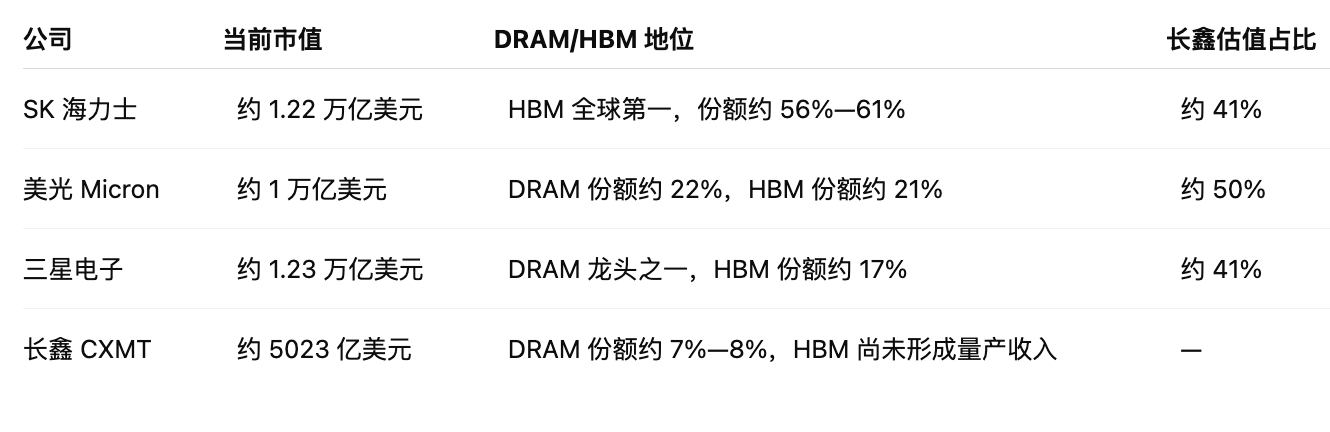
Among these, the most comparable companies are Micron and Hynix.
Samsung’s $1.23 trillion market cap also includes:
Mobile phones
Home appliances
OLED panels
Foundry services
Logic chips
NAND
DRAM
Therefore, you cannot treat Samsung’s entire market cap as a valuation for the storage business.
But even putting Samsung aside and comparing only Micron:
Changxin’s current DRAM share is only about one-third of Micron’s; its HBM revenue is basically zero. Its global customers and profitability are also far below Micron’s, yet the valuation provided by Hyperliquid is already half of Micron’s.
This means the market is not buying Changxin of today; it is buying a partially realized “future China version of Micron, or even a China version of Hynix.”
3. A more intuitive benchmark: how much market cap corresponds to each 1% share
You can roughly estimate how much valuation the market is willing to pay for every 1% of market share.
SK hynix
$1.22 trillion ÷ about 61% HBM share:
For every 1% HBM share, it corresponds to a market value of approximately $20 billion.
Micron
$1 trillion ÷ about 21% HBM share:
For every 1% HBM share, it corresponds to a market value of approximately $47.6 billion.
Changxin
$502.3 billion ÷ 7%—8% DRAM share:
For every 1% DRAM share, it corresponds to a market value of approximately $62.8 billion—$71.8 billion.
And this comparison itself is already clearly favorable to Changxin.
Because Hynix and Micron use HBM market share—HBM is the core AI storage, with the highest profit margins, and the main business currently driving the valuation of both companies.
Changxin’s 7%—8% is only the total share of traditional DRAM; its current HBM commercialization share is close to zero.
In other words:
Changxin’s valuation for every 1% of traditional DRAM share is already higher than the valuation Micron gets for every 1% of HBM share.
This pricing clearly is no longer reflecting the current business; it is paying upfront for the successful expectations years in the future.
Of course, “market cap ÷ market share” is not a rigorous valuation model because Samsung, Micron, and Hynix also have NAND, SSDs, packaging, and other businesses.
But as a sideways “sentiment thermometer,” it is sufficient to show that the unit-share valuation Changxin is currently enjoying is already extremely expensive.
4. Even if the optimistic endgame can be realized, you shouldn’t buy it at zero discount today
Assuming the most optimistic scenario is ultimately fully realized:
Changxin’s global DRAM share rises to 15%—20%
DDR5 and LPDDR products enter global mainstream customers
HBM reaches mass production successfully
Yield keeps improving
Domestic AI chip companies make large-scale purchases
Changxin ultimately reaches an industry position in line with today’s Micron and even Hynix
Even so, you still cannot directly use Micron’s or Hynix’s today’s valuation to price Changxin today.
At least consider three layers of discounts.
1. Time value
From early HBM planning to today occupying more than half of the global share took nearly a decade for Hynix to get there.
Even if Changxin executes smoothly, from samples and verification to true small-batch delivery and ultimately forming significant revenue and profits, it will still take at least several years.
Assuming Changxin can reach a valuation of between $1 trillion and $1.2 trillion five years from now:
Discounted at a required annual return of 15%, the present value is about 50% of the terminal value.
Using a 20% discount rate, the present value is about 40% of the terminal value.
Therefore, $1.2 trillion in five years, converted back to today, is only worth about:
$48 billion—$60 billion.
And Hyperliquid has already given about $502.3 billion.
This means the market has basically priced in the optimistic endgame that “Changxin will be close to Hynix in five years,” at a higher probability of success.
Even if success does happen, investors may not necessarily still be able to achieve sufficiently high annualized returns.
2. Execution risk
HBM is not equal to completing commercialization just by “making samples.”
What must be solved for real mass production:
DRAM die yield
TSV silicon through-vias
Multi-layer stacking
Advanced packaging
Heat dissipation and power consumption
Long-term reliability
Customer qualification
Large-scale, stable delivery
If any link falls below expectations, it will delay the realization of revenue and profits.
Even if Changxin can mass-produce HBM in the future, it does not mean its product performance, yields, costs, and gross margin will immediately approach Hynix’s.
3. Capex and equity dilution
DRAM and HBM are both extremely capital-intensive industries.
To continuously expand wafer production capacity, upgrade process nodes, build advanced packaging lines, and catch up with the overseas “three giants,” Changxin will still need to invest massive capital in the future.
These funds may come from:
Operating cash flow
Bank financing
Government and industrial capital
Share issuance and refinancing
Even if the company’s revenue grows, existing shareholders still need to bear the risk of high capital expenditures, potential financing dilution, and an industry cycle reversal.
So, the current valuation of $502.3 billion is more like:
It has taken a long-term optimistic endgame, with a very high probability of success, a low discount rate, and a low risk discount, and brought it forward to today.
There is basically no safety margin left for “technical catch-up not meeting expectations,” “a DRAM cycle reversal,” or “HBM commercialization delays.”
5. SMIC has already validated the valuation boundary of the “China’s only domestic leading player” narrative
The story of “domestic substitution, absolute leading player, strategic scarcity” is not the first time A-shares have been traded on that narrative.
The most typical example is SMIC.
SMIC is the absolute leading foundry in mainland China:
Strong policy support
No substitutability in terms of domestic position
Taking on the core mission of domestic substitution
Downstream demand exists over the long term
This logic is very similar to Changxin’s position as China’s only large-scale DRAM manufacturer.
But the reality is:
Semiconductor Manufacturing International Corporation (SMIC) has never received a valuation at the same level as TSMC solely because it is “China’s only domestic leading foundry” and “strategically irreplaceable.”
The reason is simple.
Ultimately, the industry will still depend on:
Technological generation gap
Yield
Capacity
Customers
Gross margin
Free cash flow
Capital expenditure efficiency
Global competitiveness
Domestic monopoly can ensure some domestic procurement and policy support, but it cannot automatically close the technology gap, nor can it guarantee profit margins in global competition.
Changxin is also facing similar issues right now:
Advanced DRAM process is still playing catch-up
Access to EUV equipment is constrained
Advanced HBM advanced packaging has not yet formed mature large-scale mass production
The overseas “three giants” are still iterating continuously
A global high-end customer qualification system has not been established yet
“Domestic monopoly” can improve the certainty of Changxin’s survival and growth, but it cannot directly be equated with Hynix’s HBM capability, nor can it automatically translate into the same valuation as mature global leaders.
SMIC’s historical experience shows:
Strategic position can bring a valuation premium, but the technology gap and profitability still determine the valuation ceiling.
6. The price also clearly includes a “channel scarcity premium”
The CXMT-USDC contract has a very special feature:
It may be one of the few channels through which overseas investors can bypass the STAR Market listing threshold and directly trade Changxin at its price.
The STAR Market has:
An asset threshold of 500,000 RMB
Requirement of at least two years of securities trading experience
Restrictions on participation by overseas capital
Therefore, the buy-side demand on Hyperliquid does not necessarily all come from deep judgments about Changxin’s technology, yields, profits, and customer structure.
A large portion of the demand may come from:
“Finally there’s a channel to buy Changxin.”
This portion of the funds pays for the scarcity of access, not for the company’s cash flow.
At the same time, this contract is essentially a synthetic perpetual derivative:
Does not represent Changxin’s true equity
No dividend rights
No voting rights
It may not have a 1:1 exchange or settlement mechanism with the A-share market
The price may deviate from the true spot price for a long time
When liquidity is weak, abnormal price swings and “sticker pins” are more likely
Before Changxin’s official listing, the market lacked real, high-frequency, sufficiently deep spot price data as an anchor.
Therefore, $7.51 is closer to an expected price formed jointly by scarce trading channels, limited liquidity, and optimistic sentiment—not necessarily a stable discovery of true enterprise value.
After the listing on July 27, once real A-share prices appear, the on-chain contract and the spot market will begin to re-establish a pricing relationship.
At that time, there may be two outcomes:
A-share prices surge significantly, further reinforcing Hyperliquid’s optimistic pricing;
The real A-share price is significantly lower than the implied on-chain price, causing the contract to quickly revert.
Given the nearly six-times IPO premium, the second scenario cannot be ignored.
7. What kind of future would be needed for today’s price to be supported?
A valuation of $502.3 billion is approximately equal to:
50% of Micron’s market cap
41% of Hynix’s market cap
41% of Samsung Electronics’ total market cap
To support this price, Changxin in the future cannot be only a “domestic DRAM leading player.”
It at least needs to complete step by step:
Global DRAM share rises from 7%—8% to around 15%;
DDR5 and LPDDR5X steadily enter mainstream customers at home and abroad;
HBM moves from sample shipments to large-scale mass production;
HBM yields, performance, and costs are competitive;
Domestic AI chip companies form large-scale procurement;
The high-visibility memory upcycle lasts for a long time;
Massive capital expenditures do not severely dilute shareholder returns;
Export controls and equipment restrictions do not further worsen.
This is not a single condition.
Rather, it’s a whole set of optimistic assumptions that all have to hold simultaneously.
If any link falls below expectations, it will affect the valuation of the endgame. If multiple links miss expectations at the same time, the current valuation will face a clear compression.
Final conclusion
Putting a few perspectives together:
Nearly a 6× IPO valuation premium
An implied market capitalization of about $502.3 billion
It has reached half of Micron’s market capitalization
Changxin’s DRAM share is only 7%—8%
HBM has not yet formed mass-production revenue
Unit market-share valuation is significantly higher than that of mature peers
The optimistic endgame needs at least several years to play out
There are execution risks in technical catch-up, customer qualification, and yield
DRAM itself is still a strong cyclical industry
In the future, it will still require continuous massive capital expenditures
The price includes a premium for STAR Market access and scarcity of on-chain channels
The contract does not represent real equity, and there is a risk of re-pricing after listing
Therefore, my conclusion is:
$7.51 is expensive and lacks sufficient safety margin.
It’s not to say Changxin has no value.
As the only Chinese company that truly has scalable DRAM manufacturing capability, the logic of domestic substitution and long-term growth for Changxin is certainly valid.
But:
The logic holds, but that doesn’t mean every price is worth buying.
At this level, upside potential requires multiple key links to be successfully realized over the coming years. But downside risks—catch-up not meeting expectations, delayed HBM mass production, a DRAM cycle reversal, regulatory changes, the re-pricing after the listing on July 27, and rapid evaporation of on-chain liquidity—may emerge in a shorter time.
The current risk-reward ratio is clearly asymmetric.
From a value-investing perspective, this is not a good entry point.
This article is based on publicly available market data and news reports, representing only personal opinions and not constituting any investment advice.
The CXMT perpetual contract on Hyperliquid is a high-risk synthetic derivative and does not represent Changxin Technology’s true equity. It does not provide dividend rights or voting rights. Before participating in trading, please fully understand risks related to leverage, liquidity, oracles, regulation, and price deviation.