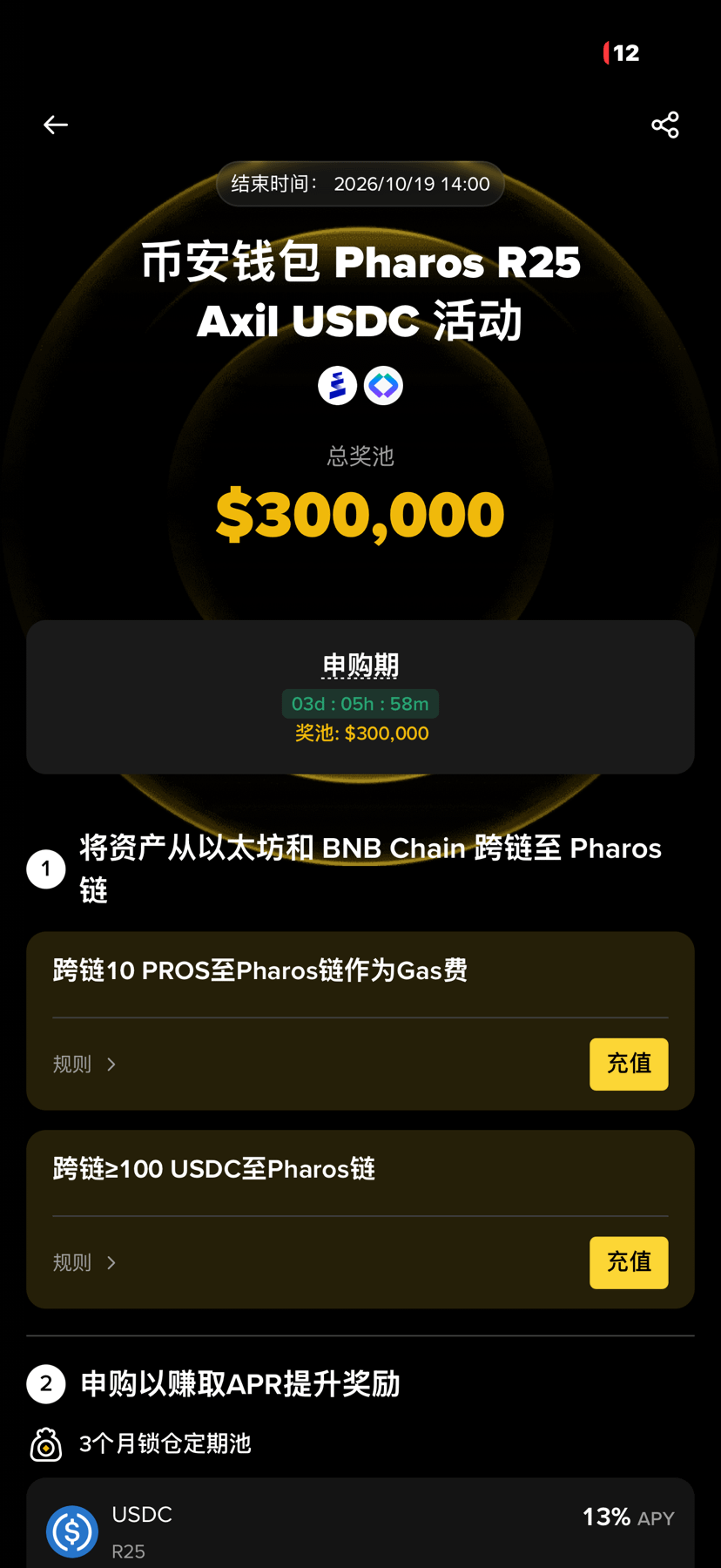


In the Binance Wallet’s DeFi section, it’s packed with 40+ protocols—lending, LSDFi, and restaking. The RWA slot has been left empty all along.
This time, the first RWA slot is for PROS: open subscriptions at 8:00 AM on 7/15, with a window of only 5 days.
The only thing I really want to understand is this: why does this thing dare to let retail investors touch it?
First, look at the product. This is the full name of the Vault: R25 Axil Prime 3M USDC Vault. The share token is APC3M. It has a 3-month lock-up. You subscribe with USDC, with an official net yield annualized at 13%, a hard cap of 70 million U, and a minimum of 100 U to participate. In addition, the Binance Wallet also includes an extra PROS airdrop rewards pool equivalent to 300,000 USD—whoever deposits gets a share of it by pro rata allocation. This is extra “sugar” and is not included in the 13%.
The underlying isn’t US Treasuries or gold—it’s consumer credit from emerging markets: Mexico, Thailand, the Philippines, Indonesia, and Pakistan. Ordinary people usually can’t access it and it’s been open only to institutions.
The problem lies here. In emerging-market consumer lending, when the bad-debt cycle hits, it can bury people. Why would it dare to advertise a 13% return, and even let you buy it by clicking twice in your wallet?
The answer is two checkpoints.
First: 120% over-collateralization. You put in 100. Underneath, 120 worth of assets are pledged as a cushion. The bad debts chew through that 20% safety buffer first, and only then does your principal get touched.
Second: on-chain reserve proof. Whether the money is still there and whether the collateral is sufficient isn’t something the project team just says “rest assured, it’s stored.” It’s something you can verify on-chain anytime. These days, there are plenty of claims of over-collateralization—but only a few dare to put reserves on-chain for you to check.
The operator is Axil. The people behind it come from BlackRock, HSBC, and HashKey. They focus on structured risk control for private placements in emerging markets, not two programmers who just decide to issue loans by gut feel.
But the 13% yield plus airdrops are just the sugar on the surface. The real bet R25 has is one layer deeper.
Assets like consumer credit loans take several days to settle completely, and ordinary Vaults simply can’t handle them. R25 is based on ERC-4626, 7540, and 7575 standards: custody, issuance, valuation, subscriptions/redemptions, fees, and execution are broken into independent modules. Plug-and-play adapters natively accommodate these non-real-time settlement assets. Pharos running on R25 is a compliant asset chain backed by Ant, with a $44M Series A and a $1B valuation. What Binance wants isn’t a wealth-management product—it’s a set of molds to standardize the issuance and management of various RWA Vaults.
APC is just the first prototype pulled out from this mold by R25. Going forward, US stock ETFs, private credit, and commodities—anything that matches the standards—can be Vault-ized. For quantitative teams, strategy providers, and even KOLs, they can issue their own Vaults on R25, with all technical complexity abstracted away. You just focus on your strategy. The threshold to launch an on-chain fund has been pushed down to the floor.
🎈For those who want to get onboard: update to the latest version of the Binance App, go to the Wallet page, and transfer assets to the Pharos chain—DeFi, Protocol, and R25—with a minimum of 100 U. The window is only 5 days: from 8:00 AM on 7/15 to 7/19 at night. The 70 million allocation will close once it’s filled.
Risk warning: The 13% is the target return for the USDC portion. The PROS airdrop is extra and not included in that figure; not principal-guaranteed and not interest-guaranteed. Only the shares you subscribe in Binance Wallet DeFi count.#PROS