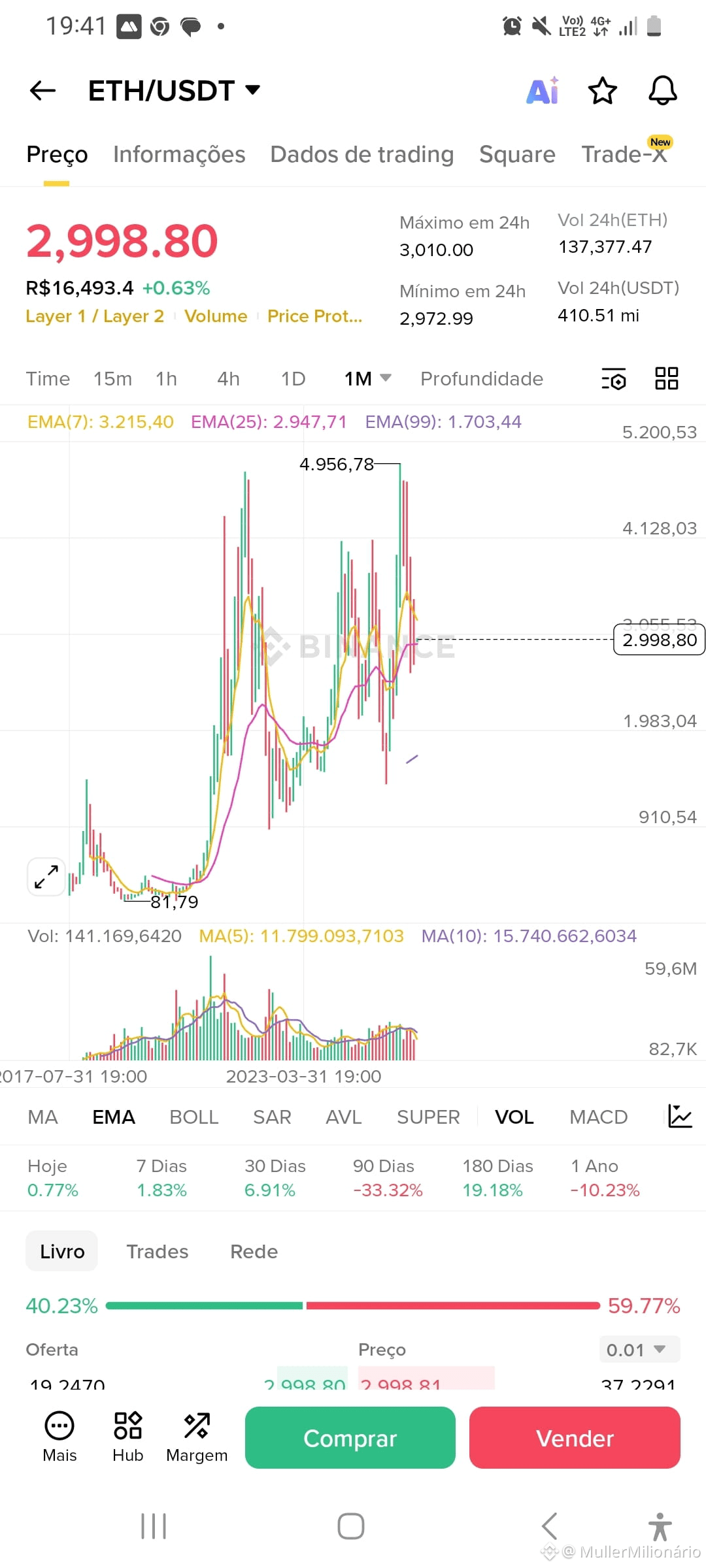
ETH
The Pectra updates (May 2025) and Fusaka (late 2025/early 2026) have reduced Layer 2 (L2) costs by up to 90% and increased the processing capacity of the main network.
In 2026, Ethereum ETFs will no longer be a novelty and will become stable channels of capital. Ethereum has consolidated its position as the leading infrastructure for the tokenization of real-world financial assets, such as bonds and funds.
Analysts point to indicators such as the MVRV Z-Score, which compares market value to realized value. Currently, this indicator suggests that ETH is in a zone historically associated with accumulation phases.
Demand is outstripping the available supply on exchanges. Institutional investors, digital asset treasury companies, and the recently approved ETFs (Exchange-Traded Funds) are buying and holding large amounts of ETH. Standard Chartered (Geoff Kendrick) raised its projection for ETH, estimating that the currency will reach a price of US 8,000. Tom Lee projects that Ethereum could soar to US 9,000 in early 2026.
After all, will Ethereum exit accumulation in 2026, which has persisted for 4 years, to reach new highs?
The Pectra updates (May 2025) and Fusaka (late 2025/early 2026) have reduced Layer 2 (L2) costs by up to 90% and increased the processing capacity of the main network.
In 2026, Ethereum ETFs will no longer be a novelty and will become stable channels of capital. Ethereum has consolidated its position as the leading infrastructure for the tokenization of real-world financial assets, such as bonds and funds.
Analysts point to indicators such as the MVRV Z-Score, which compares market value to realized value. Currently, this indicator suggests that ETH is in a zone historically associated with accumulation phases.
Demand is outstripping the available supply on exchanges. Institutional investors, digital asset treasury companies, and the recently approved ETFs (Exchange-Traded Funds) are buying and holding large amounts of ETH. Standard Chartered (Geoff Kendrick) raised its projection for ETH, estimating that the currency will reach a price of US 8,000. Tom Lee projects that Ethereum could soar to US 9,000 in early 2026.
After all, will Ethereum exit accumulation in 2026, which has persisted for 4 years, to reach new highs?