
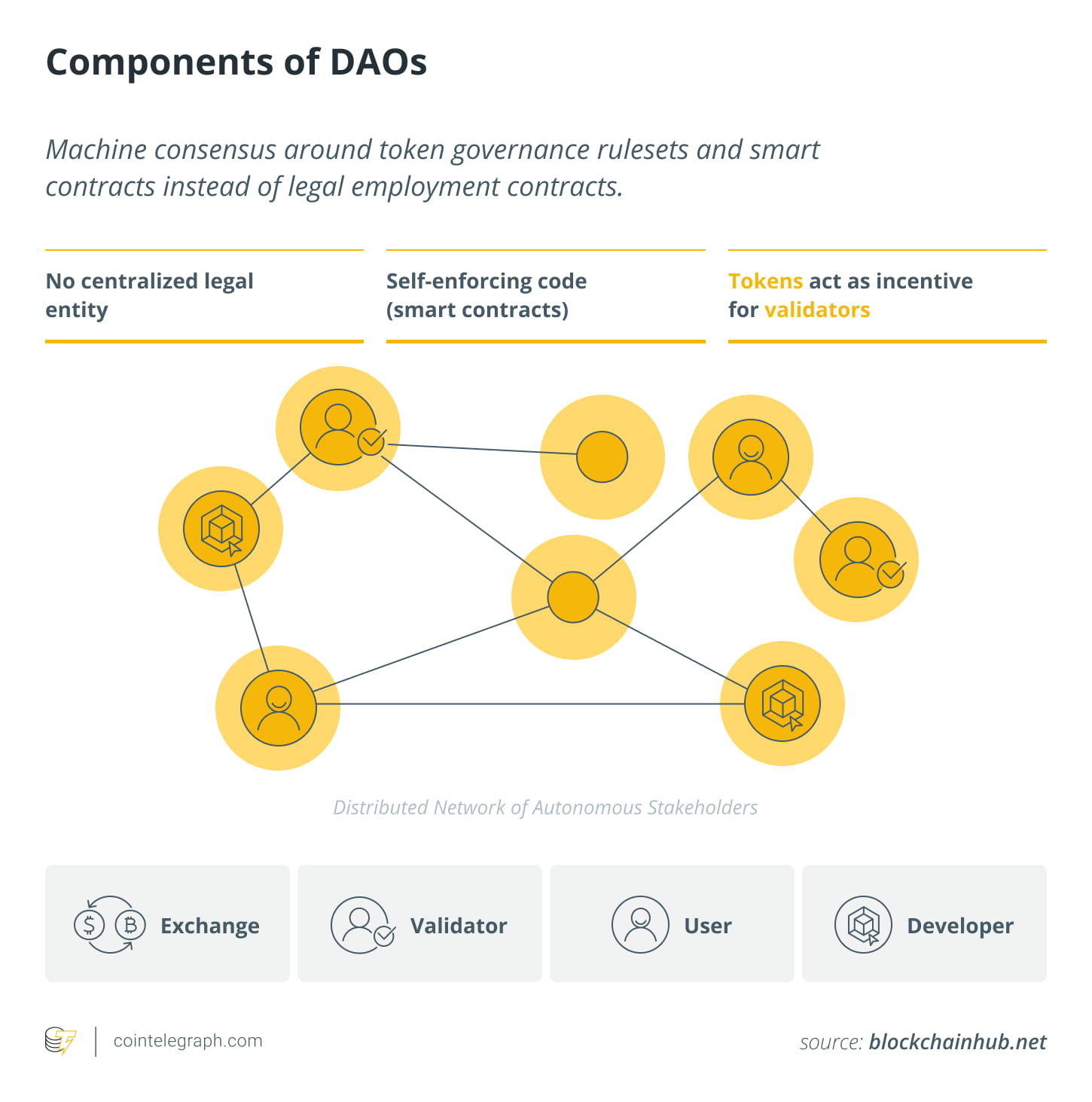
A Decentralized Autonomous Organization (DAO) is an entity without a central leadership. Decisions are made from the bottom up and governed by a community organized around a specific set of rules that are executed on the blockchain.

A DAO is an Internet-native organization jointly owned and governed by its members. They have built-in vaults that can only be accessed with the approval of their members. Decisions are made through proposals that the group votes on during a specific period.
DAOs work without hierarchical management and can serve many purposes. These include freelance networks that pool funds through contracts to pay for software subscriptions, charitable organizations whose members approve donations, and group-owned venture capital firms.
Before proceeding, it is important to distinguish The DAO, an organization native to the Internet, from The DAO, one of the first such organizations ever created. The DAO was a project founded in 2016 that ultimately failed and led to a dramatic split in the Ethereum network.
How does DAO work?
As mentioned above, a DAO is an organization that makes decisions from the bottom up; a group of members own the organization. There are several ways to participate in the DAO, usually by owning tokens.
DAOs operate using smart contracts, which are essentially blocks of code that automatically execute as long as a set of conditions are met. Today, smart contracts are deployed on numerous blockchains, although Ethereum was the first to use them.
These smart contracts establish the rules of the DAO. Those who own a stake in the DAO will gain voting rights and may influence how the organization operates by deciding or creating new governance proposals.
This model prevents the DAO from being overwhelmed by proposals: proposals are only passed if approved by a majority of stakeholders. How the majority is determined varies from DAO to DAO and is specified in the smart contract.
The DAO is completely autonomous and transparent. Since they are built on an open source blockchain, their code can be viewed by anyone. Anyone can audit their built-in vaults because the blockchain records all financial transactions.
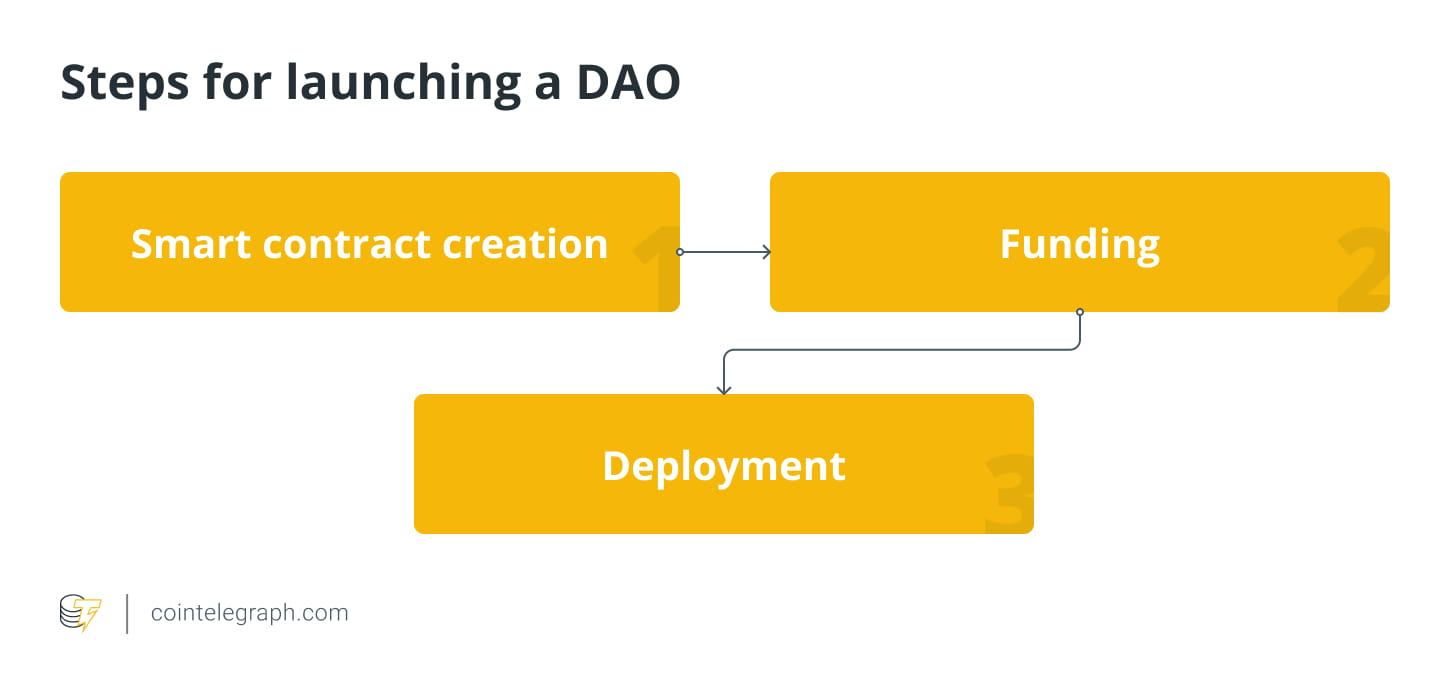
Typically, DAO startup occurs in three main steps
Smart Contract Creation: First, a developer or a group of developers must create a smart contract behind the DAO. Once launched, they can only change the rules set by these contracts through the governance system. This means they must test contracts extensively to ensure they don’t overlook important details.
Funding: Once the smart contract is created, the DAO needs to determine how it will receive funds and how it will establish governance. Typically, tokens are sold to raise funds; these tokens give holders voting rights.
Deployment: After everything is set up, the DAO needs to be deployed to the blockchain. From this point on, stakeholders determine the future of the organization. The organization’s founders – those who wrote the smart contracts – no longer have a greater influence on the project than other stakeholders.
Why do we need DAO?
As an Internet-native organization, DAO has several advantages over traditional organizations. A significant advantage of DAOs is that no trust is required between two parties. While traditional organizations require a lot of trust in the people behind them – especially on behalf of investors – with DAOs, only the code needs to be trusted.
I believe this code is easier to do because it is publicly available and can be tested extensively before release. Every action taken after the launch of the DAO must be approved by the community and be completely transparent and verifiable.
Such an organization has no hierarchical structure. However, it can still accomplish tasks and grow while being controlled by stakeholders through its native token. The lack of hierarchy means any stakeholder can come up with an innovative idea and the entire team will consider it and improve upon it. Internal disputes are often easily resolved through voting systems, consistent with pre-written rules in smart contracts.
By allowing investors to pool their funds, DAOs also give them the opportunity to invest in early-stage startups and decentralized projects while sharing the risk or any profits they might make from it.
principal-agent dilemma
The main advantage of DAOs is that they provide a solution to the principal-agent dilemma. This dilemma is a conflict of priorities between an individual or group (the principal) and the person who makes decisions and acts on their behalf (the agent).
Problems can arise in certain situations, and a common issue is the relationship between stakeholders and the CEO. The agent (CEO) may work in a manner that is inconsistent with the priorities and goals identified by the principal (stakeholders) and instead act in his or her own self-interest.
Another classic example of the principal-agent dilemma is when an agent takes on too much risk because the principal bears the burden. For example, a trader can use extreme leverage to chase performance bonuses, knowing that the organization will compensate for any downside.
DAO solves the principal-agent dilemma through community governance. Stakeholders will not be forced to join the DAO, but will only do so after understanding the rules that govern it. They do not need to trust any agent acting on their behalf, but work as part of a team with aligned incentives.
The interests of token holders are aligned because the nature of the DAO incentivizes them not to be malicious. Since they have a stake in the network, they want to see it succeed. To oppose it would be to go against their self-interest.
What is The DAO?
DAOs are an early iteration of modern decentralized autonomous organizations. Launched in 2016, it aims to be an automated organization that acts as a form of venture capital fund.
Those who own DAO tokens can profit from their investment in the organization by harvesting dividends or benefiting from token price appreciation. The DAO was initially viewed as a revolutionary project and raised $150 million in Ethereum ( ETH ) in one of the largest crowdfunding campaigns at the time.
The DAO was launched on April 30, 2016, after Ethereum protocol engineer Christoph Jentzsch released the open source code for an Ethereum-based investment organization. Investors purchase DAO tokens by transferring ether into its smart contract.
Days after the token sale, some developers expressed concerns that vulnerabilities in The DAO’s smart contracts could allow malicious actors to drain their funds. While governance proposals were put forward to fix the flaw, attackers exploited it and stole over $60 million worth of ETH from The DAO’s wallets.
At the time, approximately 14% of all ETH in circulation was invested in The DAO. The hack was a major blow to the entire DAO and the Ethereum network, which was only a year old at the time. A debate is taking place within the Ethereum community as everyone scrambles to figure out what to do. Initially, Ethereum co-founder Vitalik Buterin proposed a soft fork that would blacklist attackers’ addresses and prevent them from transferring funds.
The attacker, or someone pretending to be them, then responded to the offer, claiming that the funds were obtained in a "legitimate" manner according to the rules of the smart contract. They claim they are prepared to take legal action against anyone who attempts to seize the funds.
The hackers even threatened to bribe ETH miners with some of the stolen funds to thwart the soft fork attempt. In the ensuing debate, a hard fork was identified as the solution. The hard fork was implemented to roll back the history of the Ethereum network to before The DAO was hacked and reallocate stolen funds to smart contracts that allow investors to withdraw funds. Those who disagree with the move reject the hard fork and support an earlier version of the network, known as Ethereum Classic ( ETC ).
Disadvantages of DAO
Decentralized autonomous organizations are not perfect. They are a very new technology and have attracted a lot of criticism due to lingering concerns about their legality, safety and structure.
For example, MIT Technology Review revealed that it believes leaving important financial decisions to the public is a bad idea. While MIT shared its thoughts back in 2016, the organization never seemed to change its mind about DAOs — at least publicly. The DAO hack also raises security concerns because flaws in smart contracts are difficult to fix even if they are discovered.
DAOs can be spread across multiple jurisdictions and there is no legal framework for them. Any legal issues that may arise may require those involved to navigate numerous regional laws in complex legal battles.
For example, in July 2017, the U.S. Securities and Exchange Commission issued a report concluding that The DAO violated some of the country’s securities laws by selling securities in the form of tokens on the Ethereum blockchain without authorization.
DAO example
Decentralized autonomous organizations have gained traction over the past few years and are now fully integrated into many blockchain projects. For example, the decentralized finance (DeFi) space uses DAOs to allow applications to become fully decentralized.
To some, the Bitcoin ( BTC ) network is the earliest example of a DAO. Networks expand through community agreements, even if most network participants have never met. It also has no organized governance mechanism, instead miners and nodes must signal support.
However, Bitcoin is not considered a DAO by today’s standards. By current standards, Dash will be the first true DAO, as the project has a governance mechanism that allows stakeholders to vote on the use of its funds.
Other more advanced DAOs, including decentralized networks built on the Ethereum blockchain, are responsible for launching cryptocurrency-backed stablecoins. In some cases, the organizations that originally launched these DAOs slowly relinquished control of the project until one day they became irrelevant. Token holders can actively vote on governance proposals to hire new contributors, add new tokens as collateral for their tokens, or adjust other parameters.
In 2020, DeFi lending protocols launched their own governance tokens, distributed through a liquidity mining process. Essentially, anyone who interacts with the protocol receives tokens as a reward. Since then, other projects have copied and adapted the model.
Now, the list of DAOs is quite extensive. Over time, it has become a clear concept that has become increasingly popular. Some projects are still looking to achieve full decentralization through the DAO model, but it’s worth pointing out that they are only a few years old and have yet to achieve their ultimate goal.
As an Internet-native organization, DAOs have the potential to revolutionize the way corporate governance works. As the concept matures and the legal gray areas in which they operate are cleared, more and more organizations may adopt the DAO model to help manage some of their activities.