


Summary
AAVE, as the world's largest decentralized liquidity protocol, has grown into an on-chain financial infrastructure comparable to the top 50 banks in the United States. Based on AAVE's official website and the latest strategic blueprint disclosed by its founders, by December 2025, the total value locked (TVL) of the protocol is expected to reach $65 billion, covering over 12 public chains and capturing 59% of the global DeFi lending market share and 61% of active loan volume; by 2025, the protocol's fee income is projected to reach $885 million, accounting for 52% of the total fees of all lending protocols in the industry, far exceeding the total of the next five competitors. Through a three-pronged upgrade of the 'annual $50 million repurchase plan + Umbrella risk protection module + RWA ecological expansion', a more robust value closed loop is constructed. This report is centered on authoritative disclosures from the official website and the founders, comprehensively updating the token economy, core data, and strategic layout, analyzing its trillion-dollar asset-bearing potential.
I. Core Positioning of AAVE Protocol and Key Milestones for 2025
The AAVE official website defines it as 'the world's largest liquidity protocol', with core functions covering asset supply, lending, swap, staking, and other full scenarios, with core competitiveness upgraded to a cross-chain liquidity hub, institutional-level RWA lending platform, and decentralized stablecoin ecosystem, achieving cumulative deposits of $3.33 trillion and issuing nearly $1 trillion in loans, marking an industry milestone.
2025 Key Milestones:
• June 2025: The Umbrella protocol module officially launched, replacing the original Safety Module, optimizing risk protection mechanisms;
• September 2025: Protocol revenue surpasses $862.7 million, confirming it will exceed the full-year 2024 total ($904.2 million);
• December 2025: SEC terminates a four-year investigation, clearing compliance barriers for institutional cooperation;
• December 2025: RWA collateral lending platform Horizon net deposits reach $550 million, becoming the largest RWA lending scenario globally;
• December 2025: The DAO rejected the Aave Labs acquisition proposal, maintaining decentralized governance independence.
II. AAVE Token Economic Model
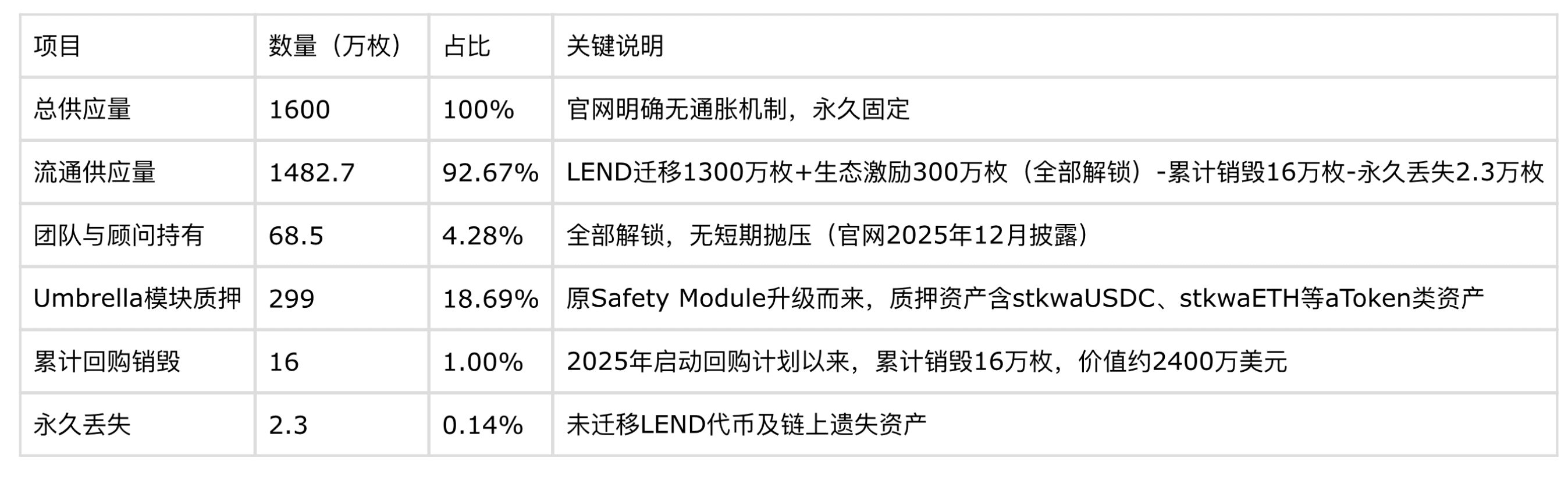
The AAVE token serves as the core of protocol governance and value capture, with a total supply permanently fixed at 16 million, and the economic model will complete the Umbrella module upgrade and buyback mechanism optimization in 2025, with core data revised as follows:
1. Current Status of Token Supply and Circulation
2. Core Uses of Tokens
• Governance Power Enhancement: Holding AAVE allows for initiating/voting on AIP proposals, with the rejection of Aave Labs acquisition and the passing of the Umbrella module and other key decisions in 2025 reflecting DAO governance capability; adjustments to protocol parameters, asset listings, buyback plans, and other core matters all require token holder voting;
• Risk Hedging (Umbrella Staking): The staking range expands to stkwaUSDC, stkwaETH, stkwaUSDT and other aTokens, with each asset corresponding only to similar loan bad debt guarantees, improving fund efficiency; stakers enjoy a 70% share of protocol fees + dynamic AAVE rewards, with stkGHO yield adjusted to around 7.7%;
• Rate Discounts: Holding users enjoy a borrowing interest rate discount of 0.25%-0.75%, with staking users receiving an additional 0.5% discount, up to 1.25%;
• GHO Ecosystem Binding: Stakers are given priority to obtain GHO minting quotas, and the upcoming sGHO savings product (Aave Savings Rate ASR) will provide additional GHO returns for stakers.
3. Deflationary Mechanism (Latest DAO Buyback Proposal)
AAVE's deflationary logic is upgraded to 'institutional buyback + precise destruction', with the official website and DAO proposals clearly stating core rules:
• Source of Buyback Funds: 30% of protocol revenue (DAO proposal adjustment, previously 25%);
• Buyback Scale: The DAO approved the 'annual $50 million buyback plan' in October 2025, with an actual completion of $24 million in 2025, remaining quota to be executed in 2026, with weekly buybacks of $250,000 to $1.75 million, adjusted based on revenue dynamics;
• Destruction Effect: As of December 2025, a total of 160,000 AAVE has been destroyed, accounting for 1% of total supply, calculated at the current market price ($351.27), the destruction value is approximately $56.2 million;
• Future Expectations: If the buyback target of $50 million is met in 2026, 142,000 AAVE is expected to be destroyed, resulting in a cumulative deflation rate of 1.89%.
III. Core Data Support
1. TVL and Market Share
AAVE leads the DeFi lending space with absolute advantage, core data by the end of 2025:
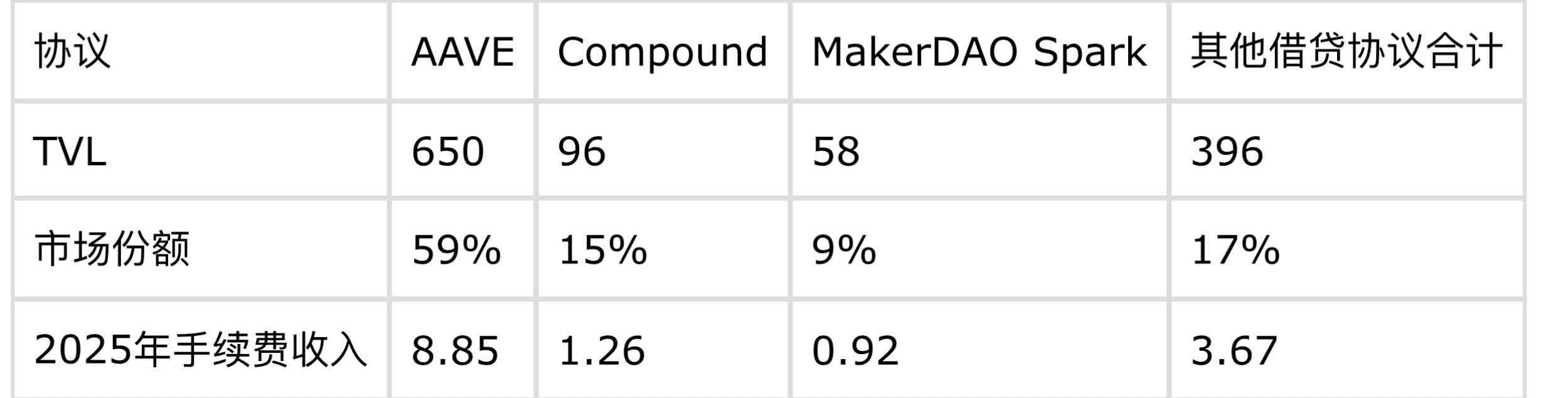
• Current TVL: $65 billion (Aave V3 independently statistics $39.2 billion), covering Ethereum, Polygon, Arbitrum, and more than 12 public chains, the only protocol with TVL exceeding $1 billion on all four chains;
• Market Share: Accounts for 59% of the global DeFi lending market, with active loans accounting for 61%, far exceeding Compound (15%) and MakerDAO Spark (9%);
• Cross-chain Distribution: Ethereum mainnet $25 billion (38.5%), Polygon $15 billion (23.1%), L2 networks (Arbitrum/Optimism, etc.) $25 billion (38.4%).
Chart 1: Comparison of TVL of Top DeFi Lending Protocols in December 2025 (Unit: $ billion)
2. Protocol Revenue
AAVE's revenue scale has increased in tandem with industry discourse power, with 2025 data hitting a record high:
• Total Revenue for 2025: $885 million (fees), accounting for 52% of total fees across all lending protocols in the industry, surpassing the total of the next five competitors combined;
• Revenue Structure: Lending interest accounts for 72% ($637 million), flash loan fees account for 21% ($186 million), and other fees account for 7% ($62 million);
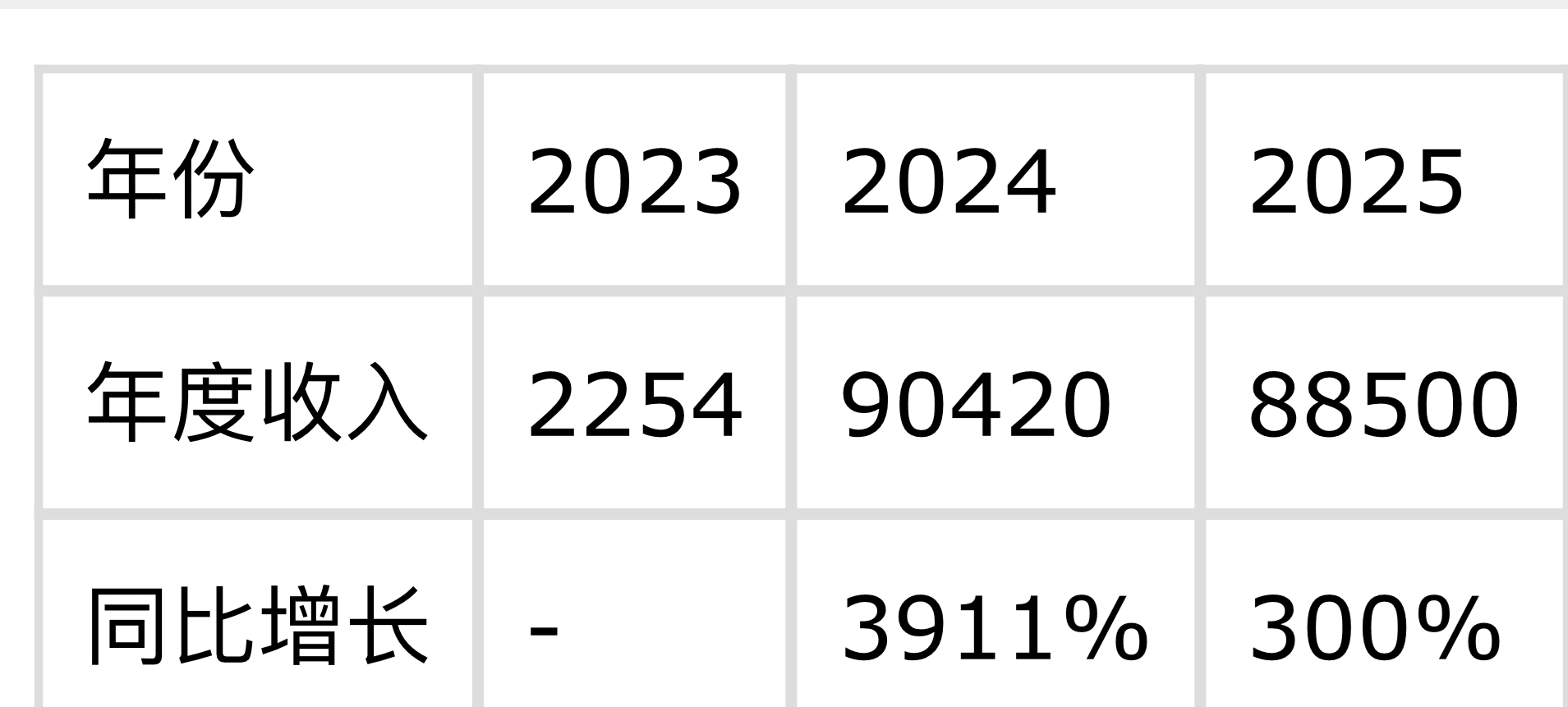
• Historical Growth: $22.54 million in 2023 → $904.2 million in 2024 → $885 million in 2025 (as of December), with a three-year compound growth rate exceeding 1700%;
• Downside Resistance: During the 2025 market correction period (BTC down 18%), average monthly revenue still reached $73.75 million, far exceeding the same period in 2024 ($68 million).
Chart 2: AAVE Annual Revenue Trends from 2023 to 2025 (Unit: $10,000)
3. GHO Stablecoin (Latest Ecosystem Dynamics)
GHO, as AAVE's native over-collateralized stablecoin (collateral ratio ≥ 115%), will see significant improvements in circulation and ecosystem adaptability in 2025:
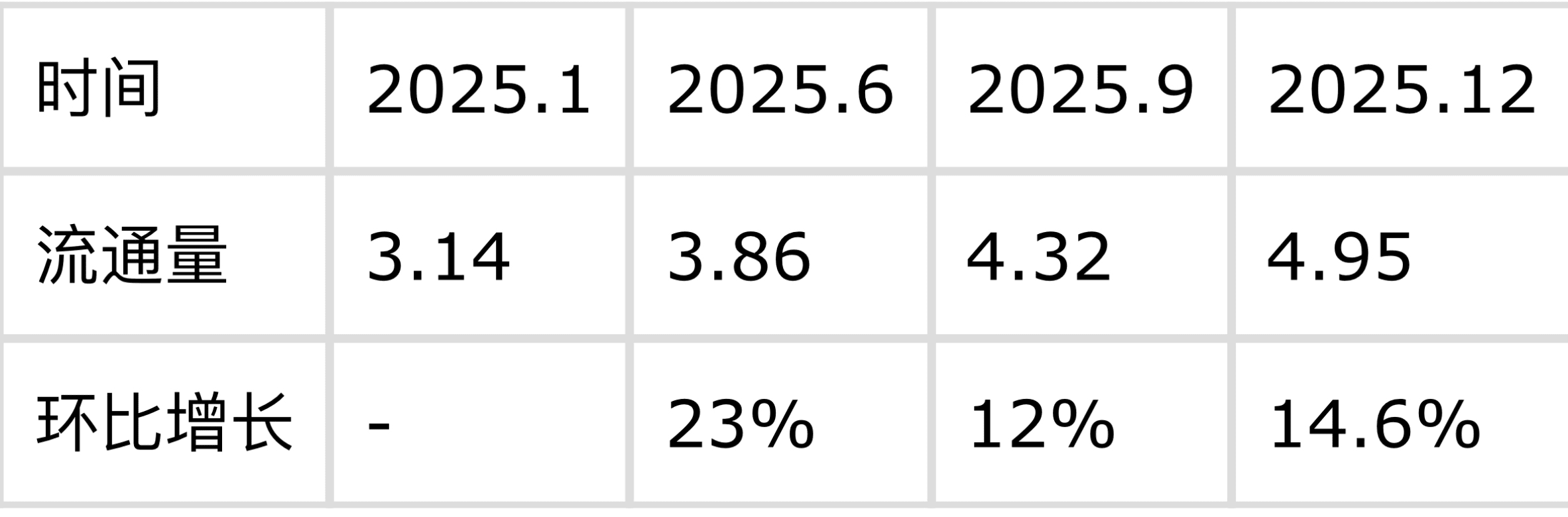
• Circulation Scale: Reached $495 million on December 24, 2025, an increase of 57.6% compared to the beginning of the year ($314 million)
• Revenue Contribution: Contributes $88.5 million in revenue in 2025, accounting for 10% of total protocol revenue;
• Ecosystem Progress: Expanded to networks such as Arbitrum and Base, integrated with DEXs like Uniswap and Curve, with the upcoming launch of the sGHO savings product, aiming to increase circulation to $300-500 million;
• Staking Situation: The GHO staking value in the Umbrella module is $7.31 million, accounting for 2% of the total staking amount.
Chart 3: Growth of GHO Stablecoin Circulation (January 2025 - December 2025, Unit: $ billion)
4. Capital Flow (On-chain + Institutional Data)
• Staking Trends: Umbrella module staking TVL reached $36.79 million, with Ethereum staking accounting for 47.7% ($17.54 million), and stablecoin staking accounting for 43.5% ($15.91 million);
• Institutional Holdings: Multicoin, a16z, and other institutions hold a cumulative 2.86 million AAVE, accounting for 19.3% of circulation, with holding periods exceeding 18 months;
• Chip Structure: 75% of large holders have a median holding period of 281.5 days, with an average daily transaction of 0.073, mainly for long-term allocation; 25% of addresses only hold AAVE as a single asset.
Chart 4: AAVE Token Distribution (December 2025, Unit: %)

IV. Risks and Strategic Outlook for 2026
1. Core Risks
• Mechanism Transition Risk: After the Umbrella module replacement, the stkGHO yield dropped from 13% to 7.7%, which may lead to some staking funds flowing out;
• Competitive Risks: Compound V3 dynamic interest rates and Spark RWA integration continue to divert users, with AAVE's market share slightly decreasing by 6 percentage points to 59% in 2025 compared to 2024 (65%);
• GHO Liquidity Risk: GHO is only listed on 2 mainstream exchanges, with a 24-hour trading volume of $16,200, limited depth, and may face liquidity pressure in extreme markets.
2. Three Major Strategic Pillars for 2026
• Aave V4 Upgrade: Adopting a 'hub and spoke' architecture to create a unified cross-chain liquidity pool, aiming to carry trillion-dollar assets and become the liquidity platform of choice for institutions;
• Horizon Institutional Market: Deepening collaboration with Circle, Franklin Templeton, VanEck, etc., raising RWA net deposits from $550 million to over $1 billion;
• Aave App Popularization: Launching a mobile app, aiming to acquire the first 1 million users, opening up the mass market entrance, and driving protocol scale growth;
• sGHO Ecosystem Landing: Launching low-risk savings product sGHO, with no deposit and withdrawal fees, providing returns based on Aave loan rates and GHO borrowing income, pushing GHO circulation over $500 million.
V. Conclusion
Based on the latest disclosures from the AAVE official website and its founder, the protocol has completed the transition from 'DeFi lending leader' to 'global on-chain credit infrastructure', with core value support upgraded to: 59% market monopoly share, annual profit scale exceeding $885 million, compliance advantages after the SEC investigation termination, and a triple growth curve of RWA + V4 + App.
From a data perspective, signals such as 'buyback plan implementation', 'institutional holdings increase', and 'RWA scale explosion' validate the resilience of the fundamentals in 2025; the trillion-dollar asset carrying target and $1 billion RWA deposit plan for 2026 open up space for long-term growth. Short-term attention is needed on market cycle fluctuations, but the protocol's infrastructure attributes, institutionalized deflationary mechanism, and clear institutional route still make it a core target for long-term allocation.
