

Source: Global Times
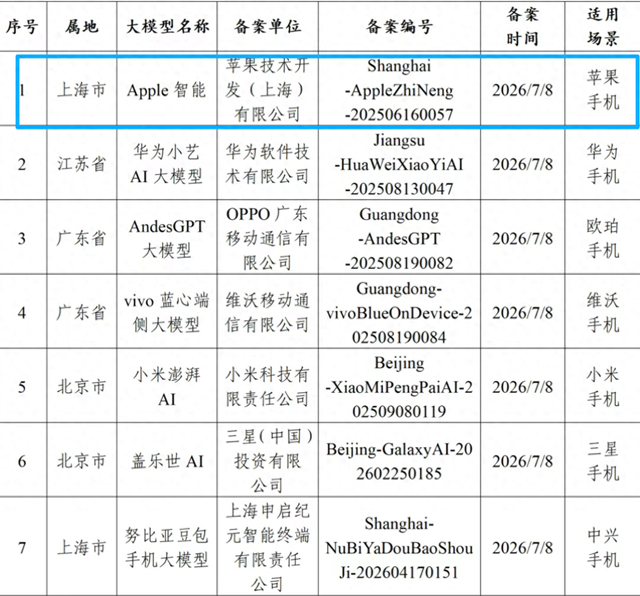
【Global Times Tech Report, reporter Lin Mengxue】On July 15, according to a notice released by the official WeChat account of “Cybersecurity in China,” the “Apple Intelligence” large model submitted by Apple Technology Development (Shanghai) Co., Ltd. has officially passed domestic regulatory filing, indicating that Apple’s push to deploy generative AI services in China has taken a key step.
Previously, overseas tech media found technical leads in the firmware of the iOS 27 Beta 2 version: Apple has added an ExtensionKit component named SearchPartnerInferenceProvider within the system. The appearance of this component suggests that Apple is building underlying infrastructure to enable third-party visual search and AI service providers to integrate. Depending on regional compliance requirements, it can dynamically switch to corresponding search and AI capability partners, enabling localized service adaptation.
So far, Qianwen has already confirmed that it will provide some generative AI capabilities, while Baidu continues to take on the development of search and Siri-related capabilities.
Global Times reporters found that the key areas of cooperation between Apple and Baidu will focus on developing AI-based search capabilities. These capabilities are part of the “Apple Intelligence” feature ecosystem. In addition to supporting image and text processing, they will also be used to upgrade the Siri voice assistant for the China version.
In addition, Alibaba said in a response to Global Times that “Alibaba Qianwen will be integrated as an AI capability into Apple Intelligence, bringing intelligent experiences to users in China of iOS, iPadOS, macOS, and visionOS. Users won’t need to switch between apps to directly experience Qianwen’s capabilities in text and image understanding, content generation, and more on Apple devices.”
Notably, by 2026, leading Android brands in China such as Huawei, Xiaomi, and OPPO have already completed the filing/registration of on-device AI large models. Mature localized AI features are now available across full price segments. Meanwhile, Apple has been slow to roll out its China-local AI capabilities, creating a performance gap with competitors in core experiences.
From a market perspective, according to data from market analysis firm IDC, due to the global parts and component cost crisis affecting supply chains including memory chips, in Q2 2026 China's smartphone market shipments reached 66 million units, down 4.3% year over year. Against this backdrop, analysts expect that component cost pressure will continue to affect the market through 2027; and in the long term, deeper hardware-side integration of AI technologies is expected to rekindle upgrade and replacement demand around 2028 to 2029.